 TaxTMI
 TaxTMI


 02 Nov 2026

Introduction
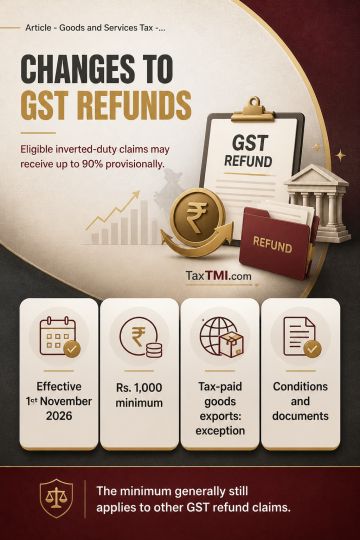
The Central Government, through Notification No. 03/2026-Central Tax dated 26th October 2026, has brought Section 155 of the Finance Act, 2026 into effect from 1st November 2026.
This amendment relates to Sections 54(6) and 54(14) of the CGST Act, 2017.
It introduces two important changes to the GST refund mechanism:
- Extension of the 90% provisional refund facility to eligible inverted duty structure claims.
- Removal of the Rs. 1,000 minimum refund restriction for specified export refund claims.
These changes are expected to provide relief to manufacturers and exporters by improving refund processing and cash flow.
1. Extension of 90% Provisional Refund Facility to Inverted Duty Structure
What Is Inverted Duty Structure?
An inverted duty structure arises when the GST rate on inputs purchased by a business is higher than the rate applicable to its outward supplies.
Because of this difference, businesses accumulate excess Input Tax Credit (ITC) in their electronic credit ledger.
Simple Example
A manufacturer purchases raw materials and pays 18% GST.
However, the GST rate applicable to the finished goods sold by the manufacturer is only 5%.
As a result:
- GST paid on purchases is higher.
- GST collected on sales is lower.
- Excess ITC accumulates in the electronic credit ledger.
Such businesses may be eligible to claim a refund of unutilised ITC under Section 54(3), subject to the applicable conditions.
What Was the Earlier Provision?
Section 54(6) provides for provisional refunds of up to 90% of certain eligible refund claims, subject to prescribed conditions.
Earlier, this facility was available for specified refund categories, including zero-rated supplies.
What Is the New Amendment?
Section 155 of the Finance Act, 2026 amends Section 54(6) to extend the provisional refund facility to eligible claims arising from an inverted duty structure.
In simple terms, businesses facing accumulated ITC because the GST rate on inputs is higher than that on outward supplies can now benefit from the 90% provisional refund facility, subject to applicable conditions.
2. Removal of Rs. 1,000 Minimum Refund Limit for Certain Exporters
What Was the Earlier Provision?
Under Section 54(14) of the CGST Act, GST refunds below Rs. 1,000 are generally not allowed.
For example, if an exporter is eligible for a refund of Rs. 750, the minimum refund restriction would ordinarily prevent the claim.
What Is the New Amendment?
Section 155 of the Finance Act, 2026 introduces an exception to the Rs. 1,000 minimum refund restriction.
The restriction will not apply to refund claims relating to goods exported out of India with payment of tax.
This allows eligible exporters to claim refunds even when the amount is below Rs. 1,000.
Practical Example
ABC Exports exports goods outside India after paying GST.
After completing the export transaction, the company becomes eligible for a refund of Rs. 750.
Under the amended provisions:
- The refund amount is below Rs. 1,000.
- The minimum refund restriction will not apply to this specified category.
- The exporter can claim the eligible refund of Rs. 750, subject to applicable conditions.
Who Will Benefit?
This amendment will particularly benefit:
- Small exporters.
- Businesses undertaking low-value export transactions.
- Exporters regularly claiming small-value refunds.
Important Point
The relaxation applies specifically to goods exported out of India with payment of tax.
It should not be understood as a general removal of the Rs. 1,000 minimum refund restriction for all GST refund categories.
3. Summary of Changes Under Section 155
| CGST Act provision | Amendment | Benefit |
| 90% provisional refund facility extended to eligible inverted duty structure claims. | Faster access to refund amounts. | |
| Rs. 1,000 minimum refund restriction removed for specified exports of goods with payment of tax. | Relief for small-value exporters. |
4. What Should Businesses Do?
Businesses operating under an inverted duty structure should review their accumulated ITC and identify eligible refund claims.
Exporters should examine their refund claims relating to goods exported with payment of tax, particularly where the amount is below Rs. 1,000.
Businesses should also ensure that refund applications are supported by the necessary documents and comply with the applicable GST refund procedures.
Conclusion
Section 155 of the Finance Act, 2026 introduces important changes to the GST refund mechanism.
The extension of the 90% provisional refund facility to eligible inverted duty structure claims will help businesses access refund amounts faster and improve working capital.
Similarly, the removal of the Rs. 1,000 minimum refund restriction for specified exports of goods with payment of tax will provide relief to exporters undertaking small-value transactions.
Overall, these amendments are expected to improve the refund mechanism and provide additional financial flexibility to eligible businesses.
Effective Date: 1st November 2026.
Legal Reference: Section 155 of the Finance Act, 2026 read with Sections 54(6) and 54(14) of the CGST Act, 2017.