 TaxTMI
 TaxTMI


 02 Nov 2026

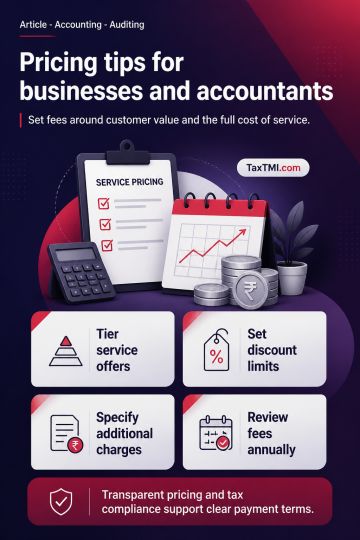
Businesses will cut costs, chase volume and work longer hours before they touch the lever that matters most: charging correctly. Professional firms are often the worst offenders.
In 1992 two McKinsey consultants, Michael Marn and Robert Rosiello, published a result in the Harvard Business Review that still startles owners.
Working through the economics of about 2,400 companies, they estimated that a 1% rise in price, with volume unchanged, would lift operating profit by roughly 11% for the average company - a far bigger effect than the same 1% gain in volume or cost.
More than three decades later, most businesses - and most professional practices - still spend more effort squeezing suppliers than thinking about their own prices.
The lever left untouched
Ask an owner how to make more profit and you'll hear: sell more, cut costs, hire cheaper, work longer. Hardly anyone says charge what the work is worth.
Owners will haggle for weeks over a 2% saving from a supplier, then hand a customer 10% off in a two-minute call. Practitioners do the same with fees - quoting from habit, absorbing extra work and rarely revisiting a retainer.
The arithmetic few people run
Take a simple business:
- Revenue: Rs. 1 crore
- Variable costs: Rs. 60 lakh
- Fixed costs: Rs. 30 lakh
- Operating profit: Rs. 10 lakh
Test three 5% improvements:
| Change | New profit | Profit increase |
| Sell 5% more volume | Rs. 12 lakh | +20% |
| Cut fixed costs 5% | Rs. 11.5 lakh | +15% |
| Raise prices 5%, same volume | Rs. 15 lakh | +50% |
The reverse is just as true: a 5% discount in this business wipes out half the profit.
Every business's figures differ; the pattern doesn't. Where margins are thin, small price moves shift profit far more than similar changes in volume or cost.
A discount isn't a marketing cost. It comes straight out of profit.
Lesson from history: the "just price"
Medieval European scholars argued over the justum pretium - a price fair to both buyer and seller. Markets across Asia and the Middle East developed their own norms of fair dealing, and many religious traditions condemn cheating on weights and measures.
The lasting lesson is balanced: a fair price isn't the lowest price; it's one that honestly reflects value so both sides can keep trading. A seller who prices below the cost of doing good work eventually can't do good work - which is fair to nobody.
Why businesses underprice
Fear. The dread of losing a customer drowns out the cost of keeping them at a loss. In reality, customers buy on reliability, quality, relationships and convenience as much as price.
Cost-plus habits. Add a margin to cost and call it a price - but customers pay for value received, not your costs. Cost sets the floor; value sets the ceiling.
Copying competitors. "The market rate is X" assumes rivals priced well. Many didn't, and some are slowly going under at that rate.
Not knowing true costs. Ignore overheads, rework, delivery, support and payment delays, and some "profitable" sales are really losses.
Never revisiting prices. Salaries, rent, materials and energy rise yearly. Three years without a price review is a large, silent discount.
The bitter truth about cheap pricing
Low prices attract the most price-driven customers - who often negotiate hardest, pay slowest, complain most and leave first when someone cheaper appears.
Meanwhile the business has no margin to invest in quality, people or technology. It becomes trapped: too cheap to improve, too busy to change.
Only one firm in a market can be the cheapest - and it's seldom the most profitable.
In a nutshell
Essence: in most small businesses, price is the quickest, strongest and least-used profit lever - and it's usually fear, not customers, that stops owners pulling it.
The VALUE Pricing Method
Five steps to price with confidence:
V - Verify true unit economics
Work out the full cost to serve each product, service or customer segment: discounts, freight, payment delays, support time, returns.
Action: identify what loses money after all costs, then reprice, restructure or stop serving it.
A - Ask what value you create
What does the offer save, earn or protect for the customer - faster delivery, fewer defects, less downtime, avoided penalties, saved time?
Action: ask the best customers why they buy, and build the price around their answers.
L - Layer the offer
Customers don't all want the same thing; some want the basic version, others speed, customisation or premium support.
Action: create tiers - standard, priority, premium - so price-sensitive buyers have a route that doesn't involve discounting the core offer.
U - Use discount rules
Discounts without limits become the real price.
Action: set approval levels, track average discount by salesperson, customer and product, and trade every discount for something - volume, faster payment, a longer contract.
E - Escalate prices regularly and professionally
Action: review at least annually, announce increases in advance with reasons, apply them to new customers first if needed and give key accounts a defined transition period.
A case: the sachet that reshaped a market
In 1980s India, shampoo came mainly in bottles many households couldn't afford. Entrepreneur C. K. Ranganathan, whose company later became CavinKare, built the Chik brand on single-use sachets at a very low unit price.
The insight wasn't "charge less." It was "price for the way the customer can buy." Changing the unit made the product affordable without destroying its value, and the sachet model spread across categories and countries. Pricing covers the unit, the pack, the terms and the choice - not just the number.
Price the payment terms too
Thirty days' credit and ninety days' credit are different products; long credit costs interest and risk.
Action: offer better terms for advance or prompt payment, or build the cost of longer credit into the price.
For practitioners: pricing your own practice
- Scope before you quote. Price compliance retainers on transaction volume, entities, GSTINs and complexity, not a flat monthly figure for every client.
- Separate compliance from advisory. Charge advisory meetings, notices and representations separately, with a written scope.
- Move from hours to outcomes where sensible. Hourly billing penalises efficiency; fixed fees with defined deliverables reward it.
- Write change clauses into engagement letters. Unpriced extra work is a hidden discount - specify how additional scope is billed.
- Review fees every year. Link increases to added services, statutory changes and inflation, and communicate them early.
Indicators of success
Better pricing shows within two or three quarters:
- Gross margin rises without a matching drop in volume.
- Discount levels fall, and discounts need approval.
- Win rates hold or dip only slightly while average deal value climbs.
- Customer mix improves - fewer low-margin clients, more who value what you provide.
Outlook: the coming decade
Pricing is turning dynamic and data-driven. Airlines and hotels led the way; AI pricing tools are now within reach of small retailers, manufacturers and service firms. Consumer law in India and elsewhere is tightening against drip pricing and hidden charges. The future belongs to businesses that price boldly on value and transparently enough that customers trust the number.
Immediate actions by role
- Owner: pick one product or service you suspect is underpriced and test a 5% increase on new customers.
- Sales head: list every discount given last quarter and why.
- Finance team: compute the profit effect of a 1% price rise across the business.
- Marketing: rewrite one product page to describe value in the customer's terms, not features.
Illustration from a smaller enterprise
Take an illustrative CA practice charging a flat Rs. 8,000 a month for bookkeeping and compliance regardless of client size. Larger clients consume three times the effort.
The partners introduce three tiers based on transaction volume and a separate fee for advisory meetings. Two small clients leave; most stay. Revenue rises 22% with the same team - and the partners finally have time for the advisory work they enjoy.
The objection we hear most - and our response
The objection: "Our market is brutally price-sensitive. Customers compare online in seconds. Raise prices even slightly and they're gone."
The answer: Some markets really are commoditised, and there cost leadership matters. But even there, most firms have room in discounting, credit terms, product mix and their least profitable customers. Test rather than guess: raise prices for a small segment or new customers and measure what happens. Many owners find customers far less sensitive than feared - and those who leave are often the least profitable.
Keep pricing lawful and transparent
Price-fixing with competitors, misleading "original price" claims, hidden charges and unfair discrimination can breach competition and consumer-protection law. Tax treatment must be right too - GST generally applies to transaction value, with specific conditions for discounts to be excluded. Clear pricing is good strategy and good compliance.
Practitioners' FAQ
"Won't customers walk if we raise prices?"
Some might; many stay when value is clear. Test increases carefully and measure both volume and profit.
"How often should prices be reviewed?"
At least annually, and whenever input costs move significantly.
"Is discounting always wrong?"
No. Planned, targeted discounts can help. Habitual, unapproved ones quietly erode margin.
Position as at October 2026: India's GST rates were substantially rationalised from 22 September 2025. Businesses should confirm the current rate on each product and pass on changes correctly; misleading price displays and drip pricing are also targeted under the Central Consumer Protection Authority's 2023 dark-pattern guidelines.
Pitfalls
- Matching every competitor's price cut.
- Month-end discounts to close a sale without approval.
- Treating a price rise as a crisis rather than routine.
- Burying fees in fine print.
- Launching new products without testing willingness to pay.
Half-hour action exercise
Answer four questions with real numbers:
1. When did we last raise prices or fees?
2. What was our average discount last quarter?
3. Which 20% of customers generate most of our profit - and which generate losses?
4. If we raised prices 5% and lost 5% of customers, would profit rise or fall?
Model question 4 in a spreadsheet. For most businesses, profit rises.
Summary for busy professionals
- With thin margins, a small price rise usually beats similar gains in volume or cost.
- Owners underprice out of fear, cost-plus habit, copying rivals, unknown costs and stale prices.
- Use VALUE: Verify unit economics, Ask what value you create, Layer offers, Use discount rules, Escalate regularly.
- Price the unit, pack and payment terms - not just the number.
- Keep pricing lawful, transparent and correctly taxed.
Customers seldom leave because a fair price is too high. They leave when the value is unclear.
References
- Michael V. Marn and Robert L. Rosiello, "Managing Price, Gain Profit," Harvard Business Review (September-October 1992).
- Hermann Simon, Confessions of the Pricing Man (Springer, 2015).
- Public profiles and interviews of C. K. Ranganathan on the Chik shampoo sachet (CavinKare).
- Central Consumer Protection Authority, Guidelines for Prevention and Regulation of Dark Patterns (2023).
----
Aashok Kumar Sharma