 TaxTMI
 TaxTMI


 03 Nov 2026

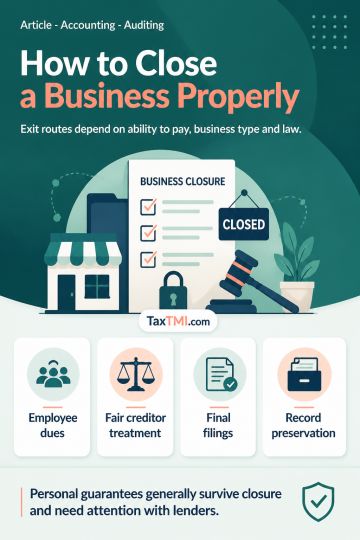
Business plans never include the last chapter. That's why so many closures turn into penalties, disqualifications and broken relationships - and why a well-managed exit can launch the next venture.
Walt Disney's first animation studio, Laugh-O-Gram, went bankrupt in Kansas City in 1923; he headed for California with very little money. Before Microsoft, Bill Gates and Paul Allen ran a small venture called Traf-O-Data that never became a real business.
Plenty of celebrated entrepreneurs have a closed venture in their past. What counted was not that it ended, but what they learned - and how they left.
Nobody plans the last chapter
Business plans cover launch, growth, funding and expansion. Very few carry a page titled "If this doesn't work." So when a venture fails - as many do - owners are unprepared, and practitioners see three common responses:
- Some keep going long after it stopped making sense, burning savings and borrowed money.
- Some simply stop - stop paying, stop filing, stop answering calls. The office shuts, but the company lives on paper, quietly accumulating penalties.
- Some leave behind unpaid staff, angry suppliers and tax demands that follow them for years.
There's a better path. Closing properly isn't an admission of defeat. It's the final act of responsible leadership.
Lesson from history: the honest bankrupt
History has treated business failure in very different ways. Some societies jailed debtors - Charles Dickens's father was confined in London's Marshalsea prison in 1824, an experience that shaped novels such as Little Dorrit. Others developed ways for honest debtors to settle what they could and begin again.
Most modern insolvency law follows the second approach: an honest failure, handled openly, shouldn't end someone's economic life. That protection, though, depends on how the ending is managed - transparently and lawfully, or by disappearing.
The hardest call: when to stop
The most painful question isn't how to close but when. Founders are optimists - that's why they started - yet optimism can slide into denial.
Signals that closure or major restructuring deserves serious thought:
- Milestones repeatedly missed despite genuine effort.
- Monthly losses funded by fresh personal borrowing.
- Statutory dues - taxes, employee contributions - delayed to pay other bills.
- Customers not returning because of the product, not the marketing.
- The founder's health, relationships or family finances deteriorating.
The sunk cost is gone. The only real question is how much more to lose.
Part one: Kill Criteria
The best moment to set stopping rules is before they're needed. Investors and seasoned founders often agree kill criteria - specific conditions that trigger a radical change of direction or closure:
- "If we haven't reached Rs. X monthly revenue with positive contribution by [date], we pivot or close."
- "If personal borrowing pays salaries for three straight months, we stop and review with an adviser."
- "If statutory dues go unpaid for two months, we take professional advice immediately."
Action: write them now, while calm, and share them with a partner, mentor or spouse who'll hold you to them.
In a nutshell
Essence: set stopping rules while calm, because decisions made in desperation almost always come too late.
Why "just letting it lapse" backfires
An abandoned entity creates problems that don't fade:
- Filings keep falling due. A company or LLP normally stays liable for annual filings until formally closed, and late fees mount.
- Directors pay a price. In India, directors of companies that fail to file financial statements or annual returns for three consecutive years can be disqualified from any directorship for five years; other countries have similar rules.
- Tax registrations stay live. Uncancelled GST, VAT or sales-tax registrations keep generating returns and late fees.
- Personal guarantees survive. Closing the business doesn't cancel the promoter's guarantee.
- Reputation travels. Suppliers, staff and customers remember how they were treated at the end - and tell others.
A case from the record: the 2017 drive
In 2017 the Ministry of Corporate Affairs removed more than two lakh non-filing companies from the register in one sweep and disqualified lakhs of associated directors. Many were dormant firms whose owners had simply stopped filing. Directors suddenly couldn't serve on boards - including those of their other, active companies - and bank accounts of struck-off companies were restricted.
A formal closure taking a few months would have avoided much of it.
Part two: the Clean Close
Procedure varies by entity and country; treat this as a roadmap and confirm current requirements with professionals.
Step 1: Take stock honestly
List assets, liabilities, contracts, employees, registrations, licences, bank accounts, loans and guarantees. Identify pending assessments and disputes.
Step 2: Choose the route
- Solvent closure - all debts can be paid. Options include voluntary winding up or, for companies with no operations and no liabilities, applying to the Registrar for the name to be struck off.
- Insolvent closure or restructuring - debts can't be paid in full. Formal processes such as India's Insolvency and Bankruptcy Code, US Chapter 7 or 11, or UK administration and liquidation provide structure. Seek advice early; trading on while insolvent can create personal exposure for directors in some jurisdictions.
Step 3: Treat people fairly
Tell employees early and honestly; pay final wages, leave encashment, gratuity and statutory dues as the law requires; issue relieving letters and experience certificates. How people are treated at the end is how the owner will be remembered.
Step 4: Settle with creditors and customers
Talk to suppliers and lenders, agree payment plans where possible, and fulfil or refund customer orders responsibly. Don't pay friendly creditors first while ignoring others - preferential payments can be reversed in insolvency.
Step 5: Close every registration
File final returns and cancel GST and other indirect-tax registrations, close TAN-related obligations, surrender licences and close professional tax, shops-and-establishments and other registrations.
Step 6: Close the books properly
Prepare final financial statements, file final tax returns and preserve records for the statutory period; past years can often be reopened after closure.
Step 7: Close bank accounts last
Keep at least one account open until refunds, final payments and obligations are complete.
Step 8: Address guarantees and personal exposure
Seek releases of personal guarantees or negotiate settlements with lenders.
For practitioners: closure engagement essentials
- Start with a compliance sweep. Bring all pending ROC, GST, TDS and income-tax filings current - strike-off generally requires the entity to have no liabilities and up-to-date filings.
- Prepare a statement of affairs. Certify assets and liabilities as of a cut-off date; it drives the choice between strike-off, voluntary liquidation and IBC routes.
- Sequence GST cancellation carefully. File the final return and account for stock, capital goods and pending credits before cancellation.
- Document director protections. Minute board decisions, creditor communications and payment priorities to defend directors against later allegations.
- Check disqualified-director status. Review whether any director is already disqualified and advise on the effect on their other companies.
Indicators of success
A clean close is judged by what's left behind:
- Employees paid their dues and given references.
- Suppliers and lenders settled or formally agreed.
- Filings complete and the entity properly closed.
- No proceedings outstanding.
- Relationships intact - people would work with the founder again.
Outlook: the coming decade
As entrepreneurship spreads, more businesses will close and more founders will start again. India's insolvency framework, faster company exits and digital filings make clean closures more achievable than ever. In a connected world, how one business is closed shapes who trusts its founder with the next.
Illustration from a smaller enterprise
Take an illustrative owner of a struggling restaurant who decides to close. Instead of locking the doors, she gives staff a month's notice and pays their dues in full, settles suppliers over three months, surrenders licences and closes the company properly. Two years later the same suppliers extend credit to her new venture, and three former staff rejoin her.
The objection we hear most - and our response
The objection: "Formal closure is slow and expensive. The company has no money. Why spend on lawyers and filings for a business that's already dead?"
The answer: Because abandonment usually costs more - just later. Accumulating late fees, director disqualification that blocks the next venture, tax notices years afterwards, frozen bank accounts and a damaged reputation all exceed the cost of doing it properly. For small companies with no liabilities, strike-off is designed to be relatively simple. A proper closure ends the costs; disappearing only postpones them.
The human side
Closing a business can feel like grief, touching identity, confidence and relationships. Encourage clients to talk to people they trust and to seek professional support if the strain becomes heavy. The discipline and humility of an honest closure often underpin the next venture; people rarely remember that a business failed, but they remember whether the founder vanished or closed it with integrity.
Pitfalls
- Abandoning an entity without formal closure.
- Paying friendly creditors first while ignoring statutory dues and staff.
- Moving assets out just before closure - such transfers can be challenged and reversed.
- Destroying records.
- Signing new contracts or taking new credit knowing the business can't pay.
Practitioners' FAQ
"How do we know when to close?"
Set kill criteria in advance - limits on losses, time or cash - and review them honestly.
"Can a company just stop filing and fade away?"
No. Abandoned companies face penalties and director disqualification. Close it properly.
"What happens to personal guarantees?"
They usually survive closure; negotiate with lenders as part of a planned exit.
Position as at October 2026: In India, company strike-off is handled through the Registrar of Companies (with an accelerated corporate exit centre established to speed up applications), LLP closure follows the LLP Act procedures, and insolvency is governed by the Insolvency and Bankruptcy Code, 2016, including a pre-packaged route for MSMEs. Labour code requirements for final settlement and GST cancellation rules apply. Confirm current forms and fees before acting.
Half-hour action exercise
Even for a healthy business, do this once:
1. Write three kill criteria for the business or its riskiest project.
2. List every registration it holds - needed to close or sell, and useful for today's compliance.
3. List every personal guarantee signed.
File the page somewhere safe. It may never be needed; if it is, everyone will be glad it exists.
Summary for busy professionals
- Closure is part of business life, and closing well is a leadership skill.
- Set kill criteria in advance so the decision is calm, not desperate.
- Abandoned entities keep generating filings, penalties, disqualification and guarantee exposure - the 2017 strike-off drive showed how widely.
- Follow the Clean Close: take stock, choose the route, treat people fairly, settle creditors, close registrations, close books, close bank accounts last, address guarantees.
- An honest closure protects the founder's name and often seeds the next success.
How a business closes shapes the owner's reputation - and their next beginning.
References
- Neal Gabler, Walt Disney: The Triumph of the American Imagination (Knopf, 2006) - on Laugh-O-Gram Studio.
- Paul Allen, Idea Man (Portfolio, 2011) - on Traf-O-Data.
- Ministry of Corporate Affairs, Government of India - 2017 press releases on strike-off and director disqualification; Companies Act, 2013, sections 164 and 248. mca.gov.in
- Insolvency and Bankruptcy Code, 2016 (India). ibbi.gov.in
- Michael Slater, Charles Dickens (Yale University Press, 2009) - on John Dickens and the Marshalsea.