 TaxTMI







 27 Nov 2026

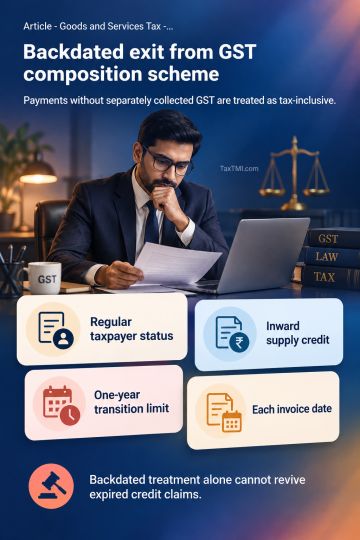
Retrospective Transition to the Regular Taxation Scheme Raises Important Questions About Input Tax Credit Entitlement
The composition scheme under Section 10 of the CGST Act, 2017 offers a simplified tax regime for eligible small taxpayers. However, a taxpayer opting for this scheme must continuously monitor the applicable turnover threshold and other statutory eligibility conditions. Failure to withdraw from the composition scheme upon becoming ineligible may result in substantial financial consequences, including payment of GST at normal rates, denial of input tax credit (ITC), and interest and penalties. An important question arises when the Department retrospectively treats a composition dealer as a regular taxpayer. While the Department demands tax at normal rates for the earlier period, can the taxpayer simultaneously claim ITC that would otherwise have been available under the regular taxation scheme?
The Dehradun State Bench of the Goods and Services Tax Appellate Tribunal (GSTAT) examined these issues in Narula Bicycle's Junction Versus The Commissioner Cgst Dehradun - 2026 (11) TMI 1059 - GSTAT DEHRADUN, by a Bench comprising Hon'ble Shri Naresh Katyal, Member (Judicial), and Hon'ble Shri Amand Shah, Member (Technical). The Tribunal upheld the benefit of cum-tax valuation under Section 15(1) read with Rule 35 but rejected the taxpayer's claims for ITC on inward supplies and opening stock on account of the statutory time limits. It also upheld the liability to interest and penalty under Section 73 while setting aside the additional general penalty imposed under Section 125.
Incorrect Understanding of the Composition Threshold Resulted in Substantial GST Liability
M/S Narula Bicycle' s Junction, a proprietorship concern engaged in the supply of bicycles, tricycles, toys and related goods, was registered under the composition scheme and discharged GST at 1%. Its turnover during FY 2018-19 amounted to Rs. 1 42,97,621, which exceeded the applicable composition threshold of Rs. 75 lakh. However, acting on the advice of its part- time accountant that the applicable threshold was Rs. 1.50 crore, the taxpayer continued under the composition scheme during FY 2019-20. It declared outward supplies of Rs. 91,85,178 and discharged composition tax of Rs. 91, 852 without separately collecting GST from its customers. The Department subsequently noticed the irregularity during scrutiny of returns and examination of information received from the Directorate General of Analytics and Risk Management (DGARM).
A show- cause notice dated 22.05.2024 was issued under Section 73(1), demanding differential GST of Rs. 10,10,370, together with applicable interest, and proposing penalty. The taxpayer accepted its ineligibility under the composition scheme but requested that the consideration already received from customers be treated as inclusive of GST. It also claimed ITC on inward supplies received during FY 2019-20 and on inventory held as on 31.03.2019. However, the adjudicating authority, vide Order-in-Original dated 20. 08.2024, confirmed the differential tax demand, interest, penalty under Section 73, and an additional general penalty aggregating Rs. 50,000 under Section 125 of the CGST and Uttarakhand GST Acts.
The First Appellate Authority (FAA), vide Order- in- Appeal dated 0307.2025, accepted the taxpayer' s claim for cum- tax benefit and reduced the differential tax liability from
Rs. 10,10,370 to Rs. 8,92 274. However, it rejected both categories of ITC claims on the ground that the prescribed statutory time limits had expired before issuance of the show- cause notice. It also upheld interest and penalties, with a corresponding reduction in the penalty under Section 73. Aggrieved by the denial of ITC and imposition of penalties, the taxpayer approached GSTAT, while the Department challenged the benefit of cum- tax valuation through a cross- objection.
The Department Cannot Levy GST Over and Above the Consideration Already Received from Customers
The Tribunal first examined the correctness of the taxpayer's continuation under the composition scheme for FY 2019-20. Section 10 makes eligibility for the composition scheme, inter alia, dependent on the aggregate turnover of the preceding financial year. Since the taxpayer's turnover for FY 2018-19 exceeded the applicable threshold of Rs. 75 lakh, the Tribunal held that the taxpayer was liable to discharge GST under the regular taxation scheme with effect from 01.04.2019. However, the Tribunal rejected the Department's method of applying the normal GST rate directly to the entire declared turnover. Section 10(4) prohibits a composition dealer from collecting tax from recipients of supplies. Since the taxpayer had not separately collected GST from its customers, the consideration already received was required to be treated as inclusive of GST under Section 15(1) read with Rule 35 of the CGST Rules, 2017.
The Tribunal relied upon the decision of the Hyderabad Bench of GSTAT in Sri Parameshwara Bricks Versus State Tax Officer, O/O State Tax Officer Peddapalli Circle Karimnagar Division Telangana, State Tax Officer Peddapalli Circle & Ors. - 2026 (8) TMI 1442 - GSTAT HYDERABAD. In that case, the Tribunal recognised that where the Department retrospectively treats a composition dealer as a regular taxpayer, the consideration already realised from customers cannot ordinarily be increased by adding GST over and above that amount when tax was not separately collected. A taxpayer's ignorance of the applicable statutory provisions or failure to withdraw from the composition scheme does not authorise the Department to recover tax exceeding the amount legally payable. This decision reinforces the important distinction between determining the applicable rate of tax and determining the taxable value upon which that rate is to be applied.
In the present case, the FAA correctly applied the formula prescribed under Rule 35 by multiplying the gross consideration of Rs. 91,85,178 by 12 and dividing the resultant amount by 112. The total GST liability was accordingly determined at Rs. 9,84,126. After deducting composition tax of Rs. 91,852 already discharged, the differential tax liability was reduced to Rs. 8,92,274, resulting in a reduction of Rs. 1,18,096 in the original tax demand. The Tribunal upheld this computation and dismissed the Department's cross-objection. The benefit of cum-tax valuation is not a discretionary concession but a consequence of determining the correct tax liability where the consideration already received is inclusive of tax.
Retrospective Conversion into a Regular Taxpayer Does Not Extend the Limitation Prescribed Under Section 16(4)
The taxpayer's principal grievance concerned denial of ITC on inward supplies received during FY 2019-20, comprising IGST credit of Rs. 6,29,460.16 and CGST and SGST credit of Rs. 106.03 each. The taxpayer argued that once the Department retrospectively treated it as a regular taxpayer, the corresponding benefit of ITC should also be extended. It sought adjustment of the available ITC against the differential output tax liability. Although this contention appears commercially reasonable, the Tribunal examined it in the light of the statutory restrictions governing availment of ITC. Under Section 16(4), as applicable to FY 2019-20, the Tribunal identified 20.10.2020 as the applicable deadline for claiming ITC. The taxpayer had neither furnished the regular returns in FORM GSTR-3B nor claimed the relevant ITC within the prescribed period.
The Tribunal relied upon the Andhra Pradesh High Court's decision in Thirumalakonda Plywoods, Versus The Assistant Commissioner – State Tax, Anantapur Circle – 1 - 2023 (7) TMI 1226 - ANDHRA PRADESH HIGH COURT, wherein the Court held that the eligibility conditions prescribed under Section 16(2) and the time limit prescribed under Section 16(4) operate independently. The non-obstante clause appearing in Section 16(2) does not override the statutory limitation under Section 16(4). Similarly, acceptance of a belated return upon payment of late fee does not automatically extend the time limit for claiming ITC. The Tribunal also referred to the Supreme Court's decisions in ALD Automotive Pvt. Ltd. Versus The Commercial Tax Officer Now Upgraded As The Assistant Commissioner (CT) & Ors. - 2018 (10) TMI 814 - Supreme Court, and M/s. TVS MOTOR COMPANY LTD. Versus THE STATE OF TAMIL NADU AND OTHERS - 2018 (10) TMI 887 - Supreme Court, which recognised that ITC is a statutory benefit governed by prescribed conditions. The Tribunal also referred to Chief Commissioner of Central Goods and Service Tax & Ors. Versus M/s Safari Retreats Private Ltd. & Ors. - 2024 (10) TMI 286 - Supreme Court, in support of the statutory framework governing ITC entitlement.
The Tribunal further examined the retrospective relief provided under Section 16(5), inserted by the Finance (No. 2) Act, 2024. Notwithstanding Section 16(4), this provision permits the availment of ITC in respect of invoices or debit notes pertaining to FY 2017-18, FY 2018-19, FY 2019-20 and FY 2020-21 in any return under Section 39 furnished up to 30.11.2021. However, the taxpayer continued to furnish composition-related statements and returns instead of regular returns in FORM GSTR-3B and did not claim the disputed ITC within the extended statutory period. Consequently, the Tribunal held that the taxpayer could not invoke Section 16(5) to make a fresh claim in its reply to the show-cause notice in 2024. A retrospective determination of output tax liability does not, by itself, revive an expired statutory time limit for claiming ITC.
Entitlement to Input Tax Credit on Opening Stock Remains Subject to the One Year Restriction Under Section 18(2)
Apart from ITC on inward supplies received during FY 2019-20, the taxpayer claimed credit of GST embedded in inventory as on 31.03.2019. Section 18(1)(c) provides that where a registered person ceases to pay tax under Section 10 and becomes liable to pay tax under Section 9, such person is entitled to take credit of input tax in respect of inputs held in stock, inputs contained in semi-finished or finished goods held in stock, and capital goods on the day immediately preceding the date from which regular taxation becomes applicable, subject to the prescribed conditions and reduction in respect of capital goods. Since the Tribunal treated 01.04.2019 as the date of transition to the regular taxation scheme, it recognised that the taxpayer was otherwise eligible to claim ITC on the inventory held as on 31.03.2019.
However, the entitlement under Section 18(1)(c) is subject to the independent statutory restriction contained in Section 18(2). This provision stipulates that a registered person shall not be entitled to take ITC under Section 18(1) after the expiry of one year from the date of issue of the relevant tax invoice. Importantly, this limitation is linked to the date of each individual invoice and not to the date of issuance of the show-cause notice or the date on which the Department retrospectively determines the taxpayer's status. For instance, ITC relating to an invoice dated 15.06.2018 would become time-barred after the expiry of one year from that date. Even in respect of the latest possible invoice relating to stock held on 31.03.2019, the one-year statutory period would have expired by March 2020.
The Tribunal accordingly held that issuance of the show-cause notice in May 2024 could not revive the taxpayer's entitlement to ITC on opening stock. An important distinction must be maintained between ITC on regular inward supplies governed by Section 16 and ITC arising upon transition from the composition scheme governed by Section 18(1)(c). While Section 16(5) expressly relaxes the time restriction under Section 16(4) for specified financial years, it does not expressly override the independent one-year restriction prescribed under Section 18(2). Therefore, the retrospective relief available under Section 16(5) cannot automatically be extended to time-barred ITC claims arising under Section 18(1)(c).
The Doctrine That Law Does Not Compel the Impossible Deserves Particular Professional Attention
Perhaps the most thought-provoking observation of the Tribunal appears in paragraph 3.15 of the judgment. The Tribunal noted that the taxpayer had continued to furnish FORM GST CMP-08 and FORM GSTR-4 instead of FORM GSTR-3B. However, the taxpayer had not specifically advanced the plea based on the legal maxim Lex non cogit ad impossibilia, which means that the law does not compel a person to perform an impossible act. The Tribunal observed that the taxpayer had not pleaded that its registration status under the composition scheme restricted access to the regular return-filing functionality on the GST portal, thereby making it physically impossible to furnish FORM GSTR-3B and claim ITC during the relevant period. In the absence of such a plea, the Tribunal declined to permit adjustment of ITC against the retrospectively determined output tax liability as a computational relief.
In the author's considered opinion, this observation deserves particular attention from senior GST professionals. When the Department retrospectively determines that a taxpayer was liable to discharge GST under the regular taxation scheme, a question may arise as to whether the corresponding statutory benefit of ITC can be denied where the taxpayer establishes that the prescribed return-filing mechanism was genuinely unavailable. However, a distinction must be drawn between impossibility arising from circumstances beyond the taxpayer's control and difficulties arising from the taxpayer's own failure to comply with statutory obligations. A mere assertion of ignorance, incorrect professional advice, or continuation under an inapplicable taxation scheme may not be sufficient to establish legal impossibility.
It would nevertheless be incorrect to interpret the Tribunal's observation as a ruling that the statutory limitations under Sections 16(4) and 18(2) can necessarily be overcome by invoking this legal maxim. The Tribunal did not adjudicate the merits of such a contention because it had not been specifically raised. The question whether genuine and demonstrable impossibility of compliance can justify appropriate relief in a case of retrospective conversion remains open for examination in suitable proceedings. Professionals handling similar disputes should therefore carefully examine the factual circumstances, portal restrictions, correspondence with the Department, and evidence of attempts made by the taxpayer to comply with the statutory requirements.
Bona Fide Belief Cannot Eliminate Interest Liability but the Same Contravention Cannot Attract Multiple Penalties
The taxpayer sought relief from interest and penalties on the ground that continuation under the composition scheme was attributable to incorrect advice from its part-time accountant. The Tribunal rejected the plea regarding interest, observing that interest under Section 50 is payable for delayed payment of tax to the Government. The taxpayer's bona fide belief regarding the applicable composition threshold could not extinguish this statutory liability. However, interest was required to be computed on the revised differential tax liability of Rs. 8,92,274, determined after extending the cum-tax benefit and deducting the composition tax already paid, rather than on the original demand of Rs. 10,10,370.
As regards penalty, the Tribunal observed that the taxpayer was aware of its actual turnover during FY 2018-19 but continued under the composition scheme during FY 2019-20 despite exceeding the applicable threshold. Accordingly, it upheld the penalty of Rs. 89,228, comprising Rs. 44,614 each under the CGST and Uttarakhand GST Acts, imposed under Section 73. However, the Tribunal set aside the additional general penalty of Rs. 50,000 imposed under Section 125. Section 125 is a residual penal provision applicable to contraventions for which no penalty is separately provided. Furthermore, Section 75(13) prohibits imposition of another penalty for the same act or omission where a penalty has already been imposed under the applicable demand determination provision.
The Tribunal ultimately dismissed the taxpayer's appeal, subject to deletion of the general penalty of Rs. 50,000, and also dismissed the Department's cross-objection. The judgment establishes that retrospective transition to the regular taxation scheme requires correct determination of output tax liability on a cum-tax basis where tax was not separately collected, but does not automatically restore ITC that has become time-barred. It also highlights the importance of continuously monitoring composition eligibility and raising all relevant legal and factual grounds at the earliest stage of adjudication.
***