 TaxTMI







 27 Nov 2026

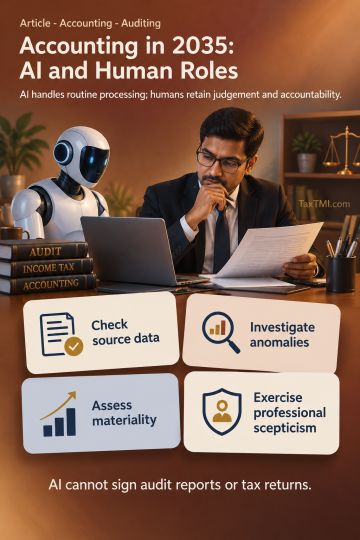
AI won't end chartered accountancy. It will end the version of it built mainly on typing, matching and copying - and reward the version built on judgement.
Ask a group of CA students what worries them most about the profession and many will say AI. They have watched tools read invoices, draft reconciliations and summarise standards in seconds - tasks that once filled the first two years of articleship.
The fear is understandable. But the history of accounting technology suggests a different conclusion: tasks disappear, while the demand for trusted judgement grows. The question for every professional is which side of that line their working week sits on.
What the spreadsheet did
In 1979 Dan Bricklin and Bob Frankston released VisiCalc, the first electronic spreadsheet for personal computers. Accountants who had spent days recalculating paper worksheets could now change one figure and watch every total update instantly.
Many predicted accountants would vanish. They didn't. US labour statistics in the following decades showed bookkeeping and accounting clerks declining while accountants and auditors grew. The spreadsheet removed arithmetic and created demand for analysis, planning and advice that had previously been too slow or costly.
Technology didn't end accounting; it changed what accountants were paid for. AI is starting that shift again, faster and deeper.
Fear and reality
Generative AI can already:
- Read invoices, contracts and bank statements.
- Draft reconciliations, journal entries and variance explanations.
- Answer questions about financial data in plain language.
- Summarise standards, regulations and tax rules.
- Detect anomalies across millions of transactions.
So "will AI take my job?" is a natural question. The honest answer: AI will take many tasks; whether it takes a job depends on how much of that job consists of those tasks - and what the professional does next.
Lesson from history: Pacioli's system of trust
In 1494 the Italian friar and mathematician Luca Pacioli published Summa de arithmetica, containing one of the first printed descriptions of double-entry bookkeeping, the method Venetian merchants had used for generations.
Double entry did more than record transactions. It made errors and fraud easier to detect, because every entry had to balance.
For five centuries the purpose has stayed the same: to give people a trustworthy picture of economic reality. Quill, ledger, spreadsheet, ERP, AI - the tools change; the purpose doesn't.
What AI will take
Work that is repetitive, rules-based and data-heavy:
- Data entry and invoice processing.
- Bank and ledger reconciliations.
- Standard journals and accruals.
- First drafts of routine reports, notes and variance commentary.
- Expense audits and compliance checks against fixed rules.
- Simple tax return preparation.
- Sample-based audit testing - increasingly replaced by testing entire populations.
What AI will leave
Work requiring judgement, accountability and trust:
- Interpreting complex transactions where standards require judgement.
- Estimating uncertain values - impairment, provisions, fair value.
- Deciding what matters - materiality and risk.
- Investigating the anomalies AI flags.
- Signing and accepting professional responsibility.
- Explaining numbers to boards, lenders, investors and regulators.
- Advising on decisions, ethics and trade-offs.
AI can produce the numbers. A professional still has to stand behind them.
In a nutshell
Essence: AI will absorb most routine processing, and professional value will shift to judgement, verification, explanation and advice.
What AI will demand
1. Data literacy - understanding sources, quality and structure.
2. AI supervision - knowing how tools work, where they fail and how to check them.
3. Controls over AI - documenting, testing and governing AI-driven processes.
4. Business understanding - operations, strategy and markets, not just ledgers.
5. Communication - explaining complex financial information simply.
6. Ethics and scepticism - resisting pressure, questioning results, protecting trust.
7. Continuous learning - because tools and rules will keep changing.
The uncomfortable reality
Many finance teams still spend most of their week on work AI can already help with - chasing invoices, matching entries, rebuilding the same reports each month.
The professionals most at risk aren't those who fear AI. They're those comfortable doing only what AI does well and waiting for someone else to retrain them.
AI won't replace accountants. Accountants who use AI well will replace those who don't.
The Take-Leave-Demand Grid
Map a role - or a team - in three columns:
| Take | Leave | Demand |
| Tasks AI can largely automate | Tasks needing human judgement and accountability | New skills to build |
| Invoice entry, reconciliations | Estimates, materiality, sign-off | Data literacy, AI supervision |
| Routine reports | Explaining results to the board | Business partnering, communication |
Estimate the share of time in each column today. If "Take" exceeds half, the career plan starts now.
For practitioners: what firms and members should do
- Redesign articleship and junior roles. If trainees no longer learn by doing routine entries, build structured exposure to reviewing AI output, investigating exceptions and understanding why entries are made.
- Write a firm AI policy covering approved tools, client-data confidentiality, review requirements and documentation of AI-assisted work.
- Document AI use in audit files. Where analytics or AI support audit procedures, record the tool, data, parameters and the auditor's evaluation, consistent with Standards on Auditing.
- Reprice services around value. As processing time falls, move from hourly billing on bookkeeping to fixed or value-based fees for reporting, analysis and advice.
- Invest in CPE beyond the mandatory hours - data analytics, automation controls and industry knowledge.
Illustration
Take an illustrative 12-person finance team at a Rs. 1,000 crore manufacturer.
Today about 60% of time goes on data entry, reconciliations and routine reporting, and the monthly close takes 12 working days.
Over two years the CFO:
- Automates invoice processing and bank reconciliations with AI-assisted tools.
- Uses AI to draft variance explanations that analysts review and correct.
- Trains the team in data analysis, automation controls and business partnering.
- Assigns analysts to support plant managers and sales heads directly.
Result: the close drops to five days. Headcount stays roughly the same but roles change - four people move into business partnering and one owns automation controls. Errors fall, and plant managers start consulting finance before decisions rather than after. The team didn't shrink; it moved up the value chain.
A day in 2035
An accountant in 2035 might:
- Start with an AI summary of overnight transactions, anomalies and risks.
- Spend the morning investigating two unusual items and deciding whether they matter.
- Meet a sales director to model pricing scenarios.
- Review and approve AI-drafted disclosures, correcting the judgement areas.
- Explain to the board why cash flow differs from profit this quarter.
- Spend an hour learning about a new regulation or AI capability.
Less typing, more thinking - and more trust placed on fewer, better-qualified people.
Indicators of success
- Close time falls as routine work is automated.
- The share of time spent on analysis and advice rises.
- Error rates drop, with AI output reviewed and controlled.
- Team skills in data, AI supervision and business partnering grow each year.
Outlook: the coming decade
By 2035 software will perform many routine accounting tasks, and auditors may test full populations as standard. New fields - AI assurance, sustainability reporting, data governance - will need accountants' judgement. The profession will be smaller in routine work and larger in responsibility.
The small-practice version
Take an illustrative three-person practice serving 60 small clients, most of whose time goes on keying bank statements and invoices.
It adopts AI-assisted bookkeeping, uses the time saved to offer monthly MIS and cash-flow reviews, and charges for advisory work. Within a year revenue rises 30% with the same team, and clients value the practice more than before.
The objection we hear most - and our response
The objection: "If AI does most of the work, firms will need far fewer accountants. Junior roles will vanish and the profession will shrink."
The answer: Routine processing roles will shrink, and that transition will be hard for some. But history shows that when tasks get cheaper, demand for related services often grows - more analysis, more advice, more assurance over new kinds of information, including ESG and AI itself. The real challenge is training: if juniors no longer learn through routine work, firms must design new ways to build judgement. The profession won't disappear; it will ask more of fewer, better-prepared people.
Practitioners' FAQ
"Should students still study accounting deeply?"
Yes - deep understanding is what lets a professional check AI. Add data skills, technology awareness and communication.
"Can AI sign an audit report or tax return?"
No. Professional responsibility rests with qualified people and firms under law and professional standards.
"Where should finance teams start with AI?"
With high-volume, rules-based tasks - invoice capture, reconciliations, expense review - under strong human review.
"Is AI output reliable?"
Not always. It can be confidently wrong, so every important output must be checked against source data.
Position as at October 2026: Accounting firms and finance teams are rapidly adopting AI for data extraction, reconciliation, analytics and drafting. Professional bodies and regulators, including ICAI and international standard-setters, are issuing guidance on technology use, data protection and professional responsibility. Review your firm's AI policy and controls regularly.
Pitfalls
- Ignoring AI and hoping it passes.
- Trusting AI output without verification.
- Automating processes without controls and documentation.
- Neglecting training for juniors whose routine tasks disappear.
- Treating technology skills as someone else's job.
Terms explained
- Generative AI - AI that creates text, images or other content.
- Automation - technology performing tasks with little human involvement.
- Full-population testing - analysing every transaction rather than a sample.
- Business partnering - finance working closely with operations to support decisions.
- AI supervision - reviewing and controlling AI output and processes.
- Professional scepticism - questioning information instead of accepting it at face value.
Misconceptions clarified
- "AI will replace all accountants." It replaces tasks; judgement, accountability and advice remain human.
- "Technology is IT's job." Accountants must understand the tools that produce their numbers.
- "Small practices can't benefit." Small firms often gain most, because time saved converts directly into advisory capacity.
Action checklist
Every finance task tagged Take, Leave or Demand
One routine task piloted with AI under review
Data and AI skills in the training plan
Controls documented for each automated process
Discussion points for the team
1. Which routine task would you most like AI to take over?
2. Which new skill would raise your value the most?
Half-hour action exercise
List everything done in finance last week and mark each item Take, Leave or Demand.
Choose one "Take" task and trial an AI tool on it this month, with careful checking. Choose one "Demand" skill and book time to learn it.
Summary for busy professionals
- VisiCalc reduced clerical roles but raised demand for accountants and analysis; AI is repeating that shift faster.
- AI will absorb routine, rules-based work - data entry, reconciliations, standard entries, first drafts.
- Professionals keep judgement, estimates, materiality, investigation, sign-off, explanation and advice.
- AI demands data literacy, supervision, controls, business understanding, communication, ethics and continuous learning.
- Firms must redesign training, adopt an AI policy, document AI-assisted work and reprice around value.
For 500 years accounting's purpose has been to tell the truth about money. AI changes how that is done - not why.
References
- Dan Bricklin, "The Idea" and history of VisiCalc. bricklin.com
- US Bureau of Labor Statistics, Occupational Employment and Wage Statistics - accountants and auditors; bookkeeping, accounting and auditing clerks. bls.gov
- Luca Pacioli, Summa de arithmetica, geometria, proportioni et proportionalita (Venice, 1494); Jane Gleeson-White, Double Entry (Allen & Unwin, 2011).
- James Bessen, Learning by Doing: The Real Connection between Innovation, Wages, and Wealth (Yale University Press, 2015).
- Institute of Chartered Accountants of India - publications on AI and technology in accounting and audit. icai.org