 TaxTMI







 27 Nov 2026

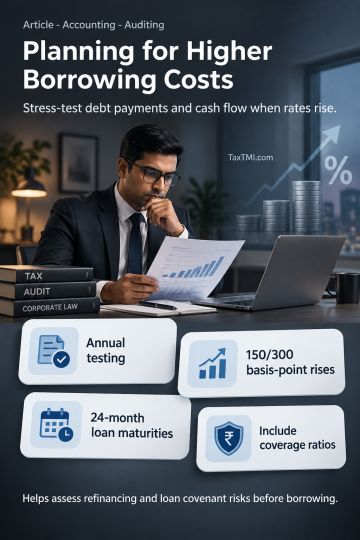
For more than a decade money was almost free, and many business models quietly depended on it. The end of that era separated sound businesses from fragile ones - and the next rate cycle will do the same.
When a client applies for a term loan, the projections almost always assume today's interest rate for the full tenure. Interest cover looks comfortable, covenants look safe and the project IRR clears the hurdle.
Change one input - add three percentage points to the rate - and many of those projections fall apart. Running that single sensitivity before the client signs is one of the most useful things a practitioner can do.
The bank that bet on low rates
On 9 March 2023 depositors tried to withdraw roughly US$42 billion from Silicon Valley Bank in a single day. By the next morning regulators had closed it - then the second-largest bank failure in US history.
SVB hadn't made reckless loans in the usual sense. It had put much of its deposits into long-dated government bonds and mortgage securities bought when rates were very low. When the Federal Reserve raised rates rapidly from March 2022, those bonds lost market value, and when depositors - many of them startups that had also lived on cheap money - pulled cash, the losses crystallised.
SVB was a casualty of a world that had assumed money would stay cheap.
Thirteen years of nearly free money
After the 2008 crisis, central banks in many developed economies cut rates close to zero and bought large quantities of bonds. For about thirteen years borrowing was unusually cheap.
That environment:
- Inflated asset prices - property, shares, private companies.
- Encouraged borrowing for expansion and acquisitions.
- Let loss-making companies keep raising funds.
- Made distant projects look more attractive.
- Kept alive weak firms that would otherwise have failed.
Many businesses and investors came to treat low rates as permanent.
Lesson from history: the Volcker shock
US inflation reached double digits in the late 1970s. In August 1979 Paul Volcker became Federal Reserve chairman and tightened policy hard, pushing the federal funds rate to around 20% at its 1981 peak.
A painful recession followed, with high unemployment and many failures - but inflation fell and a long stretch of steadier prices ensued.
The point isn't that rates must be high. It's that rates move in cycles, and businesses planning for only one phase are eventually caught by the other.
What changed after 2021
Pandemic supply shocks, stimulus and later energy spikes pushed inflation sharply higher in 2021 and 2022, and central banks responded:
- The Federal Reserve lifted its policy rate from near zero in March 2022 to 5.25%-5.50% by July 2023.
- The RBI raised the repo rate from 4.0% to 6.5% between May 2022 and February 2023, before starting to cut again in 2025.
- Many other central banks followed.
Even with some rates since lowered, few expect a return to the near-zero world of the 2010s.
When money is free, every plan looks good. When money has a price, only good plans survive.
In a nutshell
Essence: near-zero rates are over for now, so every business must be able to survive debt that costs real money.
Who suffered most
1. Heavily indebted businesses on floating rates, whose interest bills jumped.
2. Companies needing to refinance, which faced much higher rates as old loans matured.
3. Loss-making startups, as investors demanded profitability over growth at any cost.
4. Leveraged real estate, squeezed by falling values and rising costs.
5. "Zombie" firms unable to cover interest from operating profit for years, which lost the cheap lifelines keeping them going.
The uncomfortable reality
Plenty of businesses credited their cheap-money success to strategy and execution. Some of it was. Some was simply cheap capital - easy loans, high valuations and patient investors.
When the tide went out the difference showed. Some companies had built profitable businesses; others had built businesses that only worked while money was free.
The 300-Basis-Point Test
Run it annually and before any major borrowing decision.
1. Debt cost
If the interest rate rose three percentage points, what would happen to the interest bill and cash flow? Would operating cash flow still cover interest comfortably?
2. Refinancing
Which loans mature within 24 months? Could they be refinanced at three points higher - and would lenders still lend?
3. Customer demand
How would higher rates hit customers? Fewer home purchases, lower capex, slower consumer credit?
4. Working capital
Would customers pay more slowly, and would suppliers want faster payment?
5. Asset values
Would property, investments or the business itself lose value - and would that breach covenants?
If the business fails the test, fix the capital structure before rates move, not after.
For practitioners: making the test part of every engagement
- Add a rate sensitivity to every CMA and project report - base case, +150 bp and +300 bp - with interest cover and DSCR under each.
- Build a debt maturity ladder for the next 24 months and agree refinancing plans with lenders early.
- Review covenant headroom quarterly, including ratios linked to asset values and net worth, and flag potential breaches before they happen.
- Use current discount rates in valuations, impairment tests and capital budgeting; cheap-money WACC assumptions overstate value.
- Assess going concern for highly leveraged clients using the stressed case, and document the mitigating actions management can realistically take.
Illustration
Take an illustrative building-materials distributor with Rs. 250 crore revenue Rs. 80 crore of floating-rate debt at 9% and EBIT of Rs. 15 crore.
Today: interest is Rs. 7.2 crore and interest cover just over 2 times.
Under the test:
- Interest climbs to Rs. 9.6 crore.
- Construction customers slow purchases and EBIT falls to Rs. 12 crore.
- Interest cover drops to about 1.25 times - near a typical bank covenant.
Actions:
- Debt reduced by Rs. 20 crore by clearing slow-moving stock and tightening collections.
- Part of the remaining debt moved to a fixed rate.
- A planned debt-funded warehouse dropped in favour of leasing.
When rates do rise, the company stays comfortably inside its covenants while a more indebted rival is forced to sell assets. The test cost an afternoon with a spreadsheet; it saved the business.
Operating in a world where money costs something
- Prioritise cash flow and profit, not just growth.
- Price for inflation - review prices regularly and include escalation clauses.
- Run working capital tightly - every day of receivables now carries a real cost.
- Match debt to assets - short-term funds for short-term needs, long-term for long-term assets.
- Diversify funding - banks, NBFCs, equity, supplier credit and internal accruals.
- Value projects at realistic discount rates, not those of the cheap-money years.
Indicators of success
- Interest cover remains above two times under stress.
- Refinancing needs for the next 24 months are known and planned.
- Debt maturities match asset lives.
- Prices are reviewed at least twice a year.
Outlook: the coming decade
Rates may rise and fall, but most economists don't foresee a return to near-zero levels. Tariffs, energy prices and ageing populations may keep inflation pressure alive. Capital will carry a real price, and business models will need to earn more than that price to survive.
Immediate actions by role
- Owner: list every loan - rate, maturity, fixed or floating.
- CFO: run the test and present the results to the board.
- Sales head: check contracts for price-escalation clauses.
- Board: set a minimum interest-cover ratio for the business.
The objection we hear most - and our response
The objection: "Rates are already falling and central banks will cut again in the next downturn. There's no need to plan for high rates."
The answer: Rates may fall - some already have. But nobody knows how far, for how long, or what the next inflation shock will bring. Businesses that can survive higher rates gain options when they fall; those that need low rates to survive are at the mercy of central banks. Plan for a range, not a forecast.
Practitioners' FAQ
"Fixed or floating?"
It depends on cash-flow stability, debt size and risk appetite; many businesses use a mix to balance cost and certainty.
"How do higher rates affect startup funding?"
Investors want clearer paths to profit and value companies more conservatively, so capital efficiency matters more.
"What interest cover is healthy?"
It varies by industry and lender, but many look for operating profit of at least two to three times interest; less leaves little room for shocks.
"Can inflation help a business?"
Those with pricing power and fixed-rate debt may benefit, but most face higher wages, materials and capital costs.
Position as at October 2026: Policy rates in the US and India are below their 2023 peaks, following cuts in 2024-2026, but remain well above the near-zero levels of the 2010s. Inflation risks from tariffs, energy and supply shocks remain. Run the 300-Basis-Point Test regardless of where rates are today.
Pitfalls
- Assuming today's rate will last the life of a loan.
- Funding long-term assets with short-term debt.
- Ignoring maturities until a few months before they fall due.
- Raising prices too late in inflationary periods.
- Valuing projects on cheap-money assumptions.
Terms explained
- Policy rate - the rate a central bank sets to steer borrowing costs.
- Basis point - one hundredth of a percentage point; 300 bp equals 3%.
- Floating rate - a rate that moves with a benchmark.
- Refinancing risk - the risk of being unable to replace maturing debt on acceptable terms.
- Interest cover - operating profit divided by interest expense.
- Zombie company - a firm unable to cover interest from operating profit for years.
- Covenant - a condition in a loan agreement the borrower must satisfy.
Action checklist
Rate stress test run every year
24-month debt maturity ladder prepared
Fixed and floating mix reviewed
Escalation clauses in customer contracts
Board-approved minimum interest cover
Discussion points for the team
1. Which loan matures first, and at what rate could it be refinanced?
2. What would a three-point rise do to interest cover and DSCR?
3. Which contracts let us pass cost increases on?
Half-hour action exercise
From the latest financial statements, compute operating profit divided by interest expense. Recompute it assuming interest rises three points and operating profit falls 15%.
If the ratio drops below 2, there's work to do - while there's still time to do it.
Summary for busy professionals
- Roughly thirteen years of near-zero rates encouraged debt, rich valuations and fragile models.
- Volcker's tightening shows rates move in cycles; SVB's collapse shows the price of assuming they don't.
- Higher rates hurt indebted firms, refinancers, loss-making startups, leveraged property and zombies most.
- Stress debt cost, refinancing, demand, working capital and asset values at +300 bp.
- Put the test into CMA reports, covenant reviews, valuations and going-concern assessments.
Cheap money hides weakness; priced money reveals it. Build a business that can afford the truth.
References
- Board of Governors of the Federal Reserve System, Review of the Federal Reserve's Supervision and Regulation of Silicon Valley Bank (April 2023). federalreserve.gov
- Paul A. Volcker with Christine Harper, Keeping At It: The Quest for Sound Money and Good Government (PublicAffairs, 2018).
- Reserve Bank of India - Monetary Policy Statements, 2022-2026. rbi.org.in
- Bank for International Settlements, research on "zombie firms" (BIS Quarterly Review, September 2018). bis.org