 TaxTMI







 26 Nov 2026

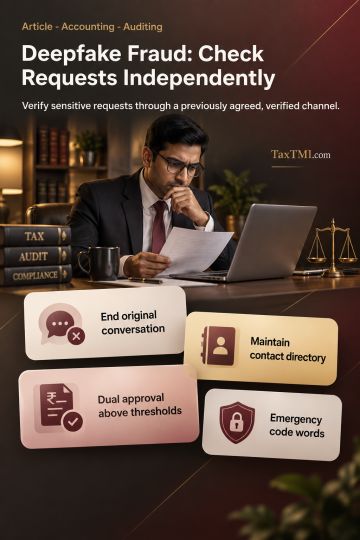
For a century a familiar face and voice were proof of identity. AI has turned them into instruments of theft - and payment controls built on recognition no longer hold.
Most payment-control documents in Indian SMEs contain a sentence like this: "Urgent payments may be released on the verbal or written instruction of the MD." It was written to keep business moving when the MD was travelling.
In a world of real-time voice and video cloning, that sentence is an open door. Internal auditors and CFOs need to replace it before someone walks through.
The US$25 million video call
In January 2024 an employee in the Hong Kong office of Arup, the British engineering firm behind many of the world's best-known buildings, logged into a video meeting with what appeared to be the firm's CFO and a handful of colleagues.
Every face and voice seemed genuine. The "CFO" outlined a secret deal and instructed that funds be sent. Over several transactions the employee remitted around HK$200 million - roughly US$25 million - into bank accounts run by fraudsters.
Every other participant had been a deepfake: AI-generated video and audio of real colleagues.
Arup subsequently acknowledged the fraud and stated that none of its systems had been breached. The attackers didn't break into the company's computers; they broke into an employee's trust.
An earlier version
In 2019 the chief executive of a UK energy company took a call from what sounded exactly like his boss at the German parent - same accent, same manner of speaking - asking for an urgent payment of about EUR220,000 to a Hungarian supplier. He paid.
The voice was AI-generated. The company's insurer, which reported the case, called it one of the first known voice-cloning frauds.
Within five years the technology had progressed from voice alone to live video with several fake participants.
Lesson from history: the Cottingley Fairies
In 1917 two young cousins in Cottingley, England, produced photographs appearing to show them with fairies. Many believed them, including Sir Arthur Conan Doyle, who wrote in support of the pictures.
Decades later the cousins admitted the fairies were paper cut-outs.
The lesson has only strengthened: people believe what they see, especially when it matches what they expect. Today's fakes move, speak and respond in real time.
Why the fraud works
1. Authority - the request seems to come from a senior leader.
2. Urgency - "it has to be done today."
3. Secrecy - "this is confidential; don't discuss it."
4. Familiarity - the face and voice belong to someone the target knows.
5. Plausibility - it fits real activity: an acquisition, a supplier payment, a tax settlement.
Convincing voice clones now need only short samples, often freely available from public videos, earnings calls, interviews and social media.
Once anyone's face and voice can be copied, a face and voice stop being proof.
In a nutshell
Essence: deepfakes make familiar faces and voices unreliable as proof, so payment and data controls must never depend on recognising people.
Targets beyond the finance team
- HR - fake candidates in video interviews, sometimes seeking system access.
- IT help desks - callers impersonating staff to reset passwords.
- Suppliers - fake calls to change bank details.
- Customers - cloned voices of relatives in "emergency" scams.
- Investors and markets - fake videos of executives making statements.
The uncomfortable reality
Plenty of companies still train employees to act fast when a senior person asks, and to regard a video meeting as safer than an email.
Deepfakes exploit exactly that habit. The more a business rewards instant obedience, the easier it becomes to rob.
The Out-of-Band Rule
Every instruction to transfer funds, alter bank details, release confidential data or give system access is confirmed over an independent channel agreed in advance - no matter who seems to be making it.
1. Pre-agree the channel
Keep an internal directory of verified numbers and contacts, and never use contact details supplied in the request itself.
2. Call back independently
End the call or thread and contact the person through the verified channel to confirm.
3. Require dual approval
Payments above a threshold need two authorised people, at least one uninvolved in the request.
4. Make the pause acceptable
Leaders say publicly: "I'll never be upset if you verify a request from me. I'll be upset if you don't."
5. Use emergency code words
For genuinely urgent cases, pre-agreed phrases known only to authorised people add a further check.
Verifying isn't distrust of the boss; it's protection of the boss's name.
For practitioners: testing and strengthening the control
- Rewrite the payment authorisation policy to remove "verbal instruction" exceptions and require call-back verification above defined limits.
- Test vendor-master changes in every internal audit: sample bank-detail changes and confirm each was verified through an independent channel before the next payment.
- Configure banking controls - dual authorisation, beneficiary cooling-off periods and payee-name checks where the bank offers them.
- Include social-engineering scenarios in fraud risk assessments and in training, using deepfake examples.
- Check insurance cover. Many cyber and crime policies treat social-engineering losses differently; confirm what is covered and what conditions apply.
Illustration
Take an illustrative Rs. 500 crore company. On a Friday afternoon the accounts manager gets a WhatsApp message from the "managing director," followed by a short video call. The face and voice are familiar. An overseas acquisition must close today, the MD says, and Rs. 4.8 crore should go to a law firm's escrow account. "Keep this confidential until Monday."
Under the Out-of-Band Rule:
- The accounts manager politely ends the call.
- She rings the MD on the number in the verified directory.
- The real MD is at a family function and knows nothing of any acquisition.
- She alerts IT security and the bank, and a complaint goes to the cyber-crime authorities.
Not a rupee leaves the account. At Monday's leadership meeting the MD publicly thanks her, and her example becomes the basis of a training session.
Strengthening defences
1. Training with real deepfake voice and video examples.
2. Payment controls - dual approval, thresholds, verified vendor-bank changes and cooling-off periods for new beneficiaries.
3. Lower exposure - be thoughtful about how much executive audio and video is public, where practical.
4. Technology - email authentication, identity verification and deepfake-detection tools (helpful, but no substitute for process).
5. Bank cooperation - payee-name checks and fraud alerts where available.
6. Incident response - immediate bank contact to attempt recall; speed matters.
7. Insurance - review cyber and crime cover for social-engineering losses.
Indicators of success
- Every payment above the threshold has a recorded call-back.
- Vendor bank changes are independently verified before use.
- Deepfake examples feature in training at least annually.
- Attempted frauds are reported, showing staff recognise them.
Outlook: the coming decade
Real-time deepfakes will get cheaper and harder to detect. Banks and technology firms will add identity verification, payee checks and alerts, and criminals will adapt. The most durable defence will remain one simple rule followed every time: verify through a separate channel before money moves.
The objection we hear most - and our response
The objection: "Our people know our leaders well; they'd spot a fake. And verifying every request slows business."
The answer: Arup's employee also knew the people on the call - or believed so. The whole point of a deepfake is to fool recognition. And the check is needed only for a narrow set of risky instructions - payments, bank-detail changes, sensitive data and access - and takes a few minutes. Set minutes of verification against millions lost and months of investigation.
Practitioners' FAQ
"Can detection software solve this?"
It helps, but detection is a race against improving fakes. Process controls such as out-of-band verification remain essential.
"What should happen immediately after a suspected deepfake payment?"
Contact the bank at once to stop or recall funds, report to cyber-crime authorities (in India, helpline 1930 and cybercrime.gov.in), preserve evidence and notify insurers.
"Are small businesses targeted?"
Yes. Fewer controls and quick, informal approvals make them attractive targets.
"Should executives stop appearing in public videos?"
Not necessarily - but assume their voices and faces can be cloned and design controls accordingly.
Position as at October 2026: Deepfake-enabled fraud continues to grow worldwide. In India, cyber-fraud can be reported through the national helpline 1930 and cybercrime.gov.in; banks are expanding payee-verification and fraud-alert services. Regulators and auditors increasingly expect strong controls over payment instructions and vendor-master changes.
Pitfalls
- Treating video or voice as proof of identity.
- Using contact details supplied in a suspicious request.
- Single-person approval of large or unusual payments.
- Penalising staff for verifying requests from seniors.
- Delaying the report after a suspected fraud.
Terms explained
- Deepfake - AI-generated video or audio imitating a real person.
- Voice cloning - artificially recreating a particular person's voice.
- Out-of-band verification - checking an instruction over a different channel known to be reliable.
- Business email compromise - fraud using fake or hacked email to redirect payments.
- Social engineering - manipulating people rather than systems to obtain money or access.
- Payee verification - a bank service confirming the account holder's name is the one intended.
- Cooling-off period - a waiting time before money can first be sent to a newly added beneficiary.
- Code word - a pre-agreed phrase confirming identity in emergencies.
Misconceptions clarified
- "I'd know my own boss." Fooling that instinct is precisely what deepfakes are for.
- "Video calls are safer than email." Both can now be faked convincingly.
- "Detection software will catch it." Process controls are the dependable defence.
Action checklist
Verified contact directory maintained
Call-back mandatory for payment requests
Dual approval above the threshold
Vendor bank changes verified independently
Cooling-off period for new beneficiaries
Leadership has publicly backed verification
Bank and cyber-crime contacts on hand
Discussion points for the team
1. Who can release money on one instruction from a senior leader?
2. When was a vendor bank-detail change last verified by phone?
3. What would you do if the CEO called asking for an urgent transfer?
Closing note
Every fraud of this kind succeeds at the same moment - when one person decides not to pause. Make the pause normal, expected and praised, and even the most convincing fake will fail.
Half-hour action exercise
Ask the client's finance head: "Suppose I appeared on a video call this minute and told you to rush a payment to an account you've never used. What happens next?"
If the answer is "I'd make the payment," write the Out-of-Band Rule into the payment policy today - and have the MD announce it personally.
Summary for busy professionals
- Deepfake video and voice now impersonate leaders convincingly - Arup lost about US$25 million in 2024 after a fake video call.
- The fraud relies on authority, urgency, secrecy, familiarity and plausibility.
- Familiar faces and voices are no longer proof of identity.
- Pre-agree channels, call back independently, require dual approval, make pausing acceptable and use emergency code words.
- Audit vendor changes, configure bank controls, train staff and respond fast.
In the age of deepfakes, trust isn't what you see. It's what you verify.
References
- CNN and Financial Times reporting on the Arup deepfake fraud in Hong Kong (February and May 2024); Arup public statement (May 2024).
- The Wall Street Journal, "Fraudsters Used AI to Mimic CEO's Voice in Unusual Cybercrime Case" (30 August 2019).
- Arthur Conan Doyle, The Coming of the Fairies (1922); Science and Media Museum (UK) - the Cottingley Fairies.
- Indian Cyber Crime Coordination Centre - National Cyber Crime Reporting Portal. cybercrime.gov.in
- US Federal Bureau of Investigation, Internet Crime Complaint Center - annual reports on business email compromise. ic3.gov