 TaxTMI





 13 Nov 2026

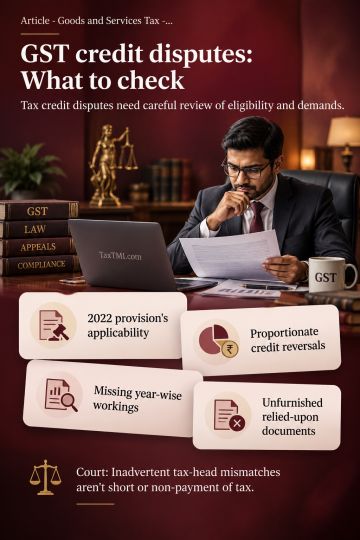
The developments in GST administration during the last 100 days at the level of CBIC, GSTAT and GST Council pave way for the ease of doing business in India. The Union Finance Minister is open to major amendments in law, provided the concern of the taxpayer is genuine and it is properly represented. Example are sections 125, 129 and 130 which is going to have massive transformation with effect from 01/04/2027 or a little later. As I make an attempt on this write up on the auspicious day of Deepavali, it is observed that more than one lakh e appeals have been filed in the GSTAT portal and around 11,000 appeals are selected for admission. Around 500 cases have attained finality on core GST issues other than anti profiteering cases. The speed at which things are happening give us scope for a better compliance time in the times to come.
However, in the past the things were handled at the whims and fancies of the field formations and these facts come to light now through various GSTAT orders. I have a live case and the corresponding SCN has several flaws and I though it appropriate to create awareness on such happenings. There are three issues in all and all these three issues may be happening to other taxpayers as well. The first issue hovers around clause aa of sub-section 2 of section 16 of the CGST Act which was introduced only on 01/01/2022. My SCN pertains to the period only up to 31/03/2021. That period is covered under CBIC Circular number 183/15/2022 dated 27/12/2022 which even though binding on field formation was not appropriately taken in to account and even the OIO got passed confirming the demand as proposed in SCN quoting the reason as the taxpayer has not proved the receipt of service by him. The beauty is the service received by taxpayer is rent and monthly payments are made to property owner only due to the occupation of the premises during the previous month.
The taxpayer is rendering taxable as well as exempted services and accordingly covered by section 17 (2). However, while raising this demand the above ITC which was held as inadmissible was also held as ITC availed in the SCN. The issue is live and sub judice as of now. However, in case the ITC under 16 (2) (aa) is eligible, reversal amount would be more and in case it is finally held that the ITC considered in issue 1 in not eligible, the amount required to be reversed under section 17(2) shall come down proportionately. Whether this aspect is considered at SCN stage or OIO stage is not clear as we have not been furnished year wise workings or relied upon documents considered by field formation. It is a single SCN for 2017-18, 2018-19. 2019-20 as well as 2020-21.
The third issue is confirmation of demand on account of inadvertent error in availing the ITC due to tax head mis- match . The Kerala High Court has settled this issue in Rejimon P Alex case that there is no short payment or non- payment in such cases and accordingly section 73 as well as 74 is not applicable. However, demand was confirmed on 24/04/2025 in the OIA despite the availability of Kerala High Court ruling.
These are not the only things which I have observed. There is a tendency amongst tax professionals to start replying the SCN with applicable facts as well as legal position without examining the correctness or otherwise of the SCN itself. In the instant case, a sum of 13,00,000 was wrongly adapted as 31,00,000 and accordingly there was an excess demand of GST amounting to 3,24,000. To elaborate further, it was only a part of the month where rent was only 13 lakhs whereas for other months, those were full months and amount was 31 lakhs. It is now proved beyond all reasonable doubts that ITC reversal is sought to an extent of 3,24,000 which is factually incorrect. My question is whether this is incidental or intentional ?. If incidental, then it was caused due to GROSS NEGLIGENCE which was not expected from that tax officer. If that is intentional, who has given them the powers to do so?.
Conclusion: Thanks to the intervention of the Supreme Court of India due to their intervention on setting up as well as operationalization of the required benches of GSTAT through the Team Computers case in the year 2024. Though that case is live even today, the GSTAT benches have started bringing in lot of confidence in the minds of all the taxpayers that justice might have been delayed but it was not DENIED. I appeal to all the tax officers to be more vigilant from this Deepawali of 2026 onwards in issuing SCN, passing the OIO as well as OIA. We have already come across few cases where cost is being imposed on the erring tax officials. This trend is definitely going to improve due to grave errors would not be taken lightly by GSTAT as well as High Courts. The CBIC instruction number 02/2026 issued on 30/10/2026 is a real eye opener for all the tax officials all over India on as how the Government is determined to avoid frivolous litigation due to the errors as discussed above. The tax professionals are requested to bring to the notice of the adjudicating officer all the errors which are apparent on the SCN in order to get appropriate relief at adjudication level itself. Though till yesterday the officers had a different mindset, the same is bound to change at least in the year 2027 as we may get few more orders at GSTAT as well as at High Court where imposition of cost on the erring tax officials becomes more visible to all the tax officials. The best example is imposition of cost of 25,000 on the tax officer due to filing an appeal before GSTAT without abiding the circular on monetary limits as reported in Butulu Majhi Versus Pradhan Traders - 2026 (11) TMI 354 - GSTAT BHOPAL