 TaxTMI
 TaxTMI


 29 Oct 2026

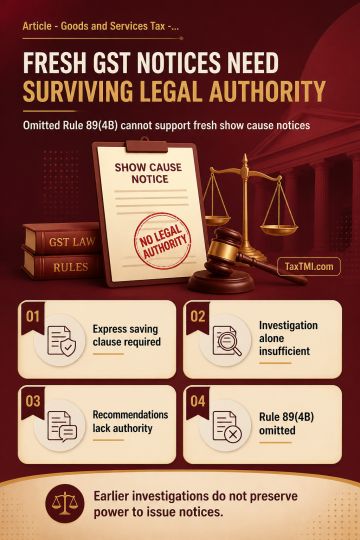
The controversy concerned the power to issue a notice after the omission of the rule
When a tax rule is omitted, an important question arises: can the Department still rely on that rule to issue a fresh show cause notice for an earlier period? The answer depends on whether the law preserves the power to take such action despite the omission. A saving clause serves this purpose by expressly protecting specified liabilities or proceedings. Where no such protection exists, the Department must establish the legal basis for invoking the omitted rule. The fact that an investigation or other preparatory work began while the rule was in force does not, by itself, resolve that question.
This issue arose in Morepen Laboratories Limited Versus Union of India and others. - 2026 (10) TMI 1763 - HIMACHAL PRADESH HIGH COURT. The Himachal Pradesh High Court examined a show cause notice dated 02.12.2025 issued under Rule 89(4B) of the CGST Rules, 2017, even though the notification dated 08.10.2024 omitted the rule without a saving clause. The petitioner sought to quash the notice and also challenged the rule's legality and constitutional validity. The Department defended its action by submitting that it had initiated and completed the process leading to the notice before the omission.
Applying the Supreme Court's reasoning in Goodluck India Ltd. v. Union of India, 2026 (8) TMI 719 - Supreme Court, the High Court held that the notice lacked statutory backing and quashed it. The decisive distinction was between completing preparatory steps while the rule existed and having the legal authority to issue the notice after the rule's omission. In the circumstances before the Court, the earlier departmental process could not preserve that authority without a saving clause. The judgment thus emphasises that the legal foundation of a notice must be examined independently of the work already undertaken by the Department.
Former Rule 89(4B) provided a special route for specified export refund claims
In simple terms, former Rule 89(4B) governed refund of unutilised input tax credit for specified exporters making zero-rated supplies without payment of tax. It applied where the exporter received supplies benefiting from Notification No. 40/2017-Central Tax (Rate) or Notification No. 41/2017-Integrated Tax (Rate), both dated 23.10.2017, or availed benefits under Notification Nos. 78/2017-Customs or 79/2017-Customs, both dated 13.10.2017. These references identified the specific concessional or exemption arrangements that attracted the special provision.
The refund covered eligible credit on inputs received under the specified notifications for export of goods, together with credit on other inputs and input services to the extent used in making those exports. Put simply, the enquiry centred on credit attributable to the relevant exported goods. The provision did not create input tax credit where no tax had been paid or credit was otherwise inadmissible.
It therefore focused on identifying eligible credit connected with the specified exports. Readers should distinguish this provision from Rule 96(10), which addressed restrictions on refund of IGST paid on exports. Although both formed part of the export refund framework, they differed in function and refund route.
Former Rule 89(4B) required identification of export-related credit, while Rule 89(4) prescribed a turnover-based formula
Former Rule 89(4B) did not provide a mathematical formula for calculating the refund. Instead, it required identification of eligible input tax credit attributable to the specified exports. This included credit on inputs received under the notifications mentioned in the rule, together with credit on other inputs and input services to the extent used in making those exports. In practice, the exporter had to establish which purchases and services contributed to the exported goods and how much eligible credit related to them. This exercise created difficulties where common inputs or services supported both exports and domestic supplies. The agenda material for the 54th GST Council meeting acknowledged the absence of a standard formula, differing departmental practices, and the burden of maintaining the necessary correlation. These observations explain the administrative background; they were not independent findings in the Morepen Laboratories case.
By comparison, Rule 89(4) calculates the maximum admissible refund by applying the prescribed zero-rated turnover ratio to eligible credit. Its formula is: Refund Amount = [(Turnover of zero-rated supply of goods + Turnover of zero-rated supply of services) x Net ITC] / Adjusted Total Turnover. In simpler terms, it determines the qualifying zero-rated share of turnover and applies that proportion to Net ITC. Net ITC broadly covers eligible credit on inputs and input services for the relevant period, subject to applicable exclusions. Adjusted Total Turnover is the denominator as specifically defined by the rule and must not be equated with total sales appearing in the books. The essential distinction is between identifying credit connected with particular exports under former Rule 89(4B) and applying the prescribed turnover formula under Rule 89(4).
For illustration, suppose the qualifying zero-rated turnover is Rs. 60 lakh, Adjusted Total Turnover is Rs. 100 lakh, and eligible Net ITC is Rs. 10 lakh. Zero-rated turnover represents 60% of Adjusted Total Turnover; applying that percentage to Rs. 10 lakh produces a refund amount of Rs. 6 lakh. The calculation is therefore Rs. 60 lakh x Rs. 10 lakh / Rs. 100 lakh. This example assumes that all three figures have first been determined according to the statutory definitions and that other refund requirements are satisfied. It explains the arithmetic under Rule 89(4), rather than suggesting that the same formula was expressly prescribed under former Rule 89(4B) or applied by the Court in this case
Completion of the earlier departmental process did not preserve the notice
The Department submitted that it had initiated and completed the process leading to the notice before the statutory rule was omitted. The submission sought to connect the notice with activity undertaken during the rule's operative life. However, it did not overcome the fact that the notice itself was issued after omission, without an identified saving clause preserving its foundation.
The distinction matters because investigation, scrutiny, internal consideration, and notice issuance are not necessarily interchangeable legal events. Preparatory work may explain how the authority reached its proposed conclusions, but it does not itself determine whether the authority can lawfully invoke an omitted provision. The judgment shows that the Court must examine chronology alongside the amendment's legal effect.
The Court should nevertheless state its rejection of the Department's explanation within the facts decided. It did not hold that every action concerning an earlier tax period becomes impermissible whenever a provision changes. It held that the particular notice, founded on the omitted Rule 89(4B), lacked statutory backing. The decisive enquiry was whether the legal basis invoked for that action remained available or had been validly preserved.
Proceedings under an omitted rule can continue only if the law preserves them
When a rule is omitted, the fact that proceedings began while it was in force does not, by itself, establish that they can continue afterwards. It becomes necessary to examine whether the law expressly protects those proceedings. Such protection may take the form of a saving clause or another statutory provision permitting their continuation despite the omission. In Goodluck India Limited v. Union of India, 2026 (8) TMI 719 - Supreme Court, the Supreme Court examined this issue concerning Rule 96(10). Relying on the Constitution Bench decision in Kolhapur Canesugar Works Ltd. v. Union of India, 2000 (2) TMI 823 - Supreme Court, it explained that proceedings under an omitted rule required an effective legal provision to preserve their continuation.
The Himachal Pradesh High Court reproduced and applied this reasoning in Morepen Laboratories. The Court's passages explained why Section 6 of the General Clauses Act, 1897, could not automatically preserve proceedings under the omitted rule. Section 6 protects against certain consequences of repeal within its statutory scope; however, the cited decisions distinguished the repeal of a Central Act or regulation from the omission of a rule. Consequently, the Department could not rely merely on the fact that its earlier process had commenced or been completed before omission. Since no saving clause preserved Rule 89(4B) as the basis for the notice dated 02.12.2025, that earlier process could not supply the missing statutory authority.
The Court also reproduced the Supreme Court's explanation concerning the GST Council's recommendation for prospective omission. A recommendation may explain the background to a legislative change, but it cannot insert a saving clause that the actual notification does not contain. The relevant question was therefore whether the law, as ultimately amended, preserved the proceedings-not simply whether the Council had recommended prospective operation. This distinction prevents policy recommendations from being treated as enacted provisions. While Goodluck India directly concerned Rule 96(10), the Himachal Pradesh High Court applied its reasoning to the notice founded on omitted Rule 89(4B).
The Court quashed the notice for want of statutory backing
The operative finding appears in paragraph 6. Having considered the omission of Rule 89(4B) without a saving clause and the Supreme Court's judgment, the High Court held that the notice dated 02.12.2025 was "non-est in the eyes of law". The reason was clear: the authority issued the notice without statutory backing. The Court accordingly allowed the petition and quashed the notice, with consequences to follow.
This determined the notice's legal foundation, not merely directed reconsideration of the taxpayer's representation. The Court did not require the petitioner to return to the issuing authority to adjudicate the same notice. Nor did it preserve that notice subject to correction of a procedural irregularity. The identified defect went to the authority relied upon for its issuance.
The relief should also be distinguished from a determination of refund quantum. The judgment contains no independent computation of admissible refund, no quantified payment direction, and no refund-processing deadline. Its operative consequence is the quashing of the impugned notice. Any further consequence must be understood against the relevant record and applicable law, rather than supplied by inference as though expressly ordered.
The ratio should not be enlarged into a ruling on every historical transaction
Paragraph 3 records the petitioner's submission referring to retrospective omission. That submission must be distinguished from the Court's operative reasoning in paragraph 6, which rests on the omission's lack of a saving clause and the absence of statutory backing for the notice subsequently issued. A careful account of the judgment should preserve that distinction between an argument advanced and the ground on which relief was granted.
It is therefore more precise to describe Morepen Laboratories as a decision invalidating this fresh notice founded on omitted Rule 89(4B) than as a declaration that every application of the rule throughout its existence was unlawful. Similarly, although constitutional relief was sought, the Court did not separately examine and declare the former rule unconstitutional. The statutory omission provided the basis for disposing of the challenge before it.
For the same reason, the judgment does not independently decide whether to reopen every concluded assessment or refund proceeding. Nor does its reasoning dispense with the need to examine whether another proceeding rests on an independent statutory ground. Its value is strongest when applied to the material features actually considered: the provision invoked, its omission without preservation, the notice date, and the lack of statutory backing.
Check the notice's legal basis before examining the demand
For practitioners, the first enquiry should be whether the notice has a valid legal foundation. Where it relies on an omitted rule, examine the omission date, any saving or sunset clause, and whether the notice depends upon that rule before addressing the allegations or calculations. For departmental authorities, earlier investigation cannot replace the statutory authority needed to issue a notice. Checking the applicable law before issuance can prevent avoidable disputes and litigation.
In Morepen Laboratories, the High Court applied the reasoning in Goodluck India to Rule 89(4B). The notice failed because it was issued after the rule's omission without a saving clause preserving its legal basis.