 TaxTMI
 TaxTMI


 29 Oct 2026

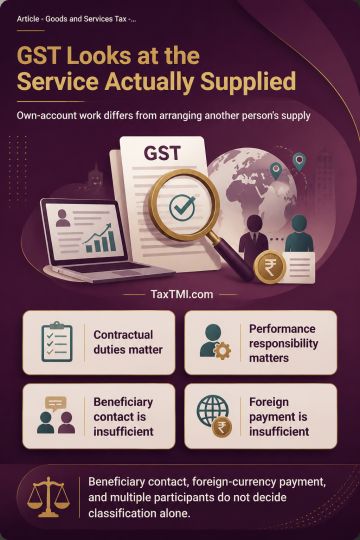
The Intermediary Test Begins with the Supplier's Actual Role
An Indian business may provide marketing, recruitment support, information technology or administrative services to an overseas customer. Its work may involve communicating with the customer's business partners or assisting people who ultimately benefit from the customer's operations. However, those circumstances do not automatically make the Indian supplier an intermediary. The essential question is whether it supplies the contracted service itself or merely arranges a separate supply between other persons.
The GST Appellate Tribunal examined this distinction in Navitas Eduservices Private Limited v. Commissioner of CGST, South Delhi 2026 (10) TMI 1143 - GSTAT NEW DELHI-[PB]. The GST Appellate Tribunal, Principal Bench, New Delhi, comprising Hon'ble Justice (Retd.) Dr. Sanjaya Kumar Mishra, President, and Hon'ble Shri Anil Kumar Gupta, Member (Technical), decided five taxpayer appeals and one departmental appeal through a common order.
The decision addressed two distinct legal questions. The first concerned whether Navitas India's services qualified as exports rather than as intermediary services. The second concerned whether the First Appellate Authority could annul an order and require the original officer to reconsider it. The taxpayer succeeded on the service-classification issue, while the Department succeeded on the remand issue. These outcomes must be understood separately.
The Contractual Chain Must Be Examined Before Classifying the Service
Navitas Eduservices Private Limited, formerly Learning Information Systems (India) Private Limited, was a wholly owned subsidiary of Navitas Pty Limited, Australia. The Australian entity operated an international education business involving partner universities and recruitment advisers. Under a Master Services Agreement dated 07.12.2016, the Indian company supplied marketing, promotion, business-support and IT-enabled services to its Australian parent.
The services included marketing strategies; support for recruitment advisers; presentations; application-related assistance; document verification; web development; digital design; marketing automation; and maintenance of the Study Link portal. Navitas India received consideration in Australian Dollars on a cost-plus-16% basis. The agreements described an independent-contractor relationship and restricted the assumption of obligations on behalf of the principal.
Navitas Australia separately engaged recruitment advisers and paid them commission linked to successful student enrolments. Navitas India was not a party to those adviser agreements. The advisers' involvement in the wider business arrangement did not establish that Navitas India itself occupied their contractual role. Each relationship had to be examined according to its obligations, services and payment arrangements.
Counting Three Parties Does Not Complete the Intermediary Test
The Department relied on the involvement of Navitas Australia, universities, advisers and students. It argued that Navitas India helped facilitate the supply of education and therefore acted as an intermediary. However, merely identifying several participants in a commercial network does not establish the legal relationship required by Section 2(13) of the IGST Act, 2017.
The intermediary framework involves a principal supply between other persons and a separate service that arranges or facilitates that supply. The supplier's actual role is therefore central. A person performing its own contracted work is not necessarily providing a separate facilitation service merely because that work contributes to another transaction. Commercial assistance and statutory intermediation are not interchangeable expressions.
The Tribunal applied the own-account exclusion and examined whether Navitas India acted as a broker, agent, or similar facilitator. It concluded that the company supplied substantive services as an independent subcontractor. The relevant inquiry was not simply how many people benefited from the business, but what Navitas India undertook to supply.
Subcontracting Remains Different From Merely Arranging a Supply
CBIC Circular No.159/15/2021-GST dated 20.09.2021 explains that a subcontractor actually supplying the principal service, wholly or partly, is not an intermediary merely because another business has outsourced the work to it. The subcontractor supplies its own service to the principal supplier; it does not merely arrange a supply between that principal and another person. The clarification also recognises that interaction with the ultimate customer need not change this position.
A simple illustration helps. A foreign company may engage an Indian company to develop software, prepare marketing material or process applications. The Indian company may need information from the foreign company's customers to complete that work. Such contact does not, by itself, turn performance of the contracted service into brokerage. By contrast, a person whose task is merely to bring two other parties together for a separate supply presents a different arrangement.
Navitas India's case required the same distinction. The Department's focus on the broader education business could not replace examination of the services subcontracted to the Indian company. The relevant service was the work Navitas India actually undertook, not simply the ultimate educational programme supported by that work.
The Payment Method Supports the Analysis but Does Not Decide It Alone
The difference between Navitas India's cost-plus remuneration and the advisers' enrolment-linked commission supported the distinction between their roles. The Indian company was paid for its contracted operations, while the advisers operated under separate arrangements with Navitas Australia. Reading these relationships together helped identify the service each participant supplied.
Nevertheless, cost-plus remuneration does not automatically exempt an intermediary from classification. Equally, describing consideration as commission does not necessarily establish an intermediary relationship. A payment label cannot replace examination of the underlying obligations and actual conduct. The contractual scope, responsibility for performance, authority to represent others and nature of the supply remain important.
The Tribunal's conclusion therefore rested on the arrangement as a whole. Neither foreign-currency payment nor cost-plus remuneration, considered alone, would answer every export question. Their significance arose from their connection with the independent supply established by the agreements and supporting records.
Outsourced Work Does Not Lose Its Independent Character Because It Serves Another Customer
In Genpact India Private Limited v. Union of India, 2022 (11) TMI 743 - PUNJAB AND HARYANA HIGH COURT, the Punjab and Haryana High Court examined outsourced business-process services supplied under a subcontracting arrangement. The Indian company performed substantive work using its own resources, even where the deliverables reached the overseas principal's customers. The absence of a separate contract with those customers and the actual performance of the services were material. The arrangement did not become intermediary activity merely because the work supported the principal's customer relationships.
Similarly, Columbia Sportswear India Sourcing Private Limited v. Union of India, 2025 (5) TMI 2139 - KARNATAKA HIGH COURT concerned sourcing and business-support activities for an overseas entity. The Karnataka High Court considered the independent-contractor relationship, the absence of authority to bind the foreign recipient and the substantive services performed. Its reasoning distinguished actual support services from merely obtaining or arranging another person's supply.
The Tribunal also relied on Commissioner, Central Excise, CGST-Delhi South Commissionerate v. Blackberry India (P) Ltd [2024 (11) TMI 830 - SC Order] - M/s. Dow Chemical International Pvt, Ltd. Vs. Commissioner of State Tax, Mazgaon, Mumbai 2026 (6) TMI 375 - GSTAT NEW DELHI-[PB]. These authorities helped interpret the own-account exclusion. Their relevance lay in the nature of the service and contractual role, not in creating a blanket rule that every outsourced activity must receive identical treatment.
Incidental Assistance to Students Does Not Make Them the Contractual Recipient
The education-sector comparison was particularly important. In Fateh Education Consulting Private Limited v. Assistant Commissioner, 2026 (5) TMI 632 - DELHI HIGH COURT, the Delhi High Court examined consultancy, marketing and recruitment support supplied to foreign universities. Consideration came from those universities; students were not charged, and the supplier lacked authority to bind the universities or guarantee admission. Incidental assistance to Indian students did not, by itself, make the services intermediary services.
The practical distinction is between the person receiving the contracted service and a person who benefits from its performance. A student may benefit from information, document checking or application assistance. That benefit does not automatically establish that the student is the recipient of the particular service contracted and paid for by an overseas entity.
Navitas India's arrangement was not identical to every education consultancy contract, but the reasoning helped identify the correct questions. Who engaged the supplier, who was liable to pay, what work was promised and whether the supplier merely arranged another supply mattered more than the location of an incidental beneficiary. The Tribunal accordingly followed the applicable High Court reasoning rather than the contrary advance rulings cited by the Department.
An Explained Name Change Is Different From an Unidentified Service Recipient
The refund rejection also referred to differences between the names appearing in the agreements and invoices. The agreement used the earlier name, Learning Information Systems (India) Private Limited, while later documents used the Navitas name. The original order also referred to the descriptions used for the Australian entity.
The Tribunal considered the explained corporate history and noted that the Indian company's reconstitution and changed name were not seriously disputed. The naming objection did not establish a substantive defect sufficient to defeat the claims. The Tribunal must compare a document bearing an earlier company name with the corporate records, not automatically treat it as evidence of a different transaction.
This finding should not be enlarged into permission to disregard identity discrepancies. Businesses should maintain the records connecting earlier and current names, agreements, invoices and foreign remittances. An explained change and an unresolved uncertainty about the actual supplier or recipient are different situations.
Export Eligibility Requires More Than an Overseas Payment
Navitas India submitted that the conditions under Section 2(6) of the IGST Act, 2017 were satisfied: the supplier was in India, the recipient was outside India, the place of supply was outside India, consideration was received in convertible foreign exchange, and the entities were not merely establishments of a distinct person. The intermediary classification was central because it affected the place-of-supply analysis for the disputed periods.
The taxpayer relied on its agreements, export invoices, foreign inward remittance certificates and transfer-pricing records. It also opposed the Department's physical-presence and unjust-enrichment objections. The Tribunal ultimately accepted the export classification on the arrangement before it. That conclusion should not be restated as a rule that payment by any foreign customer automatically establishes export eligibility.
The refund periods concerned 2018 to 2023. Application to other periods requires examination of the statutory provisions governing those periods and any subsequent amendments. The judgment's enduring classification principle is the distinction between supplying a service on one's own account and arranging someone else's supply.
Five Refunds Were Allowed, but the Departmental Matter Remained Open
The taxpayer's five appeals succeeded, and the adverse appellate orders were set aside. The Tribunal directed refunds of unutilised ITC totalling Rs.1,41,09,366, along with interest from the dates specified for each appeal in paragraph 37. The individual amounts and dates are relevant to the calculation but are not reproduced to explain the legal principle.
Paragraph 37 mentions interest at 6% and 9% without clearly explaining which rate applies to which period or appeal. The two rates should not be added together, nor should 9% be assumed to apply throughout. The paragraph also does not fix a separate deadline for payment of these refunds.
The Department's appeal had a different outcome. Its objection to the First Appellate Authority's remand was accepted, and the matter was returned to the First Appellate Authority for a decision on the merits. The refund total therefore relates only to the five taxpayer appeals; it does not include a refund finally allowed in the separate departmental matter.
Annulment Cannot Be Used to Achieve a Remand Prohibited by Law
The Department's appeal challenged an order in which the First Appellate Authority annulled the original decision and directed the adjudicating officer to reconsider the matter. Section 107(11) of the CGST Act, 2017 permits confirmation, modification or annulment, but expressly prevents the First Appellate Authority from referring the case back to the officer who passed the original order.
The distinction is substantive, not merely terminological. An order does not cease to be a remand merely because it first declares the original order annulled. If its operative direction sends the matter back for reconsideration, it produces the result prohibited by the provision. The power to annul cannot be used as an indirect means to exercise the power to remand.
The Department therefore succeeded on this objection. That success did not establish that its intermediary classification was correct. It established that the First Appellate Authority had used an impermissible procedure. The service-classification reasoning and the limits on appellate power remained separate questions.
The Power to Remand Depends on the Governing Statute
Different appellate authorities do not necessarily have the same powers. Section 107(11) of the CGST Act, 2017 prevents the First Appellate Authority from sending a case back to the original adjudicating officer. However, Section 113(1) of the CGST Act, 2017 expressly allows the GSTAT to remand a matter to the Appellate Authority, Revisional Authority or original adjudicating authority. Therefore, there was no contradiction in rejecting the First Appellate Authority's remand while directing a remand through the Tribunal's own order. Each authority had to act within the powers granted to it.
In the Department's appeal, the matter was returned to the First Appellate Authority, not to the original adjudicating officer. That authority had to hear both sides and decide the case on merits, consistently with the principles explained in the Tribunal's common order. The Tribunal preferred disposal within six weeks of taking cognisance of its order. This was a preferred timeframe for deciding the remanded matter, not a deadline for paying the refunds directed in the other five appeals.
The different outcomes must also remain clear. The taxpayer's five appeals resulted in refund directions, while the Department's separate appeal resulted in fresh examination by the First Appellate Authority. The Department's success in setting aside an unlawful remand did not amount to acceptance of its argument that the services were intermediary services. Equally, the refund directions in the five taxpayer appeals did not automatically dispose of the separate departmental matter. A common order must be read according to the relief granted in each appeal.
The Actual Service Must Determine Its GST Treatment
The agreement, work performed, invoices and payments must together establish the supplier's actual role. Promotional activity or contact with students does not, by itself, prove intermediary status. Supplying a contracted service is different from arranging a supply between others. The judgment requires applying that distinction to the evidence, while each appellate authority acts within its statutory powers.
***