 TaxTMI
Login

Login
Loading...
Press 'Enter' to add multiple search terms. Rules for Better Search

Press 'Enter' after typing page number.
Press 'Enter' after typing page number.


No Folders have been created
Are you sure you want to delete "My most important" ?
NOTE:
Press 'Enter' after typing page number.









Press 'Enter' after typing page number.

All TMI Notes
Press 'Enter' after typing page number.
Press 'Enter' after typing page number.
All TMI Notes

Note

Bookmark

Share


Download

This commentary provides doctrinal analysis and practical insights on the legal issue discussed below. The judgment is analysed in the context of its factual background, issues framed, and conclusions reached by the Court.
2026 (5) TMI 158 - ANDHRA PRADESH HIGH COURT
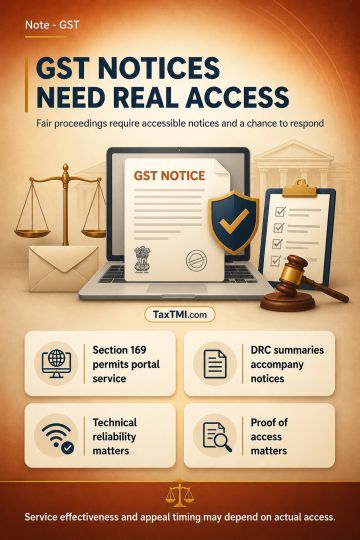
Service of a show-cause notice and the consequential adjudication order is not a technical preliminary in GST demand proceedings. It is the procedural event that enables the taxpayer to answer the proposed demand, seek a hearing and preserve the statutory remedies that follow an adverse order. The legal difficulty arises where a notice or order is uploaded on the GST portal but is not effectively brought to the taxpayer's attention, particularly when it is placed in a portal location that is not readily visible.
The decision in 2026 (5) TMI 158 - ANDHRA PRADESH HIGH COURT adopts an equitable response to this difficulty. It records the earlier view that uploading a show-cause notice or order on the portal is sufficient proof of service under Section 169(1)(b), but recognises that many assessees who are not technically equipped may suffer adverse orders without a meaningful remedy. The assessment order was consequently set aside and the matter remanded, subject to deposit of 20% of the disputed tax within six weeks.
The result is significant. Portal-based availability may possess statutory force, but a court may still intervene where exclusive reliance on electronic communication has deprived the taxpayer of a real opportunity to contest an adverse determination. The relief granted balances the revenue interest against procedural fairness; it does not extinguish the demand proceedings or decide the tax dispute on merits.
Section 2(26) of the Central Goods and Services Tax Act, 2017 defines the "common portal" as the common goods and services tax electronic portal referred to in Section 146. Section 146 authorises the Government, on the recommendations of the Council, to notify the Common Goods and Services Tax Electronic Portal for facilitating registration, tax payment, returns, computation and settlement of integrated tax, e-way bills and such other prescribed functions and purposes.
Section 169(1) provides that every decision, order, summons, notice or other communication under the Act or Rules "shall be served by any one of the following methods". The materially relevant alternatives are: direct tender under clause (a); registered post, speed post or courier with acknowledgement due under clause (b); communication to the registered e-mail address under clause (c); and "by making it available on the common portal" under clause (d). Clauses (e) and (f) contemplate newspaper publication and affixation in the circumstances specified there.
Section 169(2) states that every such communication "shall be deemed to have been served on the date on which it is tendered or published or a copy thereof is affixed in the manner provided in sub-section (1)." Section 169(3) separately creates a rebuttable presumption for registered post or speed post: it is deemed received on expiry of normal postal transit time "unless the contrary is proved." The text expressly attaches the latter presumption to postal modes, not to e-mail or portal availability.
In demand proceedings under Section 73, the proper officer must "serve notice" upon the person chargeable with tax, requiring that person to show cause why the amount specified, interest and penalty should not be paid. The notice must be issued at least three months before the time limit for issuance of the order. Section 73(9) then requires determination after considering the representation, if any, made by the person concerned. The statutory requirement of service is therefore connected directly to the taxpayer's opportunity to furnish a representation.
Section 75(4) reinforces this safeguard: an opportunity of hearing shall be granted where the taxpayer makes a written request or "where any adverse decision is contemplated". Section 75(6) further requires the order to set out the relevant facts and the basis of the decision, while Section 75(7) prevents confirmation beyond the amount and grounds specified in the notice.
Rule 142 of the Central Goods and Services Tax Rules, 2017 operates alongside these provisions. Rule 142(1)(a) requires the proper officer to serve, along with a notice under Section 73, a summary electronically in FORM GST DRC-01. Rule 142(4) requires the reply to a notice whose summary has been uploaded in DRC-01 to be furnished in FORM GST DRC-06. Rule 142(5) requires electronic uploading of the summary of an order in FORM GST DRC-07, and Rule 142(6) treats the order referred to in sub-rule (5) as the notice for recovery. The Rule thus gives electronic forms an important procedural role, but the full notice, the taxpayer's response and the reasoned adjudication remain central to lawful determination.
The principal question is not merely whether a document was uploaded. It is whether the statutory method adopted amounts to legally valid service in the circumstances and, separately, whether the method afforded an effective opportunity to reply and be heard. These inquiries can overlap, but they are not identical.
One view proceeds from the plain language of Section 169(1)(d): making a communication available on the common portal is itself one of the legislatively recognised methods. On this approach, physical delivery, postal dispatch or e-mail transmission is not an invariable precondition to portal service. The alternative modes in clauses (a) to (e) are generally framed disjunctively, whereas clause (f) is expressly available only where the preceding modes are not practicable.
The competing concern is that an electronic facility must operate in a manner consistent with the statutory expression "common portal" and with the requirement of fair notice. If a notice is available only under an obscure or additional tab, is hosted on a State portal without demonstrated reflection on the common portal, or is merely accompanied by an e-mail alert without the notice itself, courts have examined whether the purported service actually enabled the taxpayer to know and answer the case.
The question also has distinct consequences at two stages. For an unresponded show-cause notice, deficient service may vitiate an ex parte adjudication because the taxpayer was denied the opportunity contemplated by Sections 73 and 75. For an order passed after the taxpayer has contested the notice, a defect in the later mode of service may affect the commencement of appellate limitation, but ordinarily cannot be used to erase an adjudication in which the taxpayer had participated on merits.
The operative reasoning in 2026 (5) TMI 158 - ANDHRA PRADESH HIGH COURT is measured rather than absolute. The court did not discard the proposition that portal upload is sufficient proof of service. Indeed, it expressly recorded its earlier view to that effect. However, it recognised the practical consequence of exclusive technological service for assessees who are not technically equipped and who consequently suffer orders without an effective remedy. The remand, conditioned by a 20% deposit of disputed tax, shows that procedural relief may be granted without compromising the department's ability to adjudicate the demand afresh.
The decision consequently supports a contextual application of natural justice. A bare assertion that the taxpayer was unaware of an upload cannot, by itself, displace the statutory mode of service. Yet where the circumstances reveal a real loss of opportunity, a court may fashion relief that restores participation, safeguards revenue through an appropriate deposit and leaves all substantive objections open before the proper officer.
Section 169 should not be read as creating an unqualified presumption that every portal upload necessarily produces actual knowledge. Section 169(1)(d) identifies a statutory mode of service. The statutory efficacy of that mode remains important. But the fairness of proceeding ex parte must be assessed with Sections 73(1), 73(9) and 75(4): a notice must permit a meaningful show-cause response, a representation must be considered, and a hearing is mandatory where an adverse decision is contemplated.
Rule 142 supplies an additional practical distinction. A DRC-01 is described as a summary served electronically "along with" the statutory notice. The word "along with" is material: it does not treat an unexplained portal summary as a substitute for the underlying show-cause notice. Similarly, DRC-07 is a summary of the order. A taxpayer challenging service should therefore preserve the complete portal record, including the tab under which the document appeared, its visibility, the date on which it was first accessed, any e-mail alerts and whether the full communication was capable of being downloaded.
The doctrine of waiver also requires care. Participation after actual awareness of the notice can cure prejudice arising from the particular mode of service, because the taxpayer has in fact answered the proposed case. Conversely, a taxpayer who did not know of the notice, did not reply and suffered an ex parte order has a substantial natural-justice grievance. Waiver cannot ordinarily be inferred merely from a portal account existing or from an unproved assumption that a taxpayer must have noticed every portal entry.
2026 (7) TMI 1602 - PUNJAB AND HARYANA HIGH COURT held that uploading notices or orders only in the "View Additional Notices and Orders" tab did not constitute valid service. It reasoned that, although Section 169(1)(d) permits availability on the common portal, the portal had to be notified or prescribed for service under the statutory scheme; the material considered did not establish such notification for notices and orders. It also held that an e-mail alert without the statutory communication or its contents was not service by e-mail under Section 169(1)(c). Ex parte matters were restored to the show-cause stage, while contested matters received different treatment. This authority advances the strict proposition that an authorised electronic mode must be established, not presumed.
2024 (12) TMI 1400 - DELHI HIGH COURT accepted affidavit evidence that neither the notice nor the order was received physically or at the registered e-mail address. Since the show-cause notice was placed under "Additional Notices and Orders", the court held that the taxpayer deserved an opportunity to reply and remanded the matter. The decision is particularly relevant to evidentiary practice: a clear affidavit of non-receipt, coupled with evidence of portal placement, may establish actionable prejudice.
2024 (5) TMI 974 - DELHI HIGH COURT similarly held that upload in the inaccessible "Additional Notices" category did not establish effective notice where the taxpayer missed the show-cause notice and did not participate. The resulting order was set aside, with time granted for response and a personal hearing. The principle is not that portal communication is invariably invalid, but that portal architecture and actual accessibility matter where an ex parte order is founded on non-response.
2025 (3) TMI 1308 - DELHI HIGH COURT noted a departmental concession that the portal functioned differently from the department's and taxpayer's perspectives. Since the notices were visible only under the additional-notices tab and may have been missed, the demand orders were set aside. The direction that future hearing notices be e-mailed as well as uploaded presents a practical safeguard against recurrence.
2025 (7) TMI 1866 - CALCUTTA HIGH COURT treated placement of the first notice relating to an assessment under an "Additional Tab" as procedurally deficient. The court reasoned that the designation "additional" was incongruous where no earlier notice existed and that the less accessible placement could not amount to proper communication. It further connected deficient communication with the taxpayer's ability to pursue remedies and with the mandatory safeguards of representation and hearing.
2022 (3) TMI 86 - MADRAS HIGH COURT considered whether uploads on a State portal automatically satisfied the requirement of availability on the common portal. It held that, without confirmation of reliable auto-population and taxpayer accessibility on the common portal, State-portal upload alone was insufficient. Owing to technical glitches, the court directed simultaneous service through registered post, speed post or courier with acknowledgement until the problems were resolved. The analysis focuses on demonstrable availability, not merely departmental uploading.
2024 (2) TMI 357 - MADRAS HIGH COURT recognised e-mail as a valid statutory mode under Section 169(1)(c), but held that where an electronic communication receives no response, prudence and natural justice require at least one further notice through another mode under Section 169(1) before an ex parte adjudication. This approach preserves the statutory legitimacy of digital service while requiring the department to respond reasonably to silence.
2025 (1) TMI 1021 - MADRAS HIGH COURT adopted a more sequential construction, holding that direct service, post or registered e-mail should be attempted alternatively and that portal publication should follow upon failure or impracticability of those methods. On that construction, portal-only service was inadequate. This view illustrates that courts have not adopted a uniform approach to the ordering of the alternatives in Section 169(1).
2026 (2) TMI 995 - UTTARAKHAND HIGH COURT addressed the distinct setting of cancelled registration. It held that a taxpayer whose registration stood cancelled could not be expected to monitor the GST portal and that exclusive portal upload was ineffective in those circumstances. The order was quashed, with liberty to issue a fresh notice by a lawful mode and to grant hearing if sought. Cancellation of registration is thus a particularly material fact in a service challenge.
2025 (9) TMI 112 - DELHI HIGH COURT upheld service of personal-hearing notices sent to the e-mail address furnished at registration. It distinguished a statutory mode of e-mail service from a mere portal alert and held that issuance through a Section 169(1) mode is distinct from the deeming provision in Section 169(2). Where the registered e-mail address is used and departmental records establish transmission, the assertion of non-service may fail.
2025 (8) TMI 1129 - TELANGANA HIGH COURT also treated upload on the common portal as valid service where the taxpayer did not establish contrary facts and did not participate. This decision reflects the textual view that Section 169(1)(d) is an independent statutory mode. It stands in contrast to authorities that emphasise notification, tab placement, accessibility or prior use of alternative modes.
2025 (12) TMI 1598 - ALLAHABAD HIGH COURT accepted that electronic service through e-mail or the common portal is permissible and that clauses (a) to (e) do not carry an inter se priority. However, it held that mere upload or an alert, without verifiable access, acknowledgement or actual or constructive communication of the complete notice or order, did not commence the limitation for appeal. This analysis importantly distinguishes legal permissibility of a service mode from proof of effective communication sufficient to trigger adverse limitation consequences.
There exist divergent judicial views on whether portal upload alone is sufficient in every case and on whether Section 169(1) establishes a hierarchy among methods. The governing decision considered here does not nullify portal service as a statutory method. Instead, it permits calibrated relief where technological limitations have resulted in a taxpayer losing the opportunity to defend an assessment.
For the department, the least contentious course is to ensure that the full show-cause notice and order are accessible in a clearly visible portal location, retain an auditable upload trail, and use the registered e-mail address or another statutory mode where the portal record indicates non-participation. This is especially important before an ex parte order is passed. A summary in DRC-01 or DRC-07 should be accompanied by a procedurally complete record of the statutory communication.
For a taxpayer, a service challenge should be fact-specific. Relevant materials include screenshots of the portal dashboard and relevant tabs, the registered e-mail particulars, inbox and spam-folder records, access logs where available, evidence of cancellation of registration, the full text of e-mail communications and a precise affidavit explaining non-receipt and the resulting inability to reply or seek hearing. Once actual knowledge is obtained, prompt action and substantive participation are important, since a taxpayer who has replied and contested the show-cause notice may find it difficult to invalidate the proceeding solely by relying on a prior defect in service.
Where the challenge succeeds, remand rather than final annulment is ordinarily the appropriate result. The taxpayer receives a chance to reply and be heard; the proper officer retains authority to decide the demand on merits; and conditions such as deposit of a proportion of disputed tax may be imposed to protect revenue. The 20% deposit condition in the governing decision is an illustration of this balancing exercise, not a general statutory rule.
GST adjudication is designed to operate electronically, and Section 169 expressly accommodates electronic modes. Yet the statutory acceptance of technology does not reduce service to a mechanical act of uploading. Section 73 requires a show-cause notice, Section 75 requires consideration of representation and hearing where an adverse decision is contemplated, and Rule 142 requires electronically communicated summaries to function within that broader adjudicatory structure.
The central lesson is that service through the GST portal must be assessed both as a matter of statutory form and practical fairness. Where portal availability has genuinely enabled the taxpayer to participate, an objection to the mode of service may not assist. Where the notice was effectively inaccessible and the assessment was made ex parte, the governing decision supports restoration of the opportunity to contest the demand, while preserving the revenue's interest through conditions appropriate to the case.
Full Text:

