 TaxTMI
Login

Login
Loading...
Press 'Enter' to add multiple search terms. Rules for Better Search

Press 'Enter' after typing page number.
Press 'Enter' after typing page number.


No Folders have been created
Are you sure you want to delete "My most important" ?
NOTE:
Press 'Enter' after typing page number.












Press 'Enter' after typing page number.

All TMI Notes
Press 'Enter' after typing page number.
Press 'Enter' after typing page number.
All TMI Notes

Note

Bookmark

Share


Download

This is a neutral professional article. The judgment is analysed in the context of its factual background, issues framed, and conclusions reached by the Court.
2026 (10) TMI 148 - DELHI HIGH COURT
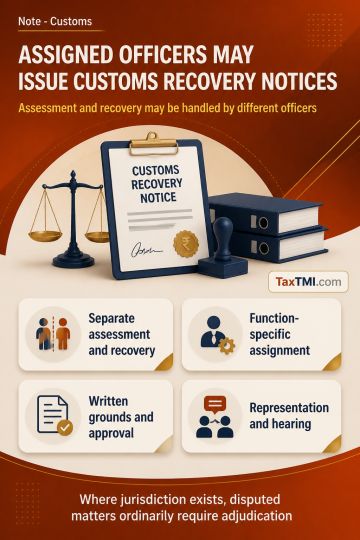
A recurring challenge to customs show cause notices concerns the competence of the officer who issued the notice. The challenge commonly takes the form that an investigating or intelligence officer was not the "proper officer" for recovery proceedings under Section 28, or that an officer issuing a confiscation or penalty notice did not satisfy the requirements of Section 124.
The jurisdictional question must be approached through the statutory design. It is not resolved merely by the officer's designation, nor solely by the fact that the officer conducted an investigation. The relevant inquiry is whether the officer was an officer of customs and whether the statutory function in question was assigned to that officer in the manner contemplated by the Act.
In the High Court decision reported at 2026 (10) TMI 148 - DELHI HIGH COURT, an exporter challenged a show cause notice issued following an investigation, contending that the Assistant Commissioner attached to the Special Intelligence and Investigation Branch was not competent to issue it under Sections 28 and 124. The High Court held that the jurisdictional issue stood concluded in favour of the department by the Supreme Court's review decision. It consequently declined to exercise writ jurisdiction at the notice stage and left the factual controversy for adjudication.
Section 2(34) defines "proper officer", in relation to functions under the Act, as "the officer of customs who is assigned those functions by the Board or the Principal Commissioner of Customs or Commissioner of Customs under section 5." The definition is function-specific. It directs attention to the particular power being exercised, rather than treating an officer's general status as sufficient for every purpose under the Act.
Under Section 4(1), the Board may appoint such persons as it thinks fit to be officers of customs. Section 4(2) permits the Board to authorise specified senior customs authorities to appoint officers below the rank of Assistant Commissioner or Deputy Commissioner. Appointment establishes the officer's status within the customs administration; assignment under Section 2(34) identifies the functions that may be exercised as a proper officer.
Section 17 provides for self-assessment by an importer or exporter. The proper officer may verify the entries and self-assessment and, for that purpose, examine or test goods. Where verification, examination, testing or other material shows that the self-assessment is incorrect, the proper officer may re-assess the duty. The provision also requires a speaking order where a re-assessment contrary to the self-assessment is not accepted in writing.
Section 28 authorises the proper officer to serve a notice seeking recovery where duty has not been levied or paid, has been short-levied or short-paid, or has been erroneously refunded. The operative language in Section 28(1)(a) is that "the proper officer shall" serve notice within the stipulated period. Section 28(4) similarly requires the proper officer to serve notice within five years where the stipulated grounds of collusion, wilful mis-statement or suppression of facts are present.
Section 28(11) contains a non-obstante validation provision. It states that all persons appointed as officers of customs under Section 4(1) before the specified date "shall be deemed to have and always had the power of assessment under section 17 and shall be deemed to have been and always had been the proper officers for the purposes of this section." This deeming provision is central where the validity of an earlier Section 28 notice is questioned on the ground that the issuing customs officer did not hold proper-officer status.
Explanation 2 to Section 28 states that non-levy, short-levy or erroneous refund occurring before the Finance Bill, 2011 received Presidential assent would continue to be governed by Section 28 as it stood immediately before that assent. The issue was whether this saving of the earlier substantive and procedural regime curtailed the validating operation of Section 28(11).
Section 124 independently safeguards a person against confiscation or penalty under the relevant Chapter. It prohibits an order of confiscation or penalty unless the affected person is given: a notice in writing, with the prior approval of an officer not below the rank of Assistant Commissioner, stating the proposed grounds; a reasonable opportunity to submit a written representation; and a reasonable opportunity of hearing.
The principal requirement in Section 124(a) is not phrased as a requirement that the notice be issued by "the proper officer." Its focus is on prior approval by an officer of the prescribed minimum rank. However, the second proviso permits the proper officer to issue a supplementary notice in the prescribed circumstances and manner. Accordingly, an objection under Section 124 must identify the precise statutory deficiency alleged, rather than assume that the Section 28 test applies identically to every confiscation or penalty notice.
The Supreme Court in 2024 (11) TMI 391 - Supreme Court (LB) reconsidered the jurisdictional foundation of notices issued by intelligence officers. It held that officers appointed as customs officers and assigned the relevant functions may be proper officers for Section 28. The Court rejected the proposition that Section 28 can be exercised only by the very officer who had undertaken the assessment function under Section 17.
The Court treated assessment and recovery as distinct statutory functions. After the self-assessment framework, Section 17 empowers the proper officer to verify and, where required, re-assess. Section 28 addresses a subsequent recovery process where non-levy, short levy, non-payment, short-payment or erroneous refund is alleged. Neither the use of the expression "the proper officer" nor the structure of the two provisions creates an inflexible statutory cross-reference requiring identity of the assessment officer and the notice-issuing officer.
The definite article in "the proper officer" does, however, retain significance. It confines the statutory function to an officer properly identified for that function by the assignment mechanism. It does not convert the phrase into an exclusive reference to the officer who dealt with the original assessment.
The Supreme Court held that Section 28(11) and Explanation 2 operate in separate fields. Explanation 2 preserves the pre-amendment Section 28 regime for the specified past matters. It does not neutralise the express deeming command in Section 28(11) that qualifying officers appointed under Section 4(1) "shall be deemed to have been and always had been" proper officers for Section 28.
On that construction, the retrospective validation provision addresses the jurisdictional defect asserted in respect of historical notices. The Supreme Court upheld the constitutional validity of Section 28(11) in the challenge before it and set aside the restrictive interpretation that had confined its validation effect. The Court also upheld the validating measure under Section 97 of the Finance Act, 2022 insofar as challenged in those proceedings. The findings on limitation in the original Canon India proceedings were left undisturbed; jurisdictional competence, therefore, does not dispense with an independent examination of limitation where it remains in issue.
The High Court applied the Supreme Court's jurisdictional conclusion to the challenge against the Assistant Commissioner attached to the Special Intelligence and Investigation Branch. It held that the officer was a proper authority and that the jurisdictional basis for quashing the notice did not survive.
The result is important for the scope of judicial review. The notice in question raised factual allegations concerning the nature of exported goods, declared value, claimed export incentives, purchase transactions, movement of funds and the relationship with an overseas purchaser. The effect of the acceptance of a closure report in a separate criminal investigation, vis-a -vis the customs notice, also required factual determination and evidence. These questions could not be resolved in a writ petition challenging the notice itself.
The High Court applied the settled principle that availability of an efficacious alternate remedy ordinarily restrains writ intervention. The recognised exceptions include enforcement of fundamental rights, breach of natural justice, proceedings wholly without jurisdiction, and challenge to the validity of legislation. Since the proper-officer objection no longer established a want of jurisdiction, the adjudicatory process was required to proceed after allowing a response and hearing.
The historical Notification No. 40/2012-Customs (N.T.) assigned Section 28 functions to Deputy Commissioners or Assistant Commissioners of Customs and Central Excise. It also assigned the second proviso to Section 124 to that category of officers. The notification is expressly recorded as superseded. It should therefore not be treated as the present source of authority for any current proceeding, but it illustrates the statutory method of assigning functions to specified classes of officers.
Section 110AA further reflects a structured allocation model after inquiry, investigation or audit. Where an officer has reason to believe that specified duty, drawback or interest discrepancies exist, that officer must transfer relevant documents and a written report to the proper officer having jurisdiction for assessment as assigned under Section 5, or, in multiple-jurisdiction cases, to an officer assigned by the Board. Thereafter, the Section 28 power is exercised by that proper officer or an authorised subordinate officer. This provision reinforces the distinction between investigating a matter and exercising the statutory recovery jurisdiction; it does not, by itself, determine the validity of a notice issued before its insertion.
The proper-officer inquiry under customs law is function-centred. Section 2(34) requires assignment of the relevant function to an officer of customs; Section 4 concerns appointment; and Section 28 prescribes recovery action by the proper officer. The statutory scheme does not mandate that the officer who undertook, verified or re-assessed under Section 17 must be the sole officer competent to initiate Section 28 proceedings.
Section 28(11) gives retrospective validating effect to the status and assessment power of qualifying officers appointed under Section 4(1), and its operation is not cut down by Explanation 2 merely because an earlier version of Section 28 governs the underlying recovery proceedings. On the supplied authorities, a notice issued by an Assistant Commissioner in an intelligence branch cannot be invalidated solely because that officer did not undertake the initial assessment.
Finally, the failure of a proper-officer challenge ordinarily redirects the dispute to adjudication. The noticee remains entitled to contest the factual allegations, statutory ingredients, limitation and procedural compliance before the competent authority, followed by remedies available in accordance with law.
Full Text:

