Loading...

⚠ ✕
❮ Top
☎ Help
☰
×

By creating an account you can:

Logo TaxTMI
Call Us / Help / Feedback✕

Contact Us At :

✉ E-mail: [email protected]

✆ To Call / Whatsapp, Check Contact Us

FAQs :

To know Frequently Asked Questions, Check FAQs

Most Asked Video Tutorials :

For more tutorials, Check Video Tutorials

Submit Feedback/Suggestion :

Email :
Please provide your email address so we can follow up on your feedback.
Category :
Description :
Min 15 characters 0/2000
Make Most of Text Search ✕
  1. Checkout this video tutorial: How to search effectively on TaxTMI.
  2. Put words in double quotes for exact word search, eg: "income tax"
  3. Avoid noise words such as : 'and, of, the, a'
  4. Sort by Relevance to get the most relevant document.
  5. Press Enter to add multiple terms/multiple phrases, and then click on Search to Search.
  6. Text Search
  7. The system will try to fetch results that contains ALL your words.
  8. Once you add keywords, you'll see a new 'Search In' filter that makes your results even more precise.
  9. Text Search
╳
Add to...
You have not created any category. Kindly create one to bookmark this item!
✕
Create New Category
Hide
Title :
Description :
❮❮ Hide
❮ Default View
Expand ❯❯
Close ✕
🔎 Filters / Advanced Search ❯
TEXT

Press 'Enter' to add multiple search terms. Rules for Better Search

Search In
Main Text + AI Text ❯
  • Main Text
  • Main Text + AI Text
  • AI Text
Law:
---- All Laws---- ❯
  • ---- All Laws----
  • Benami Property
  • Bill
  • Central Excise
  • Companies Law
  • Customs
  • DGFT
  • FEMA
  • GST
  • GST - States
  • IBC
  • Income Tax
  • Indian Laws
  • Money Laundering
  • SEBI
  • SEZ
  • Service Tax
  • VAT / Sales Tax
Types:
---- All Types ---- ❯
  • ---- All Types ----
  • Act Rules
  • Case Laws
  • Circulars
  • Manuals
  • News
  • Notifications
Sort By: ?
In Sort By 'Default', exact matches for text search are shown at the top, followed by the remaining results in their regular order.
Relevance Default Date
☰   Show Results ❯
    Export of Principal-to-Principal Support and Software Development Services under the IGST Act
    Refund of Unutilised Input Tax Credit by SEZ Units under Section 54 and Rule 89
    Case Laws Customs
    Private Bonded Warehouse Licence: Penalty-Based Disqualification under Regulation 3(2)(c)
    Refund of Accumulated Compensation Cess on Zero-Rated Supplies under Section 54 and Rule 89
    Penalty for Wrongful Availment of Input Tax Credit: The Distinction Between Sections 73 and 74
    Input Tax Credit on Resort Construction After Retrospective Substitution in Section 17(5)(d): Except...
    Shareholder Locus Standi under Section 61 in Challenges to Resolution-Plan Approval
    GSTR-2A Mismatch, Supplier Certification (of tax payment) and the Burden of Proving Input Tax Credit...
    Concessional GST on Works Contracts for Co-operative Spinning Mills: Government Entity Status and Pr...
    Case Laws Customs
    Abetment and Knowing Use of False Import Documents under Sections 112(a) and 114AA
    Subcontracted Services on Own Account and the Intermediary Exclusion under Section 2(13)
    Case Laws Customs
    Classification of Two-Ton Ductless Split Air Conditioners under Tariff Item 8415 82 10
    Case Laws Income Tax
    Transfer Pricing of Pre-Conversion Interest on Compulsorily Convertible Debentures
    Case Laws Customs
    Clubbing of Contrived Split Consignments under Rule 2(a) and Valuation of a Dismantled Motorcycle
    GST on Corporate Guarantees: Substantive Liability, Deemed Valuation and Judicial Relief
    Case Laws Income Tax
    Employee Secondment under the India-USA DTAA: Employment Rights, Reimbursements and Included Service...
    Pre-deposit Under Section 112 and Independent Compliance with Tribunal Filing Fees
    Case Laws Income Tax
    TDS on Interest Paid by Co-operative Banks to Non-Member Co-operative Societies under Section 194A(3...
    Input Tax Credit and Supplier Non-Payment: Statutory Limits on Mechanical Reversal Under Section 16(...
    Case Laws Customs
    Appellate Jurisdiction over Goods Imported as Baggage under Sections 129A and 129DD of the Customs A...
❮
❯
❯❯
Maximize Maximize Maximize
0 / 200
Expand Note
Add to Folder

No Folders have been created

+

Are you sure you want to delete "My most important" ?

NOTE:

Notes
Showing Results for :
Reset Filters
Results Found:
Show All Summaries Hide All Summaries
Case Laws GST
Show AI Summary
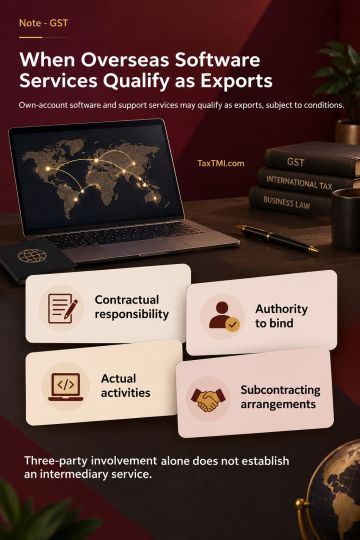
Principal-to-principal software development and support services may qualify as exports when supplied on own account and statutory conditions are satisfied.
Principal-to-principal software development and business support for overseas group entities are distinguished from intermediary services by examining the supply actually undertaken. Intermediation requires a separate service of arranging or facilitating a main supply between two other persons; the presence of three parties or benefits to end customers is insufficient. Development, sourcing assistance and call-centre or product support may be own-account services when the supplier is responsible for performing the work rather than arranging another person's supply. Contractual responsibility, authority to bind the overseas entity, actual activities and subcontracting arrangements are relevant. Cost-plus payment and an independent-contractor label are indicators, not conclusive tests; neither third-party contact nor group ownership alone determines classification.
Case Laws GST
Show AI Summary
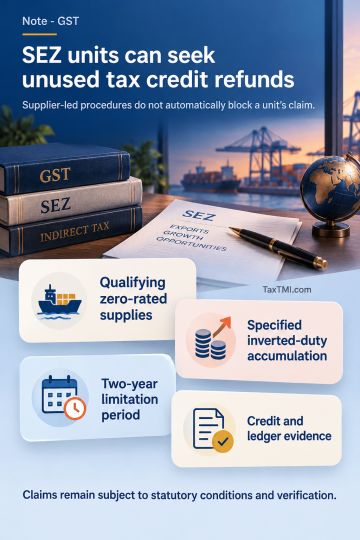
SEZ refund eligibility extends to unutilised input tax credit despite supplier-specific procedures, subject to statutory conditions and verification.
SEZ units are not categorically excluded from claiming refunds of unutilised input tax credit merely because Rule 89 prescribes a supplier-led procedure for supplies to SEZs. That procedure governs the supplier's claim for the relevant inward supply; it does not exclude a unit's own claim under the statutory refund framework. Section 54 of the CGST Act permits registered persons to claim refunds of unutilised credit subject to substantive conditions, including those governing zero-rated supplies made without payment of tax and specified inverted-duty accumulation. Refund applications must identify the applicable statutory basis, relevant date and two-year limitation period, and support the claim with evidence of qualifying supplies, credit sources, ledger balances and computation.
Case Laws Customs
Show AI Summary
Warehouse licensing disqualification requires more than a prior customs monetary penalty and depends on offence-based eligibility criteria.
Penalisation for an offence under Regulation 3(2)(c) is not established merely by the existence of a customs monetary penalty. The legal basis and character of the earlier proceedings must be examined against the distinction between adjudicatory penalties and the offences-and-prosecutions framework. The absence of conviction alone does not resolve every disqualification ground. Antecedent verification follows a centralised process, while a favourable eligibility assessment must be followed by the insurance, undertaking, indemnity and warehouse-keeper requirements under Regulation 4.
Case Laws GST
Show AI Summary
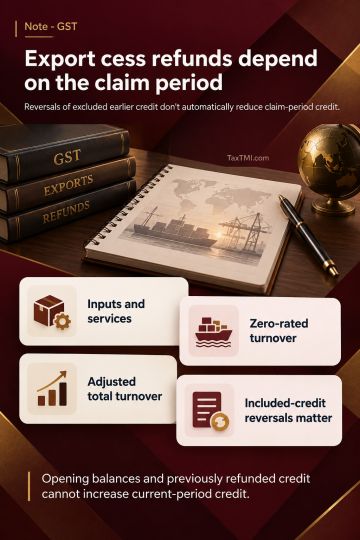
Compensation cess refunds on exports depend on period-specific credit attribution, not automatic deductions for unrelated earlier-period reversals.
Under Rule 89(4), the refund formula applies Net ITC to zero-rated turnover and adjusted total turnover. Period-specific Net ITC depends on credit availed on inputs and input services during the period for which the claim is filed. A reversal reported during that period does not automatically reduce Net ITC if it relates to residual earlier-period credit excluded from the current computation. Reversals affecting credit included in the computation remain relevant, and opening balances or previously refunded credit cannot be added to current-period Net ITC.
Case Laws GST
Show AI Summary
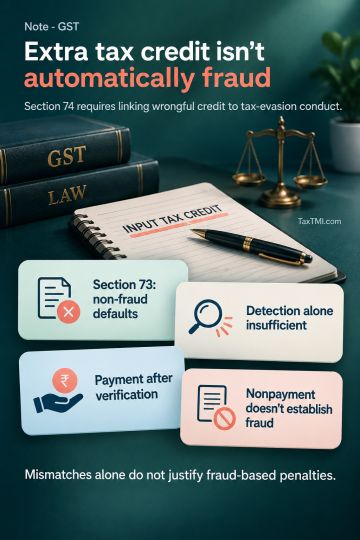
Input tax credit mismatches alone do not justify fraud-based penalties, even when excess credit is paid after verification.
Section 74 requires a factual connection between the wrongful credit and fraud, wilful misstatement or suppression of facts to evade tax; a mismatch or eligibility failure alone does not establish that connection. Section 73 covers defaults without those elements. Departmental detection, an admission of excess credit and payment after verification do not by themselves establish why the excess arose or prove the conduct necessary for Section 74. Failure to pay the pre-notice penalty cannot itself establish the fraud-related basis for Section 74.
Case Laws GST
Show AI Summary
Resort construction credit depends on immovability, own-account use, and the statutory distinction between buildings and plant and machinery.
Input tax credit on resort construction is subject to the blocked-credit restriction for goods and services received to construct immovable property on a taxable person's own account, including property used in the course or furtherance of business. The general business-use entitlement under section 16 does not displace this restriction in section 17(5)(d). The Finance Act, 2025 retrospectively substituted plant and machinery for "plant or machinery" from 1 July 2017, with the relevant provision commencing on 1 October 2025. The defined expression covers apparatus, equipment and machinery fixed to the earth by foundation or structural support and used for making outward supplies, including those foundations and supports. It excludes land, buildings and other civil structures, telecommunication towers and pipelines laid outside factory premises.
Case Laws IBC
Show AI Summary
Shareholder standing in insolvency appeals depends on legal capacity, not merely allegations of fraudulent changes to creditor-approved plans.
Individual shareholder standing to appeal against approval of a resolution plan is distinct from the legality of the plan itself. Under Section 61(1) of the Insolvency and Bankruptcy Code, 2016, an appellant must qualify as a person aggrieved. The applicable judicial interpretation restricts an appeal pursued exclusively in an individual shareholder capacity, even where equity interests are affected. Section 61(3) separately specifies permissible grounds of challenge: a plan's contravention of law and material irregularity in the resolution professional's exercise of powers are distinct grounds. Pleading either ground does not itself establish standing.
Case Laws GST
Show AI Summary
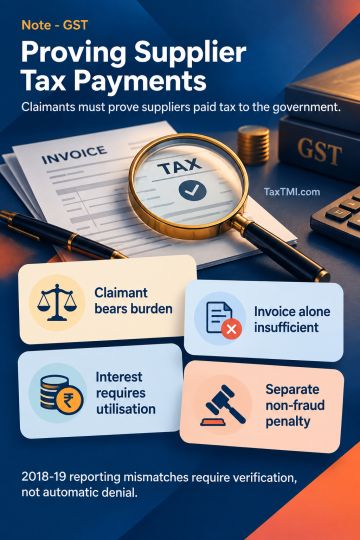
Input tax credit requires proof of supplier tax payment; reporting mismatches call for verification rather than automatic denial.
Supplier payment of tax to the Government is a condition of input tax credit eligibility under section 16(2)(c), and the claimant bears the burden of proving eligibility under section 155. Payment of the invoice and tax to the supplier, receipt of the supply and possession of an invoice do not themselves establish the supplier's remittance. For 2018-19, a GSTR-2A mismatch calls for verification and does not alone prove ineligibility. Interest under section 50(3) requires credit to have been both wrongly availed and utilised; its calculation follows Rule 88B(3). Non-fraud penalty operates under a separate statutory trigger and is not automatically excluded by the absence of fraud or utilisation.
Case Laws GST
Show AI Summary
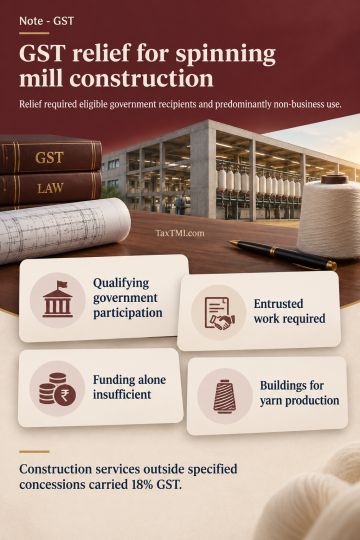
Non-business construction concessions for spinning mills require eligible recipient status and predominantly non-industrial use of the constructed buildings.
For the disputed period, the works-contract concession required both an eligible governmental recipient and structures predominantly meant for use other than commerce, industry, business or profession. Government Entity status required evidence of the recipient's constitution and qualifying governmental participation, while procurement had to relate to entrusted work. Project funding, tender approval and supervision did not by themselves establish governmental constitution or control. The spinning-mill factory buildings and allied works were intended for yarn production and related commercial activities. The residual construction-services entry carried aggregate GST of 18% for services outside the specified concessional entries.
Case Laws Customs
Show AI Summary
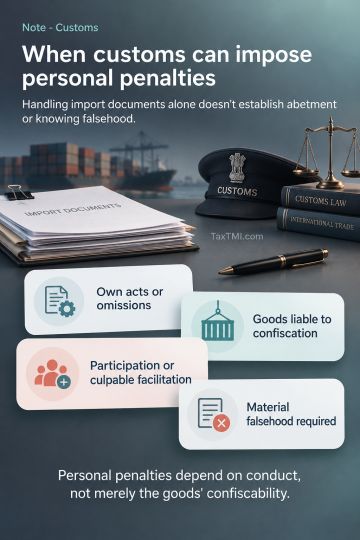
Import document handling alone does not establish customs abetment or knowing use of materially false declarations.
Personal customs penalties depend on the person's own conduct, not merely on the confiscability of imported goods. Under Section 112(a) of the Customs Act, 1962, liability may arise from a person's own act or omission rendering goods liable to confiscation or from abetment of such conduct. The direct limb can operate on a strict-liability basis where a person's own act or omission renders goods confiscable; an allegation of abetment instead requires evidence of participation or culpable facilitation. Section 114AA requires knowing or intentional making, signing or use, or causing the making, signing or use, of a declaration, statement or document that is materially false or incorrect in customs business.
Case Laws GST
Show AI Summary
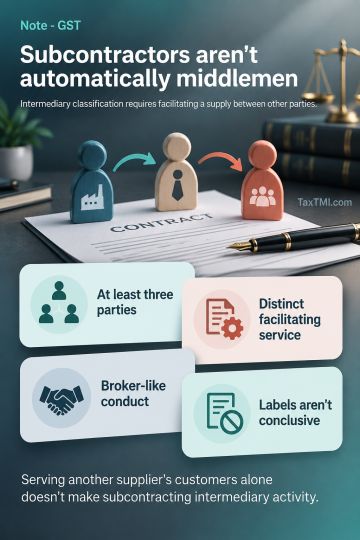
Subcontracted services performed on own account are not intermediary services merely because they support overseas recruitment and customer-facing activities.
Intermediary classification under Section 2(13) of the IGST Act distinguishes arranging or facilitating supplies between other persons from supplying services on one's own account. The intermediary framework requires at least three parties, a main supply and a distinct ancillary facilitating supply, with conduct resembling that of a broker or agent. Subcontracting the whole or part of a service is not intermediary activity merely because performance supports another supplier's business or involves its customers. Neither a bilateral agreement, contractual label nor remuneration method is conclusive.
Case Laws Customs
Show AI Summary
Split air conditioner classification requires capacity and refrigeration features to be assessed against the applicable tariff hierarchy.
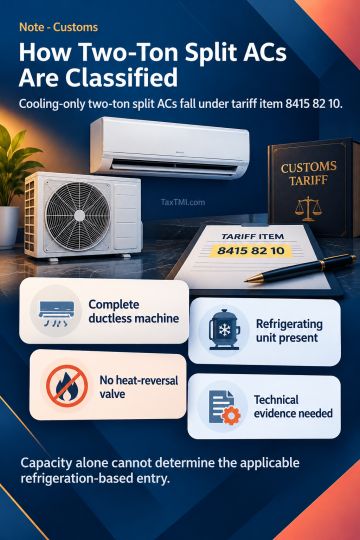
Classification of ductless split air conditioners depends on the complete tariff description and the machine's technical characteristics. A complete, cooling-only, two-ton split air conditioner incorporating a refrigerating unit and lacking a heat-reversal valve falls within tariff item 8415 82 10 rather than the general split-system item 8415 10 10. Item 8415 82 10 inherits its parent subheading's refrigerating-unit requirement, while item 8415 83 10 requires the absence of such a unit. Capacity alone does not establish the applicable refrigeration-based entry. Technical evidence should establish whether the goods are a complete machine and identify their capacity and operating features.
Case Laws Income Tax
Show AI Summary
Convertible debenture interest requires evidence-based pricing before conversion; future equity conversion alone cannot establish a nil arm's length price.
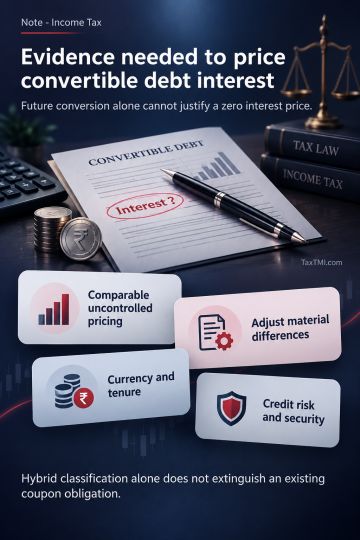
Pre-conversion interest on compulsorily convertible debentures (CCDs) issued to a non-resident associated enterprise requires arm's length pricing. Compulsory future conversion and hybrid classification do not, by themselves, establish a nil price or extinguish an existing coupon obligation. Rule 10AB's Other Method requires a price charged, paid or expected in comparable uncontrolled circumstances, with reasonably accurate adjustments for material differences under Rule 10B. Currency, benchmark date, tenure, credit risk, security, non-redemption and conversion benefits affect comparability; a conventional bank lending rate is not automatically comparable to a long-tenor CCD.
Case Laws Customs
Show AI Summary
Split motorcycle consignments require evidence of deliberate fragmentation for composite classification, with valuation assessed independently of classification.
Clubbing of split consignments for customs classification depends on proof that apparently separate imports form one deliberately fragmented transaction, not merely on the possibility of assembly. Rule 2(a) extends a tariff heading to an incomplete article possessing the essential character of the complete article and also covers a complete article presented disassembled. A change of tariff heading alone does not establish that the transaction value is inaccurate; substantive misdescription of the goods requires separate evidentiary consideration. Replacement value must follow the prescribed sequence of methods.
Case Laws GST
Show AI Summary
Corporate guarantee taxation depends on distinguishing taxable supply from valuation, particularly for unpaid support between related businesses.
GST on corporate guarantees requires separate consideration of whether a taxable supply exists and how that supply is valued. Section 7(1)(c) and Schedule I encompass qualifying supplies between related or distinct persons without consideration when made in the course or furtherance of business. Rule 28(2) deems the value of a guarantee furnished to a banking company or financial institution for a related recipient in India to be one per cent of the guaranteed amount per annum or actual consideration, whichever is higher. Where the recipient is eligible for full input tax credit, the proviso treats the value declared in the invoice as the value of the supply.
Case Laws Income Tax
Show AI Summary
Employee secondment taxation depends on employment rights, service consideration and demonstrable transfer of technical capability to host entities.
Local operational control and a stated suspension of foreign employment do not, by themselves, resolve whether underlying foreign employment rights survive. Under Article 12(4)(b) of the India-USA DTAA, technical or consultancy services must make technical knowledge, experience, skill, know-how or processes available, or involve development and transfer of a technical plan or design. Under the knowledge-transfer limb, the recipient must acquire a capability it can use independently; the mere application of expertise or presence of qualified personnel is insufficient. Recovery at actual cost and absence of markup do not, by themselves, establish that a foreign enterprise's receipt is non-taxable.
Case Laws GST
Show AI Summary
GST appellate pre-deposits may be satisfied by verified earlier payments after demand reduction, but filing fees remain independently payable.
When the first appellate authority substantially reduces the disputed tax demand, an earlier deposit may be sufficient to satisfy the Tribunal-stage requirement, subject to verification. Sufficiency depends on the reduced liability, the applicable appellate requirements and the amount actually deposited; a first appellate payment does not automatically eliminate the additional obligation. Tribunal filing fees under Section 112(7) operate independently of pre-deposit. Where a fee shortfall and earlier deposit require verification, proof of fee payment and verification of the deposit precede consideration of admission.
Case Laws Income Tax
Show AI Summary
Inter-co-operative society interest exemption preserves non-deduction by co-operative banks when depositors are co-operative societies under the statutory withholding framework.
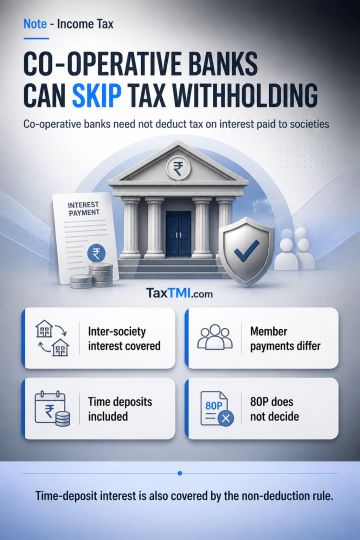
Section 194A(3)(v) separately addresses interest paid by a co-operative bank to a member and interest paid by a co-operative society to another co-operative society. The exclusion of co-operative banks is confined to the member-payment limb; a co-operative bank remains a co-operative society for the inter-co-operative society limb. Paragraph 42.7 of Circular No. 19/2015 preserves non-deduction, including time-deposit interest, where the depositor is a co-operative society. Section 80P does not determine this withholding obligation.
Case Laws GST
Show AI Summary
Input tax credit reversal requires evidence linking supplier non-payment to recipient ineligibility and a reasoned statutory inquiry.
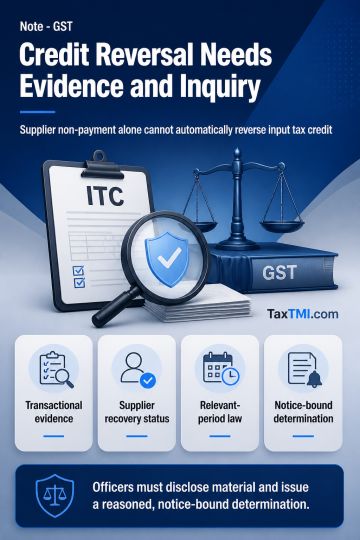
Input tax credit under Section 16(2)(c) remains conditional on actual payment of tax to Government, but supplier non-payment or retrospective cancellation cannot by itself justify reversal. The recipient must establish eligibility through transactional evidence, while the proper officer must investigate the particular supply, disclose supplier-default and recovery material, apply the law applicable to the relevant period, and issue a reasoned, notice-bound determination. Supplier recovery status and protection against duplicate collection are material considerations.
Case Laws Customs
Show AI Summary
Baggage-related customs appeals proceed through statutory revision when the jurisdictional exclusion applies to passenger imports.
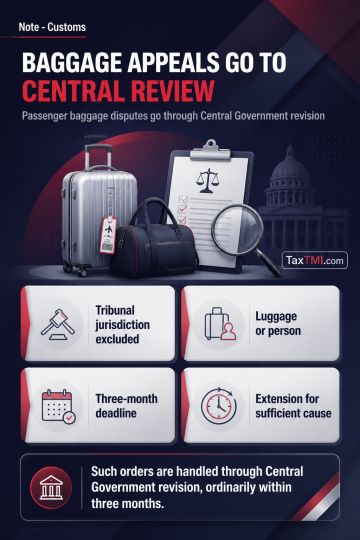
The first proviso to section 129A(1) excludes Appellate Tribunal jurisdiction over an order under section 128A relating to goods imported or exported as baggage. The decisive issue is the order's connection with baggage, not disputes concerning confiscation, declaration, duty, personal effects, concealment, concession, or penalty. Articles carried by an international passenger in luggage or on the person may constitute baggage. Section 129DD provides revision before the Central Government, ordinarily within three months, subject to a further period on sufficient cause.

TMI Notes

Back

All TMI Notes

Showing Results for :
Reset Filters
No Records Found

TMI Notes

Back

All TMI Notes

Wrong-Head GST Payment and the Distinction Between Appropriation and Refund Under Sections 19 and 77

23 September, 2026

Contents
Circulars
Acts
Rules & Regulations
Plus +
Summary
Note

Note

-

Bookmark

(New) -

Download

Print

Print

This commentary provides doctrinal analysis and practical insights on the legal issue discussed below. The judgment is analysed in the context of its factual background, issues framed, and conclusions reached by the Court.

2026 (7) TMI 909 - MADRAS HIGH COURT

1. Introduction

Wrong-head payment under GST arises where the taxpayer has remitted the full tax quantified for a supply, but the remittance is mapped to an incorrect tax head-for example, Integrated Goods and Services Tax (IGST) instead of the corresponding Central Goods and Services Tax (CGST) and State Goods and Services Tax (SGST) components. The immediate administrative response may be to treat the CGST and SGST liabilities as unpaid, require a fresh discharge under those heads, and leave the taxpayer to pursue a refund of the IGST amount.

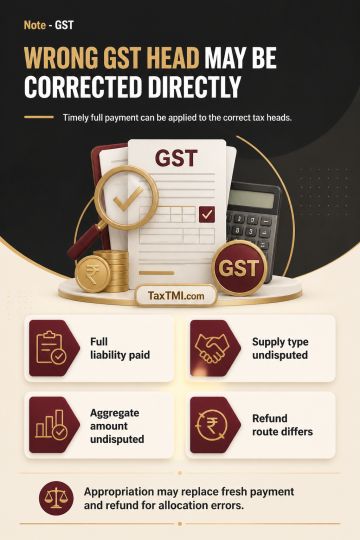
The decision reported at 2026 (7) TMI 909 rejects that sequence on its facts. Where the aggregate tax liability was admittedly discharged within the prescribed period, albeit under the wrong IGST head, the taxpayer could not be required first to make a second payment under CGST and SGST and thereafter seek refund of the amount already remitted. The appropriate relief was appropriation of the amount already paid against the correct heads, with a refund application being used only if procedurally necessary.

The decision draws an important doctrinal line. A mere wrong-head remittance is distinct from the statutory situation in which a supply initially regarded as inter-State is subsequently held to be intra-State, or vice versa. This distinction determines whether the specialised refund scheme under Sections 19 and 77 applies, or whether the case calls for correction and appropriation of an amount already paid.

2. Legal & Statutory Context

Section 19 of the IGST Act and Section 77 of the CGST Act

Section 19 of the Integrated Goods and Services Tax Act, 2017 addresses a characterisation error concerning the nature of the supply. Section 19(1) provides that a registered person who has paid IGST on a supply considered to be inter-State, but which is "subsequently held to be an intra-State supply", shall be granted refund of the IGST paid, in the prescribed manner and subject to prescribed conditions. Section 19(2) correspondingly provides that a person who paid CGST and SGST or Union territory tax on a transaction considered intra-State but subsequently held inter-State shall not be required to pay interest on the IGST payable.

Section 77 of the Central Goods and Services Tax Act, 2017 is the corresponding provision in the reverse direction. Section 77(1) states that where CGST and SGST, or CGST and Union territory tax, have been paid on a transaction considered intra-State but subsequently held inter-State, the taxes so paid shall be refunded in the prescribed manner and subject to prescribed conditions. Section 77(2) contains the converse interest protection where IGST was initially paid but CGST and SGST or Union territory tax later become payable.

Both provisions therefore presuppose a substantive mistake as to whether the supply is inter-State or intra-State. They do not, by their express terms, deal with a case in which the nature of the supply and the aggregate tax burden are not in dispute, but payment has inadvertently been recorded under an incorrect tax head.

Electronic cash ledger and inter-head transfer

Section 49 of the CGST Act contains the general payment architecture. Under Section 49(1), a deposit towards tax or other dues is credited to the electronic cash ledger. Section 49(3) permits the amount available in that ledger to be used for payment in the prescribed manner. Of particular relevance, Section 49(10) permits a registered person, on the common portal, to transfer any amount of tax, interest, penalty, fee or other amount "available in the electronic cash ledger" to the electronic cash ledger for "integrated tax, central tax, State tax, Union territory tax or cess". Such transfer is "deemed to be a refund from the electronic cash ledger".

Rule 87 of the Central Goods and Services Tax Rules, 2017 operationalises this ledger framework. Rule 87(13) provides that a registered person may transfer an amount available in the electronic cash ledger to the ledger for IGST, CGST, SGST, Union territory tax or cess through FORM GST PMT-09. This is a statutory mechanism for an available cash-ledger balance; its applicability must, however, be assessed against the actual ledger position and the stage at which the wrong-head amount was debited.

Refund provisions and procedure

Section 54 of the CGST Act permits a person claiming refund of tax, interest or other amount paid to apply within two years from the relevant date. Under the residual clause in the definition of "relevant date", in any other case it is the date of payment of tax. Section 54(8)(d) specifically permits payment of a refund to the applicant where it is "refund of tax in pursuance of section 77". Further, Section 54(10)(b) permits the proper officer to deduct from a refund due any tax, interest, penalty, fee or other amount that remains unpaid.

Rule 89 of the Central Goods and Services Tax Rules, 2017 generally requires a refund claim to be filed electronically in FORM GST RFD-01. Rule 89(1A), for a Section 77 claim, prescribes an application before expiry of two years from the date of payment of tax under the correct head. Its operative formulation is confined to a transaction considered intra-State and subsequently held inter-State. The administrative clarification discussed below extends that rule, in the corresponding situation, to claims under Section 19 of the IGST Act.

3. Interpretative Issues

Wrong classification of supply versus wrong tax head

The central interpretative issue is whether every payment under an incorrect GST head must be processed under Sections 19 and 77. The answer in 2026 (7) TMI 909 is negative. The decision holds that Section 19, the corresponding Section 77, and Rule 89(1A) do not apply where the tax was "paid inadvertently under a wrong head". The statutory trigger is not the mere use of an incorrect head; it is the later determination that the supply was of a different inter-State or intra-State character from that originally considered by the taxpayer.

This construction follows the statutory language. The words "considered by him to be" and "subsequently held" require a change or correction in the characterisation of the supply. A head-allocation error, without such a change in the legal character of the supply, does not automatically enter that specialised regime.

Whether a timely aggregate remittance constitutes discharge

The second issue is the legal consequence of full remittance under a wrong head. The decision proceeds on the categorical factual recording that the aggregate dues were discharged under the IGST head within the prescribed period. On that basis, the taxpayer was not to be subjected to a circular process of paying CGST and SGST again, followed by recovery of the amount already paid as IGST.

The ruling does not erase the statutory distinction between IGST, CGST and SGST. Rather, it treats the distinction as requiring correct appropriation, not duplicate payment, where the amount already remitted is identifiable and the aggregate liability has been discharged in time. The material consideration was not an open-ended entitlement to revise completed tax payments, but the acknowledged existence of a wrong-head payment corresponding to the same liability.

Appropriation, transfer and refund as procedural alternatives

A third issue concerns the appropriate procedural route. The directions recognise that the form of correction may depend upon the administrative position of the amount. The taxpayer was directed to apply for appropriation of the amount remitted under IGST against CGST and SGST. If necessary for that purpose, the taxpayer could submit a refund application. Thus, refund was not treated as the mandatory substantive remedy; it was retained as a procedural means to implement appropriation where the system or ledger architecture so required.

4. Detailed Commentary & Analysis

The principal contribution of 2026 (7) TMI 909 lies in aligning procedure with the admitted economic reality of payment. The rectification order had accepted that the aggregate dues were remitted, but required the taxpayer to pay CGST and SGST first and claim refund of IGST later. The decision held that this approach penalised a taxpayer who had discharged the liability within time but had selected the wrong head.

The relief was carefully structured. First, the taxpayer was required to file an application specifically requesting appropriation of the amount remitted under IGST against the CGST and SGST liabilities. Secondly, a refund application could be submitted if it was procedurally necessary. Thirdly, the authorities were directed to appropriate the amounts already available within 30 days of receipt of the application. Finally, the rectification order was set aside to the extent it conflicted with these directions.

This sequencing has two consequences. It preserves the department's ability to require an identifiable application and verify the linkage between the wrong-head payment and the asserted liability. At the same time, it prevents procedure from converting an admitted allocation mistake into an obligation to make a second cash outflow. The approach accords with the settled principle that procedural requirements should facilitate lawful tax administration and should not operate punitively where the substantive tax position-timely discharge of the aggregate liability-is accepted.

The decision should nevertheless be read within its factual limits. It does not declare that every incorrect declaration in a return, every excess payment, or every tax-head mismatch must be rectified through judicially ordered appropriation. Its reasoning depends on the recorded finding that the total tax liability was already discharged and on the availability of a direct nexus between the amount paid and the CGST-SGST liability sought to be adjusted.

Section 49(10) and Rule 87(13) furnish a significant statutory context for this result where funds remain available in the electronic cash ledger. They contemplate inter-head transfer through the common portal and FORM GST PMT-09. However, the decision does not rest its conclusion on a finding that the amount was, at the relevant time, an unutilised electronic cash-ledger balance. It instead orders appropriation of the amount already available, allowing a refund application if required procedurally. This distinction is material where a payment has already been debited against a filed return or where portal mechanics do not permit a straightforward PMT-09 transfer.

5. Judicial / Administrative Perspective

The principal judicial direction

In 2026 (7) TMI 909, the taxpayer's core grievance was accepted because the full aggregate liability had been paid within time under IGST instead of being apportioned between CGST and SGST. The decision expressly held that the Section 19 framework, the corresponding Section 77 framework and Rule 89(1A) did not govern this pure wrong-head error. The operative remedy was appropriation, not payment afresh followed by refund.

Earlier authority on transfer between tax heads

The ruling reported at 2018 (11) TMI 954 concerned a remittance under the SGST head although the supply was inter-State and IGST was payable. The authority directed release of the detained goods and required transfer of the tax and penalty amount to the IGST head in accordance with the applicable refund-adjustment mechanism. It treated administrative delay in inter-head correction as an insufficient basis to continue prejudice after the payment itself was undisputed.

That decision supports the broader proposition that an acknowledged wrong-head remittance may be corrected by transfer or adjustment rather than by insisting that the taxpayer suffer the consequences of an administrative allocation error. However, the principal decision governs the present issue's statutory characterisation: where there is merely an inadvertent wrong-head payment, Sections 19 and 77 cannot be assumed to apply solely because the heads differ.

Return-correction perspective

The decision reported at 2020 (11) TMI 108 dealt with erroneous reporting and allocation of credit between IGST, CGST and SGST. Relief was granted to correct the allocation despite expiry of the ordinary rectification period because the error was inadvertent, no effective mechanism existed to detect and correct it in time, and denial would prejudice legitimate credit. Its direct subject was return correction and credit distribution, not appropriation of a tax payment already made under the wrong head.

Its relevance is therefore limited but instructive. It recognises that bona fide GST reporting errors should not produce substantive prejudice where the statutory or technological correction mechanism has been ineffective. The principal decision applies that concern in the distinct setting of wrong-head payment and appropriation.

Administrative clarification under Sections 19 and 77

Circular No. 162/18/2021-GST clarifies that "subsequently held" in Section 77 and Section 19 includes both a correction found by the taxpayer and one found or held by a tax officer in proceedings. It further states that a refund under those provisions can be claimed in either situation, provided the taxpayer pays the required tax under the correct head. The circular explains that Rule 89(1A) allows the refund claim within two years from the date of payment under the correct head, subject to its transitional treatment for payments made before the rule came into force.

This clarification applies to a supply whose inter-State or intra-State character is subsequently corrected. It does not displace the principal decision's conclusion that an inadvertent wrong-head remittance, without a changed classification of the supply, falls outside Sections 19 and 77. The two positions operate in separate factual fields: one concerns wrong characterisation of the supply; the other concerns wrong allocation of an otherwise discharged liability.

6. Implications & Observations

For taxpayers, the decision provides a focused basis to seek appropriation where the department's own record acknowledges that the total tax payable was remitted in time but under the wrong tax head. The application should distinctly identify the relevant tax period, the liability declared, the payment evidence, the wrong head used, the correct CGST and SGST allocation, and the precise appropriation requested.

The ledger position requires careful examination. If the amount remains available in the electronic cash ledger, Section 49(10) read with Rule 87(13) may offer a direct transfer mechanism through FORM GST PMT-09. If the amount has already been debited or the system does not permit such transfer, the application should request appropriation while expressly reserving the option of a refund application if the authority considers it procedurally necessary.

Taxpayers should not automatically characterise a pure wrong-head case as a Section 19 or Section 77 refund claim. Doing so may unnecessarily import the requirement, recognised in the circular for classification cases, of first paying tax under the correct head and then claiming refund. The factual narrative must instead establish whether the supply was ever wrongly considered inter-State or intra-State, or whether the error was confined to the tax head selected for payment.

For revenue authorities, the decision underscores the need to distinguish collection of unpaid tax from rectification of an admitted allocation error. Where the aggregate payment is not disputed, an insistence on duplicate payment before appropriation may conflict with the direction that the taxpayer should not be penalised for the wrong-head remittance. At the same time, appropriation should be confined to amounts demonstrably linked to the correct liability and should not be treated as dispensing with verification of the taxpayer's records.

7. Concluding Remarks

Wrong-head GST payment is not invariably a refund case under Sections 19 and 77. Those provisions address a subsequent correction in the inter-State or intra-State character of a supply. Where the supply classification is not the issue and the taxpayer has timely discharged the entire aggregate tax under the incorrect head, 2026 (7) TMI 909 recognises appropriation to the correct CGST and SGST heads as the appropriate substantive outcome.

The practical lesson is to identify the error accurately before selecting the remedy. A cash-ledger transfer under Section 49(10) and Rule 87(13), an appropriation request supported by payment records, or a refund application used as a procedural mechanism may each have a role. The decisive distinction remains whether the case concerns an incorrect legal classification of the supply or merely an incorrect tax head for an otherwise discharged liability.


Full Text:

2026 (7) TMI 909 - MADRAS HIGH COURT

Topics

Acts Income Tax