Loading...

⚠ ✕
❮ Top
☎ Help
☰
×

By creating an account you can:

Logo TaxTMI
Call Us / Help / Feedback✕

Contact Us At :

✉ E-mail: [email protected]

✆ To Call / Whatsapp, Check Contact Us

FAQs :

To know Frequently Asked Questions, Check FAQs

Most Asked Video Tutorials :

For more tutorials, Check Video Tutorials

Submit Feedback/Suggestion :

Email :
Please provide your email address so we can follow up on your feedback.
Category :
Description :
Min 15 characters 0/2000
Make Most of Text Search ✕
  1. Checkout this video tutorial: How to search effectively on TaxTMI.
  2. Put words in double quotes for exact word search, eg: "income tax"
  3. Avoid noise words such as : 'and, of, the, a'
  4. Sort by Relevance to get the most relevant document.
  5. Press Enter to add multiple terms/multiple phrases, and then click on Search to Search.
  6. Text Search
  7. The system will try to fetch results that contains ALL your words.
  8. Once you add keywords, you'll see a new 'Search In' filter that makes your results even more precise.
  9. Text Search
╳
Add to...
You have not created any category. Kindly create one to bookmark this item!
✕
Create New Category
Hide
Title :
Description :
❮❮ Hide
❮ Default View
Expand ❯❯
Close ✕
🔎 Filters / Advanced Search ❯
TEXT

Press 'Enter' to add multiple search terms. Rules for Better Search

Search In
Main Text + AI Text ❯
  • Main Text
  • Main Text + AI Text
  • AI Text
Law:
---- All Laws---- ❯
  • ---- All Laws----
  • Benami Property
  • Bill
  • Central Excise
  • Companies Law
  • Customs
  • DGFT
  • FEMA
  • GST
  • GST - States
  • IBC
  • Income Tax
  • Indian Laws
  • Money Laundering
  • SEBI
  • SEZ
  • Service Tax
  • VAT / Sales Tax
Types:
---- All Types ---- ❯
  • ---- All Types ----
  • Act Rules
  • Case Laws
  • Circulars
  • Manuals
  • News
  • Notifications
Sort By: ?
In Sort By 'Default', exact matches for text search are shown at the top, followed by the remaining results in their regular order.
Relevance Default Date
☰   Show Results ❯
    Export of Principal-to-Principal Support and Software Development Services under the IGST Act
    Refund of Unutilised Input Tax Credit by SEZ Units under Section 54 and Rule 89
    Case Laws Customs
    Private Bonded Warehouse Licence: Penalty-Based Disqualification under Regulation 3(2)(c)
    Refund of Accumulated Compensation Cess on Zero-Rated Supplies under Section 54 and Rule 89
    Penalty for Wrongful Availment of Input Tax Credit: The Distinction Between Sections 73 and 74
    Input Tax Credit on Resort Construction After Retrospective Substitution in Section 17(5)(d): Except...
    Shareholder Locus Standi under Section 61 in Challenges to Resolution-Plan Approval
    GSTR-2A Mismatch, Supplier Certification (of tax payment) and the Burden of Proving Input Tax Credit...
    Concessional GST on Works Contracts for Co-operative Spinning Mills: Government Entity Status and Pr...
    Case Laws Customs
    Abetment and Knowing Use of False Import Documents under Sections 112(a) and 114AA
    Subcontracted Services on Own Account and the Intermediary Exclusion under Section 2(13)
    Case Laws Customs
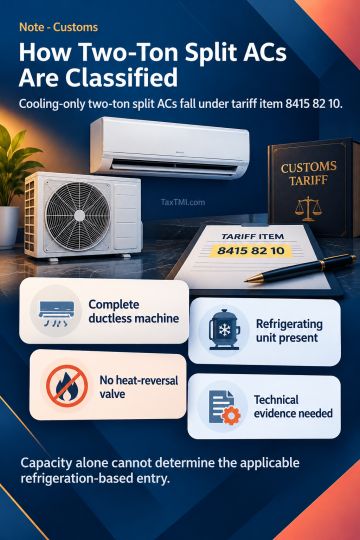
    Classification of Two-Ton Ductless Split Air Conditioners under Tariff Item 8415 82 10
    Case Laws Income Tax
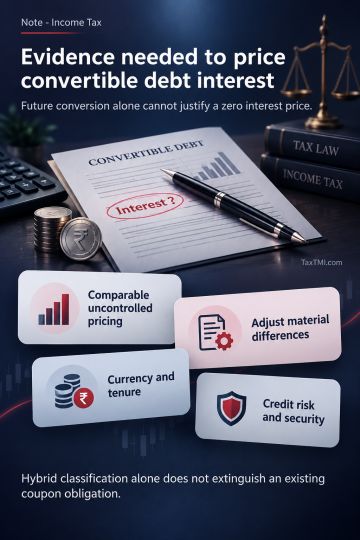
    Transfer Pricing of Pre-Conversion Interest on Compulsorily Convertible Debentures
    Case Laws Customs
    Clubbing of Contrived Split Consignments under Rule 2(a) and Valuation of a Dismantled Motorcycle
    GST on Corporate Guarantees: Substantive Liability, Deemed Valuation and Judicial Relief
    Case Laws Income Tax
    Employee Secondment under the India-USA DTAA: Employment Rights, Reimbursements and Included Service...
    Pre-deposit Under Section 112 and Independent Compliance with Tribunal Filing Fees
    Case Laws Income Tax
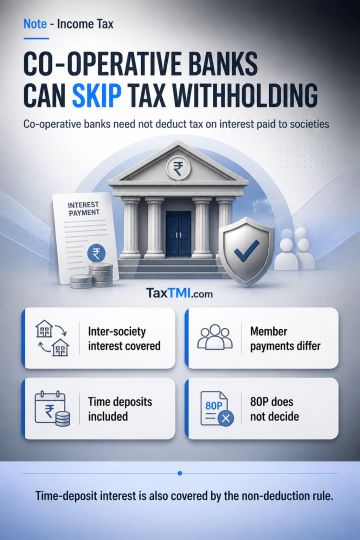
    TDS on Interest Paid by Co-operative Banks to Non-Member Co-operative Societies under Section 194A(3...
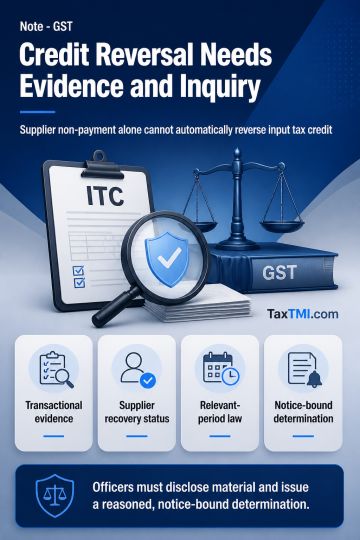
    Input Tax Credit and Supplier Non-Payment: Statutory Limits on Mechanical Reversal Under Section 16(...
    Case Laws Customs
    Appellate Jurisdiction over Goods Imported as Baggage under Sections 129A and 129DD of the Customs A...
❮
❯
❯❯
Maximize Maximize Maximize
0 / 200
Expand Note
Add to Folder

No Folders have been created

+

Are you sure you want to delete "My most important" ?

NOTE:

Notes
Showing Results for :
Reset Filters
Results Found:
Show All Summaries Hide All Summaries
Case Laws GST
Show AI Summary
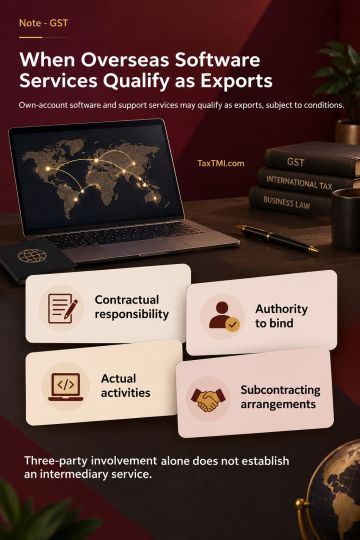
Principal-to-principal software development and support services may qualify as exports when supplied on own account and statutory conditions are satisfied.
Principal-to-principal software development and business support for overseas group entities are distinguished from intermediary services by examining the supply actually undertaken. Intermediation requires a separate service of arranging or facilitating a main supply between two other persons; the presence of three parties or benefits to end customers is insufficient. Development, sourcing assistance and call-centre or product support may be own-account services when the supplier is responsible for performing the work rather than arranging another person's supply. Contractual responsibility, authority to bind the overseas entity, actual activities and subcontracting arrangements are relevant. Cost-plus payment and an independent-contractor label are indicators, not conclusive tests; neither third-party contact nor group ownership alone determines classification.
Case Laws GST
Show AI Summary
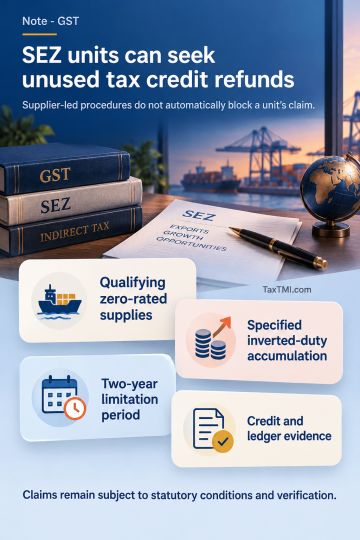
SEZ refund eligibility extends to unutilised input tax credit despite supplier-specific procedures, subject to statutory conditions and verification.
SEZ units are not categorically excluded from claiming refunds of unutilised input tax credit merely because Rule 89 prescribes a supplier-led procedure for supplies to SEZs. That procedure governs the supplier's claim for the relevant inward supply; it does not exclude a unit's own claim under the statutory refund framework. Section 54 of the CGST Act permits registered persons to claim refunds of unutilised credit subject to substantive conditions, including those governing zero-rated supplies made without payment of tax and specified inverted-duty accumulation. Refund applications must identify the applicable statutory basis, relevant date and two-year limitation period, and support the claim with evidence of qualifying supplies, credit sources, ledger balances and computation.
Case Laws Customs
Show AI Summary
Warehouse licensing disqualification requires more than a prior customs monetary penalty and depends on offence-based eligibility criteria.
Penalisation for an offence under Regulation 3(2)(c) is not established merely by the existence of a customs monetary penalty. The legal basis and character of the earlier proceedings must be examined against the distinction between adjudicatory penalties and the offences-and-prosecutions framework. The absence of conviction alone does not resolve every disqualification ground. Antecedent verification follows a centralised process, while a favourable eligibility assessment must be followed by the insurance, undertaking, indemnity and warehouse-keeper requirements under Regulation 4.
Case Laws GST
Show AI Summary
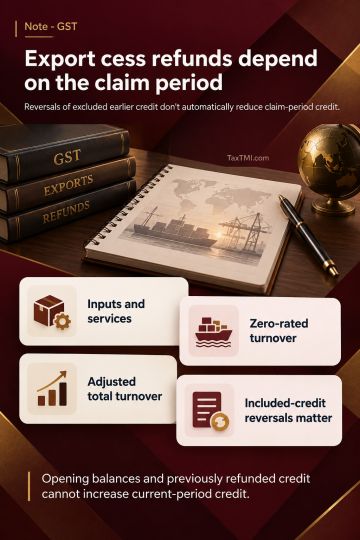
Compensation cess refunds on exports depend on period-specific credit attribution, not automatic deductions for unrelated earlier-period reversals.
Under Rule 89(4), the refund formula applies Net ITC to zero-rated turnover and adjusted total turnover. Period-specific Net ITC depends on credit availed on inputs and input services during the period for which the claim is filed. A reversal reported during that period does not automatically reduce Net ITC if it relates to residual earlier-period credit excluded from the current computation. Reversals affecting credit included in the computation remain relevant, and opening balances or previously refunded credit cannot be added to current-period Net ITC.
Case Laws GST
Show AI Summary
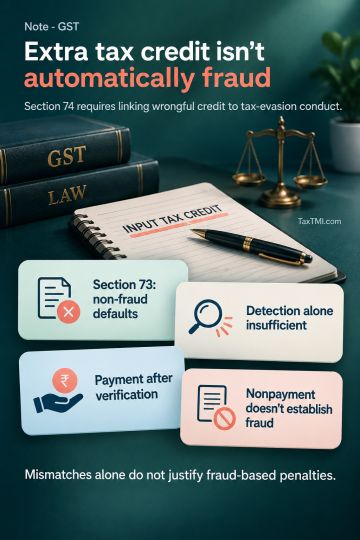
Input tax credit mismatches alone do not justify fraud-based penalties, even when excess credit is paid after verification.
Section 74 requires a factual connection between the wrongful credit and fraud, wilful misstatement or suppression of facts to evade tax; a mismatch or eligibility failure alone does not establish that connection. Section 73 covers defaults without those elements. Departmental detection, an admission of excess credit and payment after verification do not by themselves establish why the excess arose or prove the conduct necessary for Section 74. Failure to pay the pre-notice penalty cannot itself establish the fraud-related basis for Section 74.
Case Laws GST
Show AI Summary
Resort construction credit depends on immovability, own-account use, and the statutory distinction between buildings and plant and machinery.
Input tax credit on resort construction is subject to the blocked-credit restriction for goods and services received to construct immovable property on a taxable person's own account, including property used in the course or furtherance of business. The general business-use entitlement under section 16 does not displace this restriction in section 17(5)(d). The Finance Act, 2025 retrospectively substituted plant and machinery for "plant or machinery" from 1 July 2017, with the relevant provision commencing on 1 October 2025. The defined expression covers apparatus, equipment and machinery fixed to the earth by foundation or structural support and used for making outward supplies, including those foundations and supports. It excludes land, buildings and other civil structures, telecommunication towers and pipelines laid outside factory premises.
Case Laws IBC
Show AI Summary
Shareholder standing in insolvency appeals depends on legal capacity, not merely allegations of fraudulent changes to creditor-approved plans.
Individual shareholder standing to appeal against approval of a resolution plan is distinct from the legality of the plan itself. Under Section 61(1) of the Insolvency and Bankruptcy Code, 2016, an appellant must qualify as a person aggrieved. The applicable judicial interpretation restricts an appeal pursued exclusively in an individual shareholder capacity, even where equity interests are affected. Section 61(3) separately specifies permissible grounds of challenge: a plan's contravention of law and material irregularity in the resolution professional's exercise of powers are distinct grounds. Pleading either ground does not itself establish standing.
Case Laws GST
Show AI Summary
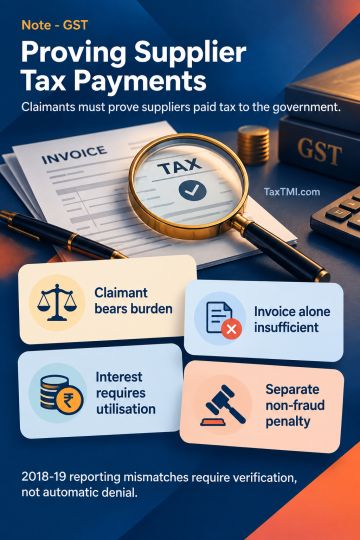
Input tax credit requires proof of supplier tax payment; reporting mismatches call for verification rather than automatic denial.
Supplier payment of tax to the Government is a condition of input tax credit eligibility under section 16(2)(c), and the claimant bears the burden of proving eligibility under section 155. Payment of the invoice and tax to the supplier, receipt of the supply and possession of an invoice do not themselves establish the supplier's remittance. For 2018-19, a GSTR-2A mismatch calls for verification and does not alone prove ineligibility. Interest under section 50(3) requires credit to have been both wrongly availed and utilised; its calculation follows Rule 88B(3). Non-fraud penalty operates under a separate statutory trigger and is not automatically excluded by the absence of fraud or utilisation.
Case Laws GST
Show AI Summary
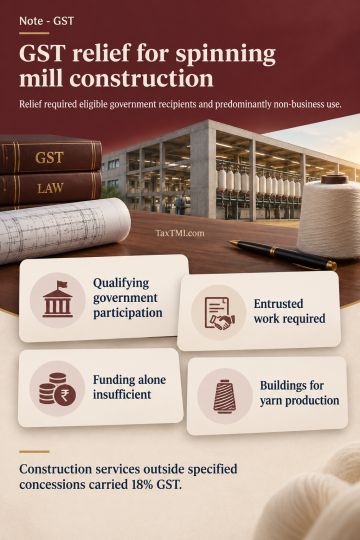
Non-business construction concessions for spinning mills require eligible recipient status and predominantly non-industrial use of the constructed buildings.
For the disputed period, the works-contract concession required both an eligible governmental recipient and structures predominantly meant for use other than commerce, industry, business or profession. Government Entity status required evidence of the recipient's constitution and qualifying governmental participation, while procurement had to relate to entrusted work. Project funding, tender approval and supervision did not by themselves establish governmental constitution or control. The spinning-mill factory buildings and allied works were intended for yarn production and related commercial activities. The residual construction-services entry carried aggregate GST of 18% for services outside the specified concessional entries.
Case Laws Customs
Show AI Summary
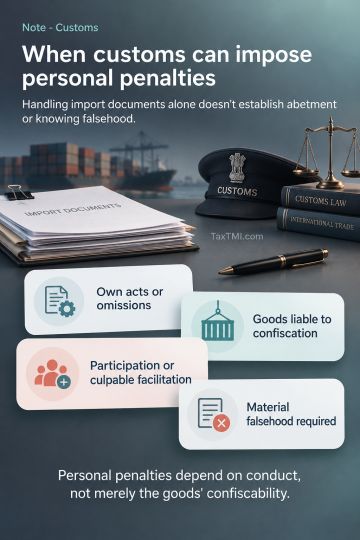
Import document handling alone does not establish customs abetment or knowing use of materially false declarations.
Personal customs penalties depend on the person's own conduct, not merely on the confiscability of imported goods. Under Section 112(a) of the Customs Act, 1962, liability may arise from a person's own act or omission rendering goods liable to confiscation or from abetment of such conduct. The direct limb can operate on a strict-liability basis where a person's own act or omission renders goods confiscable; an allegation of abetment instead requires evidence of participation or culpable facilitation. Section 114AA requires knowing or intentional making, signing or use, or causing the making, signing or use, of a declaration, statement or document that is materially false or incorrect in customs business.
Case Laws GST
Show AI Summary
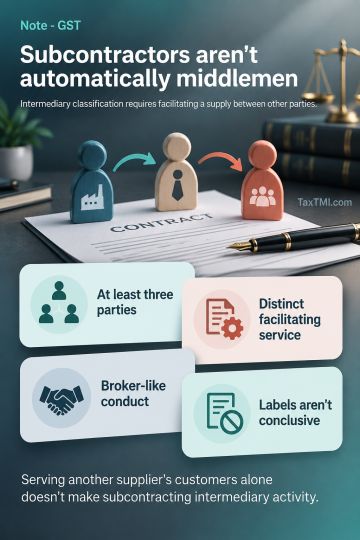
Subcontracted services performed on own account are not intermediary services merely because they support overseas recruitment and customer-facing activities.
Intermediary classification under Section 2(13) of the IGST Act distinguishes arranging or facilitating supplies between other persons from supplying services on one's own account. The intermediary framework requires at least three parties, a main supply and a distinct ancillary facilitating supply, with conduct resembling that of a broker or agent. Subcontracting the whole or part of a service is not intermediary activity merely because performance supports another supplier's business or involves its customers. Neither a bilateral agreement, contractual label nor remuneration method is conclusive.
Case Laws Customs
Show AI Summary
Split air conditioner classification requires capacity and refrigeration features to be assessed against the applicable tariff hierarchy.
Classification of ductless split air conditioners depends on the complete tariff description and the machine's technical characteristics. A complete, cooling-only, two-ton split air conditioner incorporating a refrigerating unit and lacking a heat-reversal valve falls within tariff item 8415 82 10 rather than the general split-system item 8415 10 10. Item 8415 82 10 inherits its parent subheading's refrigerating-unit requirement, while item 8415 83 10 requires the absence of such a unit. Capacity alone does not establish the applicable refrigeration-based entry. Technical evidence should establish whether the goods are a complete machine and identify their capacity and operating features.
Case Laws Income Tax
Show AI Summary
Convertible debenture interest requires evidence-based pricing before conversion; future equity conversion alone cannot establish a nil arm's length price.
Pre-conversion interest on compulsorily convertible debentures (CCDs) issued to a non-resident associated enterprise requires arm's length pricing. Compulsory future conversion and hybrid classification do not, by themselves, establish a nil price or extinguish an existing coupon obligation. Rule 10AB's Other Method requires a price charged, paid or expected in comparable uncontrolled circumstances, with reasonably accurate adjustments for material differences under Rule 10B. Currency, benchmark date, tenure, credit risk, security, non-redemption and conversion benefits affect comparability; a conventional bank lending rate is not automatically comparable to a long-tenor CCD.
Case Laws Customs
Show AI Summary
Split motorcycle consignments require evidence of deliberate fragmentation for composite classification, with valuation assessed independently of classification.
Clubbing of split consignments for customs classification depends on proof that apparently separate imports form one deliberately fragmented transaction, not merely on the possibility of assembly. Rule 2(a) extends a tariff heading to an incomplete article possessing the essential character of the complete article and also covers a complete article presented disassembled. A change of tariff heading alone does not establish that the transaction value is inaccurate; substantive misdescription of the goods requires separate evidentiary consideration. Replacement value must follow the prescribed sequence of methods.
Case Laws GST
Show AI Summary
Corporate guarantee taxation depends on distinguishing taxable supply from valuation, particularly for unpaid support between related businesses.
GST on corporate guarantees requires separate consideration of whether a taxable supply exists and how that supply is valued. Section 7(1)(c) and Schedule I encompass qualifying supplies between related or distinct persons without consideration when made in the course or furtherance of business. Rule 28(2) deems the value of a guarantee furnished to a banking company or financial institution for a related recipient in India to be one per cent of the guaranteed amount per annum or actual consideration, whichever is higher. Where the recipient is eligible for full input tax credit, the proviso treats the value declared in the invoice as the value of the supply.
Case Laws Income Tax
Show AI Summary
Employee secondment taxation depends on employment rights, service consideration and demonstrable transfer of technical capability to host entities.
Local operational control and a stated suspension of foreign employment do not, by themselves, resolve whether underlying foreign employment rights survive. Under Article 12(4)(b) of the India-USA DTAA, technical or consultancy services must make technical knowledge, experience, skill, know-how or processes available, or involve development and transfer of a technical plan or design. Under the knowledge-transfer limb, the recipient must acquire a capability it can use independently; the mere application of expertise or presence of qualified personnel is insufficient. Recovery at actual cost and absence of markup do not, by themselves, establish that a foreign enterprise's receipt is non-taxable.
Case Laws GST
Show AI Summary
GST appellate pre-deposits may be satisfied by verified earlier payments after demand reduction, but filing fees remain independently payable.
When the first appellate authority substantially reduces the disputed tax demand, an earlier deposit may be sufficient to satisfy the Tribunal-stage requirement, subject to verification. Sufficiency depends on the reduced liability, the applicable appellate requirements and the amount actually deposited; a first appellate payment does not automatically eliminate the additional obligation. Tribunal filing fees under Section 112(7) operate independently of pre-deposit. Where a fee shortfall and earlier deposit require verification, proof of fee payment and verification of the deposit precede consideration of admission.
Case Laws Income Tax
Show AI Summary
Inter-co-operative society interest exemption preserves non-deduction by co-operative banks when depositors are co-operative societies under the statutory withholding framework.
Section 194A(3)(v) separately addresses interest paid by a co-operative bank to a member and interest paid by a co-operative society to another co-operative society. The exclusion of co-operative banks is confined to the member-payment limb; a co-operative bank remains a co-operative society for the inter-co-operative society limb. Paragraph 42.7 of Circular No. 19/2015 preserves non-deduction, including time-deposit interest, where the depositor is a co-operative society. Section 80P does not determine this withholding obligation.
Case Laws GST
Show AI Summary
Input tax credit reversal requires evidence linking supplier non-payment to recipient ineligibility and a reasoned statutory inquiry.
Input tax credit under Section 16(2)(c) remains conditional on actual payment of tax to Government, but supplier non-payment or retrospective cancellation cannot by itself justify reversal. The recipient must establish eligibility through transactional evidence, while the proper officer must investigate the particular supply, disclose supplier-default and recovery material, apply the law applicable to the relevant period, and issue a reasoned, notice-bound determination. Supplier recovery status and protection against duplicate collection are material considerations.
Case Laws Customs
Show AI Summary
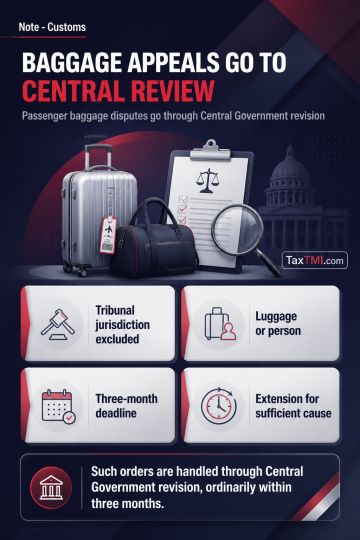
Baggage-related customs appeals proceed through statutory revision when the jurisdictional exclusion applies to passenger imports.
The first proviso to section 129A(1) excludes Appellate Tribunal jurisdiction over an order under section 128A relating to goods imported or exported as baggage. The decisive issue is the order's connection with baggage, not disputes concerning confiscation, declaration, duty, personal effects, concealment, concession, or penalty. Articles carried by an international passenger in luggage or on the person may constitute baggage. Section 129DD provides revision before the Central Government, ordinarily within three months, subject to a further period on sufficient cause.

TMI Notes

Back

All TMI Notes

Showing Results for :
Reset Filters
No Records Found

TMI Notes

Back

All TMI Notes

Central Excise

Dead Credits and Transitional Limits: CESTAT Larger Bench on Refund of Education and Krishi Kalyan Cess under GST

26 November, 2025

Contents
Circulars
Forms
Acts
Rules & Regulations
Plus +
Summary
Note

Note

-

Bookmark

(New) -

Download

Print

Print

Deciphering Legal Judgments: A Comprehensive Analysis of Judgment

Reported as:

2025 (11) TMI 1641 - CESTAT NEW DELHI- (LB)

Introduction

The Larger Bench of the CESTAT, New Delhi was constituted to resolve a significant conflict of views within the Tribunal regarding the fate of accumulated balances of Education Cess (EC), Secondary & Higher Education Cess (SHEC) and Krishi Kalyan Cess (KKC) at the time of transition to the Goods and Services Tax (GST) regime. The controversy lay at the intersection of the Central Excise / Service Tax regime and the transitional and saving provisions of the Central Goods and Services Tax Act, 2017 (CGST Act), specifically Sections 140 and 142.

The reference arose because two Division Benches of the Tribunal had taken irreconcilable positions: one (Nu Vista) allowing cash refund of such unutilised cesses u/s 142(3) of the CGST Act, and another (NMDC) denying such refund and treating the credits as lapsed. The Larger Bench was also required to consider whether refund claims filed post-GST could escape limitation u/s 11B of the Central Excise Act, 1944 by invoking the transitional provisions of the CGST Act.

This decision is of wider importance in the indirect tax jurisprudence because it clarifies:

  • whether EC/SHEC/KKC balances as on 30.06.2017 constitute a "vested" or "indefeasible" right capable of refund in cash;
  • the scope of "eligible duties and taxes" u/s 140 CGST Act and its Explanations; and
  • the reach of Section 142(3) CGST Act and its interaction with the general refund provisions of Section 11B of the Central Excise Act.

Key Legal Issues

Issue 1: Refundability of unutilised cesses post-GST

The primary issue was whether, after abolition of EC/SHEC/KKC in 2015 and non-permissibility of their transition u/s 140 CGST Act in 2017, the closing credit balances of these cesses as on 30.06.2017 could nonetheless be refunded in cash u/s 142(3) of the CGST Act read with Section 11B of the Central Excise Act.

This is essentially a question of statutory interpretation and reconciliation of multiple regimes: the CENVAT Credit Rules, 2004 (CCR), the Finance Acts imposing the cesses, Section 11B of the Central Excise Act, and Sections 140 and 142 of the CGST Act.

Issue 2: Limitation for refund claims filed after GST

The second issue was whether a refund claim filed in 2021 for cess balances that effectively became unusable in 2015 was barred by limitation, or whether Section 142(3) (and Section 142(9)(b)) CGST Act displaced or overrode the time limit prescribed in Section 11B of the Central Excise Act.

This is a combined question of interpretation of the saving/transitional provisions and of the temporal reach of the pre-GST refund regime.

Detailed Issue-wise Analysis

1. Nature of EC/SHEC/KKC credits and the "vested right" argument

The appellants and intervenors advanced the familiar "indefeasible right" theory rooted in Eicher Motors Ltd. v. Union of India and its progeny. The submissions emphasised that:

  • CENVAT/Modvat credit validly availed is a substantive vested right, often characterised as a "property right", which cannot be taken away save by clear statutory language providing for lapsing;
  • the abolition of EC/SHEC/KKC in 2015 did not contain an express lapsing provision akin to certain situations u/r 11(3)(ii) of the CCR; and
  • therefore, in the absence of a specific lapsing clause, the balances survived and Section 142(3) CGST Act compelled the authorities to refund any "amount eventually accruing" in cash.

Reliance was also placed on Slovak India Trading Co. (Karnataka High Court, affirmed in limine by the Supreme Court) and subsequent CESTAT decisions treating unutilised CENVAT credit as refundable where further utilisation was impossible (e.g. on closure of unit), as well as post-GST Tribunal decisions (Nu Vista, BHEL, Toyota Kirloskar, Tata Steel BSL) extending the "vested right" logic to transition-related refunds.

The Larger Bench, however, subjected this line of authority to close scrutiny in light of later and higher judicial pronouncements:

  • Cellular Operators Association of India (Delhi High Court) had already distinguished Eicher Motors and rejected the plea that EC/SHEC credit constituted a vested right that could be re-purposed (via cross-utilisation) once the cess levy was abolished.
  • Gauri Plasticulture (Full Bench, Bombay High Court) had effectively neutralised Slovak India by holding that cash refund of unutilised CENVAT credit was not permissible absent express statutory mandate, and clarified that the Supreme Court's order in Slovak India did not lay down law under Article 141 but rested on a concession.
  • Assistant Commissioner v. Sutherland Global Services Pvt. Ltd. (Division Bench, Madras High Court) and Muthoot Finance Ltd. v. Union of India (Kerala High Court) had specifically treated EC/SHEC/KKC as "dead CENVAT credit" on the dates of abolition, rejecting arguments of vested rights or transitional carry-forward.

In this doctrinal context, the Larger Bench concluded that the "indefeasible right" jurisprudence from Eicher and Samtel was inapposite: those cases dealt with lapsing of credit while the underlying levy survived, and were decided on the competence of delegated legislation (Rule 57F(4A)), whereas the present situation involved statutorily extinguished levies (cesses) with strictly ring-fenced utilisation (cess-to-cess) and no enabling provision for post-abolition refund.

2. Pre-GST legal position: utilisation, refund and lapse of cesses

The Bench carefully reconstructed the pre-GST statutory matrix:

  • EC and SHEC on goods and services were abolished/exempted in 2015; KKC was similarly discontinued thereafter. Rule 3(7) CCR and its provisos confined utilisation of these credits strictly to payment of the same cess; cross-utilisation with basic excise duty or service tax was generally prohibited.
  • Once EC and SHEC ceased to be leviable (for goods from 01.03.2015, for services from 01.06.2015), any remaining credit could not be applied to any future output liability-the utilisation channel was permanently blocked.

Two High Court decisions squarely addressed the consequences:

  1. Cellular Operators Association of India (Delhi High Court): Refused to permit cross-utilisation of accumulated EC/SHEC credits toward excise duty or service tax, rejecting the contention that withdrawal of cess and its alleged "subsuming" into higher excise/service tax rates conferred a vested right to use the credits differently. The Court distinguished Eicher and held that once the cess levy ceased, there was no right to convert its credit into general excise/service tax credit.
  2. Banswara Syntex Ltd. (Rajasthan High Court): Rejected a refund claim u/s 11B of Central Excise Act for unutilised EC/SHEC credit, holding that neither the Act nor the CCR envisaged cash refund of such balances absent wrongful or erroneous payment of duty.

On the strength of these authorities, the Larger Bench held that even prior to 01.07.2017 there was:

  • no statutory basis to merge cess credits with regular CENVAT or to seek their cash refund; and
  • judicial recognition that such balances, once utilisation became impossible, had effectively lapsed.

Accordingly, the Bench rejected the notion that a "vested right" in cess credits survived up to the appointed day of GST.

3. Eligibility of cesses for transition u/s 140 CGST Act

On facts, the appellant had initially included the cess balances in the figure of "CENVAT credit" in columns 5 and 6 of TRAN-1, and only reversed them pursuant to audit objection and Board instructions. The question arose: were EC/SHEC/KKC even legally eligible for transition u/s 140(1)?

The Bench analysed:

  • the ER-1 return structure, in which "CENVAT credit" sensu stricto appears in columns identified for duty of excise and service tax, whereas EC/SHEC/KKC appear in distinct columns; and
  • Section 140(1) CGST Act read with Explanations 1 and 2, which provide an exhaustive, positive list of "eligible duties" and "eligible duties and taxes", notably excluding all cesses; and
  • two key CBIC circulars (No. 267/80/2018-CX8 and No. 87/06/2019-GST) that operationalised this structure and directed field formations not to allow transition of EC/SHEC/KKC.

The Bench rejected the argument that absence of notification bringing certain amendments into force (particularly the 2018 amendment linking Explanation 1 to Section 140(1)) entitled assessees to treat cesses as "eligible duties". It held that even without Explanation 3, the combined effect of Explanations 1 and 2-being inclusively exhaustive-necessarily excluded cesses from transition. Furthermore, the proviso to Section 140(1), denying credit where the amount is not "admissible as input tax credit under this Act", precluded transition of cesses because no analogous levy existed under GST to which such credits could be applied.

Thus, the Bench concluded that ab initio there was no statutory right to transition cess credits u/s 140(1). The taxpayer's initial inclusion of cesses in TRAN-1 was contrary to law, properly reversed, and could not form the foundation of any subsequent restitutionary claim.

4. Scope of Section 142(3) CGST Act and interaction with Section 11B

The appellants relied heavily on the phrase in Section 142(3) that "any amount eventually accruing shall be paid in cash, notwithstanding anything to the contrary contained under the provisions of existing law other than the provisions of sub-section (2) of section 11B...". They argued that:

  • Section 142(3), being a transitional non obstante provision, overrides the limitation in Section 11B(1) and the scheme of Rule 5 CCR;
  • refund of pre-GST CENVAT credit balances requires no specific time limit u/s 142(3); and
  • decisions such as Combitic Global Caplet and certain CESTAT orders (Toyota Kirloskar, Tata Steel BSL) support the view that Section 142(3) creates a special right to cash refund of any residual CENVAT credit.

The Larger Bench, aligning with NMDC and several High Court rulings, rejected this expansive reading. Its analysis of Section 142(3) stressed that:

  • refund applications are to be "disposed of in accordance with the provisions of existing law"; this necessarily imports the procedural and substantive conditions of Section 11B (including limitation and the requirement that the claim be one for "duty of excise" erroneously paid or refundable under existing law);
  • the non obstante clause in Section 142(3) operates only to alter the mode of grant (payment in cash rather than re-credit) where a refund is otherwise found due under existing law, not to create a new substantive entitlement or override conditions precedent to refund; and
  • the second proviso to Section 142(3) expressly denies refund of any CENVAT credit that has been carried forward as transitional credit, reinforcing that Section 142(3) does not function as an alternative route to monetise credits which the statute does not recognise as refundable.

The Bench distinguished Combitic Global Caplet on facts: there, the issue concerned the form of refund (cash versus re-credit) of rebate already determined refundable in respect of pre-GST exports. That case did not involve unutilised cess balances which were never statutorily refundable under the existing law, nor did it address the cellular/Banswara/Sutherland line of authorities.

5. Limitation for refund claims filed post-GST

On limitation, the Bench treated the crucial dates as those when the cesses became unusable:

  • for EC/SHEC on goods: 01.03.2015;
  • for EC/SHEC on services: 01.06.2015.

If a legally sustainable claim for refund had existed u/s 11B, the one-year period would run from those dates. The fact that some assessees (such as in Banswara Syntex) did attempt such claims, and had them rejected on merits, reinforced that the operative window closed in 2016.

In the present case, the assessee did not invoke Section 11B pre-GST; instead, it carried forward the balances, attempted transition via TRAN-1 in 2017, reversed them on audit objection, and eventually filed a refund claim in October 2021-well beyond any conceivable limitation period u/s 11B. The Bench held that taxpayers could not bypass the pre-existing time bar by invoking Section 142(3) years later. Having chosen not to pursue the "normal avenue" within the then-prevailing framework, assessees could not resuscitate dead claims through the transitional provisions of a new regime.

Key Holdings and Reasoning

Ratio decidendi

The operative principles crystallised by the Larger Bench may be summarised as follows:

  1. Unutilised balances of EC, SHEC and KKC, whose utilisation was statutorily restricted to payment of the same cesses and whose levies were abolished in 2015, became "dead CENVAT credits" upon such abolition. There was no statutory right, either under the Central Excise Act or the CCR, to (a) convert them into general excise/service tax credit, or (b) obtain cash refund u/s 11B.
  2. Section 140 CGST Act and its Explanations 1 and 2 create an exhaustive list of "eligible duties and taxes" for transitional credit. Cesses are excluded. Even independently of Explanation 3, there is no legal entitlement to transition EC/SHEC/KKC u/s 140(1), and the proviso to Section 140(1) bars transition of credits not admissible as input tax credit under the CGST Act.
  3. Section 142(3) CGST Act does not create a new substantive right to refund of unutilised CENVAT credit; it merely prescribes that where a refund is otherwise due under "existing law" (including compliance with Section 11B), such amount is to be paid in cash instead of re-credit. It does not override the limitation or the structural constraints of Section 11B and CCR Rule 5, nor does it revive lapsed claims or convert non-refundable amounts into refundable ones.
  4. Accordingly, refund of blocked EC/SHEC/KKC balances u/s 142(3) CGST Act is not permissible. Earlier CESTAT decisions allowing such refund by relying on Slovak India or the "vested right" logic of Eicher are inconsistent with later High Court authorities and cannot be followed.
  5. Even assuming arguendo that any refund right could be conceived, refund claims filed in 2021 in respect of credits that became unusable in 2015 are hopelessly time-barred u/s 11B; Section 142(3) cannot be used to circumvent this limitation.

Obiter aspects

Certain broader observations, though not strictly necessary to dispose of the appeals, have significant persuasive value:

  • The Bench's endorsement of Sutherland, Muthoot, Cellular Operators, Banswara Syntex and the Full Bench ruling in Gauri Plasticulture effectively establishes a coherent High Court consensus against treating unutilised cess credits as either transitional or refundable. This substantially narrows the practical scope of the "indefeasible right" doctrine in the context of cesses and transition.
  • The Bench's analysis of TRAN-1, ER-1 and Board circulars underscores that administrative instructions consistently treated cesses as non-transitionable. Though circulars cannot override statute, their congruence with the statutory scheme bolsters the conclusion that taxpayers could not legitimately expect to monetise such credits.

Conclusion

The Larger Bench has definitively aligned the Tribunal's jurisprudence with the emerging High Court consensus on transitional treatment of EC/SHEC/KKC. It has rejected attempts to stretch the doctrines of vested CENVAT credit and Section 142(3) CGST Act beyond their statutory contours, and has reaffirmed the centrality of Section 11B and the CCR framework in determining the destiny of pre-GST credits.

Practically, the ruling:

  • closes the door on cash refunds of unutilised cess credits lying as on 30.06.2017;
  • confirms that such credits effectively lapsed on abolition of the cesses in 2015, and cannot be resurrected via GST transitional provisions; and
  • signals that transitional and saving clauses in the CGST Act cannot be used to undo conscious legislative choices not to provide either cross-utilisation or refund of specific levies.

For the future, this decision is likely to minimize litigation on similar refund claims and reinforce a more restrained view of "indefeasible" CENVAT rights in contexts where the foundational levy has itself been withdrawn without an express refund or carry-forward mechanism. Unless there is legislative intervention to grant ex gratia relief-which appears unlikely given the temporal distance and consistent judicial approach-the fate of pre-GST cess balances is now largely sealed.


Full Text:

2025 (11) TMI 1641 - CESTAT NEW DELHI- (LB)

Topics

Acts Income Tax