Loading...

⚠ ✕
❮ Top
☎ Help
☰
×

By creating an account you can:

Logo TaxTMI
Call Us / Help / Feedback✕

Contact Us At :

✉ E-mail: [email protected]

✆ To Call / Whatsapp, Check Contact Us

FAQs :

To know Frequently Asked Questions, Check FAQs

Most Asked Video Tutorials :

For more tutorials, Check Video Tutorials

Submit Feedback/Suggestion :

Email :
Please provide your email address so we can follow up on your feedback.
Category :
Description :
Min 15 characters 0/2000
Make Most of Text Search ✕
  1. Checkout this video tutorial: How to search effectively on TaxTMI.
  2. Put words in double quotes for exact word search, eg: "income tax"
  3. Avoid noise words such as : 'and, of, the, a'
  4. Sort by Relevance to get the most relevant document.
  5. Press Enter to add multiple terms/multiple phrases, and then click on Search to Search.
  6. Text Search
  7. The system will try to fetch results that contains ALL your words.
  8. Once you add keywords, you'll see a new 'Search In' filter that makes your results even more precise.
  9. Text Search
╳
Add to...
You have not created any category. Kindly create one to bookmark this item!
✕
Create New Category
Hide
Title :
Description :
❮❮ Hide
❮ Default View
Expand ❯❯
Close ✕
🔎 Filters / Advanced Search ❯
TEXT

Press 'Enter' to add multiple search terms. Rules for Better Search

Search In
Main Text + AI Text ❯
  • Main Text
  • Main Text + AI Text
  • AI Text
Law:
---- All Laws---- ❯
  • ---- All Laws----
  • Benami Property
  • Bill
  • Central Excise
  • Companies Law
  • Customs
  • DGFT
  • FEMA
  • GST
  • GST - States
  • IBC
  • Income Tax
  • Indian Laws
  • Money Laundering
  • SEBI
  • SEZ
  • Service Tax
  • VAT / Sales Tax
Types:
---- All Types ---- ❯
  • ---- All Types ----
  • Act Rules
  • Case Laws
  • Circulars
  • Manuals
  • News
  • Notifications
Sort By: ?
In Sort By 'Default', exact matches for text search are shown at the top, followed by the remaining results in their regular order.
Relevance Default Date
☰   Show Results ❯
    Export of Principal-to-Principal Support and Software Development Services under the IGST Act
    Refund of Unutilised Input Tax Credit by SEZ Units under Section 54 and Rule 89
    Case Laws Customs
    Private Bonded Warehouse Licence: Penalty-Based Disqualification under Regulation 3(2)(c)
    Refund of Accumulated Compensation Cess on Zero-Rated Supplies under Section 54 and Rule 89
    Penalty for Wrongful Availment of Input Tax Credit: The Distinction Between Sections 73 and 74
    Input Tax Credit on Resort Construction After Retrospective Substitution in Section 17(5)(d): Except...
    Shareholder Locus Standi under Section 61 in Challenges to Resolution-Plan Approval
    GSTR-2A Mismatch, Supplier Certification (of tax payment) and the Burden of Proving Input Tax Credit...
    Concessional GST on Works Contracts for Co-operative Spinning Mills: Government Entity Status and Pr...
    Case Laws Customs
    Abetment and Knowing Use of False Import Documents under Sections 112(a) and 114AA
    Subcontracted Services on Own Account and the Intermediary Exclusion under Section 2(13)
    Case Laws Customs
    Classification of Two-Ton Ductless Split Air Conditioners under Tariff Item 8415 82 10
    Case Laws Income Tax
    Transfer Pricing of Pre-Conversion Interest on Compulsorily Convertible Debentures
    Case Laws Customs
    Clubbing of Contrived Split Consignments under Rule 2(a) and Valuation of a Dismantled Motorcycle
    GST on Corporate Guarantees: Substantive Liability, Deemed Valuation and Judicial Relief
    Case Laws Income Tax
    Employee Secondment under the India-USA DTAA: Employment Rights, Reimbursements and Included Service...
    Pre-deposit Under Section 112 and Independent Compliance with Tribunal Filing Fees
    Case Laws Income Tax
    TDS on Interest Paid by Co-operative Banks to Non-Member Co-operative Societies under Section 194A(3...
    Input Tax Credit and Supplier Non-Payment: Statutory Limits on Mechanical Reversal Under Section 16(...
    Case Laws Customs
    Appellate Jurisdiction over Goods Imported as Baggage under Sections 129A and 129DD of the Customs A...
❮
❯
❯❯
Maximize Maximize Maximize
0 / 200
Expand Note
Add to Folder

No Folders have been created

+

Are you sure you want to delete "My most important" ?

NOTE:

Notes
Showing Results for :
Reset Filters
Results Found:
Show All Summaries Hide All Summaries
Case Laws GST
Show AI Summary
Principal-to-principal software development and support services may qualify as exports when supplied on own account and statutory conditions are satisfied.
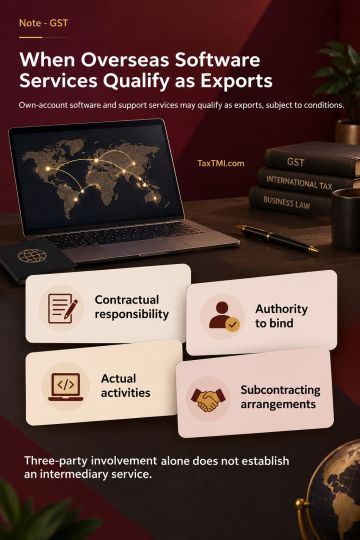
Principal-to-principal software development and business support for overseas group entities are distinguished from intermediary services by examining the supply actually undertaken. Intermediation requires a separate service of arranging or facilitating a main supply between two other persons; the presence of three parties or benefits to end customers is insufficient. Development, sourcing assistance and call-centre or product support may be own-account services when the supplier is responsible for performing the work rather than arranging another person's supply. Contractual responsibility, authority to bind the overseas entity, actual activities and subcontracting arrangements are relevant. Cost-plus payment and an independent-contractor label are indicators, not conclusive tests; neither third-party contact nor group ownership alone determines classification.
Case Laws GST
Show AI Summary
SEZ refund eligibility extends to unutilised input tax credit despite supplier-specific procedures, subject to statutory conditions and verification.
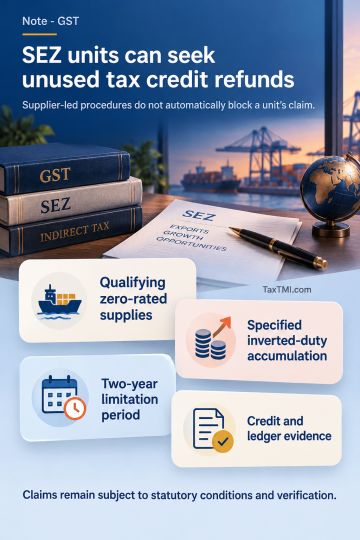
SEZ units are not categorically excluded from claiming refunds of unutilised input tax credit merely because Rule 89 prescribes a supplier-led procedure for supplies to SEZs. That procedure governs the supplier's claim for the relevant inward supply; it does not exclude a unit's own claim under the statutory refund framework. Section 54 of the CGST Act permits registered persons to claim refunds of unutilised credit subject to substantive conditions, including those governing zero-rated supplies made without payment of tax and specified inverted-duty accumulation. Refund applications must identify the applicable statutory basis, relevant date and two-year limitation period, and support the claim with evidence of qualifying supplies, credit sources, ledger balances and computation.
Case Laws Customs
Show AI Summary
Warehouse licensing disqualification requires more than a prior customs monetary penalty and depends on offence-based eligibility criteria.
Penalisation for an offence under Regulation 3(2)(c) is not established merely by the existence of a customs monetary penalty. The legal basis and character of the earlier proceedings must be examined against the distinction between adjudicatory penalties and the offences-and-prosecutions framework. The absence of conviction alone does not resolve every disqualification ground. Antecedent verification follows a centralised process, while a favourable eligibility assessment must be followed by the insurance, undertaking, indemnity and warehouse-keeper requirements under Regulation 4.
Case Laws GST
Show AI Summary
Compensation cess refunds on exports depend on period-specific credit attribution, not automatic deductions for unrelated earlier-period reversals.
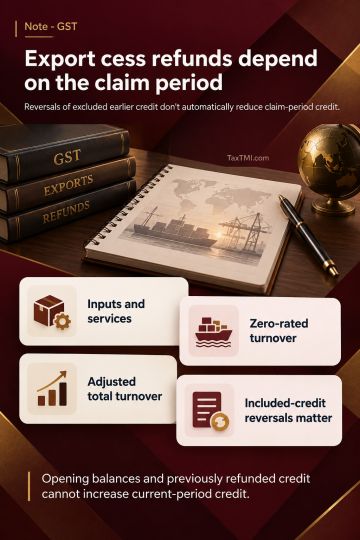
Under Rule 89(4), the refund formula applies Net ITC to zero-rated turnover and adjusted total turnover. Period-specific Net ITC depends on credit availed on inputs and input services during the period for which the claim is filed. A reversal reported during that period does not automatically reduce Net ITC if it relates to residual earlier-period credit excluded from the current computation. Reversals affecting credit included in the computation remain relevant, and opening balances or previously refunded credit cannot be added to current-period Net ITC.
Case Laws GST
Show AI Summary
Input tax credit mismatches alone do not justify fraud-based penalties, even when excess credit is paid after verification.
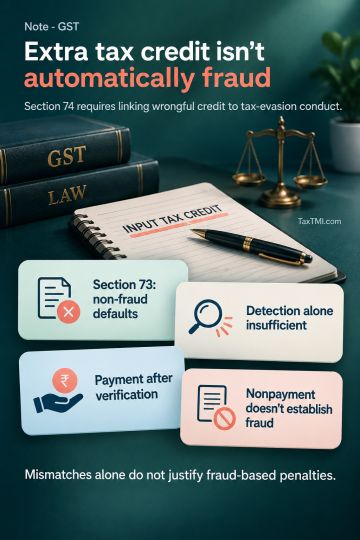
Section 74 requires a factual connection between the wrongful credit and fraud, wilful misstatement or suppression of facts to evade tax; a mismatch or eligibility failure alone does not establish that connection. Section 73 covers defaults without those elements. Departmental detection, an admission of excess credit and payment after verification do not by themselves establish why the excess arose or prove the conduct necessary for Section 74. Failure to pay the pre-notice penalty cannot itself establish the fraud-related basis for Section 74.
Case Laws GST
Show AI Summary
Resort construction credit depends on immovability, own-account use, and the statutory distinction between buildings and plant and machinery.
Input tax credit on resort construction is subject to the blocked-credit restriction for goods and services received to construct immovable property on a taxable person's own account, including property used in the course or furtherance of business. The general business-use entitlement under section 16 does not displace this restriction in section 17(5)(d). The Finance Act, 2025 retrospectively substituted plant and machinery for "plant or machinery" from 1 July 2017, with the relevant provision commencing on 1 October 2025. The defined expression covers apparatus, equipment and machinery fixed to the earth by foundation or structural support and used for making outward supplies, including those foundations and supports. It excludes land, buildings and other civil structures, telecommunication towers and pipelines laid outside factory premises.
Case Laws IBC
Show AI Summary
Shareholder standing in insolvency appeals depends on legal capacity, not merely allegations of fraudulent changes to creditor-approved plans.
Individual shareholder standing to appeal against approval of a resolution plan is distinct from the legality of the plan itself. Under Section 61(1) of the Insolvency and Bankruptcy Code, 2016, an appellant must qualify as a person aggrieved. The applicable judicial interpretation restricts an appeal pursued exclusively in an individual shareholder capacity, even where equity interests are affected. Section 61(3) separately specifies permissible grounds of challenge: a plan's contravention of law and material irregularity in the resolution professional's exercise of powers are distinct grounds. Pleading either ground does not itself establish standing.
Case Laws GST
Show AI Summary
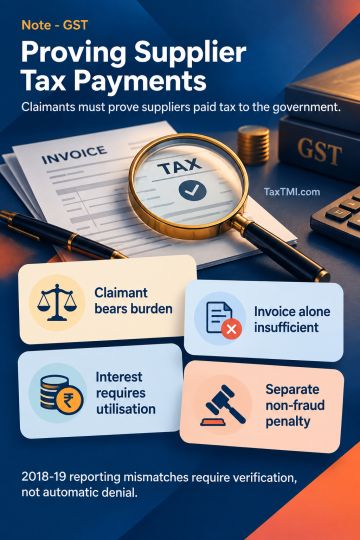
Input tax credit requires proof of supplier tax payment; reporting mismatches call for verification rather than automatic denial.
Supplier payment of tax to the Government is a condition of input tax credit eligibility under section 16(2)(c), and the claimant bears the burden of proving eligibility under section 155. Payment of the invoice and tax to the supplier, receipt of the supply and possession of an invoice do not themselves establish the supplier's remittance. For 2018-19, a GSTR-2A mismatch calls for verification and does not alone prove ineligibility. Interest under section 50(3) requires credit to have been both wrongly availed and utilised; its calculation follows Rule 88B(3). Non-fraud penalty operates under a separate statutory trigger and is not automatically excluded by the absence of fraud or utilisation.
Case Laws GST
Show AI Summary
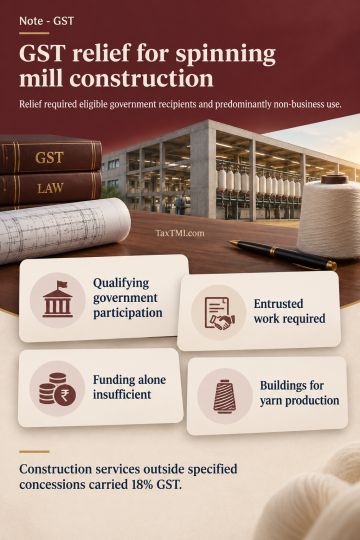
Non-business construction concessions for spinning mills require eligible recipient status and predominantly non-industrial use of the constructed buildings.
For the disputed period, the works-contract concession required both an eligible governmental recipient and structures predominantly meant for use other than commerce, industry, business or profession. Government Entity status required evidence of the recipient's constitution and qualifying governmental participation, while procurement had to relate to entrusted work. Project funding, tender approval and supervision did not by themselves establish governmental constitution or control. The spinning-mill factory buildings and allied works were intended for yarn production and related commercial activities. The residual construction-services entry carried aggregate GST of 18% for services outside the specified concessional entries.
Case Laws Customs
Show AI Summary
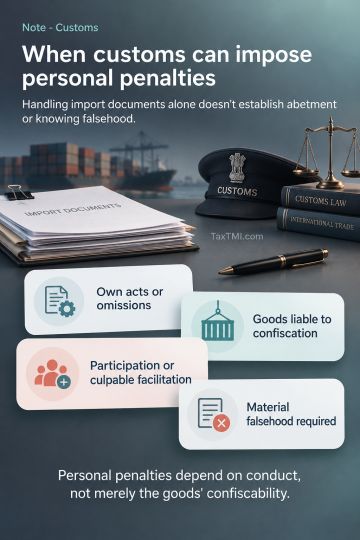
Import document handling alone does not establish customs abetment or knowing use of materially false declarations.
Personal customs penalties depend on the person's own conduct, not merely on the confiscability of imported goods. Under Section 112(a) of the Customs Act, 1962, liability may arise from a person's own act or omission rendering goods liable to confiscation or from abetment of such conduct. The direct limb can operate on a strict-liability basis where a person's own act or omission renders goods confiscable; an allegation of abetment instead requires evidence of participation or culpable facilitation. Section 114AA requires knowing or intentional making, signing or use, or causing the making, signing or use, of a declaration, statement or document that is materially false or incorrect in customs business.
Case Laws GST
Show AI Summary
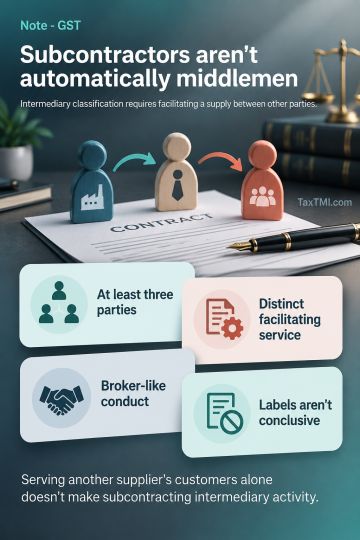
Subcontracted services performed on own account are not intermediary services merely because they support overseas recruitment and customer-facing activities.
Intermediary classification under Section 2(13) of the IGST Act distinguishes arranging or facilitating supplies between other persons from supplying services on one's own account. The intermediary framework requires at least three parties, a main supply and a distinct ancillary facilitating supply, with conduct resembling that of a broker or agent. Subcontracting the whole or part of a service is not intermediary activity merely because performance supports another supplier's business or involves its customers. Neither a bilateral agreement, contractual label nor remuneration method is conclusive.
Case Laws Customs
Show AI Summary
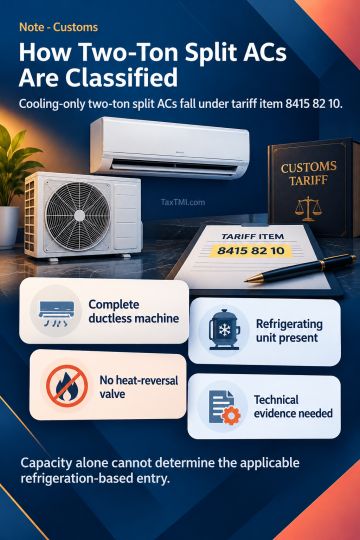
Split air conditioner classification requires capacity and refrigeration features to be assessed against the applicable tariff hierarchy.
Classification of ductless split air conditioners depends on the complete tariff description and the machine's technical characteristics. A complete, cooling-only, two-ton split air conditioner incorporating a refrigerating unit and lacking a heat-reversal valve falls within tariff item 8415 82 10 rather than the general split-system item 8415 10 10. Item 8415 82 10 inherits its parent subheading's refrigerating-unit requirement, while item 8415 83 10 requires the absence of such a unit. Capacity alone does not establish the applicable refrigeration-based entry. Technical evidence should establish whether the goods are a complete machine and identify their capacity and operating features.
Case Laws Income Tax
Show AI Summary
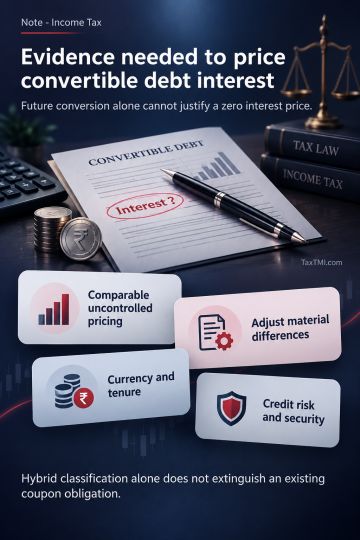
Convertible debenture interest requires evidence-based pricing before conversion; future equity conversion alone cannot establish a nil arm's length price.
Pre-conversion interest on compulsorily convertible debentures (CCDs) issued to a non-resident associated enterprise requires arm's length pricing. Compulsory future conversion and hybrid classification do not, by themselves, establish a nil price or extinguish an existing coupon obligation. Rule 10AB's Other Method requires a price charged, paid or expected in comparable uncontrolled circumstances, with reasonably accurate adjustments for material differences under Rule 10B. Currency, benchmark date, tenure, credit risk, security, non-redemption and conversion benefits affect comparability; a conventional bank lending rate is not automatically comparable to a long-tenor CCD.
Case Laws Customs
Show AI Summary
Split motorcycle consignments require evidence of deliberate fragmentation for composite classification, with valuation assessed independently of classification.
Clubbing of split consignments for customs classification depends on proof that apparently separate imports form one deliberately fragmented transaction, not merely on the possibility of assembly. Rule 2(a) extends a tariff heading to an incomplete article possessing the essential character of the complete article and also covers a complete article presented disassembled. A change of tariff heading alone does not establish that the transaction value is inaccurate; substantive misdescription of the goods requires separate evidentiary consideration. Replacement value must follow the prescribed sequence of methods.
Case Laws GST
Show AI Summary
Corporate guarantee taxation depends on distinguishing taxable supply from valuation, particularly for unpaid support between related businesses.
GST on corporate guarantees requires separate consideration of whether a taxable supply exists and how that supply is valued. Section 7(1)(c) and Schedule I encompass qualifying supplies between related or distinct persons without consideration when made in the course or furtherance of business. Rule 28(2) deems the value of a guarantee furnished to a banking company or financial institution for a related recipient in India to be one per cent of the guaranteed amount per annum or actual consideration, whichever is higher. Where the recipient is eligible for full input tax credit, the proviso treats the value declared in the invoice as the value of the supply.
Case Laws Income Tax
Show AI Summary
Employee secondment taxation depends on employment rights, service consideration and demonstrable transfer of technical capability to host entities.
Local operational control and a stated suspension of foreign employment do not, by themselves, resolve whether underlying foreign employment rights survive. Under Article 12(4)(b) of the India-USA DTAA, technical or consultancy services must make technical knowledge, experience, skill, know-how or processes available, or involve development and transfer of a technical plan or design. Under the knowledge-transfer limb, the recipient must acquire a capability it can use independently; the mere application of expertise or presence of qualified personnel is insufficient. Recovery at actual cost and absence of markup do not, by themselves, establish that a foreign enterprise's receipt is non-taxable.
Case Laws GST
Show AI Summary
GST appellate pre-deposits may be satisfied by verified earlier payments after demand reduction, but filing fees remain independently payable.
When the first appellate authority substantially reduces the disputed tax demand, an earlier deposit may be sufficient to satisfy the Tribunal-stage requirement, subject to verification. Sufficiency depends on the reduced liability, the applicable appellate requirements and the amount actually deposited; a first appellate payment does not automatically eliminate the additional obligation. Tribunal filing fees under Section 112(7) operate independently of pre-deposit. Where a fee shortfall and earlier deposit require verification, proof of fee payment and verification of the deposit precede consideration of admission.
Case Laws Income Tax
Show AI Summary
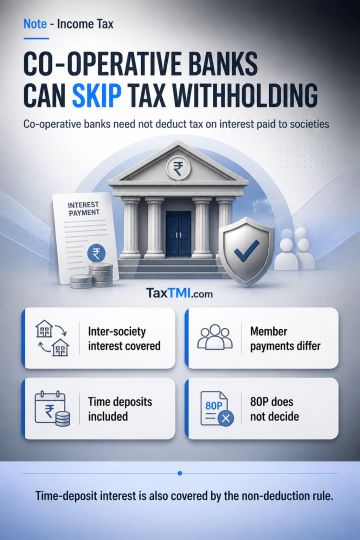
Inter-co-operative society interest exemption preserves non-deduction by co-operative banks when depositors are co-operative societies under the statutory withholding framework.
Section 194A(3)(v) separately addresses interest paid by a co-operative bank to a member and interest paid by a co-operative society to another co-operative society. The exclusion of co-operative banks is confined to the member-payment limb; a co-operative bank remains a co-operative society for the inter-co-operative society limb. Paragraph 42.7 of Circular No. 19/2015 preserves non-deduction, including time-deposit interest, where the depositor is a co-operative society. Section 80P does not determine this withholding obligation.
Case Laws GST
Show AI Summary
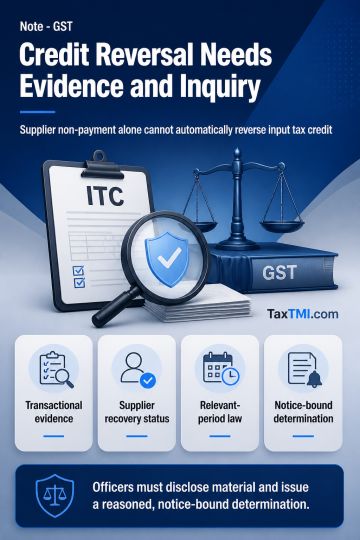
Input tax credit reversal requires evidence linking supplier non-payment to recipient ineligibility and a reasoned statutory inquiry.
Input tax credit under Section 16(2)(c) remains conditional on actual payment of tax to Government, but supplier non-payment or retrospective cancellation cannot by itself justify reversal. The recipient must establish eligibility through transactional evidence, while the proper officer must investigate the particular supply, disclose supplier-default and recovery material, apply the law applicable to the relevant period, and issue a reasoned, notice-bound determination. Supplier recovery status and protection against duplicate collection are material considerations.
Case Laws Customs
Show AI Summary
Baggage-related customs appeals proceed through statutory revision when the jurisdictional exclusion applies to passenger imports.
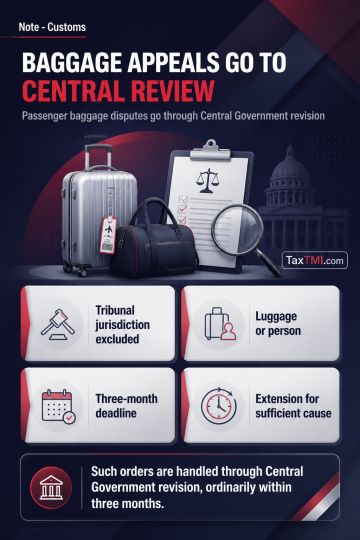
The first proviso to section 129A(1) excludes Appellate Tribunal jurisdiction over an order under section 128A relating to goods imported or exported as baggage. The decisive issue is the order's connection with baggage, not disputes concerning confiscation, declaration, duty, personal effects, concealment, concession, or penalty. Articles carried by an international passenger in luggage or on the person may constitute baggage. Section 129DD provides revision before the Central Government, ordinarily within three months, subject to a further period on sufficient cause.

TMI Notes

Back

All TMI Notes

Showing Results for :
Reset Filters
No Records Found

TMI Notes

Back

All TMI Notes

Comparison of Section 70 "Transactions not regarded as transfer" between the Income-Tax Act, 2025 (as passed) and the Income-Tax Bill, 2025 (as originally introduced)

29 August, 2025

Contents
Acts
Rules & Regulations
Summary
Note

Note

-

Bookmark

(New) -

Download

Print

Print

Section 70 Transactions not regarded as transfer.

Income-tax Act, 2025

At a Glance

Clause 70 of the Income Tax Bill, 2025 - (Old Version) lists transactions that shall not be regarded as "transfer" for the purposes of capital gains taxation u/s 67. It matters because it delineates tax-neutral corporate reorganisations, cross-border transfers between non-residents, fund relocations into IFSCs and other specified conversions. Primary stakeholders: taxpayers (individuals, HUFs, companies, financial institutions, funds), tax authorities and the securities/regulatory sector. Effective date or decision date: Not stated in the document.

Background & Scope

Statutory hook: Clause 70 (Bill) operates to exclude certain transfers from the operation of section 67 (capital gains). The clause covers a broad range of situations including partition of HUFs, transfers under will/gift/irrevocable trust, intra-group transfers between parent and subsidiary (where shareholding conditions are met), amalgamation and demerger scenarios (including certain cross-border restructurings), bank amalgamations under the Banking Regulation Act, demergers and business reorganisations, specific non-resident to non-resident transfers (bonds, GDRs, rupee-denominated bonds, derivatives), IFSC-located transactions, relocations of foreign funds into IFSC-located resultant funds, conversions (e.g., bonds to shares, preference to equity), conversions between gold and Electronic Gold Receipts, transfers to public institutions for works of art, and succession transfers (firm to company, company to LLP, proprietorship to company) subject to multiple conditions. Definitions and cross-references are provided in a Table attached to the clause; these import meanings from other statutes and specified Schedules where relevant.

Statutory Provision Mode

Text & Scope

The provision explicitly lists categories of transfers that will not be treated as "transfer" - thereby exempting them from capital gains computation u/s 67. The clause is structured as a non-exhaustive catalogue of tax-neutral transfers, each with conditions. Coverage includes:

  • Family settlements: partition distributions within HUFs (clause (a)).
  • Transfers on death/gift/irrevocable trust by individuals/HUFs (clause (b)).
  • Group transfers between Indian parent and subsidiary and vice versa where whole share capital is held (clauses (c) & (d)).
  • Amalgamation and demerger neutral transfers, including specific cross-border conditions and exceptions tied to domestic company status or continuation of shareholders (clauses (e)-(m)).
  • Banking amalgamations sanctioned under the Banking Regulation Act (clause (i)).
  • Non-resident to non-resident transfers outside India in specified securities and bonds (clauses (p)-(s)).
  • Relocation of funds into IFSC-located resultant funds and corresponding shareholder/unit-holder exchanges (clauses (t) & (u)), with detailed definitions in the Table.
  • Conversions and redemptions - sovereign gold bonds redemption, conversion of gold to Electronic Gold Receipt, bonds/debentures to shares, preference shares to equity (clauses (x), (y), (z), (za), (zb)).
  • Transfers for public institutions and art acquisitions to government/universities/museums (clause (zc)).
  • Succession transfers from firms/sole proprietorships to companies, and conversion of companies to LLPs subject to conditions (clauses (zd), (ze), (zf)).
  • Other specified transactions - securities lending schemes, reverse mortgage schemes, transfers of SPV shares to business trusts, mutual fund consolidations, joint venture interest exchanges by public sector companies (clauses (zg)-(zl)).

Interpretation

The legislative intent evident from the Bill's text is to carve out tax neutrality for commercial and structural reorganisations, cross-border non-resident transactions executed in specified marketplaces, and to encourage certain policy objectives (e.g., IFSC fund relocations, conversions to LLP, public sector restructurings) by removing capital gains consequences subject to specified conditions. The clause relies heavily on specific qualifying tests (shareholding continuity, registration/certificates, resident status of companies/funds, adherence to SEBI/IFSCA regulations) which indicate a purposive, conditional exemption rather than blanket immunity.

Exceptions/Provisos

Carve-outs and conditions are integral: most exemptions require either continuity of ownership (e.g., 25% or 75% shareholder continuation thresholds for cross-border amalgamation/demerger), the amalgamated/resulting company being an Indian company, regulatory sanctioning (Banking Regulation Act amalgamations), registration/certification of IFSC resultant funds, and caps/limits for company-to-LLP conversions (turnover, asset values, restrictions on distribution of accumulated profits). Several clauses explicitly require that the transfer "does not attract tax on capital gains in the country in which the [foreign] company is incorporated."

Illustrations

  • Example 1: An Indian parent transfers a non-stock-in-trade capital asset to a wholly owned Indian subsidiary. If the parent (or nominees) hold the whole share capital and the subsidiary is Indian, the transfer is not a "transfer" under clause 70(c).

  • Example 2: A foreign fund (original fund) relocates assets to a resultant fund in an IFSC on or before 31 March 2025 (as per Bill). If consideration is issued in units/shares to original fund holders in the same proportion, the relocation is not a "transfer" under clause 70(t)/(u), subject to the registration/certificate requirements for the resultant fund.

  • Example 3: A private company converts into an LLP where shareholders become partners and aggregate profit share remains >=50% for five years, and asset/turnover limits are satisfied - such transfer is not a "transfer" under clause 70(ze).

Interplay

The clause imports meanings from the Banking Regulation Act, SEBI Acts and Regulations, IFSCA regulations, the Limited Liability Partnership Act and references Schedules and other sections (e.g., section 65, section 209(1), Schedule VI, Schedule VII). The Bill conditions many exemptions on compliance with those sectoral/regulatory frameworks, indicating coordinated regulatory-tax treatment. Specific cross-references to domestic company status and foreign tax consequences in the transferor's jurisdiction create inter-legislative and international tax interplay.

Differences between Section 70 of the Income-tax Act, 2025 and Clause 70 of the Income Tax Bill, 2025 - (Old Version)

Summary of material differences and practical impact derived from comparing Document 1 (Section 70 as enacted) and Document 2 (Clause 70 - Old Version of the Bill):

  • References to section numbers for foreign shares: Document 2 uses "section 9(9)(a)" in clauses (h), (m) and elsewhere; Document 1 (enacted Section 70) uses "section 9(10)(a)".
    • Practical impact: The enacted provision updates the cross-reference to a different subsection of section 9. This can change the scope of foreign shares covered (depending on the content of section 9(9)(a) v. 9(10)(a)); practitioners must check which specific category of foreign share is intended under the final section 9 reference. Exact impact depends on section 9's text (Not stated in the document).
  • Formatting and wording differences in certain clauses: Some clauses in Document 2 include parenthetical clarifications such as "(where the provisions of sections 230 to 232 of the Companies Act, 2013 do not apply)" in clauses (l) and (m). Document 1 relocates that qualification out of the clause and instead states in those clauses that the provisions of sections 230-232 shall not apply (explicitly appended at the end of clauses (l) and (m)).
    • Practical impact: The enacted text more clearly and directly excludes application of Companies Act sections 230 to 232 in the specified foreign demerger situations, potentially reducing ambiguity about the precondition for tax neutrality.
  • "Relocation" timeline and resultant fund registration wording: In the Bill (Document 2), the definition of "relocation" in the Table item 5(b) states the transfer must occur "on or before the 31st March, 2025." In the enacted text (Document 1) the deadline is extended to "on or before the 31st March, 2030."
    • Practical impact: The enacted provision provides a materially longer window (five additional years) for qualifying relocations of funds into an IFSC-located resultant fund, affecting fund managers, sponsors and foreign funds looking to migrate; increases practical opportunity to restructure without capital gains consequences.
  • Resultant fund registration wording and condition structure: Document 2 sets out the resultant fund as a fund located in an IFSC which "has been granted - (i) a certificate of registration as a Category I or Category II or Category III Alternative Investment Fund, and is regulated under the SEBI (AIF) Regulations, 2012 or regulated under the IFSCA (Fund Management) Regulations, 2022; or (ii) a certificate as a retail scheme or an Exchange Traded Fund..." Document 1 uses similar language but structures the Table 5(c) slightly differently and includes explicit reference to Schedule VI (Note 1) and to conditions in Schedule VI (Table: Sl. No. 1).
    • Practical impact: Enacted wording appears more granularly linked to Schedule VI conditions (administrative detail), which may affect eligibility assessments; practitioners must consult Schedule VI for operational criteria (Not stated in the document).
  • Other drafting refinements and additions: Document 1 includes newly numbered subclauses and adds or clarifies certain definitions (for example, the Table entry 5(a)(B) referring to Abu Dhabi Investment Authority appears more explicitly framed in Document 1).
    • Practical impact: These drafting refinements may tighten eligibility and compliance requirements in conversion and relocation scenarios; the substantive change depends on the interplay with other statutory text (Not stated in the document).

Practical Implications

  • Compliance and risk areas: Tax neutrality is conditional; failure to meet continuity, registration, or certification requirements (e.g., for IFSC resultant funds or for LLP conversion asset/turnover caps) will attract capital gains. For cross-border amalgamations/demergers, practitioners must evidence the shareholder continuity thresholds and demonstrate absence of taxability in the foreign jurisdiction where required.
  • Record-keeping/evidence: Maintain contemporaneous records proving shareholding continuity (25%/75%/50% thresholds), statutory sanction/registration certificates (IFSCA/SEBI/AIF registration, Banking Regulation Act sanction), documentation showing nature of consideration (shares/units), valuations, and foreign tax treatment certificates where clause conditions require the transfer not to attract tax in the foreign jurisdiction. Preserve corporate filings, agreements of succession/conversion and board/shareholder resolutions relied upon.

Key Takeaways

  • Clause 70 (Bill) enumerates specified transfers that are not "transfer" - insulating many reorganisations and prescribed cross-border and financial-market transactions from capital gains tax, subject to conditions.
  • Most exemptions require objective conditions: shareholding continuity, registration/certification, adherence to regulatory guidelines, or thresholds for asset/turnover/receipt.
  • Relocation relief (original fund -> resultant fund in IFSC) is time-bound under the Bill (deadline in the Bill: 31 March 2025) and requires resultant fund registration; the enacted text extends the deadline to 31 March 2030 (Not stated in the document regarding enacted change).
  • Cross-border amalgamations/demergers invoke a non-taxability condition in the foreign jurisdiction for certain transfers; proof of foreign tax treatment will be relevant.
  • Conversions (company->LLP; firm->company; proprietor->company) are exempt only if detailed continuity and non-distribution conditions are satisfied - careful compliance and record-keeping are essential.

Full Text:

Section 70 Transactions not regarded as transfer.

Topics

Acts Income Tax