Loading...

⚠ ✕
❮ Top
☎ Help
☰
×

By creating an account you can:

Logo TaxTMI
Call Us / Help / Feedback✕

Contact Us At :

✉ E-mail: [email protected]

✆ To Call / Whatsapp, Check Contact Us

FAQs :

To know Frequently Asked Questions, Check FAQs

Most Asked Video Tutorials :

For more tutorials, Check Video Tutorials

Submit Feedback/Suggestion :

Email :
Please provide your email address so we can follow up on your feedback.
Category :
Description :
Min 15 characters 0/2000
Make Most of Text Search ✕
  1. Checkout this video tutorial: How to search effectively on TaxTMI.
  2. Put words in double quotes for exact word search, eg: "income tax"
  3. Avoid noise words such as : 'and, of, the, a'
  4. Sort by Relevance to get the most relevant document.
  5. Press Enter to add multiple terms/multiple phrases, and then click on Search to Search.
  6. Text Search
  7. The system will try to fetch results that contains ALL your words.
  8. Once you add keywords, you'll see a new 'Search In' filter that makes your results even more precise.
  9. Text Search
╳
Add to...
You have not created any category. Kindly create one to bookmark this item!
✕
Create New Category
Hide
Title :
Description :
❮❮ Hide
❮ Default View
Expand ❯❯
Close ✕
🔎 Filters / Advanced Search ❯
TEXT

Press 'Enter' to add multiple search terms. Rules for Better Search

Search In
Main Text + AI Text ❯
  • Main Text
  • Main Text + AI Text
  • AI Text
Law:
---- All Laws---- ❯
  • ---- All Laws----
  • Benami Property
  • Bill
  • Central Excise
  • Companies Law
  • Customs
  • DGFT
  • FEMA
  • GST
  • GST - States
  • IBC
  • Income Tax
  • Indian Laws
  • Money Laundering
  • SEBI
  • SEZ
  • Service Tax
  • VAT / Sales Tax
Types:
---- All Types ---- ❯
  • ---- All Types ----
  • Act Rules
  • Case Laws
  • Circulars
  • Manuals
  • News
  • Notifications
Sort By: ?
In Sort By 'Default', exact matches for text search are shown at the top, followed by the remaining results in their regular order.
Relevance Default Date
☰   Show Results ❯
    Export of Principal-to-Principal Support and Software Development Services under the IGST Act
    Refund of Unutilised Input Tax Credit by SEZ Units under Section 54 and Rule 89
    Case Laws Customs
    Private Bonded Warehouse Licence: Penalty-Based Disqualification under Regulation 3(2)(c)
    Refund of Accumulated Compensation Cess on Zero-Rated Supplies under Section 54 and Rule 89
    Penalty for Wrongful Availment of Input Tax Credit: The Distinction Between Sections 73 and 74
    Input Tax Credit on Resort Construction After Retrospective Substitution in Section 17(5)(d): Except...
    Shareholder Locus Standi under Section 61 in Challenges to Resolution-Plan Approval
    GSTR-2A Mismatch, Supplier Certification (of tax payment) and the Burden of Proving Input Tax Credit...
    Concessional GST on Works Contracts for Co-operative Spinning Mills: Government Entity Status and Pr...
    Case Laws Customs
    Abetment and Knowing Use of False Import Documents under Sections 112(a) and 114AA
    Subcontracted Services on Own Account and the Intermediary Exclusion under Section 2(13)
    Case Laws Customs
    Classification of Two-Ton Ductless Split Air Conditioners under Tariff Item 8415 82 10
    Case Laws Income Tax
    Transfer Pricing of Pre-Conversion Interest on Compulsorily Convertible Debentures
    Case Laws Customs
    Clubbing of Contrived Split Consignments under Rule 2(a) and Valuation of a Dismantled Motorcycle
    GST on Corporate Guarantees: Substantive Liability, Deemed Valuation and Judicial Relief
    Case Laws Income Tax
    Employee Secondment under the India-USA DTAA: Employment Rights, Reimbursements and Included Service...
    Pre-deposit Under Section 112 and Independent Compliance with Tribunal Filing Fees
    Case Laws Income Tax
    TDS on Interest Paid by Co-operative Banks to Non-Member Co-operative Societies under Section 194A(3...
    Input Tax Credit and Supplier Non-Payment: Statutory Limits on Mechanical Reversal Under Section 16(...
    Case Laws Customs
    Appellate Jurisdiction over Goods Imported as Baggage under Sections 129A and 129DD of the Customs A...
❮
❯
❯❯
Maximize Maximize Maximize
0 / 200
Expand Note
Add to Folder

No Folders have been created

+

Are you sure you want to delete "My most important" ?

NOTE:

Notes
Showing Results for :
Reset Filters
Results Found:
Show All Summaries Hide All Summaries
Case Laws GST
Show AI Summary
Principal-to-principal software development and support services may qualify as exports when supplied on own account and statutory conditions are satisfied.
Principal-to-principal software development and business support for overseas group entities are distinguished from intermediary services by examining the supply actually undertaken. Intermediation requires a separate service of arranging or facilitating a main supply between two other persons; the presence of three parties or benefits to end customers is insufficient. Development, sourcing assistance and call-centre or product support may be own-account services when the supplier is responsible for performing the work rather than arranging another person's supply. Contractual responsibility, authority to bind the overseas entity, actual activities and subcontracting arrangements are relevant. Cost-plus payment and an independent-contractor label are indicators, not conclusive tests; neither third-party contact nor group ownership alone determines classification.
Case Laws GST
Show AI Summary
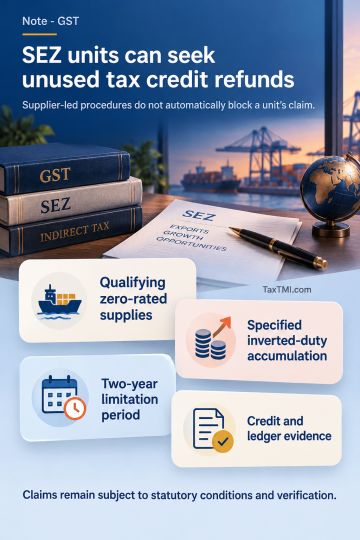
SEZ refund eligibility extends to unutilised input tax credit despite supplier-specific procedures, subject to statutory conditions and verification.
SEZ units are not categorically excluded from claiming refunds of unutilised input tax credit merely because Rule 89 prescribes a supplier-led procedure for supplies to SEZs. That procedure governs the supplier's claim for the relevant inward supply; it does not exclude a unit's own claim under the statutory refund framework. Section 54 of the CGST Act permits registered persons to claim refunds of unutilised credit subject to substantive conditions, including those governing zero-rated supplies made without payment of tax and specified inverted-duty accumulation. Refund applications must identify the applicable statutory basis, relevant date and two-year limitation period, and support the claim with evidence of qualifying supplies, credit sources, ledger balances and computation.
Case Laws Customs
Show AI Summary
Warehouse licensing disqualification requires more than a prior customs monetary penalty and depends on offence-based eligibility criteria.
Penalisation for an offence under Regulation 3(2)(c) is not established merely by the existence of a customs monetary penalty. The legal basis and character of the earlier proceedings must be examined against the distinction between adjudicatory penalties and the offences-and-prosecutions framework. The absence of conviction alone does not resolve every disqualification ground. Antecedent verification follows a centralised process, while a favourable eligibility assessment must be followed by the insurance, undertaking, indemnity and warehouse-keeper requirements under Regulation 4.
Case Laws GST
Show AI Summary
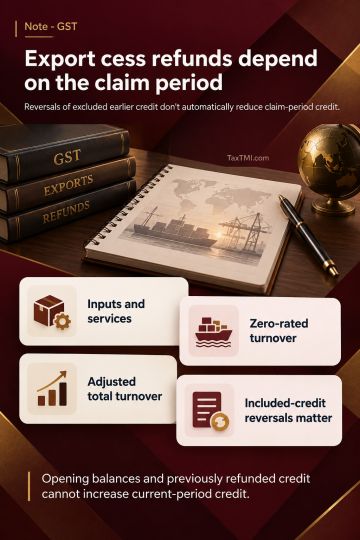
Compensation cess refunds on exports depend on period-specific credit attribution, not automatic deductions for unrelated earlier-period reversals.
Under Rule 89(4), the refund formula applies Net ITC to zero-rated turnover and adjusted total turnover. Period-specific Net ITC depends on credit availed on inputs and input services during the period for which the claim is filed. A reversal reported during that period does not automatically reduce Net ITC if it relates to residual earlier-period credit excluded from the current computation. Reversals affecting credit included in the computation remain relevant, and opening balances or previously refunded credit cannot be added to current-period Net ITC.
Case Laws GST
Show AI Summary
Input tax credit mismatches alone do not justify fraud-based penalties, even when excess credit is paid after verification.
Section 74 requires a factual connection between the wrongful credit and fraud, wilful misstatement or suppression of facts to evade tax; a mismatch or eligibility failure alone does not establish that connection. Section 73 covers defaults without those elements. Departmental detection, an admission of excess credit and payment after verification do not by themselves establish why the excess arose or prove the conduct necessary for Section 74. Failure to pay the pre-notice penalty cannot itself establish the fraud-related basis for Section 74.
Case Laws GST
Show AI Summary
Resort construction credit depends on immovability, own-account use, and the statutory distinction between buildings and plant and machinery.
Input tax credit on resort construction is subject to the blocked-credit restriction for goods and services received to construct immovable property on a taxable person's own account, including property used in the course or furtherance of business. The general business-use entitlement under section 16 does not displace this restriction in section 17(5)(d). The Finance Act, 2025 retrospectively substituted plant and machinery for "plant or machinery" from 1 July 2017, with the relevant provision commencing on 1 October 2025. The defined expression covers apparatus, equipment and machinery fixed to the earth by foundation or structural support and used for making outward supplies, including those foundations and supports. It excludes land, buildings and other civil structures, telecommunication towers and pipelines laid outside factory premises.
Case Laws IBC
Show AI Summary
Shareholder standing in insolvency appeals depends on legal capacity, not merely allegations of fraudulent changes to creditor-approved plans.
Individual shareholder standing to appeal against approval of a resolution plan is distinct from the legality of the plan itself. Under Section 61(1) of the Insolvency and Bankruptcy Code, 2016, an appellant must qualify as a person aggrieved. The applicable judicial interpretation restricts an appeal pursued exclusively in an individual shareholder capacity, even where equity interests are affected. Section 61(3) separately specifies permissible grounds of challenge: a plan's contravention of law and material irregularity in the resolution professional's exercise of powers are distinct grounds. Pleading either ground does not itself establish standing.
Case Laws GST
Show AI Summary
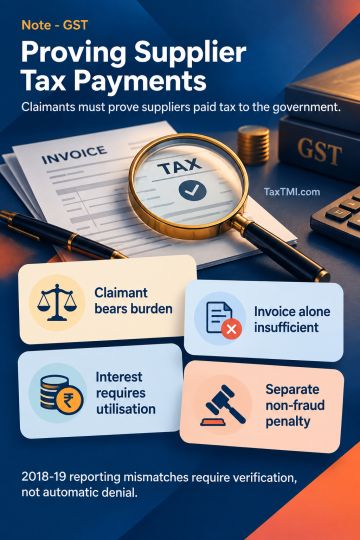
Input tax credit requires proof of supplier tax payment; reporting mismatches call for verification rather than automatic denial.
Supplier payment of tax to the Government is a condition of input tax credit eligibility under section 16(2)(c), and the claimant bears the burden of proving eligibility under section 155. Payment of the invoice and tax to the supplier, receipt of the supply and possession of an invoice do not themselves establish the supplier's remittance. For 2018-19, a GSTR-2A mismatch calls for verification and does not alone prove ineligibility. Interest under section 50(3) requires credit to have been both wrongly availed and utilised; its calculation follows Rule 88B(3). Non-fraud penalty operates under a separate statutory trigger and is not automatically excluded by the absence of fraud or utilisation.
Case Laws GST
Show AI Summary
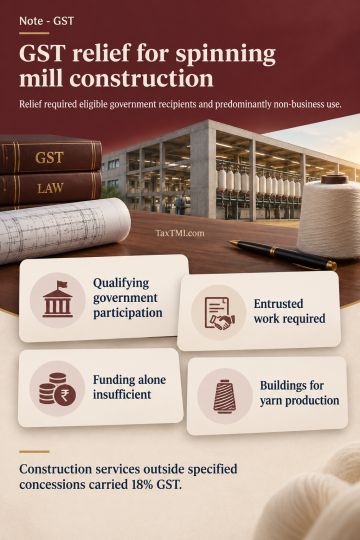
Non-business construction concessions for spinning mills require eligible recipient status and predominantly non-industrial use of the constructed buildings.
For the disputed period, the works-contract concession required both an eligible governmental recipient and structures predominantly meant for use other than commerce, industry, business or profession. Government Entity status required evidence of the recipient's constitution and qualifying governmental participation, while procurement had to relate to entrusted work. Project funding, tender approval and supervision did not by themselves establish governmental constitution or control. The spinning-mill factory buildings and allied works were intended for yarn production and related commercial activities. The residual construction-services entry carried aggregate GST of 18% for services outside the specified concessional entries.
Case Laws Customs
Show AI Summary
Import document handling alone does not establish customs abetment or knowing use of materially false declarations.
Personal customs penalties depend on the person's own conduct, not merely on the confiscability of imported goods. Under Section 112(a) of the Customs Act, 1962, liability may arise from a person's own act or omission rendering goods liable to confiscation or from abetment of such conduct. The direct limb can operate on a strict-liability basis where a person's own act or omission renders goods confiscable; an allegation of abetment instead requires evidence of participation or culpable facilitation. Section 114AA requires knowing or intentional making, signing or use, or causing the making, signing or use, of a declaration, statement or document that is materially false or incorrect in customs business.
Case Laws GST
Show AI Summary
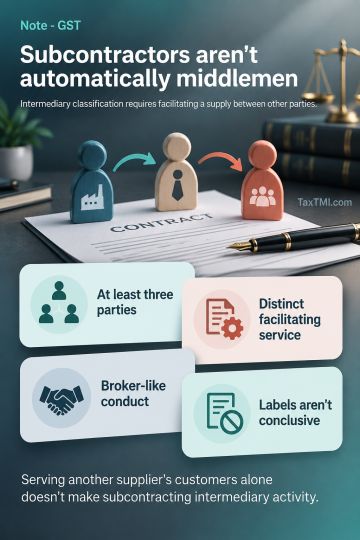
Subcontracted services performed on own account are not intermediary services merely because they support overseas recruitment and customer-facing activities.
Intermediary classification under Section 2(13) of the IGST Act distinguishes arranging or facilitating supplies between other persons from supplying services on one's own account. The intermediary framework requires at least three parties, a main supply and a distinct ancillary facilitating supply, with conduct resembling that of a broker or agent. Subcontracting the whole or part of a service is not intermediary activity merely because performance supports another supplier's business or involves its customers. Neither a bilateral agreement, contractual label nor remuneration method is conclusive.
Case Laws Customs
Show AI Summary
Split air conditioner classification requires capacity and refrigeration features to be assessed against the applicable tariff hierarchy.
Classification of ductless split air conditioners depends on the complete tariff description and the machine's technical characteristics. A complete, cooling-only, two-ton split air conditioner incorporating a refrigerating unit and lacking a heat-reversal valve falls within tariff item 8415 82 10 rather than the general split-system item 8415 10 10. Item 8415 82 10 inherits its parent subheading's refrigerating-unit requirement, while item 8415 83 10 requires the absence of such a unit. Capacity alone does not establish the applicable refrigeration-based entry. Technical evidence should establish whether the goods are a complete machine and identify their capacity and operating features.
Case Laws Income Tax
Show AI Summary
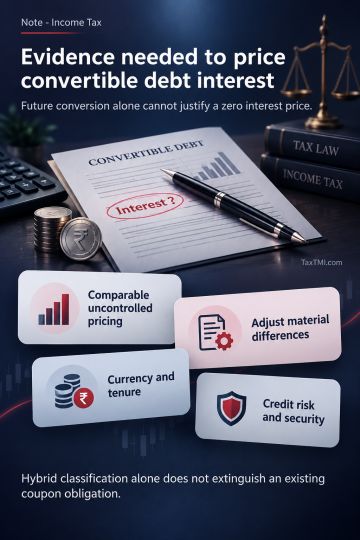
Convertible debenture interest requires evidence-based pricing before conversion; future equity conversion alone cannot establish a nil arm's length price.
Pre-conversion interest on compulsorily convertible debentures (CCDs) issued to a non-resident associated enterprise requires arm's length pricing. Compulsory future conversion and hybrid classification do not, by themselves, establish a nil price or extinguish an existing coupon obligation. Rule 10AB's Other Method requires a price charged, paid or expected in comparable uncontrolled circumstances, with reasonably accurate adjustments for material differences under Rule 10B. Currency, benchmark date, tenure, credit risk, security, non-redemption and conversion benefits affect comparability; a conventional bank lending rate is not automatically comparable to a long-tenor CCD.
Case Laws Customs
Show AI Summary
Split motorcycle consignments require evidence of deliberate fragmentation for composite classification, with valuation assessed independently of classification.
Clubbing of split consignments for customs classification depends on proof that apparently separate imports form one deliberately fragmented transaction, not merely on the possibility of assembly. Rule 2(a) extends a tariff heading to an incomplete article possessing the essential character of the complete article and also covers a complete article presented disassembled. A change of tariff heading alone does not establish that the transaction value is inaccurate; substantive misdescription of the goods requires separate evidentiary consideration. Replacement value must follow the prescribed sequence of methods.
Case Laws GST
Show AI Summary
Corporate guarantee taxation depends on distinguishing taxable supply from valuation, particularly for unpaid support between related businesses.
GST on corporate guarantees requires separate consideration of whether a taxable supply exists and how that supply is valued. Section 7(1)(c) and Schedule I encompass qualifying supplies between related or distinct persons without consideration when made in the course or furtherance of business. Rule 28(2) deems the value of a guarantee furnished to a banking company or financial institution for a related recipient in India to be one per cent of the guaranteed amount per annum or actual consideration, whichever is higher. Where the recipient is eligible for full input tax credit, the proviso treats the value declared in the invoice as the value of the supply.
Case Laws Income Tax
Show AI Summary
Employee secondment taxation depends on employment rights, service consideration and demonstrable transfer of technical capability to host entities.
Local operational control and a stated suspension of foreign employment do not, by themselves, resolve whether underlying foreign employment rights survive. Under Article 12(4)(b) of the India-USA DTAA, technical or consultancy services must make technical knowledge, experience, skill, know-how or processes available, or involve development and transfer of a technical plan or design. Under the knowledge-transfer limb, the recipient must acquire a capability it can use independently; the mere application of expertise or presence of qualified personnel is insufficient. Recovery at actual cost and absence of markup do not, by themselves, establish that a foreign enterprise's receipt is non-taxable.
Case Laws GST
Show AI Summary
GST appellate pre-deposits may be satisfied by verified earlier payments after demand reduction, but filing fees remain independently payable.
When the first appellate authority substantially reduces the disputed tax demand, an earlier deposit may be sufficient to satisfy the Tribunal-stage requirement, subject to verification. Sufficiency depends on the reduced liability, the applicable appellate requirements and the amount actually deposited; a first appellate payment does not automatically eliminate the additional obligation. Tribunal filing fees under Section 112(7) operate independently of pre-deposit. Where a fee shortfall and earlier deposit require verification, proof of fee payment and verification of the deposit precede consideration of admission.
Case Laws Income Tax
Show AI Summary
Inter-co-operative society interest exemption preserves non-deduction by co-operative banks when depositors are co-operative societies under the statutory withholding framework.
Section 194A(3)(v) separately addresses interest paid by a co-operative bank to a member and interest paid by a co-operative society to another co-operative society. The exclusion of co-operative banks is confined to the member-payment limb; a co-operative bank remains a co-operative society for the inter-co-operative society limb. Paragraph 42.7 of Circular No. 19/2015 preserves non-deduction, including time-deposit interest, where the depositor is a co-operative society. Section 80P does not determine this withholding obligation.
Case Laws GST
Show AI Summary
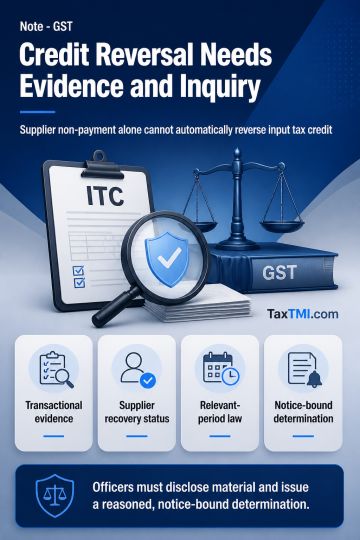
Input tax credit reversal requires evidence linking supplier non-payment to recipient ineligibility and a reasoned statutory inquiry.
Input tax credit under Section 16(2)(c) remains conditional on actual payment of tax to Government, but supplier non-payment or retrospective cancellation cannot by itself justify reversal. The recipient must establish eligibility through transactional evidence, while the proper officer must investigate the particular supply, disclose supplier-default and recovery material, apply the law applicable to the relevant period, and issue a reasoned, notice-bound determination. Supplier recovery status and protection against duplicate collection are material considerations.
Case Laws Customs
Show AI Summary
Baggage-related customs appeals proceed through statutory revision when the jurisdictional exclusion applies to passenger imports.
The first proviso to section 129A(1) excludes Appellate Tribunal jurisdiction over an order under section 128A relating to goods imported or exported as baggage. The decisive issue is the order's connection with baggage, not disputes concerning confiscation, declaration, duty, personal effects, concealment, concession, or penalty. Articles carried by an international passenger in luggage or on the person may constitute baggage. Section 129DD provides revision before the Central Government, ordinarily within three months, subject to a further period on sufficient cause.

TMI Notes

Back

All TMI Notes

Showing Results for :
Reset Filters
No Records Found

TMI Notes

Back

All TMI Notes

Evolution of Tax Enforcement : Clause 247 of Income Tax Bill, 2025 Vs. Section 132, Income-tax Act, 1961

30 May, 2025

Contents
Acts
Rules & Regulations
Summary
Note

Note

-

Bookmark

(New) -

Download

Print

Print

Clause 247 Search and seizure.

Income Tax Bill, 2025

Introduction

Clause 247 of the Income Tax Bill, 2025, represents a significant overhaul and modernization of the legal framework governing search and seizure under Indian income tax law. This provision is intended to supplant the long-standing Section 132 of the Income-tax Act, 1961. Both provisions, along with their associated rules-namely, Rules 13, 13A, 112A, and 112B of the Income-tax Rules, 1962 - form the procedural and substantive backbone for the exercise of the tax authorities' most intrusive powers: the power to search premises, seize assets, and collect evidence in the fight against tax evasion and black money. The need for such provisions arises from the inherent difficulties in detecting and proving concealed income and assets, especially in an era where financial information is increasingly digitized and globalized. The legislative intent is to balance two competing interests: the necessity for effective tax enforcement, and the protection of citizens' rights against arbitrary or excessive exercise of state power. This commentary provides a clause-by-clause analysis of Clause 247, situates it within its legal and policy context, and undertakes a comparative study with Section 132 of the 1961 Act and the relevant rules. It also explores the practical and procedural implications of the new regime, highlighting continuities, innovations, and areas of potential ambiguity or concern.

Objective and Purpose

The core objective of Clause 247 is to empower income tax authorities to uncover undisclosed income and property by authorizing searches and seizures when there is credible information suggesting non-compliance or concealment. The provision is designed to:

  • Enable the collection of evidence that may otherwise be inaccessible due to non-cooperation or deliberate concealment by taxpayers.
  • Address the challenges posed by digital records and electronic storage of information, reflecting the realities of modern business and financial practices.
  • Provide a legal framework for the provisional attachment and valuation of assets to protect the interests of the revenue.
  • Ensure procedural safeguards, including requirements for recording reasons, time limits, and approvals, to prevent abuse of power.
  • Align the tax enforcement apparatus with other legal frameworks, such as the Bharatiya Nagarik Suraksha Sanhita, 2023, and the Black Money (Undisclosed Foreign Income and Assets) and Imposition of Tax Act, 2015.

The legislative history of search and seizure provisions in Indian tax law reveals a continuous evolution, with each iteration aiming to address emerging challenges-be it the proliferation of black money, the use of technology for concealment, or the need for inter-agency cooperation.

Detailed Analysis of Clause 247 of the Income Tax Bill, 2025

1. Preconditions for Search and Seizure

Clause 247(1) largely mirrors the structure of Section 132(1), stipulating that the competent authority must have "reason to believe," based on information in possession, that:

  • (a) A person has failed to produce, or is likely not to produce, books of account, documents, or electronic information in response to a summons or notice; or
  • (b) A person is in possession of assets or information relating to assets representing undisclosed income or property, including under the Black Money Act, 2015.

Comparative Note: Section 132(1) is similar but references the Indian Income-tax Act, 1922, and does not explicitly mention the Black Money Act. Clause 247 thus expands the scope to undisclosed foreign assets and aligns with anti-black money policy.

The "reason to believe" standard is retained, with the caveat that the reasons are not to be disclosed (see Section 132 explanations). This standard has been judicially interpreted to require material, though not conclusive proof, and is subject to limited judicial review.

2. Authorisation and Execution of Search

Clause 247 vests the approving authority (Principal Chief Commissioner, Chief Commissioner, etc.) with the power to authorise a range of officers (Joint Director/Commissioner, Assistant Director/Commissioner, Income-tax Officer) to conduct searches and seizures. The authorisation chain is almost identical to that u/s 132.

Key Powers Conferred (Clause 247(1)(i)-(viii)):

  • Entry and search of premises, vessels, vehicles, aircraft, where assets or documents are suspected to be kept.
  • Requiring technical assistance for accessing electronic records, including access codes (a significant expansion to address digital data).
  • Breaking open locks and overriding digital security if access is denied.
  • Personal search of individuals suspected of concealing assets or documents.
  • Marking, copying, and extracting from documents and computer systems.
  • Inventorying assets and stock-in-trade (but only seizing non-stock assets).
  • Seizure of books, documents, computer systems, or assets (excluding stock-in-trade);
  • Deemed seizure: Order prohibiting removal or dealing with bulky, dangerous, or otherwise impracticable items.

Comparative Note: Section 132(1) confers similar powers but is less detailed regarding electronic records. Clause 247's explicit reference to "virtual digital space" and "electronic media" is a critical update, reflecting the realities of digital evidence.

The "deemed seizure" mechanism (Clause 247(1)(viii)) parallels the second proviso to Section 132(1), providing for situations where physical seizure is impracticable. The exclusion of stock-in-trade from seizure is also retained.

3. Jurisdictional Flexibility and Emergency Powers

Clause 247(2) allows a tax authority to conduct a search outside its normal jurisdiction if delay in obtaining authorisation from the proper jurisdictional authority would prejudice revenue interests. This is identical in intent to the first proviso to Section 132(1), reflecting the need for swift action in urgent cases.

Clause 247(3) provides for "extension" of search to other premises not originally included in the authorisation, based on fresh information. This mirrors Section 132(1A), with both provisions ensuring operational flexibility.

4. Deemed Seizure and Prohibitory Orders

Clause 247(4) empowers the authorised officer, where physical seizure is not practicable for reasons other than those in sub-section (1)(viii), to issue a prohibitory order for up to 60 days, prohibiting removal or dealing with the asset. The provision clarifies that such an order does not amount to "seizure."

Comparative Note: Section 132(3) and (8A) provide a similar mechanism, with a 60-day limit on the prohibitory order. The distinction between "deemed seizure" (where physical possession is impracticable) and a temporary prohibitory order is maintained in both regimes.

5. Requisitioning Assistance and Valuation

Clause 247(5) allows the authorised officer to requisition the services of police, central government officers, or other approved persons/entities (including technical experts), with a duty to comply with such requisition. This reflects an expansion to allow for specialist digital forensics and other expertise, as now required in complex cases.

Rule 13 of the Income-tax Rules, 1962, prescribes the procedure for approving such persons/entities, including application, approval, and the issuance of a Designated Approval Number. The rule also allows for ad hoc requisitioning in emergencies, subject to post-facto approval.

Clause 247(9) allows the authorised officer to refer valuation of property to a Valuation Officer, registered valuer, or other approved person/entity, with a report required within 60 days. Rule 13A prescribes the methodology for such valuation, referencing stamp duty values, Rule 11UA for securities and jewellery, and fair market value for other assets.

Comparative Note: Section 132(9D) (inserted in recent years) and Rules 13 and 13A provide an almost identical mechanism. The new Bill incorporates these mechanisms and generalizes their application.

6. Examination on Oath and Evidentiary Use

Clause 247(6) empowers the authorised officer to examine, on oath, any person found in possession or control of assets, documents, or computer systems, or present at the premises, and to use such statements as evidence in any proceedings. The examination may extend to all matters relevant to any investigation under the Act.

Comparative Note: Section 132(4) is almost identical, and the explanation appended to it has been judicially interpreted to allow examination on matters beyond the immediate search findings, provided they are relevant to tax proceedings.

7. Legal Presumptions

Clause 247(7) introduces statutory presumptions:

  • That books of account, computer systems, digital space, documents, or assets found belong to the person in possession;
  • That the contents of such books/documents/electronic records are true;
  • That signatures and handwriting are genuine;
  • That stamped/executed/attested documents and electronic communications are authentic and exchanged between the parties.

Comparative Note: Section 132(4A) provides for similar presumptions, but Clause 247 expands the language to cover electronic records and digital communications, reflecting the increasing importance of digital evidence.

These presumptions are rebuttable and have been the subject of much litigation regarding their scope and application, particularly in criminal and penalty proceedings.

8. Provisional Attachment

Clause 247(8) empowers the authorised officer to provisionally attach property during or within 60 days of the search, for up to six months, with prior approval and reasons recorded in writing. The rules u/s 413 are to apply mutatis mutandis.

Comparative Note: Section 132(9B) and (9C) provide for similar powers of provisional attachment, with identical timelines and procedural safeguards. This power is a significant addition to the search regime, allowing for revenue protection in complex or protracted cases.

9. Application of Criminal Procedure

Clause 247(10) stipulates that the provisions of the Bharatiya Nagarik Suraksha Sanhita, 2023 (the new Code of Criminal Procedure) relating to search and seizure shall apply, so far as may be, to actions under this section.

Comparative Note: Section 132(13) refers to the Code of Criminal Procedure, 1973. The update reflects the legislative shift to the new criminal code.

10. Rulemaking Powers

Clause 247(11) authorises the Board to make rules regarding procedures for ingress into premises and safe custody of seized items.

This is similar to Section 132(14), which forms the basis for Rules 13, 13A, 112A, and 112B.

11. Procedural Rules: 13, 13A, 112A, and 112B

Rules 13 and 13A: Modernizing the Procedural Framework

  • Rule 13: Details the procedure for approving and requisitioning services of experts and valuers, including application, approval, and emergencies.
  • Rule 13A: Lays down the methodology for valuation of assets seized, referencing stamp duty, Rule 11UA for securities/jewellery, and fair market value for other assets. The report is to be submitted in Form 6CA.

Rules 112A and 112B: Legacy Procedures

  • Rule 112A: Governs the inquiry process post-seizure, including issuance of notice, examination on oath, and use of material gathered, with a requirement of fair notice before adverse use.
  • Rule 112B: Provides for the release of assets ordered to be released, requiring delivery in the presence of two witnesses. 

These rules operationalize the statutory provisions and ensure procedural fairness and transparency.

Practical Implications

For Taxpayers and Businesses

  • Expanded coverage of electronic records and digital assets increases the risk of scrutiny for businesses and individuals who maintain financial information in digital form.
  • Greater inter-agency cooperation and the explicit inclusion of the Black Money Act heighten the exposure of those with undisclosed foreign assets.
  • The presumptions regarding digital records place a heavier evidentiary burden on taxpayers to rebut findings arising from electronic evidence.
  • Procedural safeguards (requirement to record reasons, time limits, approvals) offer some protection, but the non-disclosure of reasons to the affected party continues to limit transparency and challengeability.

For Tax Authorities

  • Modernized powers facilitate more effective enforcement, especially in cases involving digital concealment or cross-border assets.
  • Clearer procedures for valuation and attachment help preserve the revenue's interests pending assessment or litigation.
  • The ability to requisition technical assistance and override digital security measures is crucial in an era of encrypted and cloud-based data.

For Legal and Tax Professionals

  • Need for updated compliance advice, particularly regarding the handling, storage, and presentation of electronic records.
  • Potential for increased litigation on the scope of digital searches, data privacy, and the application of presumptions to electronic evidence.

Comparative Analysis with Section 132 and Related Rules

Substantive Powers

Both Clause 247 and Section 132 confer broad powers of search and seizure, but Clause 247 modernizes the language to explicitly address electronic records, digital space, and technical assistance, which were previously covered only by implication or later amendments (see Section 132(1)(iib)).

The inclusion of the Black Money Act in Clause 247's scope is a policy expansion, reflecting the government's focus on undisclosed foreign assets.

Procedural Framework

The procedural rules-Rules 13, 13A, 112A, and 112B-remain relevant and are largely imported into the new regime, with minor modifications for digital evidence and valuation procedures.

The requirement for timely action (e.g., 60-day limits on prohibitory orders, 6-month limit on provisional attachment) is retained, ensuring that the intrusive powers are not exercised arbitrarily or indefinitely.

Evidentiary Presumptions

Both regimes create statutory presumptions regarding the ownership, truth, and authenticity of seized documents, but Clause 247's explicit inclusion of electronic records and digital communications is a significant update.

Safeguards and Due Process

The Bill maintains the core safeguards: requirement of "reason to believe," prior approval, reasoned orders, limited duration of orders, and the right to rebut presumptions and challenge actions through administrative and judicial channels.

The rules regarding inquiry (Rule 112A) and release of assets (Rule 112B) continue to ensure procedural fairness and transparency.

Ambiguities and Potential Issues

  • The breadth of the presumptions regarding electronic records may raise concerns about privacy, data integrity, and the risk of abuse, especially given the technical complexity of digital evidence.
  • The continued non-disclosure of "reasons to believe" to the affected party, while judicially upheld, may be challenged on grounds of natural justice.
  • The interaction between Clause 247 and other laws (such as data protection legislation) may give rise to interpretive conflicts in the future.

Conclusion

Clause 247 of the Income Tax Bill, 2025, represents both continuity and change in the law of search and seizure. It retains the core structure and safeguards of Section 132, while modernizing the provision to address the challenges of a digitized, globalized, and increasingly sophisticated economic environment. The explicit focus on electronic records, the inclusion of the Black Money Act, and the alignment with the new criminal procedure code are all forward-looking measures. At the same time, the provision continues to rely on tested procedural safeguards, such as the requirement for "reason to believe," time limits, and approvals. The new rules (13 and 13A) provide much-needed clarity and structure for technical and valuation issues. Nonetheless, certain ambiguities-particularly regarding the scope of digital searches, the treatment of electronic evidence, and the balance between enforcement and privacy-may require further judicial clarification or legislative refinement as the new regime is implemented. Stakeholders should prepare for a more technologically sophisticated, but also more intrusive, enforcement environment.


Full Text:

Clause 247 Search and seizure.

Topics

Acts Income Tax