 TaxTMI





 05 Nov 2026

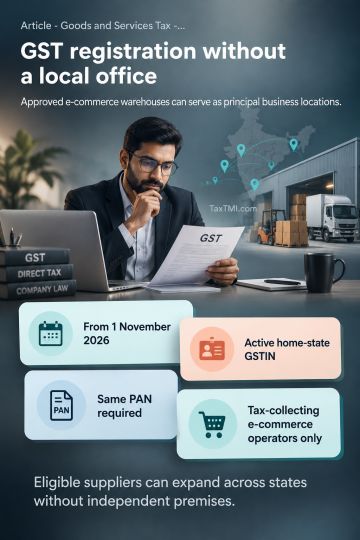
A New Opportunity for E-Commerce Suppliers to Expand Beyond Their Home State
The rapid growth of e-commerce has created new opportunities for businesses to sell goods across India without establishing traditional offices or business premises in every State. However, GST registration requirements have often posed practical challenges for suppliers seeking to store goods in warehouses operated by e-commerce platforms. Small businesses, in particular, may find it costly and inconvenient to maintain separate establishments merely to obtain registration in another State.
Recognising these difficulties, the Central Government issued Notification No. 05/2026-Central Tax dated 26.10.2026, inserting Rule 14B in the CGST Rules, 2017, with effect from 01.11.2026. The new rule introduces an optional Simplified Registration Scheme for eligible suppliers of goods operating through e-commerce operators required to collect tax at source under Section 52 of the CGST Act, 2017. The objective is to facilitate interstate business expansion while maintaining appropriate safeguards against misuse of GST registration.
To implement the new provision, GSTN issued a detailed advisory on 01.11.2026 explaining the eligibility conditions, registration procedure, warehouse approval, and Aadhaar authentication and verification requirements. This article examines the new scheme, its practical implications, and the precautions that taxpayers should observe while seeking registration under Rule 14B.
Rule 14B Provides a Special Registration Facility Through E-Commerce Warehouses
Under Rule 14B, an eligible supplier already holding regular GST registration in one State or Union Territory may obtain registration in another State or Union Territory where the supplier has no physical presence. Instead of maintaining an independent office or establishment, the supplier may declare an approved warehouse of an e-commerce operator as the Principal Place of Business (PPoB), subject to the prescribed conditions.
This facility is particularly beneficial for suppliers who store goods in warehouses maintained by e-commerce operators to fulfil customer orders. For example, a supplier registered in Delhi may wish to store goods in an e-commerce warehouse in Maharashtra to serve customers more efficiently. Under the new scheme, the supplier may seek registration in Maharashtra without establishing an independent physical office there.
However, registration under Rule 14B is restricted to supplies of goods through e-commerce operators required to collect TCS under Section 52. It cannot be used for independent sales outside the e-commerce arrangement. The scheme is therefore a special facility for a defined category of suppliers, not a general exemption from ordinary GST registration requirements.
Eligibility Conditions Must Be Carefully Examined Before Applying
A supplier seeking registration under Rule 14B must have at least one active regular GST registration under the same PAN in another State or Union Territory, known as the Home State GSTIN. The applicant must have no physical presence or any active regular registration in the State where registration is sought. Only one registration under Rule 14B is permitted against the same PAN in a particular State or Union Territory.
The GSTN advisory dated 01.11.2026 clarifies that the Home State GSTIN must not be registered under Rule 14A or Rule 9A of the CGST Rules, 2017, nor should it belong to State Code 97. These restrictions ensure that the applicant holds an eligible regular GST registration in another State or Union Territory before seeking registration under Rule 14B.
Rule 14A provides an optional simplified registration scheme for applicants whose monthly output tax liability on supplies to registered persons does not exceed Rs. 2.5 lakh, subject to prescribed conditions. However, a taxpayer registered under Rule 14A cannot directly use that GSTIN as the Home State registration for Rule 14B. Such a taxpayer may first withdraw from the Rule 14A scheme in accordance with the prescribed procedure and thereafter apply under Rule 14B, provided the remaining eligibility conditions are satisfied.
Rule 9A provides for electronic grant of GST registration within three working days to applicants identified by the GST Portal on the basis of data analysis and risk parameters. Unlike Rule 14A, it is not an optional scheme based on a monetary ceiling. A registration granted under Rule 9A is also excluded from being used as the Home State GSTIN for Rule 14B.
State Code 97 represents Other Territory under the GST registration system. A GSTIN bearing this code cannot serve as the Home State registration for Rule 14B. Similarly, an applicant cannot obtain registration under Rule 14B in a jurisdiction classified as Other Territory.
Section 29 of the CGST Act, 2017 deals with cancellation or suspension of GST registration. The proper officer may cancel registration on the taxpayer's application or on specified grounds, including discontinuance of business, contravention of statutory provisions, or other prescribed circumstances. For registration under Rule 14B, the Home State GSTIN must remain active, and no cancellation proceedings under Section 29 should have been initiated or a cancellation application filed in respect of that registration.
These conditions ensure that the simplified registration facility under Rule 14B is available only to eligible suppliers with a valid and continuing regular GST registration in their Home State. They also prevent taxpayers whose existing registrations are subject to cancellation proceedings from using those registrations as the basis for obtaining additional registrations under the new scheme.
Another essential condition is the consent of the e-commerce operator whose warehouse is proposed as the Principal Place of Business(PPoB). The supplier must also comply with the prescribed monthly output tax liability ceiling. All these conditions are cumulative, and satisfying only the requirement of having no physical presence in another State does not automatically make the supplier eligible.
The Monthly Output Tax Liability Ceiling Requires Special Attention
One of the key conditions under Rule 14B(1)(b) concerns the monthly output tax liability on supplies made to registered persons. The total liability, comprising CGST, SGST or UTGST, and IGST, must not exceed Rs. 2.5 lakh per month, excluding supplies to persons registered under the same PAN.
This ceiling should not be confused with the supplier's total turnover or the entire output tax liability arising from all supplies. In particular, the prescribed computation applies to supplies to registered persons other than those registered under the same PAN. Output tax liability on supplies to unregistered customers is not included in this eligibility ceiling. Similarly, supplies between registrations under the same PAN are excluded for this purpose, although their treatment under other GST provisions remains unaffected.
This distinction matters because a supplier may have substantial sales through an e-commerce platform but still meet the monetary condition. Conversely, a supplier with comparatively lower overall sales may fail to qualify if the relevant monthly output tax liability on supplies to registered persons exceeds Rs. 2.5 lakh.
Practical Illustrations Explain the Application of the Rs. 2.5 Lakh Ceiling
Illustration 1 - Supplier Eligible for Registration under Rule 14B
M/s Aayra Limited, registered in Delhi, proposes to sell household goods through an e-commerce operator with an approved warehouse in Maharashtra. The supplier has no physical presence or regular GST registration in Maharashtra and proposes to make supplies exclusively through the ECO.
Its estimated monthly output tax liability from the proposed Maharashtra registration is as follows.
| Particulars | Output tax liability |
| Supplies to unregistered customers | Rs. 3,50,000 |
| Supplies to registered customers under different PANs | Rs. 2,00,000 |
| Supplies to another GST registration under the same PAN | Rs. 1,00,000 |
| Total output tax liability | Rs. 6,50,000 |
| Liability relevant for Rule 14B eligibility | Rs. 2,00,000 |
| Inference: The relevant monthly output tax liability is 2.00 lakh, which is below the prescribed ceiling of Rs. 2.5 lakh. Accordingly, the supplier, Aayra Ltd., meets the monetary eligibility condition and may apply for registration under Rule 14B, subject to fulfilment of all other prescribed requirements. |
Illustration 2 - Supplier Not Eligible for Registration under Rule 14B
M/s Harpreet-Kirti Ltd, registered in Delhi, proposes to sell goods through an e-commerce operator's warehouse in Karnataka. The supplier has no physical presence or regular GST registration in Karnataka.
The estimated monthly output tax liability is as follows.
| Particulars | Output tax liability |
| Supplies to unregistered customers | Rs. 2,40,000 |
| Supplies to registered customers under different PANs | Rs. 3,60,000 |
| Supplies to another GST registration under the same PAN | Rs. 80,000 |
| Total output tax liability | Rs. 6,80,000 |
| Liability relevant for Rule 14B eligibility | Rs. 3,60,000 |
| Inference: The relevant monthly output tax liability is Rs. 3.60 lakh, exceeding the prescribed ceiling by Rs. 1.10 lakh. Accordingly, the supplier Harpreet-Kirti Ltd. does not satisfy the monetary eligibility condition and, on these facts, cannot obtain registration under Rule 14B. Hence, it must examine registration under the ordinary provisions. |
Both illustrations show that the Rs. 2.5 lakh ceiling applies to the specified monthly output tax liability, not to the supplier's entire turnover or total output tax liability. Supplies between registrations under the same PAN may still attract GST under the applicable provisions, notwithstanding their exclusion from this eligibility computation.
Registration under Rule 14B Requires Home State Details and Warehouse Approval
An eligible supplier must apply through the GST Portal by selecting Services Registration New Registration and completing Part B of FORM GST REG-01. Under the Business Details tab, the applicant must select 'Yes' for registration under Rule 14B and accept the prescribed declaration. The applicant must also furnish the active Home State GSTIN registered under the same PAN. The reason for registration will automatically appear as selling through an e-commerce portal.
In the Principal Place of Business (PPoB) and Additional Place of Business (APoB) sections, the applicant must enter the GSTIN of the concerned e-commerce operator. The operator must have an active regular registration in the relevant State and an active TCS registration under the same PAN. The portal then sends an address access request to the operator. Once approved, the applicant can select the permitted warehouse address, and the nature of possession will automatically appear as the e-commerce operator's warehouse under Rule 14B.
Applicants cannot select a warehouse address without the operator's approval. Applicants should therefore coordinate with the concerned operator before initiating registration to avoid delays in completing the application.
Consent of the E-Commerce Operator Is Essential for Registration
The e-commerce operator plays a key role in the simplified registration process. After the applicant's particulars are successfully validated, the application is forwarded to the operator for consent to use the selected warehouse as the Principal or Additional Place of Business. Under Rule 14B, the operator may provide consent within seven working days of receiving the request. If the operator does not provide consent within that period, the application cannot proceed further.
When granting consent, the operator must also furnish details of its authorised representative appointed in the concerned State or Union Territory. If consent for the Principal Place of Business is not received, the Application Reference Number (ARN) will not be generated. The GSTN advisory also advises operators not to amend the relevant warehouse particulars after providing consent and before the supplier's registration is approved.
This requirement ensures that a supplier cannot independently declare an e-commerce operator's warehouse as its business premises without the operator's knowledge and approval.
Aadhaar Authentication and Document Verification Remain Mandatory Where Applicable
After obtaining the e-commerce operator's consent, the GST Portal checks whether the prescribed biometric-based Aadhaar authentication and document verification have already been completed for the Home State GSTIN. If the necessary verification has already been completed, the ARN may be generated without repeating the process.
Otherwise, the relevant Promoter or Partner and Primary Authorised Signatory must complete the prescribed authentication and document verification at the designated GST Seva Kendra or facilitation centre. The Primary Authorised Signatory of the Home State GSTIN must select the persons required to undergo authentication through the portal facility provided under Services Registration Selection of Persons for Aadhaar Authentication under Rule 14B.
The advisory specifies that the requisite verification must be completed within 15 days of submitting Part B of FORM GST REG-01 for ARN generation. Failure to complete the verification within the prescribed period will prevent ARN generation. Applicants should therefore arrange authentication promptly, rather than assuming that submitting the registration application completes the process.
Physical Verification and Deemed Approval Make the Process More Time-Bound
Once the ARN is generated, the application may be assigned for a field visit if physical verification for the Home State GSTIN has not already been completed. The GSTN advisory states that registration will be deemed approved upon successful completion of the field visit or expiry of 30 days from ARN generation, whichever occurs earlier. Upon approval, the system generates the registration certificate electronically.
If the application is rejected, the system issues an electronic intimation in FORM GST REG-05A. An additional safeguard applies when Rule 14B applications are pending in multiple States or Union Territories. If a field visit for the selected Home State GSTIN results in negative remarks, all pending Rule 14B applications linked to that registration may be automatically rejected through FORM GST REG-05A.
The scheme therefore combines simplified registration with verification of the applicant's existing business identity. Although the procedure reduces the need to establish separate premises in another State, it does not eliminate the safeguards intended to prevent fraudulent registrations.
Continued Registration Depends on Warehouse Consent and Other Conditions
Registration under Rule 14B is not an unconditional facility. The supplier must maintain the prescribed relationship with the e-commerce operator and ensure that the Home State registration remains valid. Rule 14B also provides procedures for amending warehouse particulars and withdrawing from the simplified registration option.
If the operator withdraws permission to use a warehouse declared as the Principal Place of Business, the supplier may apply for an amendment in FORM GST REG-14 within the prescribed 30-day period. Failure to make the required amendment may result in electronic cancellation of registration under Rule 14B(24), with intimation in FORM GST REG-38. Cancellation of the Home State registration and specified changes affecting the operator's warehouse or registration may also result in cancellation under the prescribed conditions.
A supplier wishing to withdraw from the simplified scheme must apply in FORM GST REG-32 and furnish particulars establishing physical presence in the relevant State or Union Territory. Further, Rule 14B requires maintaining prescribed books and records at the Principal Place of Business in the Home State for registrations obtained under this scheme. The e-commerce operator must also appoint an authorised representative in the concerned State or Union Territory to facilitate the required information. These ongoing responsibilities warrant attention even after registration is granted.
The New Scheme Seeks to Promote E-Commerce Expansion Without Compromising Verification
The introduction of Rule 14B through Notification No. 05/2026-Central Tax dated 26.10.2026 marks an important step towards simplifying GST registration for eligible suppliers operating through e-commerce platforms. By permitting registration through approved warehouses, the scheme reduces the need to maintain separate physical establishments in different States and creates new opportunities for business expansion.
At the same time, the facility is subject to clearly defined conditions, including the Home State GSTIN, monthly output tax liability, exclusive supplies through e-commerce operators, and warehouse consent and verification requirements. The simplified procedure should therefore not be mistaken for unrestricted registration. Suppliers must carefully examine their eligibility and comply with the continuing requirements prescribed under Rule 14B.
The new scheme's real significance lies in making interstate e-commerce expansion more accessible while retaining necessary safeguards against misuse of registration. Its success will depend on effective coordination among suppliers, e-commerce operators and GST authorities. A clear understanding of the eligibility conditions and registration procedure will help genuine businesses take advantage of this facility without encountering avoidable compliance difficulties.
***