 TaxTMI
 TaxTMI





 04 Nov 2026

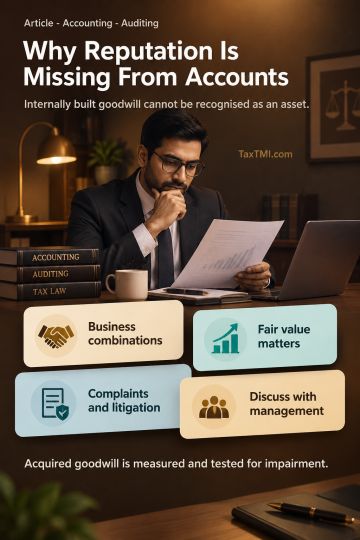
Ind AS won't let a business book its own reputation. Yet that unrecorded asset sets prices, attracts talent, secures credit and decides who survives a crisis.
In September 2015 Volkswagen admitted that software in millions of its diesel cars had been built to cheat emissions tests.
Within days its chief executive had resigned and its share price had plunged. Over the following years the group paid tens of billions in fines, settlements and recall costs around the world.
The day before the admission, none of that trust appeared anywhere on Volkswagen's balance sheet. The most valuable thing the company lost had never been recorded at all.
An asset accountants aren't allowed to see
Open any set of financial statements and you'll find land, buildings, plant, inventory, receivables and cash. You won't find the asset that gives most of them their value: trust.
Accounting standards - IAS 38 and India's Ind AS 38 - don't permit a business to recognise internally generated goodwill or reputation. Goodwill reaches the balance sheet mainly through acquisitions, when a buyer pays more than the fair value of the identifiable net assets: the premium for reputation, relationships and expected earnings.
Every owner knows reputation is real and valuable regardless. It can also vanish faster than any physical asset.
Lesson from history: the merchant's word
Long before courts enforced contracts, cross-continental trade ran on reputation. Avner Greif's research on the medieval Maghribi traders of the Mediterranean showed that a merchant who cheated an agent could be shut out by the entire community, making honesty an economic necessity as well as a moral one. Comparable trust systems operated among Indian merchant communities, Chinese trading networks and Silk Road caravans.
In those networks, a merchant's word was his credit line. That hasn't changed - it's just recorded now in reviews, searches and social media rather than letters between ports.
What reputation does that no salesperson can
- Cuts the cost of selling - referrals bring customers in and trust shortens negotiation.
- Supports pricing - people pay more to businesses they trust to deliver.
- Draws talent - good people want to work somewhere they're proud of.
- Improves credit - lenders and suppliers give better terms to those who keep promises.
- Earns forgiveness - a trusted firm gets a second chance when things go wrong; an untrusted one doesn't.
Reputation is the interest earned on years of promises kept.
The Trust Account
A practical way to think about reputation is the Trust Account. Every interaction with a customer, employee, supplier, lender or regulator is a deposit or a withdrawal:
| Deposits | Withdrawals |
| Delivering on the promised date | Missing a date without warning |
| Sharing bad news early | Hiding a problem until someone finds it |
| Paying suppliers on time | Paying small suppliers late because they can't push back |
| Resolving complaints quickly and generously | Ignoring or blaming the customer |
| Honest marketing claims | Claims the product can't support |
| Treating departing staff with dignity | Withholding settlements or certificates |
Three features make this account unusual:
1. Withdrawals outweigh deposits - one broken promise can cancel many kept ones.
2. The balance is public - visible through reviews, referrals and word of mouth.
3. Everyone can transact - every employee makes deposits or withdrawals in the company's name.
In a nutshell
Essence: reputation is a running balance of promises kept and broken, made by everyone inside the business and visible to everyone outside it.
How reputations actually erode
Rarely through one dramatic event. Usually one small broken promise at a time:
- A delivery date missed without a call.
- A small overcharge in the hope nobody notices.
- A supplier paid sixty days late - again.
- A complaint met with silence.
- An employee treated unfairly in front of colleagues.
- A marketing claim stretched a little too far.
Inside the business each feels trivial. Outside, each becomes a story that travels instantly through reviews, social platforms and messaging groups.
When incentives drain the account
Wells Fargo spent more than a century building a reputation as a solid, customer-focused American bank. Then it emerged that, under intense sales targets, staff had opened large numbers of accounts without customers' consent.
Regulators imposed penalties, and in 2018 the US Federal Reserve took the rare step of capping the bank's asset growth - a restriction lifted only in 2025. The deeper lesson: incentives that reward numbers regardless of method can make thousands of withdrawals at once.
The uncomfortable reality
Many owners spend heavily on branding - logos, websites, advertising - and very little on the behaviour that actually creates a brand. A brand is what you say about yourself; a reputation is what others say when you're not in the room.
No advertising budget can buy back a reputation you've earned.
Daily disciplines of trust
1. Promise less, keep everything
Practice: train sales teams to commit only to what operations can deliver.
2. Tell the truth early
Bad news shared early is a problem; bad news discovered late is a betrayal.
Practice: disclose delays, defects and errors proactively, with a plan.
3. Pay people on time
How a business pays reveals who it is.
Practice: treat payment terms as promises; if you can't pay, call before the due date.
4. Treat complaints as second chances
Practice: respond quickly, acknowledge, fix and follow up - and track resolution as closely as sales.
5. Align incentives with integrity
Practice: include quality, customer satisfaction and compliance in performance measures.
6. Keep marketing honest
Practice: evidence every claim before publishing; misleading claims increasingly draw regulatory action.
7. Behave the same in private as in public
Staff, vendors and partners see how you act when nobody important is watching - and that eventually becomes the public story.
For practitioners: reputation in your own practice and your clients'
- Your firm runs a Trust Account too. Filing deadlines met, notices answered on time and honest advice when it's unwelcome are the deposits that bring referrals - the main growth channel for most CA practices.
- Flag reputational risk in reporting. Consumer complaints, regulatory actions and litigation can signal contingent liabilities and going-concern issues worth discussing with management.
- Watch payment behaviour. Chronic late payment to MSE suppliers carries both a tax cost and a reputational one; highlight it in management letters.
- Account for acquired goodwill correctly. Where clients acquire businesses, ensure goodwill is measured under Ind AS 103 and tested for impairment - and explain that internally built reputation can't be capitalised.
- Advise on review practices. Steer clients away from paid or fake reviews, which now carry legal as well as ethical risk.
Indicators of success
- Repeat business and referrals form a growing share of new revenue.
- Online ratings improve and complaints get timely replies.
- Supplier terms get better over time.
- Hiring gets easier; candidates mention your reputation.
- Lenders and partners decide faster.
Outlook: the coming decade
AI tools already summarise reviews, news and social posts about a business in seconds, so buyers, lenders, employees and regulators will see reputations more completely and quickly than ever. Deepfakes and misinformation will create new forms of reputational attack. Businesses with deep, consistent trust will recover from false stories faster than those whose reputations are thin.
Immediate actions by role
- Owner: personally read the last 50 online reviews and five recent complaints.
- Customer service: set and measure a standard complaint-response time.
- HR: check what current and former staff say publicly.
- Finance: confirm every supplier was paid on agreed terms this quarter.
Illustration from a smaller enterprise
Take an illustrative electrician running a small contracting business. He always arrives when promised, explains costs before starting and fixes his own mistakes free. He spends almost nothing on advertising.
Over ten years his trust account becomes his marketing department: most work arrives by referral, customers accept quotes without long haggling and suppliers give him credit when others pay cash. His reputation never entered his books, yet it was his most valuable asset.
The objection we hear most - and our response
The objection: "People forget. Customers chase price and have short memories. Plenty of firms with poor reputations still make money."
The answer: Some do - for a while, in markets with weak competition or high switching costs. But the cost appears elsewhere: higher acquisition costs, higher attrition, tougher credit, more regulatory attention and no goodwill when a crisis hits. The internet has made memory longer, not shorter. A business with a poor reputation isn't spared the cost; it pays it in places not labelled "reputation."
Measuring what the books can't
- Repeat-purchase and retention rates.
- Share of new business from referrals.
- Online ratings and response quality.
- Suppliers' willingness to extend credit.
- Employee attrition and offer-acceptance rates.
- Complaint volumes and resolution times.
Review them alongside the financials; they often signal future revenue earliest.
Practitioners' FAQ
"Can reputation really be measured?"
Indirectly - through repeat business, referrals, reviews, supplier terms and how quickly partners agree.
"How should a firm recover from a public mistake?"
Acknowledge quickly, fix visibly, compensate fairly and explain what has changed.
"Should a small business manage online reviews?"
Yes - reply to complaints promptly and courteously, and never write or buy fake reviews.
Position as at October 2026: Regulators increasingly treat reputation-damaging conduct as legal risk: India's Central Consumer Protection Authority acts against misleading advertisements and dark patterns; a national standard (IS 19000:2022) covers online consumer reviews; and the US Federal Trade Commission's rule banning fake reviews took effect in 2024. Buying reviews is no longer just unethical - it is increasingly unlawful.
Pitfalls
- Buying fake reviews or suppressing genuine negative ones.
- Blaming customers publicly in disputes.
- Breaking promises to small suppliers because "they can't do anything."
- Treating compliance lapses as private matters that will never surface.
- Assuming past goodwill will protect you indefinitely.
Half-hour action exercise: audit the Trust Account
List the last ten complaints, delays or disputes - with customers, suppliers or staff. Mark each a deposit (handled well, trust grew) or a withdrawal (handled badly, trust fell).
Then ask the team: "Which promise do we break most often?" Fix that one first.
Summary for busy professionals
- Internally built reputation can't be capitalised, yet it drives pricing, selling costs, talent, credit and resilience.
- Treat it as a Trust Account: every interaction is a deposit or withdrawal, withdrawals weigh more and the balance is public.
- Reputations usually erode through small broken promises, and misaligned incentives can drain them at scale.
- Build trust daily: fewer, kept promises; early truth; prompt payment; generous complaint handling; honest incentives and marketing.
- Measure it through retention, referrals, reviews, supplier behaviour and staff data.
The accounts show what a business owns. Its reputation shows what it's worth.
References
- US Environmental Protection Agency, Volkswagen violations and settlements (2015 onward). epa.gov
- Avner Greif, Institutions and the Path to the Modern Economy: Lessons from Medieval Trade (Cambridge University Press, 2006).
- Board of Governors of the Federal Reserve System, enforcement action against Wells Fargo (February 2018) and termination of the asset cap (2025). federalreserve.gov
- Ind AS 38 / IAS 38 (Intangible Assets) and Ind AS 103 / IFRS 3 (Business Combinations) on goodwill.
- US Federal Trade Commission, Trade Regulation Rule on the Use of Consumer Reviews and Testimonials (2024). ftc.gov