 TaxTMI







 23 Nov 2026

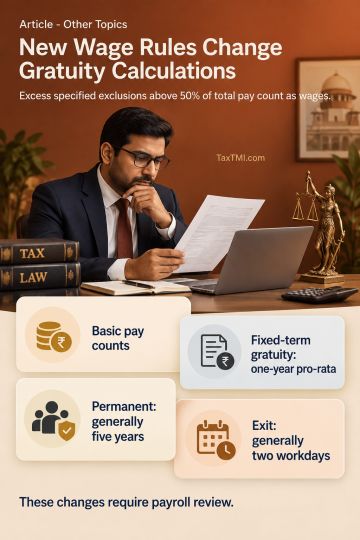
Twenty-nine central laws are now four codes. The real change isn't in the names but in salary structures, gratuity provisions, exits and how workers are engaged.
For years, payroll structuring advice in India followed one quiet principle: keep basic pay low and allowances high. It reduced PF, gratuity and bonus outgo, and nobody seriously challenged it.
That principle has now collided with a single definition of "wages" and a 50% ceiling on exclusions. For many clients the result is a larger wage base, a higher gratuity liability and an actuarial valuation that no longer matches last year's numbers.
Four codes, two decades in the making
On 21 November 2025 India brought four labour codes into force and retired 29 central labour laws, some dating from before Independence.
The idea wasn't new. In 2002 the Second National Commission on Labour recommended consolidating India's many labour statutes into a handful of broad codes. Parliament passed them in 2019 and 2020, and implementation took five more years.
Many employers spent those years assuming the codes would never arrive. They have - and businesses that prepared are adjusting, while those that waited are finding liabilities inside their own payroll.
The four codes at a glance
| Code | What it covers |
| Code on Wages, 2019 | Wage floors, timely payment, statutory bonus and pay equality |
| Industrial Relations Code, 2020 | Unions, standing orders, dispute resolution, and rules on lay-off, retrenchment and closure |
| Code on Social Security, 2020 | PF, ESI, gratuity, maternity benefit and cover for gig and platform workers |
| OSH and Working Conditions Code, 2020 | Workplace safety and health, hours, leave, contract labour and inter-state migrants |
States also frame rules under the codes and have been notifying them at different paces. Every employer must track both central and state rules for each location.
Lesson from history: the 1881 Factories Act
India's first Factories Act, passed in 1881, limited working hours for children and required basic fencing around machinery. Mill owners protested that Indian industry would become uncompetitive.
The mills survived; what changed was the definition of a responsible employer.
Each generation of labour law has followed that arc: a cost business once called impossible becomes, within a decade, the baseline nobody questions. The codes are the latest step.
Seven changes with the biggest financial impact
1. A single definition of wages - and the 50% rule
Broadly, basic pay, dearness allowance and retaining allowance count as wages, while specified allowances and payments are excluded. Where the excluded components exceed 50% of total remuneration, the excess is added back to wages.
Structures built on low basic pay and high allowances no longer deliver the old savings.
2. Gratuity for fixed-term staff after one year
Fixed-term employees qualify for pro-rata gratuity after one year of continuous service, rather than the five years that still generally apply to permanent staff.
3. Final settlement within two working days
Whatever the reason employment ends - resignation, removal, dismissal, retrenchment or closure - dues are ordinarily payable within two working days.
4. Social security for gig and platform workers
Gig and platform workers are recognised for the first time. Aggregators contribute to social security funds, with the Code providing for 1%-2% of annual turnover, capped at 5% of amounts paid or payable to such workers.
5. Higher thresholds for lay-off and retrenchment approval
Establishments now need standing orders, and government sanction before laying off, retrenching or closing, only once they employ 300 workers rather than 100 - though states can vary this.
6. Working hours and flexibility
Caps on daily and weekly hours remain, but more flexible arrangements, including compressed weeks, are allowed. Hours worked beyond the prescribed limit earn double the normal rate.
7. Women, appointment letters and digital compliance
Women can be employed in every type of establishment, including on night shifts, provided they consent and safety conditions are met. Every worker must now receive an appointment letter, and registrations, licences and returns move towards single digital filings.
The codes simplify the statute book. They don't make ignoring it any cheaper.
In a nutshell
Essence: the codes alter the wage base, gratuity exposure, exit timelines and gig-worker costs - so payroll, contracts and provisions all need re-testing.
The uncomfortable reality
Many salary structures were designed around one objective: keep basic as low as possible.
That saved contributions but also shrank employees' retirement savings and gratuity. The codes close much of that gap.
Employers who resist won't escape the cost; they'll pay it later with arrears, interest, disputes and a damaged reputation among the people they most need.
A structure built to minimise obligations isn't efficient. It's a liability deferred.
The Code Readiness Grid
Mark each area Ready, In progress or Not started:
1. Pay structure - Does every salary pass the 50% test? Has the new base for PF, gratuity and bonus been calculated?
2. Provisions - Have gratuity and leave provisions been recomputed, including for fixed-term staff?
3. Contracts and letters - Have offer letters, fixed-term agreements and contractor contracts been redrafted for the codes?
4. Exit process - Can a full and final settlement be computed and paid within two working days?
5. Workforce model - Are gig, platform or contract workers engaged, and are registrations, contributions and contractor compliance in order?
Every "Not started" is a priority this quarter.
For practitioners: the payroll re-test
- Run the 50% test employee by employee from the payroll export, and quantify the add-back for each.
- Ask the actuary for a revised Ind AS 19 / AS 15 valuation using the new wage base, and consider whether the change is a plan amendment affecting past service cost in the current period.
- Check bonus eligibility and computation under the Code on Wages using the revised wage definition.
- Review contractor compliance for wage payment, PF and ESI, given principal-employer exposure.
- Map state rules for every location where the client employs staff, since thresholds and procedures can differ.
Illustration
Take an illustrative employee earning Rs. 60,000 a month, structured as:
- Basic pay: Rs. 21,000 (35%)
- Allowances: Rs. 39,000 (65%)
Applying the 50% rule:
- The allowance ceiling is half of Rs. 60,000, i.e. Rs. 30,000.
- The Rs. 9,000 above that ceiling is treated as wages.
- The statutory wage base therefore rises from Rs. 21,000 to Rs. 30,000.
Gratuity impact (familiar 15/26 formula):
- Old base: Rs. 21,000 x 15/26 Rs. 12,115 per year of service.
- New base: Rs. 30,000 x 15/26 Rs. 17,308 per year of service.
- An increase of about 43%.
Across 200 employees like this with six years' average service, that is an extra Rs. 62 lakh or so of gratuity liability without any change in salary. Unprovided, the next audit or a wave of resignations will expose it.
The cost was there in principle; the codes made it visible.
What clients should do now
1. Recalculate every salary structure against the 50% test.
2. Refresh the gratuity and leave-encashment provisions, bringing in fixed-term employees who cross one year.
3. Talk to employees early - take-home pay may dip where contributions rise, so explain the long-term benefit before payslips change.
4. Redesign the exit process - approvals, asset return, calculation and payment - to fit two working days.
5. Examine how contractors and gig workers are engaged and whether registrations and contributions are due.
6. Put an appointment letter in every worker's hands.
7. Follow the state rules in each state of operation.
8. Update payroll software and test calculations before the next cycle.
Indicators of success
- Every salary structure passes the 50% test.
- Gratuity and leave provisions are recomputed and audited.
- Leavers receive their dues inside the two-working-day window.
- Where the law requires it, gig and contract workers are registered and covered.
- Employee questions about pay changes are answered promptly and clearly.
Outlook: the coming decade
The codes lay the ground for digital registrations, unified returns and broader social security, including for gig workers. As state rules settle and enforcement becomes data-driven, gaps will be easier to detect. Employers who use the codes to redesign fair, transparent pay will find hiring and retention easier.
Immediate actions by role
- Owner: ask for the total change in wage base and gratuity liability.
- HR head: prepare a simple explanation for employees of how structures are changing.
- Payroll team: test the two-day settlement on the next resignation.
- CFO: revise provisions and budgets for the higher wage base.
The objection we hear most - and our response
The objection: "The codes raise our employee cost. In a competitive market we can't afford it, so we'll wait for clarity or enforcement."
The answer: Often the codes don't create a new cost; they reveal one that structures were designed to avoid. Waiting doesn't remove it - it adds arrears, interest and disputes. Employers who adjust early can phase changes, explain them and plan pricing; those who wait face the same bill all at once. And in a tight talent market, a fair, transparent pay structure is itself a hiring advantage.
Practitioners' FAQ
"Do the codes apply to small businesses?"
Many provisions depend on headcount and establishment type, while some - timely payment and minimum wages, for instance - apply to all employers. Check thresholds code by code and state by state.
"Will take-home pay fall?"
It can, where a higher wage base raises employee contributions. Total remuneration needn't change, but the split between cash in hand and long-term savings may.
"Are existing fixed-term contracts affected?"
Gratuity eligibility after one year for fixed-term employees applies under the Code on Social Security. Review existing contracts with advisers.
"Does the two-day rule cover resignations?"
Yes. The Code on Wages covers cessation by resignation as well as removal, dismissal, retrenchment and closure.
Position as at October 2026: The four labour codes have been in force since 21 November 2025. Central rules and state rules are being notified in stages, and some provisions depend on them. Check the latest central and state notifications for each location before finalising pay structures, provisions and contracts.
Pitfalls
- Assuming last year's salary structure is still compliant.
- Recomputing PF but forgetting gratuity, bonus and leave encashment.
- Changing payslips without explaining why.
- Treating contract and gig workers as someone else's concern.
- Overlooking state rules where the client has branches or plants.
Half-hour action exercise
Export one month's payroll. For each employee, divide excluded allowances by total remuneration and count how many exceed 50%.
Estimate the increase in their wage base and apply the gratuity formula. That one figure shows how urgent the client's labour-code project is.
Summary for busy professionals
- Four labour codes replaced 29 central laws on 21 November 2025, more than twenty years after the 2002 recommendation to consolidate them.
- The 50% wage rule can lift the base for PF, gratuity and bonus; fixed-term staff earn gratuity after one year; final settlements fall due within two working days.
- Gig and platform workers gain social security, funded partly by aggregators.
- Grade readiness across pay structure, provisions, contracts, exit process and workforce model.
- Act early, explain changes to staff, revise actuarial valuations and track state rules.
The law has moved. Payroll has to move with it - before the bill turns up uninvited.
References
- Ministry of Labour and Employment, Government of India - the Code on Wages, 2019; the Industrial Relations Code, 2020; the Code on Social Security, 2020; the Occupational Safety, Health and Working Conditions Code, 2020, and notifications of November 2025. labour.gov.in
- Press Information Bureau, release on the implementation of the four labour codes (21 November 2025). pib.gov.in
- Report of the Second National Commission on Labour (2002), Ministry of Labour, Government of India.
- The Indian Factories Act, 1881 (Act XV of 1881).