 TaxTMI







 23 Nov 2026

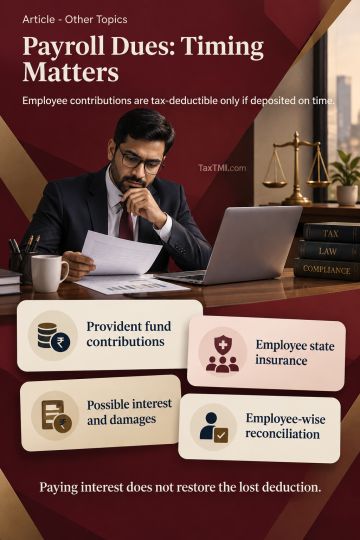
Salaries go out on time because employees would complain otherwise. Deductions slip because nobody complains - until the department or the tax officer does.
Tax auditors see it every year in the clause on employee contributions: a column of PF and ESI deposits made a week, a fortnight, sometimes two months after the due date. Each entry looks harmless. Added together they can turn into a disallowance that pushes the client's taxable income up by lakhs.
Payroll problems rarely announce themselves. They build up quietly, month after month, and then land all at once.
The ruling that changed the arithmetic
In October 2022 the Supreme Court decided Checkmate Services Pvt. Ltd. v. Commissioner of Income Tax. The question was whether an employer that deducts employees' PF and ESI contributions but deposits them after the due date under the welfare law can still claim a tax deduction for those amounts.
The Court's answer was no. Employees' contributions are held in trust; if they aren't deposited by the due date under the relevant statute, the deduction is lost permanently.
For many businesses, a few days' delay suddenly became taxable income, on top of interest and damages under labour law.
Why payroll is unlike other expenses
Most expenses involve the business's own money. Payroll doesn't. Every month the employer:
- Pays employees.
- Withholds tax, PF, ESI and professional tax from their pay.
- Adds its own contributions.
- Holds those sums briefly as a trustee.
- Remits them to the authorities by fixed dates.
- Reports them in returns and certificates.
Late salary gets noticed at once. Deductions are invisible - until an employee opens a PF passbook, checks a tax credit or tries to use ESI and finds nothing there.
Lesson from history: the tomb-builders' strike
Around 1157 BCE, in the reign of Ramesses III, the craftsmen building the royal tombs at Deir el-Medina in Egypt downed tools because their grain rations - their wages - were weeks overdue. A papyrus now held in Turin records them sitting near the temples and declaring, in effect, that they were hungry.
It is often described as the earliest recorded strike.
Three thousand years on, the principle holds: people tolerate a demanding employer, but not one who withholds what belongs to them. Today, what belongs to them includes the deductions held on their behalf.
Where the silent liabilities hide
1. Provident fund
Employer and employee contributions fall due monthly. Late payment draws interest and damages that climb with the delay, and deducting the employee share without depositing it can lead to prosecution. Under-computing wages - especially after the labour codes' 50% rule - creates arrears.
2. ESI
Where applicable, contributions must be deposited on time. Delay attracts interest and damages and, more seriously, can leave employees struggling to access medical and cash benefits when they need them.
3. Tax deducted from salaries
Tax must be estimated correctly, deducted, deposited, reported quarterly and reflected in annual certificates. Errors bring interest, fees and penalties, and employees' credits stop matching their returns.
4. Professional tax and labour welfare fund
State-level levies with their own registrations, rates and dates - small sums, often forgotten and often discovered in due diligence.
5. Gratuity, bonus and leave
Statutory bonus where applicable, gratuity and leave encashment accumulate over time. Without proper provisions they surprise owners at exits, sales and audits.
6. Misclassified workers
"Consultants" who work like employees, interns without proper terms, contract workers whose contractor hasn't paid their dues - the principal employer may remain liable.
A late salary produces an angry employee. Late deductions produce an angry regulator - and both have long memories.
In a nutshell
Essence: payroll compliance isn't about paying salaries; it's about remitting, reporting and providing for everything that surrounds them.
The uncomfortable reality
When cash is tight, some owners pay salaries on time but hold back the PF, ESI or tax deducted from them. It feels like a short loan from the government.
It isn't a loan. It's employees' money and the state's money, used without permission. The price is interest, damages, lost deductions, possible prosecution and - once employees find out - a collapse of trust.
Deducted-but-not-deposited is the most expensive working capital a business can use.
The Three-D Payroll Rule
Every statutory amount should pass three tests each month.
D1 - Deduct correctly
- The right wage base, including the labour codes' definition.
- The right rates and ceilings.
- The right tax estimate, based on declarations and proofs.
- The right state levies for each location.
D2 - Deposit on time
- A due-date calendar covering every contribution and tax.
- A separate approval line for statutory payments so cash pressure can't quietly defer them.
- Challans saved and matched to payroll.
D3 - Declare accurately
- Monthly and quarterly returns filed on time.
- Employee-wise details agreeing with payroll.
- Annual certificates issued to staff.
- Gratuity, bonus and leave provisions refreshed at least yearly.
A payroll that clears all three every month can't accumulate a silent liability.
For practitioners: what to check and report
- Prepare a deposit-date schedule for the tax audit showing, for every month, the amount deducted, the due date under the welfare statute and the actual deposit date, so late items are identified before the return is filed.
- Compute the disallowance early. Quantify the effect of late employee contributions on taxable income and advance tax, rather than discovering it at filing.
- Reconcile ECR and ESI challans to payroll employee by employee, not just in total.
- Reconcile salary TDS - payroll, quarterly statements, challans and Form 16 - before issuing certificates.
- Review classification of consultants, interns and contract staff at least once a year, and document the basis.
Illustration
Take an illustrative 120-employee services company in a cash squeeze. For five months it pays salaries on time but deposits employee PF and ESI four to eight weeks late.
The bill once the auditor raises it:
- Interest and damages on the late PF and ESI.
- Under Checkmate, the late-deposited employee contributions are disallowed, adding their full amount to taxable income.
- Three employees who needed ESI benefits face delays, and one complains.
- Management, HR and adviser time spent resolving notices.
A "loan" of a few lakh rupees for a few weeks ends up costing several times that - and the HR head notes that two strong performers left after finding gaps in their PF passbooks.
The fix: a separate approval and payment line for statutory dues, a shared due-date calendar and a monthly deduction-to-deposit reconciliation signed by the finance head.
Building a clean payroll system
1. One master record per employee - personal details, wage structure, location, PF and ESI numbers, tax regime and declarations.
2. A monthly checklist - joiners, leavers, pay changes, attendance and leave, arrears and recoveries.
3. Automated calculation, human review by someone who understands the logic.
4. Deduction-to-deposit reconciliation for every component, every month.
5. A due-date calendar with named owners, not just reminders.
6. Quarterly classification review of consultants, interns and contract workers.
7. Annual actuarial or reasoned provisions for gratuity and leave.
8. Employee self-service so staff can see payslips, tax statements and contribution records.
Indicators of success
- Amounts deducted equal amounts deposited for every statutory component.
- Deposits are made on or before due dates, every month.
- Returns and statements agree with payroll without later corrections.
- Employee queries about missing PF, ESI or tax credits fall close to zero.
Outlook: the coming decade
Payroll is becoming wholly digital and connected: PF, ESI, tax and labour-code returns are filed online and employees can check their own records on their phones. Any gap between what is deducted and what is deposited will be visible to staff and regulators almost immediately. Automated payroll with human review will become the minimum.
Immediate actions by role
- Owner: approve statutory payments separately from other payables every month.
- Payroll team: prepare a deducted-deposited-date sheet for the last three months.
- HR: review every consultant and intern for correct classification.
- CFO: confirm gratuity and leave provisions reflect the labour codes.
The objection we hear most - and our response
The objection: "We're a small company. Payroll software and providers are expensive, and the errors are minor. We'll tidy up at year-end."
The answer: Payroll errors are seldom minor once they accumulate. Interest and damages grow with time, tax disallowances can be permanent, and employees whose deductions vanish lose trust instantly. Reliable software or a provider costs far less than a year of compounding mistakes. If cost is the worry, start with the Three-D checklist in a spreadsheet - but start this month, not in March.
Practitioners' FAQ
"Can statutory dues be paid late if interest is paid?"
Interest doesn't cure everything. Late payment can still bring damages, loss of the deduction for employees' contributions and, in serious cases, prosecution - and it harms employees.
"Who is liable if the payroll provider makes a mistake?"
Generally the employer remains legally responsible. The contract may allow recovery of losses, but not escape from the liability.
"Are interns and consultants within payroll compliance?"
That depends on the real relationship, not the label. Someone who works like an employee may be treated as one.
"How often should PF and ESI records be checked?"
Monthly reconciliation is best practice; at the very least, a quarterly check that deposits match deductions for each employee.
Position as at October 2026: Payroll in India now operates under the four labour codes (in force from 21 November 2025) and the Income-tax Act, 2025 (in force from 1 April 2026), which consolidated tax-deduction provisions. Check updated wage definitions, contribution rules, due dates, return formats and state levies for each location.
Pitfalls
- Funding working capital with statutory deductions.
- Calculating contributions on an outdated wage definition.
- Missing state levies when opening new locations.
- Treating long-term "consultants" as non-employees without review.
- Leaving gratuity and leave liabilities unprovided.
Action checklist
Deductions and deposits agree every month
Statutory payments on their own approval line
Deposit-date schedule ready for the tax audit
Half-hour action exercise
Take last month's payroll. For each statutory component - PF, ESI, tax deducted, professional tax - write three figures: amount deducted, amount deposited and date deposited.
Any deposit below the deduction, or any date after the due date, is a silent liability. Fix it before the next payroll run.
Summary for busy professionals
- Payroll creates obligations well beyond salary - PF, ESI, tax deducted, state levies, gratuity, bonus and leave.
- Since Checkmate Services (2022), employee contributions deposited after the due date aren't deductible, so delay can become taxable income.
- Treating deductions as working capital is expensive and corrodes employee trust.
- Apply the Three-D rule: deduct correctly, deposit on time, declare accurately.
- Keep one master record, reconcile monthly, assign due dates to named owners and review classification regularly.
What is deducted is held in trust - and should be handled as trust money every single month.
References
- CHECKMATE SERVICES P. LTD. Versus COMMISSIONER OF INCOME TAX-1 - 2022 (10) TMI 617 - Supreme Court (LB).
- Employees' Provident Fund Organisation - contribution, interest and damages provisions. epfindia.gov.in
- Employees' State Insurance Corporation - contribution and benefit rules. esic.gov.in
- Ministry of Labour and Employment - the Code on Wages, 2019 and the Code on Social Security, 2020. labour.gov.in
- John Romer, Ancient Lives: The Story of the Pharaohs' Tombmakers (Weidenfeld & Nicolson, 1984) - on Deir el-Medina and the Turin Strike Papyrus.