 TaxTMI







 23 Nov 2026

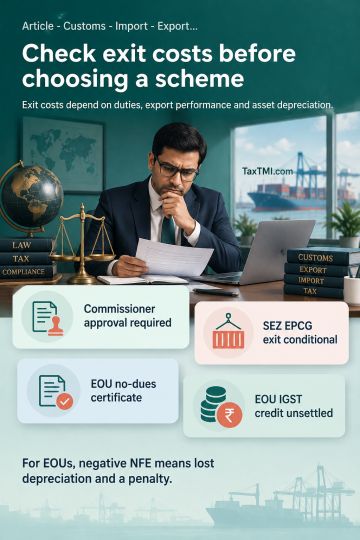
Most companies choose between an SEZ unit and an EOU on the entry benefits: duty-free imports and GST relief on local purchases.
Then, 6 or 8 years later, the business changes. Export orders slow down, or the parent wants to sell into India. That's when the bill shows up, and it's usually a customs bill.
So before you set up a new unit, test both schemes on 4 things: duty and GST, location, compliance, and exit. Exit is the one that gets skipped.
SEZ and EOU: where each scheme sits in law
An SEZ unit is governed by the Special Economic Zones Act, 2005 and the SEZ Rules, 2006. Under Section 53(1) of the Act, the zone is deemed to be outside the customs territory of India for authorised operations.
An EOU is governed by Chapter 6 of the Foreign Trade Policy 2023 and the Handbook of Procedures. Its customs exemption flows from Notification No. 52/2003-Customs dated 31.03.2003, and since 2021 EOUs have worked under the IGCR procedure (Circular No. 10/2021-Customs).
That one structural difference drives almost everything below. An SEZ is foreign territory for customs purposes. An EOU is a bonded unit inside India.
Duty and GST on entry
Both schemes give you duty-free imports, subject to conditions.
For an SEZ unit, Section 26(1)(a) of the SEZ Act exempts goods imported for authorised operations from customs duty. Local purchases are zero-rated supplies under Section 16(1)(b) of the IGST Act, so your DTA supplier either ships under LUT or pays IGST and claims a refund. No GST cost sits on your books.
For an EOU, Notification No. 52/2003-Customs exempts basic customs duty, IGST and compensation cess on imports. The IGST exemption used to carry an expiry date that was extended year after year, until Notification No. 37/2022-Customs removed the date limit on the 47th GST Council's recommendation.
Local purchases by an EOU are deemed exports under Section 147 of the CGST Act read with Notification No. 48/2017-Central Tax. Your supplier charges GST, and either the supplier or the EOU claims the refund under Rule 89 of the CGST Rules (procedure in Circular No. 14/14/2017-GST).
So an EOU does get GST relief on domestic procurement. It comes as a refund, and cash stays blocked until the refund is paid. For a unit with heavy domestic sourcing, that working capital gap is real.
Selling into the domestic market
This is where the two schemes split hardest.
Under Section 30(a) of the SEZ Act, goods removed from an SEZ to the DTA are chargeable to customs duty, including anti-dumping, countervailing and safeguard duties, as if they were imported. If your product carries a high tariff, DTA sales from an SEZ are expensive.
There's a temporary window right now. Notification No. 11/2026-Customs dated 31.03.2026, issued after the Union Budget 2026-27 announcement, allows concessional BCD and AIDC on goods made by eligible SEZ units and cleared into the DTA from 1 April 2026 to 31 March 2027.
The conditions are tight. Only units that began production on or before 31 March 2025 qualify, and the goods need at least 20% value addition. The yearly cap is 30% of the unit's highest FOB exports in any of the 3 preceding years.
Traded goods and FTWZ units are out. The unit also has to declare that it will pay full duty if any condition fails. IGST, Social Welfare Surcharge and Health Cess still apply at normal rates.
The relief expires in March 2027, so a 10-year business plan can't count on it.
An EOU sells into the DTA only after achieving positive NFE. The finished goods carry GST like any domestic supply, and you reverse the basic customs duty foregone on the inputs that went into them. Circular No. 07/2021-Customs requires AIDC foregone to be paid back the same way.
Do the arithmetic for your own product. An SEZ unit pays import duty on the full value of the finished goods, while an EOU pays back the duty it saved on inputs. If your value addition is high, the EOU route is usually cheaper for domestic sales.
Location: inside a zone or on your own land
An SEZ unit has to operate inside a notified zone. In practice, that means space taken on lease from the developer or co-developer, so a factory you already own outside the zone can't become an SEZ unit.
An EOU can be set up anywhere in India, subject to approval. Under Para 6.18(a) of FTP 2023, an existing DTA unit can apply to convert into an EOU. Applications with plant and machinery of Rs. 50 crore or more, or annual exports of Rs. 50 crore or more, go to the Board of Approval under Para 6.18(c).
If you already own a plant and the business is export-heavy, the EOU route lets you keep it. The SEZ route means a lease and a move, and you'll need the developer's cooperation again when you leave.
Compliance and the NFE obligation
Both schemes require you to be a positive net foreign exchange earner.
For an SEZ unit, Rule 53 of the SEZ Rules computes NFE cumulatively over 5 years from the start of production. If the Approval Committee finds the unit hasn't achieved positive NFE, Rule 54(2) makes it liable to penal action under the Foreign Trade (Development and Regulation) Act, 1992.
For an EOU, Para 6.04 of FTP 2023 applies the same positive NFE test over 5-year blocks from the start of production. The unit files periodic performance reports and keeps IGCR records for the customs officer.
The NFE tests are close to identical. In our experience the day-to-day SEZ burden is heavier, because every movement across the zone boundary needs documentation through the SEZ system. That includes laptops issued to employees who work from home.
Exit from an SEZ: Rule 74 and the used IT asset problem
Rule 74 of the SEZ Rules lets a unit opt out with the Development Commissioner's approval. On exit, you pay applicable duties and taxes on the capital goods, raw materials, components, consumables, spares and finished goods still in stock.
Capital goods get depreciation under Rule 49(1), applied through Rule 74(5). Rule 74 also gives a one-time option to exit by paying duty on capital goods under the prevailing EPCG scheme, if you meet EPCG eligibility. You execute a legal undertaking in Form L.
Because the SEZ is outside the customs territory, everything that crosses into the DTA on exit is treated as an import. That brings in import policy, and import policy is where the IT hardware issue sits.
DGFT Notification No. 56/2023 dated 01.01.2024 inserted Para 2.31 I(e) into FTP 2023 for used laptops, desktops, monitors and printers moving from an SEZ to the DTA. The default is restricted. They move without a licence if they've been used in the SEZ for at least 2 years and are not more than 5 years old from the date of manufacture.
A unit closing down and relocating to the DTA can move them without a licence if they're not more than 5 years old. Assets that came into the SEZ second-hand and have been used there for less than 2 years aren't covered by either relaxation.
There's one more condition. Neither relaxation applies if a CRO, WPC or RoHS exemption was used when the assets were first brought into the SEZ. Anything outside these criteria needs a restricted import licence from DGFT.
Servers aren't in that notification. A used server leaving an SEZ falls back on the general second-hand rules in Para 2.31, including item I(b) for electronics and IT goods notified under the Compulsory Registration Order, 2021. Confirm the position for your model before you assume it will clear freely.
For an IT or GCC unit with 1,000 employees, a 6-year-old laptop fleet and a server room, this can hold up the whole exit.
Exit from an EOU: Para 6.17 of FTP 2023
An EOU exits under Para 6.17 of FTP 2023 with the Development Commissioner's approval. You pay applicable customs duty, GST and compensation cess on the capital goods and inputs in the unit, and Para 6.17(b) adds a penalty if you haven't met your obligations.
Para 6.17(e) sets the procedure. You notify the Development Commissioner and customs, assess your own duty liability, and get a No Dues Certificate once dues are cleared.
The final exit order normally issues within 7 working days if no proceedings are pending under the FT(D&R) Act. Disputed amounts can be covered by a bank guarantee, bond or instalments so the exit isn't held up.
Para 6.17(d) allows exit into the EPCG scheme, subject to positive NFE and EPCG eligibility. Under Para 6.17(f), capital goods that a converted DTA unit originally bought duty-paid can go back to the DTA without duty.
An EOU can also shift into an SEZ. Para 6.38(c) of the Handbook allows this with the Development Commissioner's approval, once the EOU has met its pro-rata obligation.
The NFE position carries the most weight at exit. Duty on capital goods is confirmed after allowing depreciation only if NFE is positive. With negative NFE, you lose depreciation and face the Para 6.17(b) penalty.
There's one open GST issue. When an EOU pays IGST through a customs challan during debonding, whether it can take ITC of that IGST hasn't been clearly settled. Industry bodies raised the question with the government in July 2026, so budget for that IGST as a possible cost until there's a clarification.
An illustrative comparison
Take a software and engineering services unit with 800 employees and Rs. 25 crore of capital goods, mostly laptops, servers and networking gear. It has 7 years of positive NFE, and the group now wants to move the team into a domestic entity.
As an SEZ unit, it pays customs duty and IGST on the depreciated value of every asset that leaves the zone. Laptops older than 5 years need a DGFT licence, the servers need a separate import policy check, and the lease has to be unwound.
As an EOU in its own premises, it pays duty on depreciated capital goods under Para 6.17. There's no zone boundary to cross and no Para 2.31 I(e) licence issue on the laptops.
These figures are illustrative. Based on the exits we've handled, asset-heavy IT and services units usually pay more to leave an SEZ.
For a manufacturer with large imported inventory and weak exports, the answer can flip. An EOU that exits with negative NFE loses depreciation and pays a penalty, which can make it the more expensive exit.