 TaxTMI





 19 Nov 2026

Introduction
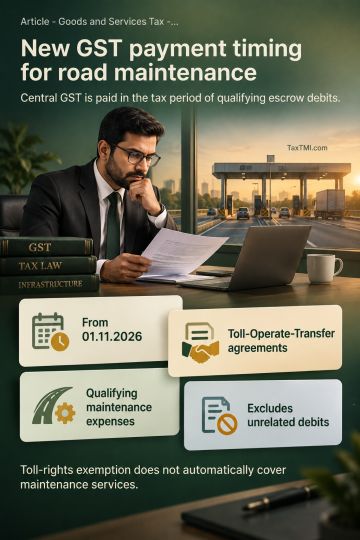
The Government has introduced a special procedure for payment of Goods and Services Tax on operation and maintenance services supplied by concessionaires under the Toll-Operate-Transfer (TOT) model. Notification No. 10/2026-Central Tax (Rate) dated 27.10.2026, issued under Section 148 of the Central Goods and Services Tax Act, 2017, has come into force on 01.11.2026. It provides that specified registered concessionaires shall pay Central GST on the amount charged or debited from the Escrow Account towards operation and maintenance expenses in the tax period in which such expenditure is charged or debited.
The amendment is significant because road and highway concession arrangements involve substantial financial commitments, long concession periods, toll collections and expenditure incurred over several years. The concessionaire ordinarily pays a considerable sum upfront to obtain the right to operate a road or highway and recover its investment through toll collections. At the same time, it remains responsible for maintaining the infrastructure in accordance with the concession agreement. The Government has now prescribed a mechanism linking GST payment on specified operation and maintenance services to the amounts charged or debited from the designated Escrow Account.
The notification does not introduce a new GST rate, grant an exemption or bring toll collections themselves within the scope of this special procedure. Its principal purpose is to prescribe a specific payment mechanism for operation and maintenance services supplied by a defined class of registered concessionaires. Its scope and implications must therefore be examined in the context of the statutory provisions and the contractual arrangements governing the TOT model.
Understanding the Toll-Operate-Transfer Model and Its Commercial Significance
Under the Toll-Operate-Transfer model, the Government or another eligible public authority grants a concessionaire the exclusive right to demand, collect and appropriate tolls in respect of an existing road or highway for a specified concession period. In consideration of these rights, the concessionaire pays an upfront concession fee and assumes responsibility for operating and maintaining the road or highway throughout the concession period.
The model differs from an ordinary construction or maintenance contract. The concessionaire is not necessarily engaged to construct a new road or highway. Instead, it acquires the right to operate an existing infrastructure asset, collect tolls from users and maintain the asset for the agreed period. Its commercial return depends upon traffic volume, toll collections, operating expenditure, maintenance obligations and the amount paid upfront to obtain the concession.
Illustration 1
Harpreet Limited enters into a TOT concession agreement with an eligible Government authority to operate a national highway for 20 years. It pays an upfront concession fee of Rs. 500 crore and receives the exclusive right to collect tolls during the concession period. It must also undertake routine maintenance, repairs and other operational activities.
Notification No. 10/2026 concerns the specified operation and maintenance services supplied by Harpreet Limited to the concessioning authority and the corresponding amounts charged or debited from the prescribed Escrow Account. The upfront concession fee and toll collections represent separate elements of the arrangement and must be examined under their respective GST provisions.
Section 148 Empowers the Government to Prescribe Special Procedures
Section 148 of the CGST Act, 2017 empowers the Government, on the recommendations of the GST Council, to notify specified classes of registered persons and prescribe special procedures for them. Such procedures may concern registration, furnishing of returns, payment of tax and administration of the GST law. The provision recognises that particular classes of taxpayers may require a specially prescribed compliance mechanism because of the nature of their business arrangements.
Exercising this power, the Central Government has notified concessionaires operating under specified TOT arrangements as the class of registered persons covered by Notification No. 10/2026-Central Tax (Rate). The notification identifies both the eligible persons and the payment procedure applicable to their specified operation and maintenance services. Consequently, this procedure is not generally available to every highway contractor, toll operator or person supplying maintenance services to a Government authority.
An important distinction must be maintained between a special procedure for payment of tax and an amendment to the ordinary time-of-supply provisions. Notification No. 10/2026 does not expressly amend Section 13 of the CGST Act. Instead, it prescribes a specific procedure under Section 148 for the notified class of registered persons. Its application must therefore remain confined to the persons, transactions and conditions expressly covered by the notification.
Only Specified Registered Concessionaires Are Covered
The notification applies to a concessionaire under a concession agreement who supplies operation and maintenance services to the concessioning authority during the concession period. The concessionaire must be a registered person, the agreement must satisfy the prescribed definition of a TOT concession agreement, and the services must be supplied to the concessioning authority during the concession period.
The notification defines a concession agreement as an agreement entered into between the concessionaire and the concessioning authority under the TOT model. The agreement must grant the concessionaire exclusive rights to demand, collect and appropriate toll in respect of a road or highway, require the concessionaire to operate and maintain that infrastructure during the concession period, and provide for payment of the concession fee upfront. These essential characteristics distinguish the notified concessionaire from an ordinary service contractor.
Illustration 2
Aayra Limited enters into a contract with a Government authority solely to maintain a highway for an annual consideration of Rs. 8 crore. It does not receive any right to collect tolls and is not required to pay an upfront concession fee.
Although Aayra Limited supplies highway maintenance services, it does not satisfy the requirements of the notified TOT arrangement. Consequently, the special payment procedure under Notification No. 10/2026 does not apply merely because the company undertakes highway maintenance work. Its GST liability continues to be governed by the otherwise applicable provisions.
Meaning and Importance of the Concessioning Authority
The notification expressly defines concessioning authority to mean the Central Government, State Government, Union territory, local authority, Governmental Authority or Government Entity entering into the concession agreement. The definition is important because the special procedure concerns operation and maintenance services supplied by the concessionaire to such an authority under the prescribed contractual arrangement.
The expression must not be confused with every organisation associated with a road or highway project. A private contractor appointed by the concessionaire to perform repairs or maintenance does not automatically become a concessioning authority. Similarly, an ordinary commercial agreement between two private businesses does not qualify merely because the work relates to road infrastructure. The identity of the authority granting the concession and the legal nature of the agreement are therefore material.
Illustration 3
Kirti Limited receives a TOT concession from an eligible State Government authority. During the concession period, it appoints Anish Kapoor, an independent contractor, to undertake road repairs and maintenance.
The special procedure may apply to qualifying operation and maintenance services supplied by Kirti Limited to the concessioning authority. However, the services Anish Kapoor supplied to Kirti Limited constitute separate transactions. Anish Kapoor cannot claim the special procedure merely because his services relate to a highway operated under the TOT model.
Escrow Account Debits Become the Basis for the Special GST Payment Procedure
The central feature of Notification No. 10/2026 is its linkage of GST payment to amounts charged or debited from the Escrow Account maintained under the concession agreement. The notification provides that the registered concessionaire shall pay Central GST on the amount charged or debited from that account towards operation and maintenance expenses in the tax period in which such expenditure is charged or debited.
An Escrow Account is generally maintained under contractual arrangements to regulate the receipt, custody and utilisation of project funds. In road and highway concession projects, the agreement may prescribe how toll collections and other permitted receipts are deposited and subsequently utilised. Amounts may be charged or debited for authorised purposes, including operation and maintenance expenditure. The notification specifically refers to the Escrow Account maintained in accordance with the concession agreement rather than to an ordinary bank account of the concessionaire.
The precise statutory wording is important. The notification does not require GST payment under this special procedure on every deposit into the Escrow Account or on its entire balance. It refers specifically to amounts charged or debited towards operation and maintenance expenses incurred by the registered concessionaire. The concessionaire must therefore identify the qualifying expenditure and the tax period in which the corresponding charge or debit occurs.
Illustration 4
Harpreet Limited is a registered concessionaire operating a national highway under a qualifying TOT concession agreement. For the purpose of this illustration, its operation and maintenance services supplied to the concessioning authority are treated as a qualifying taxable works contract under Heading 9954, Serial No. 3 of Notification No. 11/2017-Central Tax (Rate), as amended, attracting GST at 18% (9% CGST and 9% SGST). The actual classification and applicable rate must be independently determined according to the nature of the services supplied.
During November 2026, toll collections of Rs. 12 crore are credited to the prescribed Escrow Account. Out of these funds Rs. 80 lakh is charged or debited towards qualifying operation and maintenance expenses incurred during the concession period.
Under Notification No. 10/2026, the amount relevant for GST payment under the special procedure is Rs. 80 lakh, being the qualifying operation and maintenance expenditure charged or debited from the Escrow Account, and not the entire toll collections of Rs. 12 crore. Since the qualifying debit occurs during November 2026, that month is the relevant tax period.
Assuming that Rs. 80 lakh represents the taxable value exclusive of GST, the calculation is as follows:
| Particulars | Amount |
| Qualifying operation and maintenance expenditure | Rs. 80,00,000 |
| CGST at 9% | Rs. 7,20,000 |
| SGST at 9% | Rs. 7,20,000 |
| Total GST at 18% | Rs. 14,40,000 |
The illustration demonstrates that the special procedure links GST payment to the qualifying operation and maintenance expenditure charged or debited from the Escrow Account rather than to the entire toll collections. The rate adopted in this illustration is based on its stated works contract classification and should not be treated as universally applicable to every TOT operation and maintenance arrangement.
The Tax Period of Escrow Debit Is Crucial for Determining Payment
The notification expressly links payment of Central GST to the tax period in which the relevant operation and maintenance expenditure is charged or debited from the Escrow Account. This is significant because the date on which expenditure is incurred, the date of the contractor's invoice and the date of the corresponding Escrow Account charge or debit may not always coincide.
Illustration 5
Aayra Limited, a qualifying registered concessionaire, incurs operation and maintenance expenses of Rs. 30 lakh in November 2026. However, the corresponding amount is charged or debited from the prescribed Escrow Account on 05.12.2026.
Under the special payment procedure prescribed by Notification No. 10/2026, December 2026 is the relevant tax period, since the qualifying charge or debit occurs during that month.
Conversely, where Rs. 25 lakh is charged or debited from the prescribed Escrow Account on 28.11.2026 towards qualifying operation and maintenance expenditure, the notification links payment to November 2026. The concessionaire should therefore maintain appropriate records establishing the nature of the expenditure, its relationship with the concession agreement and the date of the corresponding charge or debit.
The Notification Does Not Cover Every Escrow Account Transaction
The special payment procedure applies only to amounts charged or debited from the prescribed Escrow Account towards qualifying operation and maintenance expenses. Other transactions cannot automatically be included merely because they involve withdrawals or transfers from the same account.
Illustration 6
Kirti Limited maintains an Escrow Account under its qualifying TOT concession agreement. During December 2026 Rs. 60 lakh is debited towards operation and maintenance expenses Rs. 20 lakh towards repayment of a financing obligation and Rs. 10 lakh for another purpose permitted under the agreement.
Only the qualifying operation and maintenance debit of Rs. 60 lakh is covered by the special procedure under Notification No. 10/2026. The remaining transactions cannot automatically be included merely because they originate from the same Escrow Account. The nature and purpose of each debit must be determined from the concession agreement and supporting records.
Distinction Between Upfront Concession Fee and Operation and Maintenance Expenditure
Under the notified TOT model, the concessionaire must pay the concession fee upfront to obtain the exclusive right to demand, collect and appropriate tolls. This payment is an essential characteristic of the concession agreement but must be distinguished from the subsequent expenditure incurred by the concessionaire to operate and maintain the road or highway during the concession period.
The upfront concession fee and operation and maintenance expenditure represent different elements of the commercial arrangement. Notification No. 10/2026 prescribes the special GST payment procedure for qualifying operation and maintenance expenditure charged or debited from the Escrow Account. It does not prescribe the valuation or payment procedure for the upfront concession fee.
However, a related amendment introduced with effect from 01.11.2026 separately exempts the grant of specified toll collection rights by eligible Government authorities and other notified entities. The distinction between this exemption and the special payment procedure for operation and maintenance services is explained below.
Grant of Toll Collection Rights Is Exempt but Operation and Maintenance Services Remain Separately Taxable
An important development accompanying Notification No. 10/2026-Central Tax (Rate) is the insertion of Serial No. 42A under Heading 9973 in Notification No. 12/2017-Central Tax (Rate) by Notification No. 07/2026-Central Tax (Rate) dated 27.10.2026, effective from 01.11.2026.
The new entry exempts services supplied by the Central Government, State Government, Union territory, local authority, Governmental Authority or Government Entity for granting exclusive rights of way or access, licence and authority to demand, collect and appropriate toll fees. Accordingly, the specified grant of toll collection rights by an eligible concessioning authority is exempt from GST. However, the exemption does not automatically extend to the operation and maintenance services supplied by the concessionaire to that authority, which are separately governed by Notification No. 10/2026.
Illustration 7
Harpreet Limited enters into a qualifying TOT concession agreement with an eligible Government authority and pays an upfront concession fee of Rs. 500 crore for the exclusive right to collect tolls on a national highway.
The service supplied by the Government authority through the grant of specified toll collection rights is exempt under Serial No. 42A of Notification No. 12/2017-Central Tax (Rate), as amended by Notification No. 07/2026-Central Tax (Rate).
In November 2026, Harpreet Limited incurs qualifying operation and maintenance expenses of Rs. 80 lakh, which are charged or debited from the prescribed Escrow Account. The exemption applicable to the grant of toll collection rights does not extend to these operation and maintenance services. GST on these services is payable separately by Harpreet Limited at the applicable rate under the special procedure prescribed by Notification No. 10/2026, in the tax period of the qualifying Escrow Account charge or debit.
The two notifications must therefore be read together without conflating their respective purposes. Notification No. 07/2026 provides an exemption for the specified service supplied by the concessioning authority, whereas Notification No. 10/2026 prescribes the payment procedure for qualifying operation and maintenance services supplied by the concessionaire. The same concession agreement thus involves two distinct supplies moving in opposite directions. An exemption applicable to one supply cannot automatically be extended to the other.
The Amendment Introduces Greater Certainty in GST Payment for TOT Concessionaires
Notification No. 10/2026-Central Tax (Rate), effective from 01.11.2026, prescribes a special GST payment procedure under Section 148 for registered concessionaires providing operation and maintenance services under qualifying Toll-Operate-Transfer agreements. A corresponding amendment has also been made under the IGST framework vide Notification No. 10/2026-Integrated Tax (Rate) dated 27.10.2026. GST payment is linked to the amount charged or debited from the prescribed Escrow Account for operation and maintenance expenses in the relevant tax period.
The notification neither prescribes a new GST rate nor transfers tax liability to the concessioning authority under reverse charge. The applicable GST rate and ITC eligibility remain governed by the relevant GST provisions. The special procedure must therefore be confined to qualifying concessionaires and transactions to ensure compliance and avoid unnecessary disputes.
***