 TaxTMI





 19 Nov 2026

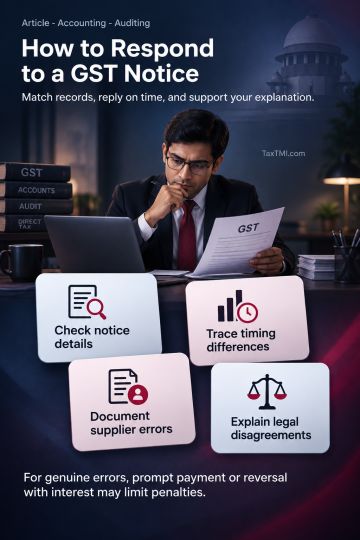
In a data-matched tax system, most notices are produced by patterns in the client's own filings. A structured reply closes many of them at the first stage.
In 1086 William the Conqueror ordered a survey of nearly every landholding in England - who held it, what it was worth, how many ploughs, mills and animals it carried. The resulting Domesday Book was used to understand and assess the kingdom's resources and dues.
Nine and a half centuries later, India's GST system runs something similar every month - not with clerks on horseback but by automatically comparing millions of invoices, returns, e-invoices, e-way bills and payments.
When the numbers disagree, a notice isn't bad luck. It's the system doing what it was designed to do.
"Why us? We pay our taxes."
An email arrives, a notice appears on the portal and the client panics.
In most cases nobody decided to target the business. Data was compared and differences were found. GST produces vast quantities of structured information, and authorities use analytics to compare it across returns, periods and taxpayers. When a client's numbers disagree with each other - or with suppliers' and customers' numbers - questions follow.
The most common triggers
1. Outward supply mismatches - sales in GSTR-1 don't match tax discharged in GSTR-3B.
2. Excess input tax credit - credit claimed exceeds the auto-generated ITC statement; one of the most frequent triggers.
3. E-way bills versus returns - goods moved but not reported, or values that differ significantly.
4. E-invoices versus returns - for e-invoicing entities, gaps between registered e-invoices and reported supplies.
5. Annual return and reconciliation differences - monthly returns, annual return and audited accounts that disagree.
6. Cross-tax turnover gaps - GST turnover materially different from income-tax turnover.
7. Suppliers later found non-genuine - buyers who took credit on their invoices receive notices.
8. Refund claims - scrutinised closely for eligibility and documentation.
9. Classification or rate disputes - especially after rate changes such as the major rationalisation from September 2025.
10. Non-filing or late filing - late fees, interest and sometimes cancellation of registration.
A case from the record: fake-registration drives
Indian GST authorities have repeatedly run nationwide special drives to detect fake and non-existent registrations used to issue invoices without real supplies. These drives have flagged large numbers of suspect registrations - and buyers who claimed credit from them have received notices, even where they insisted they acted in good faith.
The uncomfortable lesson: a client's exposure depends partly on data it doesn't control. That's exactly why its own reconciliation matters so much.
In a nutshell
Essence: most GST notices start as data mismatches - within the client's own returns or against someone else's - long before any officer opens the file.
What arrives, broadly
Without cataloguing every form, communications generally fall into:
- System intimations of mismatch - asking the taxpayer to pay or explain.
- Scrutiny of returns - an officer seeks explanations for discrepancies.
- Departmental audit.
- Show cause notices proposing tax, interest and penalty.
- Registration notices - such as proposed cancellation.
For periods from FY 2024-25 onward, demands fall under a unified provision, section 74A of the CGST Act, with penalty consequences that depend on whether fraud or suppression is alleged. Time limits and penalties vary with the provision and period.
A notice isn't a verdict. It's a question - and well-answered questions often end without a demand.
The CALM Response
When a notice arrives, work through CALM.
C - Check the notice and the clock
- Record the period, amount, issue and provision cited.
- Confirm valid issue - for instance, a document identification number where required.
- Diarise the reply deadline; missing it can lead to orders passed without the client being heard.
A - Analyse and reconcile
Pull the books, returns, e-invoices, e-way bills and supplier statements for the period and pinpoint the exact source of the difference.
L - Label the difference
- Genuine client error - consider prompt payment with interest, which may limit penalties.
- Timing difference - show the period in which the transaction was reported.
- Supplier error - collect evidence and get the supplier to correct it.
- Legal disagreement - prepare a reasoned response on the law.
M - Make a written, evidence-based reply
A clear, organised reply with reconciliations, documents and legal reasoning is far stronger than a general denial. Attend any hearing ready to walk through the reconciliation. If an order goes against the client, appeals lie within prescribed time limits, usually with a pre-deposit.
Illustration
A distributor receives an intimation that one month's ITC exceeds its auto-generated statement by Rs. 6.4 lakh.
Analysis shows:
- Rs. 3.1 lakh - invoices the suppliers reported the following month (timing).
- Rs. 2.0 lakh - one supplier reported under the wrong GSTIN (supplier error, corrected in its next return).
- Rs. 1.3 lakh - credit on a staff welfare event, a blocked credit (genuine error).
Reply: a reconciliation table, supplier correspondence and proof of next-month reporting for Rs. 5.1 lakh, plus voluntary reversal with interest for Rs. 1.3 lakh. Result: a modest payment instead of a demand on the full amount plus penalty.
For practitioners: running a notice-management practice
- Keep a notice register for every client. Date of issue, reference, issue, amount, deadline, owner and status - reviewed weekly.
- Monitor portals, not just inboxes. Many communications appear only on the GST portal; assign someone to check each client's dashboard on a fixed schedule.
- Build reply templates around reconciliations. A standard pack - books vs GSTR-1 vs GSTR-3B, 3B vs 2B, e-way bills vs sales - speeds every response.
- Fix root causes after closure. Record why each notice arose and change the monthly process so it doesn't recur.
- Advise on the pay-or-contest decision. Document the reasoning when recommending voluntary payment versus defending a disputed amount.
Prevention beats defence
- Monthly three-way reconciliation of books, GSTR-1 and GSTR-3B.
- Monthly ITC reconciliation with auto-generated statements.
- E-way bill and e-invoice reconciliation with sales.
- Annual reconciliation of GST turnover with financial statements and income-tax returns.
- Classification review whenever rates change or products launch.
- Supplier compliance checks for major vendors.
- Prompt replies to intimations before they harden into notices.
The uncomfortable reality
Many businesses treat GST as a monthly filing task rather than a monthly reconciliation task. Returns go in to beat deadlines, differences are "to be adjusted later," later becomes the annual return - and then a notice arrives.
In a data-driven system, every unreconciled difference is a future question.
Indicators of success
- Deadlines are always met.
- More notices close at the first stage.
- Demands shrink because replies are documented.
- Repeat notices on the same issue fall as root causes are fixed.
- Records are ready - reconciliations producible within days.
Outlook: the coming decade
Notices are increasingly generated by analytics comparing GST returns, e-invoices, e-way bills, income-tax data and bank information. Scrutiny will more often be triggered by a data mismatch than by an officer's choice. Clients who reconcile before filing will receive fewer notices - and answer the rest faster.
Immediate actions by role
- Finance head: set up a notice register with dates, issues, owners and status.
- Accountant: reconcile last year's GST returns with the books and e-invoices.
- Owner: make sure no notice is missed because it came by email or portal.
- Adviser: review significant replies before submission.
Illustration from a smaller enterprise
Take an illustrative Rs. 8 crore trader who gets a notice about a mismatch between GST returns and e-way bills. His first instinct is to phone a contact in the department.
Instead his accountant prepares a reconciliation showing the difference arises from cancelled e-way bills and a sales return. The documented reply goes in within a week. The notice closes without a demand - and the trader starts reconciling monthly to avoid the next one.
The objection we hear most - and our response
The objection: "Many notices are mechanical and wrong. The system treats timing differences as evasion. Why invest so much effort in the department's mistakes?"
The answer: Many intimations are indeed mechanical and some are wrong - which is exactly why monthly reconciliation pays. A client with reconciliations ready can rebut a wrong notice in hours, with evidence; one that must reconstruct the period spends weeks and may still lose. Preparation doesn't mean accepting every notice. It means defeating the wrong ones quickly.
Practitioners' FAQ
"Can an intimation the client thinks is wrong be ignored?"
No. Reply with the explanation and evidence; silence is often treated as acceptance.
"Should disputed amounts be paid to avoid penalties?"
Paying genuine errors early can reduce penalties. For disputed amounts, take advice - payment may affect the client's position.
"Who should handle notices?"
A designated person who checks the portal regularly, supported by the tax adviser.
Position as at October 2026: Key provisions include section 61 (scrutiny of returns), section 73/74 for earlier periods and section 74A for periods from FY 2024-25, plus appeal provisions requiring pre-deposit. GST rates were rationalised from 22 September 2025, and return systems increasingly lock auto-populated values. Confirm current procedures on the GST portal and with your adviser.
Pitfalls
- Filing returns without reconciling.
- Using GSTR-3B as a balancing figure.
- Replying without evidence.
- Missing reply deadlines.
- Paying demands without checking them.
- Letting the same mismatch recur every month.
Terms explained
- Scrutiny notice - a formal query asking the taxpayer to explain differences or produce documents.
- Reconciliation - a statement showing how two sets of figures, such as returns and books, agree.
- Demand - tax, interest or penalty the authority says is payable.
- Appeal - a formal challenge to an order before a higher authority.
Half-hour action exercise
For the last three months:
1. Compare GSTR-1 sales with GSTR-3B sales.
2. Compare GSTR-3B ITC with the auto-generated ITC statement.
3. Compare e-way bill values with reported supplies.
4. Confirm who checks the GST portal for notices, and how often.
Write one sentence explaining each difference. Any difference that can't be explained is the next notice - unless it's fixed first.
Summary for busy professionals
- GST notices usually stem from data mismatches, not random selection - a monthly Domesday survey.
- Common triggers: GSTR-1 vs 3B gaps, excess ITC, e-way bill and e-invoice differences, annual return gaps, fake suppliers, refunds, classification and late filing.
- Reply with CALM: Check the notice and deadline, Analyse and reconcile, Label the difference, Make a written evidence-based reply.
- Prevent notices with monthly three-way and ITC reconciliations and annual reconciliation with the accounts.
- Preparation lets genuine errors be corrected cheaply and wrong notices be defeated fast.
Every difference left unreconciled today is a potential notice tomorrow.
References
- The National Archives (UK) - Domesday Book (1086). nationalarchives.gov.uk
- Central Goods and Services Tax Act, 2017, sections 61, 73, 74, 74A and 107. cbic-gst.gov.in
- Central Board of Indirect Taxes and Customs - press releases on special drives against fake registrations. cbic.gov.in
- GST Network - advisories on return filing and auto-populated data. gst.gov.in