 TaxTMI
 TaxTMI


 30 Oct 2026

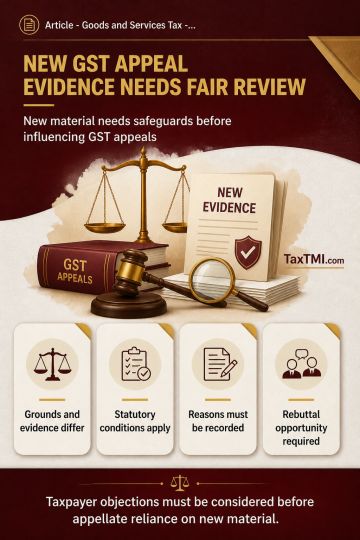
ADDITIONAL GROUNDS OF APPEAL Vs. EVIDENCE TO BE PRODUCED BEFORE APPELLATE AUTHORITY AND TRIBUNAL
1. The right of appeal is meaningful only when the appellate authority examines the real controversy, consider relevant evidence and decide the dispute in accordance with law. A procedure that permits one side to introduce new material but denies the other side a fair opportunity to challenge it cannot satisfy the principles of natural justice.
Grounds of Appeal Vs. Evidence:
2. A ground of appeal is the legal or factual proposition on the basis of which an appellant challenges the correctness or legality of the impugned order, whereas evidence is the oral or documentary material relied upon to establish the facts supporting that challenge. Section 107(10) of the CGST Act, 2017, enables the appellant, subject to the statutory conditions, to raise an additional ground that was omitted from the original appeal, while Rule 112 of the CGST Rules, 2017, permits the admission of additional evidence in specifically prescribed circumstances, including where the adjudicating authority failed to provide sufficient opportunity to produce evidence relevant to a ground of appeal.
3. The distinction is substantive: permission to raise a new ground does not, by itself, entitle the appellant to introduce additional evidence, just as admission of additional evidence does not automatically permit the appellant to raise an otherwise inadmissible ground. Both provisions must therefore be applied independently, in accordance with their respective requirements, while ensuring that the parties receive a fair opportunity to present and contest the case. The ultimate object of both provisions is to secure a decision on the true merits of the dispute, rather than allow a genuine claim to fail merely because of a curable procedural deficiency; equally, procedural flexibility must not become a means of introducing untested material or causing prejudice to the opposing party.
4. To illustrate, Section 107(10) provides for filing of additional grounds incorporating the already available data on Common portal which by default was left out in the original grounds of appeal. Such portal data was available to the adjudicating authority while concluding the adjudication orders under Section 73, 74 and 74A, but failed to recognise it for reasons unknown to taxpayers. Such furnishing of portal data has be accepted under Section 107(10) and cannot be classified as an evidence under Rule112 of the CGST Rules. Many such illustrations may be explained for analysing the scope of Section 107(10) and Rule 112 independently. What transpires from this is both adjudicating authority and appellate authority are required to carefully examine everything that is needed to pass a judicious and speaking order on merits. Otherwise it would be nothing more than recycling the same argument failing to comply the core object of appeal remedy itself.
5. The judgement dated 15/10/2026 of the Allahabad High Court in M/s Unique And Divine Eternity Versus State of Uttar Pradesh And 2 Others - 2026 (10) TMI 1238 - ALLAHABAD HIGH COURT, brings this principle into sharp focus. The petitioner had challenged the cancellation of its GST registration. During the appellate proceedings, the Department introduced certain additional inputs by a letter dated 14 July 2026, which had not formed part of the original proceedings. The taxpayer objected to their introduction on 17 July 2026. Nevertheless, the appellate authority rejected the appeal on 20 July 2026 without affording the taxpayer a further opportunity of hearing on those objections. The High Court held that once material not forming part of the original proceedings was introduced at the appellate stage and an objection was raised, the objection had to be considered and the affected party afforded an opportunity of hearing. The failure to do so vitiated the appellate order for breach of natural justice. The order was set aside and the matter remitted to the appellate authority for fresh consideration within two months.
6. The Court also took note of the earlier decisions in M/s Anandeshwar Traders Versus State of U.P. And 2 Others - 2021 (1) TMI 1091 - ALLAHABAD HIGH COURT, and M/s Khan Enterprises Versus Additional Commissioner And Another - 2023 (9) TMI 276 - ALLAHABAD HIGH COURT in which coordinate Benches had expressed the view that the facility of producing additional evidence under Rule 112 was available to the appellant and not to the Department. The significance of this judgment, however, extends beyond the question of whether the Department may introduce additional documents. It underscores a fundamental requirement: an appellate authority cannot decide a dispute on the basis of contested new material without fairly considering the objection and providing an effective opportunity to respond.
7. Rule 112 of the CGST Rules, 2017, specifically governs the production of additional evidence before the Appellate Authority or the Appellate Tribunal. It ordinarily restricts the appellant from producing evidence that was not produced during the earlier proceedings, but recognises four exceptions. Additional evidence may be admitted where the adjudicating authority refused to admit evidence that ought to have been admitted; where sufficient cause prevented the appellant from producing evidence specifically called for; where sufficient cause prevented the appellant from producing other evidence relevant to a ground of appeal; or where the impugned order was passed without giving sufficient opportunity to produce evidence relevant to a ground of appeal.
8. Rule 112(1)(d) is particularly important. It recognises that an order may have been passed without giving the taxpayer a sufficient opportunity to place relevant evidence on record. In such circumstances, the appellate process must be capable of correcting the resulting evidentiary deficiency, subject to the conditions of the Rule. The provision is not an unrestricted licence to introduce evidence at will. Rule 112(2) requires the appellate authority to record in writing the reasons for admitting the additional evidence. Rule 112(3) protects the Department by requiring a reasonable opportunity to examine that evidence, cross-examine a witness where applicable, or produce evidence in rebuttal.
9. Rule 112(4), independently, preserves the authority's power to direct the production of documents or examination of witnesses necessary to dispose of the appeal. The statutory scheme therefore balances two legitimate interests: the taxpayer's opportunity to establish the correct legal and factual position, and the Department's right to test and rebut the evidence relied upon.
10. Can the Department introduce additional documents at the appellate stage? This is the question that makes Unique and Divine Eternity ratio particularly relevant [supra]. The taxpayer's entitlement under Rule 112 to seek admission of additional evidence in prescribed circumstances cannot simply be equated with an unrestricted right of the Department to supplement the case on which the original order was founded. The Allahabad High Court referred to its earlier coordinate Bench decisions expressing the view that Rule 112's facility was available to the appellant and not to the Department. The Court set aside the appellate order because the taxpayer's objection to the newly introduced material was not followed by an adequate opportunity of hearing. It did not need to resolve every conceivable circumstance in which a Department may seek to place further material before an appellate authority. The judgment should therefore not be overstated as laying down an absolute prohibition applicable to every form of additional material in every appellate proceeding. Its immediate and binding procedural lesson is that contested material introduced at the appellate stage cannot be relied upon to the taxpayer's prejudice without considering the objection and affording a meaningful opportunity of hearing.
11. The earlier coordinate Bench decisions supply the additional legal basis for questioning the Department's entitlement to introduce evidence under Rule 112 itself. The unevenness must not defeat natural justice. There is an important distinction between permitting a taxpayer to cure an evidentiary deficiency caused by an inadequate opportunity and permitting the Department to strengthen an order by introducing material that was not part of the original proceedings. The first situation is expressly contemplated by Rule 112(1)(d). The second raises questions about the statutory authority to introduce such material, the permissible scope of appellate proceedings and the taxpayer's right to contest the new case.
12. If the Department introduces documents or factual inputs that materially alter the basis on which the appeal is to be decided, the taxpayer must be allowed to challenge their admissibility, authenticity, relevance and evidentiary value. Where necessary, an effective hearing must follow, with adequate time to respond. Merely serving a copy of a document does not invariably amount to a fair opportunity to contest it. The opportunity must be real and appropriate to the nature of the material and the objection raised. Equally, a taxpayer who seeks to introduce additional evidence must satisfy the applicable conditions under Rule 112. Natural justice does not dispense with statutory requirements; it ensures that those requirements are applied fairly.
13. An appellate remedy must correct errors, not create fresh prejudice. The statutory appeal under Section 107 of the CGST Act is intended to provide an effective examination of the impugned order. Section 107(10) separately permits the appellant, subject to its conditions, to raise an additional ground omitted from the original appeal. Rule 112 governs the distinct question of admitting additional evidence. These provisions should not be conflated: a new legal ground is not the same as new documentary or oral evidence. Read together with the duty to give a reasoned appellate decision, the provisions reflect a broader principle of fair adjudication. The appellate authority must determine the dispute on the material lawfully available to it, permit additional evidence where the statutory conditions are satisfied, and ensure that neither side is prejudiced by material introduced without an adequate opportunity to respond. An appellate order cannot be sustained merely because the authority has formally heard the appeal. The authority must also address material objections and ensure that the process by which the decision is reached is fair.
14. For a genuine taxpayer, this safeguard is especially important. The taxpayer may have been unable to produce relevant documents during adjudication because the opportunity was inadequate. Rule 112 provides a limited statutory means of curing that deficiency. The taxpayer should not then be confronted with new departmental material at the appellate stage and denied an equivalent opportunity to challenge it. The ultimate objective is neither to favour the taxpayer nor to obstruct the Department. It is to ensure that the tax liability determined is the liability authorised by law and supported by a fair examination of the evidence. An appellate authority must not deny the taxpayer an opportunity to establish the merits of the case while permitting the Department's untested material to determine those very merits.
15. To protect the rights of taxpayers,/appellants, in pursuance of 57th GST Council's recommendation, CBIC vide its Circular No. 258/04/2026-GST dated 26/10/2026 has elaborately issued clarifications and instructions to uphold the rule of law as regard to adjudication and appeal proceedings. And these instruction are binding on the authorities in terms of Section 168 of the Act. This is a welcome sign in increasing the speed of ease of governance and I convey my gratitude to the GST Council for removing longstanding misinterpretations.
Natural justice demands fairness not merely in granting a hearing, but in deciding the dispute after that hearing.