Loading...

⚠ ✕
❮ Top
☎ Help
☰
×

By creating an account you can:

Logo TaxTMI
Call Us / Help / Feedback✕

Contact Us At :

✉ E-mail: [email protected]

✆ To Call / Whatsapp, Check Contact Us

FAQs :

To know Frequently Asked Questions, Check FAQs

Most Asked Video Tutorials :

For more tutorials, Check Video Tutorials

Submit Feedback/Suggestion :

Email :
Please provide your email address so we can follow up on your feedback.
Category :
Description :
Min 15 characters 0/2000
Make Most of Text Search ✕
  1. Checkout this video tutorial: How to search effectively on TaxTMI.
  2. Put words in double quotes for exact word search, eg: "income tax"
  3. Avoid noise words such as : 'and, of, the, a'
  4. Sort by Relevance to get the most relevant document.
  5. Press Enter to add multiple terms/multiple phrases, and then click on Search to Search.
  6. Text Search
  7. The system will try to fetch results that contains ALL your words.
  8. Once you add keywords, you'll see a new 'Search In' filter that makes your results even more precise.
  9. Text Search
╳
Add to...
You have not created any category. Kindly create one to bookmark this item!
✕
Create New Category
Hide
Title :
Description :
❮❮ Hide
❮ Default View
Expand ❯❯
Close ✕
🔎 Filters / Advanced Search ❯
TEXT

Press 'Enter' to add multiple search terms. Rules for Better Search

Search In
Main Text + AI Text ❯
  • Main Text
  • Main Text + AI Text
  • AI Text
Law:
---- All Laws---- ❯
  • ---- All Laws----
  • Benami Property
  • Bill
  • Central Excise
  • Companies Law
  • Customs
  • DGFT
  • FEMA
  • GST
  • GST - States
  • IBC
  • Income Tax
  • Indian Laws
  • Money Laundering
  • SEBI
  • SEZ
  • Service Tax
  • VAT / Sales Tax
Types:
---- All Types ---- ❯
  • ---- All Types ----
  • Act Rules
  • Case Laws
  • Circulars
  • Manuals
  • News
  • Notifications
Sort By: ?
In Sort By 'Default', exact matches for text search are shown at the top, followed by the remaining results in their regular order.
Relevance Default Date
☰   Show Results ❯
    Project-Wise Anti-Profiteering Methodology in Real Estate under Section 171 of the Central Goods and...
    Case Laws Income Tax
    Retirement Leave Encashment Exemption under Section 10(10AA)(ii) and Retrospective Application of No...
    Transit-State Jurisdiction under GST: Limits on Detention and Penalty in External Inter-State Suppli...
    Post-Facto Shareholder Ratification of Diversion of Preferential Issue Proceeds under the PFUTP Regu...
    Case Laws Income Tax
    Section 195 Withholding on Payments to Non-Residents: Royalty, Fees for Technical Services and Busin...
    Penalty: Scope of "Any Person" under Section 122(1A) of the Central Goods and Services Tax Act, 2017
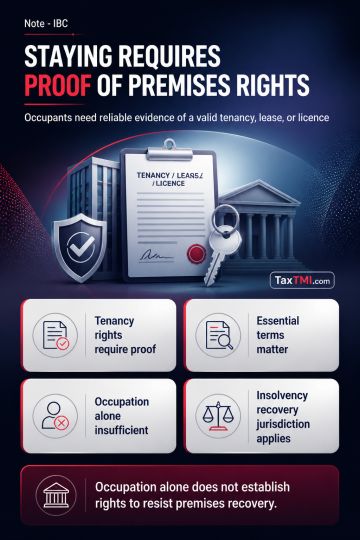
    Recovery of Corporate Debtor Premises and Proof of Tenancy, Lease or Licence Rights under the Insolv...
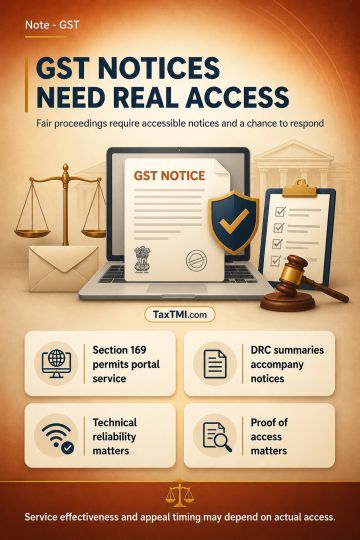
    Service of GST Notices through the Common Portal: Statutory Validity and Practical Accessibility
    Case Laws Income Tax
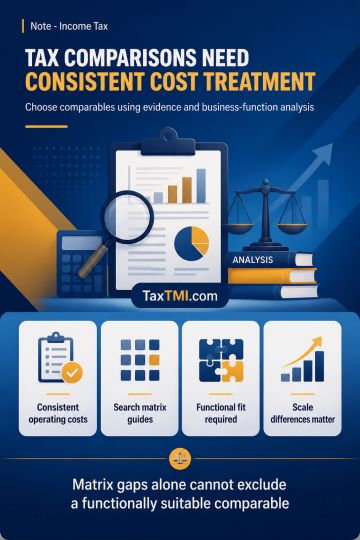
    TNMM Comparability: Operating Items, Search Matrix and Functional Analysis under Rule 10B
    Case Laws Customs
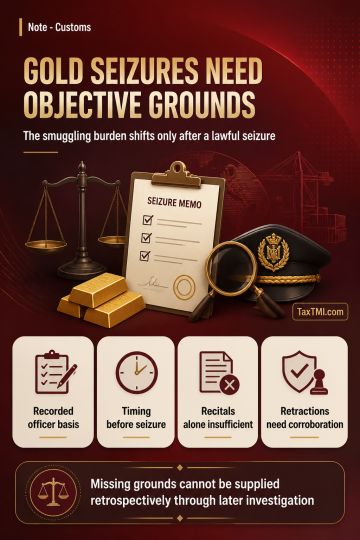
    Validity of Gold Seizure under Section 110 and the Conditional Reverse Burden under Section 123 of t...
    Case Laws Income Tax
    Deduction under Section 80GGC: Genuineness of Political Contributions and Evidentiary Burden
    Post-Death Determination of GST Liability and Estate-Limited Recovery from Legal Heirs
    Non-Confirmation of Seizure under Section 37A of FEMA and the Requirement of Recorded Reasons to Bel...
    Case Laws Companies Law
    Oppression and Mismanagement Proceedings under Sections 241 and 242: Corporate Authority During Pend...
    Case Laws Benami Property
    Benami Claims in Self-Acquired Property: Rejection of Plaint and the Limits of the Fiduciary-Capacit...
    Case Laws Income Tax
    Reopening of Assessment under Sections 147 and 148: Reason to Believe, Tangible Material and Change ...
    Case Laws Income Tax
    Penalty under Section 270A on Disallowance of Political Donation Deduction under Section 80GGC
    Case Laws Income Tax
    Conditional Registration under Section 12AB and the Limits of Commissioner's Statutory Powers
    Case Laws Customs
    Transaction Value, Rule 12 and Enhancement Based on Consent Letters in Customs Valuation: Limits of ...
    GST on Assignment of Leasehold Rights: Distinguishing Transfer of Immovable Property from Supply of ...
❮
❯
❯❯
Maximize Maximize Maximize
0 / 200
Expand Note
Add to Folder

No Folders have been created

+

Are you sure you want to delete "My most important" ?

NOTE:

Notes
Showing Results for :
Reset Filters
Results Found:
Show All Summaries Hide All Summaries
Case Laws GST
Show AI Summary
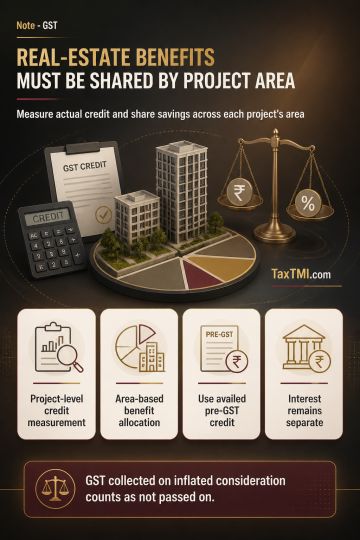
Project-wise anti-profiteering requires actual input tax credit measurement and area-based allocation of benefits to real-estate purchasers.
Real-estate anti-profiteering under Section 171 requires project-level identification of additional input tax credit and allocation of the saving across total project area on a per-square-foot basis. Purchase value may quantify credit attributable to project expenditure, but turnover or collections cannot serve as the allocation basis. The comparison must use pre-GST credit actually availed rather than merely available credit. GST collected on consideration inflated by an undistributed benefit forms part of the amount not passed on and remains distinct from statutory interest.
Case Laws Income Tax
Show AI Summary
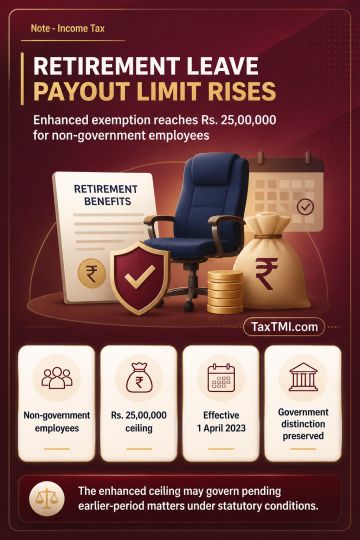
Retirement leave encashment exemption applies under the enhanced notified ceiling while preserving non-government employee classification and statutory conditions.
Section 10(10AA)(ii) governs retirement leave-encashment exemption for non-Government employees, subject to the ten-month earned-leave measure, average-salary computation, and the notified monetary ceiling. Notification No. 31/2023 specifies an enhanced ceiling of Rs. 25,00,000, is deemed effective from 1 April 2023, and certifies that retrospective effect causes no adverse effect. The enhanced ceiling is treated as a remedial rationalisation of an existing exemption and may govern pending earlier-period matters, while preserving the distinction between Government and non-Government employees.
Case Laws GST
Show AI Summary
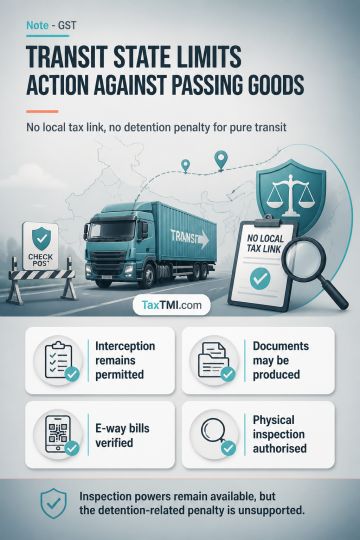
Transit GST jurisdiction limits detention penalties for documented inter-State supplies lacking a local taxable nexus.
Transit-State jurisdiction under GST permits interception, document production, e-way bill verification and authorised physical inspection of goods moving through an intermediate State. It does not, in a pure transit movement, support detention-related penalty for an external inter-State supply where origin and destination lie outside the intercepting State, no tax is payable there, and there is no evidence of diversion, local supply, fictitious or mismatched documents, or mismatch of goods. Cross-empowerment is administrative and does not create an independent territorial taxable nexus.
Case Laws SEBI
Show AI Summary
Shareholder ratification cannot cure preferential-issue fund diversion when disclosed objectives are abandoned, triggering securities-market fraud and disclosure concerns.
Post-facto shareholder approval cannot retrospectively validate diversion of preferential-issue proceeds contrary to issue-specific objects disclosed to shareholders and the market. A special resolution authorises the issue but does not permit unrestricted use of proceeds. Periodic deviation reporting, audit-committee review and utilisation disclosures promote transparency; they do not enable diversion followed by later regularisation. Immediate diversion, inadequate commercial justification and missing documentation may indicate that disclosed objects were not genuinely intended to be performed. Later amendment of corporate objects or shareholder ratification cannot cure a completed securities-market disclosure breach.
Case Laws Income Tax
Show AI Summary
Cross-border software payments require copyright-right, technical-service, and permanent-establishment analysis before withholding obligations are determined under applicable treaties.
Section 195 requires withholding only from a remittance to a non-resident that includes income chargeable in India. For software, royalty depends on transfer of copyright rights, not merely the right to install, access, use, or distribute a copyrighted article under restrictive terms. Where a DTAA is more beneficial, its royalty and FTS definitions control; treaty FTS may require technology to be made available. Amounts that are neither royalty nor FTS require consideration as business profits, ordinarily taxable only where profits are attributable to a permanent establishment. Composite payments require component-wise allocation and analysis.
Case Laws GST
Show AI Summary
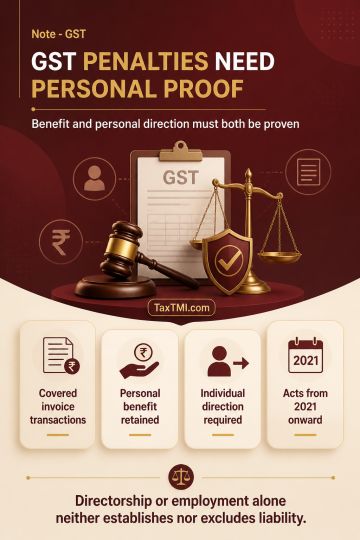
Personal GST penalty requires proof that the beneficiary retained benefit and directed a covered invoice or credit transaction.
Section 122(1A) may impose personal GST penalty on a registered or unregistered person only for a covered invoice or input tax credit transaction. Liability requires cumulative proof that the individual retained an identifiable personal benefit and that the transaction was conducted at that person's instance. Directorship, employment, registration, signature authority, or association with the taxable entity neither independently establishes nor excludes liability. Proceedings require transaction-specific and person-specific allegations and findings. The provision operates prospectively for underlying acts or transactions occurring on or after 01.01.2021.
Case Laws IBC
Show AI Summary
Proof of tenancy rights governs insolvency recovery of corporate-debtor premises from occupants lacking enforceable possessory interests.
Where premises form part of the corporate debtor's assets, Sections 18 and 25 of the Insolvency and Bankruptcy Code, 2016 require the resolution professional to take custody, control, preservation and protection measures. An occupant resisting recovery must prove a subsisting tenancy, leasehold interest or enforceable licence through reliable evidence of the parties' intended relationship and its essential terms. Permission to stock goods or conduct limited business activity, prolonged occupation, and business or utility records do not independently create rights in the premises. Section 60(5)(c) supports insolvency jurisdiction over asset-recovery measures connected with the insolvency estate.
Case Laws GST
Show AI Summary
GST portal service requires statutory validity and practical accessibility before ex parte adjudication can fairly proceed.
GST portal service is a statutory method under Section 169, but its use in an ex parte demand proceeding depends on effective accessibility and a meaningful opportunity to reply and be heard. Rule 142 requires electronic DRC-01 and DRC-07 summaries to operate alongside the underlying show-cause notice and reasoned order. Portal placement, complete communication, e-mail transmission, technical reliability and proof of actual access may determine whether service is effective, whether waiver applies, and whether appellate limitation begins.
Case Laws Income Tax
Show AI Summary
TNMM comparability requires consistent operating-cost treatment and FAR-based selection, while search matrices cannot replace evidence-led functional analysis.
TNMM requires consistent computation of operating profit and operating cost for the tested party and comparables. A provision for doubtful debts connected with sales and trade receivables may be an operating expense, as may routine business levies; income-tax on profits remains excluded. A search matrix is a disciplined evidentiary tool, not a statutory bar to an out-of-matrix comparable. Inclusion requires proof of functional fit, filter satisfaction and reasons for its absence, while rejection cannot rest solely on matrix absence. FAR analysis, segmental reliability and material scale differences govern comparability.
Case Laws Customs
Show AI Summary
Reasonable belief in gold seizure requires recorded objective grounds before the reverse burden for smuggling can arise.
Gold seizure under Section 110 requires the proper officer to hold, before seizure, objectively supportable reasons to believe that goods are liable to confiscation. For gold, Section 123 shifts the burden of disproving smuggling only after a lawful seizure made in reasonable belief that the gold is smuggled. A general panchnama recital, foreign markings, high purity, or an uncorroborated retracted statement cannot alone establish that foundation. Reasons must exist contemporaneously and cannot be supplied retrospectively through later investigation.
Case Laws Income Tax
Show AI Summary
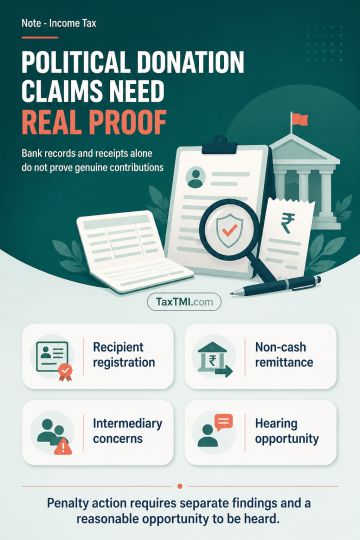
Political contribution deductions require proof that payments are genuine, not merely bank transfers, receipts, and recipient registration.
Registration of the recipient political party, non-cash remittance, banking records and donation receipts are necessary evidentiary facts for a political-contribution deduction, but do not conclusively prove a genuine contribution. Where credible material indicates an accommodation-entry arrangement involving return of funds through intermediaries, the claimant must substantiate the transaction and address taxpayer-specific circumstances. General allegations about a recipient cannot alone displace a claim without a sufficient nexus to the taxpayer's own payment. Penalty initiation requires separate determination of under-reporting or misreporting and a reasonable opportunity of hearing.
Case Laws GST
Show AI Summary
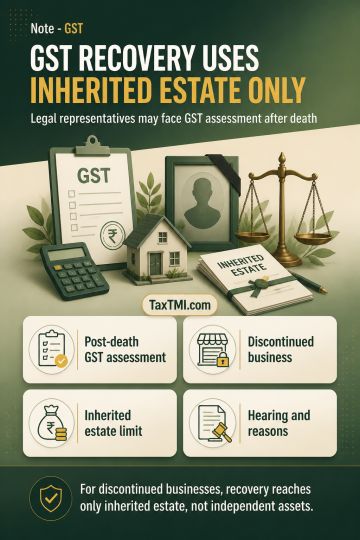
Estate-limited GST recovery permits post-death assessment of legal representatives while protecting heirs' independent assets after business discontinuance.
Section 93 permits post-death GST determination against a legal representative where a liable person dies. If the business is discontinued, tax, interest and penalty may be recovered only from the deceased's inherited estate and only within its capacity; the heir's independent assets remain outside that limit. Proceedings may be initiated without a pre-death notice, but must be addressed to the legal representative in that capacity, follow the applicable adjudication process, and provide hearing and a reasoned order.
Case Laws FEMA
Show AI Summary
Recorded reasons to believe govern foreign-asset seizure; non-confirmation requires appellate resolution before contradictory adjudication proceeds.
Section 37A permits seizure of equivalent domestic assets only where the authorised officer records written reasons to believe that foreign assets are held in contravention of FEMA. The competent authority must examine the material after hearing both sides and either confirm or set aside seizure. A reasoned non-confirmation based on an absent statutory threshold is substantive on seizure, though it does not finally decide the underlying contravention. Pending appeal, the adjudicating authority cannot displace that finding or adopt a contrary premise; Section 37A(4) applies only to confirmed seizure.
Case Laws Companies Law
Show AI Summary
Unstayed tribunal dismissal leaves former directors without corporate authority while banks follow valid company instructions amid management disputes.
Where an oppression and mismanagement petition has been dismissed, a pending appeal without an appellate stay does not itself restore a former director's authority or suspend the dismissal's operative effect. Sections 241 and 242 require statutory prejudice and prescribed Tribunal findings; procedural irregularities in director removal may be relevant but do not alone establish oppression. Banks should ordinarily follow formally authorised company instructions rather than decide unresolved management disputes, unless a binding judicial or statutory restraint applies.
Case Laws Benami Property
Show AI Summary
Benami property claims cannot be recast through wills or employment-based trust when pleadings assert beneficial ownership.
Benami-property claims based on a claimant's payment for property titled in another person's name may fall within the statutory definition when the property is alleged to be held for that claimant's benefit. A Will, succession claim, or other later instrument does not provide an independent basis of title where the pleaded foundation is restoration of beneficial ownership. The statutory scheme prohibits benami arrangements, bars enforcement of claimed beneficial ownership, and treats prohibited re-transfers as invalid; self-acquired title in the named holder's name does not displace the pleaded funding arrangement.
Case Laws Income Tax
Show AI Summary
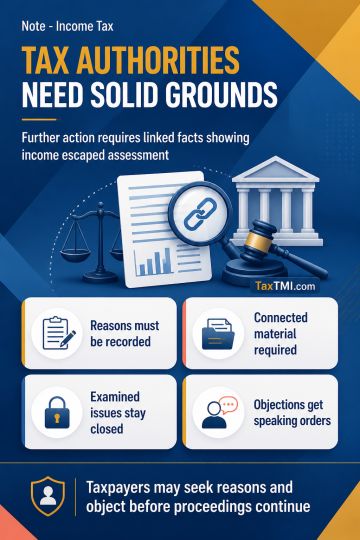
Reason to believe in reassessment requires tangible material, a live nexus, and recorded reasons; review of examined issues is barred.
Income-tax reassessment under Sections 147 and 148 is permissible only where recorded reasons, assessed at the time of notice, disclose a bona fide reason to believe that chargeable income escaped assessment. Final proof is unnecessary at that stage, but relevant tangible material must have a rational, live link to escapement. Reopening cannot be used to review an issue consciously examined and decided in the original scrutiny; nor can later or extraneous material supplement the recorded reasons. The taxpayer may seek the reasons, file focused objections, and receive a speaking order before reassessment continues.
Case Laws Income Tax
Show AI Summary
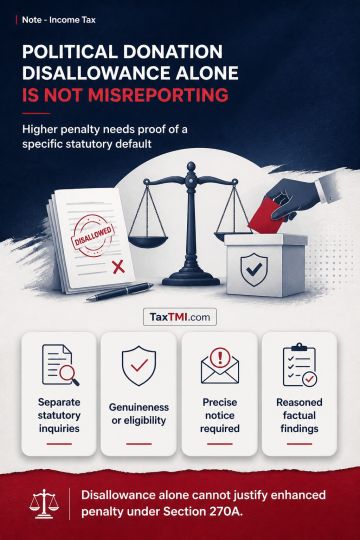
Political-donation deduction disallowance does not itself establish misreporting; enhanced penalty requires proof of a specific statutory default.
Disallowance of a political-contribution deduction under Section 80GGC and imposition of penalty under Section 270A are separate statutory inquiries. An adverse finding on genuineness or eligibility may raise assessed or reassessed income, but cannot alone establish misreporting. Enhanced penalty requires proof that the taxpayer's conduct falls within a specific Section 270A(9) category, supported by a precise notice and reasoned factual findings.
Case Laws Income Tax
Show AI Summary
Conditional charitable registration cannot suspend tax benefits pending litigation outside the statutory grant and cancellation framework.
Section 12AB permits the authority, after inquiry into objects, genuine activities and material legal compliance, to grant registration for the statutory period or reject the application. It does not create a contingent form of registration whose tax consequences await future litigation. Post-registration violations must be addressed through the separate cancellation process, requiring inquiry and hearing. Conditions in prescribed forms or administrative guidance may operationalise statutory duties but cannot create extra-statutory eligibility thresholds, future-conduct obligations or anticipatory cancellation consequences. Binding jurisdictional rulings remain applicable unless stayed, modified or reversed.
Case Laws Customs
Show AI Summary
Transaction value reassessment requires disclosed comparable evidence, while protest-qualified consent preserves appellate rights against enhanced customs valuation.
Transaction value under Section 14 and Rule 3 is the primary basis for valuing imported goods. Rule 12 permits rejection only where an objectively sustainable reasonable doubt persists after considering further information; on request, the grounds must be disclosed in writing and a hearing afforded. Redetermination must follow Rules 4 to 9 sequentially and rely on demonstrably comparable import data. Written acceptance of reassessment may dispense with a speaking order under Section 17(5), but protest-qualified or provisional-clearance correspondence may preserve the statutory right to appeal.
Case Laws GST
Show AI Summary
Leasehold rights assignment may fall outside GST when the lessee permanently transfers the entire proprietary estate.
GST treatment of assignment of leasehold rights turns on whether the lessee has made a complete transfer of its existing estate or continues to provide occupation or enjoyment. Where the assignor transfers the whole residual term, possession, building and associated rights, retains no reversionary or controlling interest, and the assignee succeeds directly to obligations towards the original lessor, the transaction may be characterised as transfer of benefits arising out of land rather than a supply of services. Labels such as premium, salami or transfer fee are not conclusive.

TMI Notes

Back

All TMI Notes

Showing Results for :
Reset Filters
No Records Found

TMI Notes

Back

All TMI Notes

Money Laundering

Reporting Entity under Prevention of Money Laundering Act, 2002 (PMLA)

9 May, 2023

Contents
Notifications
Acts
Plus +
Summary
Note

Note

-

Bookmark

(New) -

Download

Print

Print

 Section 2 - Definitions.

Prevention of Money-Laundering Act, 2002

Role and Responsibilities of Reporting Entity

Preamble 

Introduction & Overview of Prevention of Money Laundering Act

Origin & Object of PMLA

Objective is to curb acts of moneylaudering & to punish the offender

PMLA, 2002 came into force w.e.f 1st July 2005 and has undergone several amendments till now.

 • It extends to whole of India including Jammu and Kashmir

• Preamble is to prevent money-laundering and provide for confiscation of property derived from, Or involved in money-laundering and to punish those who commit the offence.


Defination of Money Laundering

 Means any act of acquiring untainted property or disguising financial assets

• According to Section 3 Read with rule 2 of Prevention of Money Laundering Act

– “whosoever directly or indirectly attempts to indulge or knowingly assists or knowingly is a party or is actually involved in any process or activity connected with the proceeds of crime including its concealment, possession, acquisition or use and projecting or claiming it as untainted property shall be guilty of offence of money

Laundering.

  • Money laundering involves disguising financial assets so that they can be used without detection of the illegal activity that produced them.


Process of Money Laundering: Placement, Layering & Integration

  1. Placement (depositing into banks)

Dirty money being inserted in financial system. The first stage is the physical disposal of cash. The launderer introduces his illegal profits into the financial system. This placement is accomplished by depositing the cash in domestic banks or in other types of formal or informal financial institutions.

  1. Layering (making shell companies causing rotation of money)

Separates the proceeds from their criminal origin by moving them through a series of financial transactions. The Second stage in money laundering is layering. The launderer engages in a series of conversions or movements of the funds to distance them from their source. Shell companies (i.e. paper companies/bogus companies) serve as front and are registered in offshore havens. They are a common tool in the layering phase.

  1. Integration(acquiring legitimate explanation through investments, loans etc)

Creating a legitimate explanation for their sources of funds, allowing them to be retained, invested or used, to acquire goods or assets. This is the stage where the funds are returned to the legitimate economy for later extraction. Examples include investing in a company, purchasing real estate, luxury goods, etc. This is the final stage in the process.


Reporting Entity

To strength the control and achieve the desired goal, the concept of reporting entity is introduced w.e.f. w.e.f. 15-2-2013 to the PMLA, 2002

Accordingly, clause (wa) to section 2(1) read as:-

(wa) "reporting entity" means a banking company, financial institution, intermediary or a person carrying on a designated business or profession;

Thus, as per clause (wa) the following persons are made reporting entity under PMLA

    • a banking company (see clause (e))
    • a financial institution (see clause (i))
    • an intermediary (see clause (n))
    •  a person carrying on a designated business or profession (see clause (sa) hereinbelow:)

Simultaneously, clause (sa) inserted to section 2(1) to define the scope and meaning of “person carrying on designated business or profession" introduced as:

(sa) "person carrying on designated business or profession" means,-

(i) a person carrying on activities for playing games of chance for cash or kind, and includes such activities associated with casino;

(ii) Inspector-General of Registration appointed under section 3 of the Registration Act, 1908 (16 of 1908.) as may be notified by the Central Government;

(iii) real estate agent, as may be notified by the Central Government;

(iv) dealer in precious metals, precious stones and other high value goods, as may be notified by the Central Government;

(v) person engaged in safekeeping and administration of cash and liquid securities on behalf of other persons, as may be notified by the Central Government; or

(vi) person carrying on such other activities as the Central Government may, by notification, so designate, from time to time;


Notified Persons / Reporting entities u/s 2(1)(sa)

With the passage to time, Ministry of Finance of the Central Government is notifying more and more category of persons as reporting entity as:

1.       As per notification dated 24-9-2014 (Issued u/s 2(1)(sa)(vi))

Looping of reporting entity

    • any person carrying on the business, either on its own behalf or on behalf of other reporting entities,
    • of storing, safeguarding and retrieving the records of the documents mentioned in clause (e) of sub-section (1) of section 12 of the said Act and the rules made thereunder
    • shall be deemed to be a person carrying on designated business or profession

2.       Notification No. 2/2015 dated 15-4-2015 (Issued u/s 2(1)(sa)(vi))

    • any person, licensed by the Insurance Regulatory and Development Authority
    • to perform the functions as specified in regulation 3 or regulation 4 or regulation 5 of the Insurance Regulatory and Development Authority (Insurance Brokers) Regulations, 2002,
    • shall be deemed to be a "person carrying on designated business or profession"

3.       Notification no. 3/2015 dated 17-4-2015 (Issued u/s 2(1)(sa)(ii))

    • a Registrar or Sub-Registrar appointed under section 6 of the Registration Act, 1908 (16 of 1908)
    • as a "person carrying on designated business or profession".

4.         Notification no. 4/2017 dated 23-8-2017(Issued u/s 2(1)(sa)(iv))

                   From 23-8-2017 to 5-10-2017

    • dealer in precious metals, precious stones and other high value goods
    • having a turnover of rupees two crore in a financial year
    • as a person carrying on designated business or profession.

This notification has been rescinded vide notification dated 6-10-2017

5.       Notification No. 8/2017 dated 15-11-2017 (Issued u/s 2(1)(sa)(iii))

                   From 15-11-2017 to 27-12-2020

    • ‘real estate agents’ as defined under clause (zm) of section 2 of the Real Estate (Regulation and Development) Act, 2016 (No. 16 of 2016)
    • shall be deemed to be a “person carrying on designated business or profession”

 Interestingly, the meaning of ‘real estate agents’ has been defined u/s 2(1)(va) of PMLA, which has reference to section 65(88) of Chapter V of Finance Act, 1994 (Known as Service Tax Act) which has already been repealed, the impugned notification make a reference to RERA Act.

This notification has been rescinded vide notification dated 28-12-2020 

6.         Notification No. 3/2018 dated 4-5-2018 (Issued u/s 2(1)(sa)(vi))

    •  the Multi-State Co-operative Society registered under the Multi-State Co-operative Societies Act, 2002 (39 of 2002)
    • designated as a “person carrying on designated business or profession”.

7.         Notification dated 28-12-2020 (Issued u/s 2(1)(sa)(iv))

    • the dealers in precious metals, precious stones as persons carrying on designated businesses or professions
    • if they engage in any cash transactions with a customer equal to or above Rupees ten lakhs, carried out in a single operation or in several operations that appear to be linked.

8.         Notification dated 28-12-2020 (Issued u/s 2(1)(sa)(iv))

                   From 28-12-2020 to 28-11-2022

    •  the “Real Estate Agents”, as a person
    • engaged in providing services in relation to sale or purchase of real estate and having annual turnover of Rupees twenty lakhs or above,
    • as “persons carrying on designated businesses or professions”.

This notification has been rescinded vide Notification dated 29-11-2022

9.         Notification dated 29-11-2022 (Issued u/s 2(1)(sa)(iii))

                   From 29-11-2022

    •  ‘real estate agents’
    • as defined under clause (zm) of section 2 of the Real Estate (Regulation and Development) Act, 2016 (16 of 2016) and as a person engaged in providing services in relation to sale or purchase of real estate and having annual turnover of Rupees twenty lakhs and above,
    • as a “person carrying on designated business or profession”.

Interestingly, the meaning of ‘real estate agents’ has been defined u/s 2(1)(va) of PMLA, which has reference to section 65(88) of Chapter V of Finance Act, 1994 (Known as Service Tax Act) which has already been repealed, the impugned notification make a reference to RERA Act.

10.         Notification dated 7-3-2023 (Issued u/s 2(1)(sa)(vi))

    • activities when carried out for or on behalf of another natural or legal person in the course of business as an activity for the purposes of said sub sub-clause, namely:-

(i) exchange between virtual digital assets and fiat currencies;

(ii) exchange between one or more forms of virtual digital assets;

(iii) transfer of virtual digital assets;

(iv) safekeeping or administration of virtual digital assets or instruments enabling control over virtual digital assets; and

(v) participation in and provision of financial services related to an issuer’s offer and sale of a virtual digital asset.

Explanation:- For the purposes of this notification “virtual digital asset” shall have the same meaning assigned to it in clause (47A) of section 2 of the Income-tax Act, 1961 (43 of 1961).

11.       Notification dated 3-5-2023 (Issued u/s 2(1)(sa)(vi))

Practicing CA, CS, CWA included in the list as:

    •  the financial transactions carried out by a relevant person on behalf of his client, in the course of his or her profession, in relation to the following activities-

(i) buying and selling of any immovable property;

(ii) managing of client money, securities or other assets;

(iii) management of bank, savings or securities accounts;

(iv) organisation of contributions for the creation, operation or management of companies;

(v) creation, operation or management of companies, limited liability partnerships or trusts, and buying and selling of business entities,

shall be an activity for the purposes of said sub-section.

Explanation 1.- For the purposes of this notification ‘relevant person’ includes –

(i) an individual who obtained a certificate of practice under section 6 of the Chartered Accountants Act, 1949 (38 of 1949) and practicing individually or through a firm, in whatever manner it has been constituted;

(ii) an individual who obtained a certificate of practice under section 6 of the Company Secretaries Act, 1980 (56 of 1980) and practicing individually or through a firm, in whatever manner it has been constituted;

(iii) an individual who has obtained a certificate of practice under section 6 of the Cost and Works Accountants Act, 1959 (23 of 1959) and practicing individually or through a firm, in whatever manner it has been constituted.

Explanation 2.- For the purposes of this notification ‘firm’ shall have the same meaning assigned to it in sub-clause (i) of clause (23) of section 2 of the Income-tax Act, 1961 (43 of 1961).

12.       Notification dated 9-5-2023 (Issued u/s 2(1)(sa)(vi))

Specified activities notified - Reporting entity

 Following activities when carried out in the course of business on behalf of or for another person, as the case may be, as an activity for the purposes of said sub-clause, namely:-

(i) acting as a formation agent of companies and limited liability partnerships;

(ii) acting as (or arranging for another person to act as) a director or secretary of a company, a partner of a firm or a similar position in relation to other companies and limited liability partnerships;

(iii) providing a registered office, business address or accommodation, correspondence or administrative address for a company or a limited liability partnership or a trust;

(iv) acting as (or arranging for another person to act as) a trustee of an express trust or performing the equivalent function for another type of trust; and

(v) acting as (or arranging for another person to act as) a nominee shareholder for another person.

Explanation.–For removal of doubts, it is clarified that the following activities shall not be regarded as activity for the purposes of sub-clause (vi) of clause (sa) of sub-section (1) of section 2 of the Act, namely:-

(a) any activity that is carried out as part of any agreement of lease, sub-lease, tenancy or any other agreement or arrangement for the use of land or building or any space and the consideration is subjected to deduction of income-tax as defined under section 194-I of Income-tax Act, 1961 (43 of 1961); or

(b) any activity that is carried out by an employee on behalf of his employer in the course of or in relation to his employment; or

(c) any activity that is carried out by an advocate, a chartered accountant, cost accountant or company secretary in practice, who is engaged in the formation of a company to the extent of filing a declaration as required under clause (b) of sub-section (1) of section 7 of Companies Act, 2013 (18 of 2013); or

(d) any activity of a person which falls within the meaning of an intermediary as defined in clause (n) of sub-section (1) of section 2 of the Prevention of Money-laundering Act, 2002 (15 of 2003).


Also see:

Role and Responsibilities of Reporting Entity


Note:

The above list is prepared for general information purpose only by TMI, for more information please check the original notifications issued by the Government.

More notification u/s 2(1)(sa) may follow the list. 

Customized search


Topics

Acts Income Tax