 TaxTMI
Login

Login
Loading...
Press 'Enter' to add multiple search terms. Rules for Better Search
 of 127

Press 'Enter' after typing page number.
of 127 Press 'Enter' after typing page number.


No Folders have been created
Are you sure you want to delete "My most important" ?
NOTE:
of 127 Press 'Enter' after typing page number.


 of 127
Press 'Enter' after typing page number.

All TMI Notes
of 127 Press 'Enter' after typing page number.
of 127 Press 'Enter' after typing page number.
All TMI Notes

Note

Bookmark

Share


Download

This is a neutral professional article. The judgment is analysed in the context of its factual background, issues framed, and conclusions reached by the Court.
2026 (8) TMI 230 - Supreme Court
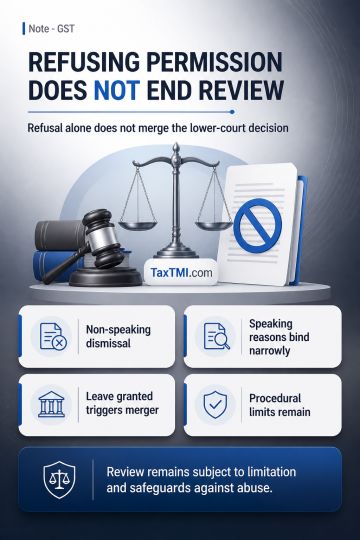
The doctrine of merger addresses the legal consequence of a superior forum deciding a matter brought from an inferior forum. It prevents two operative adjudications of the same dispute from simultaneously governing the parties where the superior court has exercised the jurisdiction entrusted to it. Its application, however, depends upon the nature of the jurisdiction exercised, the stage at which the matter was disposed of, and the contents of the superior court's order.
The issue assumes particular importance in proceedings under Article 136 of the Constitution of India. Article 136(1) provides: "the Supreme Court may, in its discretion, grant special leave to appeal from any judgment, decree, determination, sentence or order" passed by a court or tribunal in India. The constitutional design is thus discretionary at the leave stage. An application for special leave does not, without grant of leave, become an appeal in the appellate sense.
In the present GST proceeding, an earlier special leave petition against a decision favourable to an assessee had been dismissed. The court held that this dismissal did not result in merger of the High Court decision with an order of the Supreme Court. Since the matter before the High Court had been remanded for consideration of residual grounds, the petitioner was left free to challenge a prejudicial eventual order together with the reference decision. The ruling applies the settled distinction between refusal of leave and an appellate adjudication.
The material part of Article 136 is that the Supreme Court "may, in its discretion, grant special leave to appeal". This language supports the two-stage analysis: first, whether leave should be granted; and secondly, after grant, determination of the appeal. The first stage does not ordinarily replace the challenged order with a Supreme Court appellate order.
Article 141 of the Constitution of India states: "The law declared by the Supreme Court shall be binding on all courts within the territory of India." Article 141 concerns the precedential force of law declared; it is distinct from merger. Accordingly, a speaking refusal of leave may contain a binding legal proposition without causing the lower court order itself to merge into the order refusing leave.
| Question | Legal consequence |
|---|---|
| Was leave granted? | If not, the matter ordinarily remains at the discretionary special-leave stage and merger does not follow. |
| Is the dismissal non-speaking? | It ordinarily signifies only that the case was not considered fit for grant of leave; it neither affirms the reasoning below nor declares law on the underlying merits. |
| Is the dismissal speaking? | The stated legal proposition may bind under Article 141 or judicial discipline, but refusal of leave remains distinct from appellate disposal and does not itself cause merger. |
| Was an appeal decided after leave? | The superior court's appellate determination becomes operative, and merger applies. |
| Is a review, writ, or other proceeding proposed after dismissal? | Merger and automatic res judicata do not arise from a non-speaking refusal alone; maintainability remains subject to the governing remedy, limitation, procedural rules, and safeguards against abuse. |
In 2026 (8) TMI 230 - Supreme Court, the court expressly held that dismissal of the earlier special leave petition did not result in merger, applying the principle formulated in the leading authority on the subject. The order is significant because it rejects an attempt to treat dismissal of special leave as converting the High Court decision into a Supreme Court decision. The residual controversy before the High Court consequently remained capable of adjudication, and the party retained liberty to pursue a later challenge in the stated manner.
The ruling also identifies a practical consequence of non-merger. A decision subsequently rendered by the Supreme Court in favour of an assessee on the substantive question could be placed before the court dealing with the remanded proceedings. The prior dismissal of special leave did not prevent the court from applying such a later binding determination.
2000 (7) TMI 67 - Supreme Court (LB) separates Article 136 jurisdiction into the leave stage and the appellate stage. A non-speaking dismissal means only that the Supreme Court declined to exercise its discretion to grant leave. It is not an appellate decision, does not substitute the challenged order, and does not attract merger. The authority further explains that an otherwise available review before the court whose order was challenged is not excluded merely because special leave was dismissed without reasons.
The same authority draws the crucial distinction for speaking orders. Reasons stated while refusing leave may declare law and, to that extent, bind under Article 141 and judicial discipline. Yet the order remains one refusing leave; it does not attain the character of an appellate order or bring about merger. Merger arises when leave is granted and appellate jurisdiction is exercised by disposing of the appeal.
2019 (3) TMI 232 - Supreme Court reaffirmed the foundational formulation. It held that a non-speaking dismissal of special leave in limine does not extinguish the subordinate court's order and does not deprive the High Court of jurisdiction to entertain review on its merits. It also maintained the distinction between a reasoned refusal of leave, which may have Article 141 consequences, and an appellate decision after leave, which produces merger.
This authority is especially material because it treats the foundational exposition as the correct legal position. It therefore confirms that the inquiry is not whether the Supreme Court has passed any order, but whether it has granted leave and exercised appellate jurisdiction.
2012 (10) TMI 680 - Supreme Court recorded divergent approaches in authorities dealing with review after dismissal of special leave and referred the questions for authoritative consideration. It did not finally formulate the governing rule. Its relevance lies in showing why the distinction between a threshold dismissal and appellate adjudication required clarification.
The subsequent reaffirmation of the foundational rule means that the earlier reference cannot support an assertion that every dismissal of special leave causes merger or bars review. It remains relevant as procedural history of the debate, not as a contrary final rule.
In 2010 (6) TMI 687 - Supreme Court, the court held that dismissal of special leave in limine, particularly by a non-speaking order, does not confirm the High Court judgment, merge it into a Supreme Court order, or create res judicata on the merits. The refusal reflects the discretionary nature of Article 136 and cannot be equated with appellate approval of the decision below.
This authority reinforces the proposition applied in the present GST proceeding: an earlier threshold dismissal cannot be deployed as a conclusive endorsement of the legal reasoning of the High Court judgment challenged in that proceeding.
2001 (5) TMI 879 - Supreme Court held that a non-reasoned dismissal of special leave does not, by itself, operate as res judicata or merger to bar a subsequent challenge arising from review proceedings. It gave importance to the fact that the review application had been filed within time and before the special leave proceedings were pursued further. At the same time, it recognised that a belated attempt to invoke review after dismissal of special leave may, on its facts, raise concerns of abuse of process.
The practical point is limited but important. Absence of merger does not make every post-dismissal review maintainable. The review must independently satisfy the statutory or procedural conditions governing review, including limitation and the narrow grounds on which review may be sought.
2002 (9) TMI 102 - Supreme Court explains that merger ordinarily concerns the operative mandate of a superior court's order, not an automatic incorporation of every part of the reasoning of the lower forum. A dismissal on a technical ground without consideration of the merits does not create a declaration of law under Article 141 on the underlying controversy. Only the limited procedural propositions expressly decided may have binding force.
The authority is material where a party seeks to infer broad precedential endorsement from a brief or technical Supreme Court order. Such an inference is impermissible unless the order itself contains a declaration of the relevant legal principle.
1978 (5) TMI 120 - Supreme Court holds that a summary, non-speaking dismissal cannot safely be treated as deciding every ground raised in the special leave petition. It generally indicates only that leave was not granted. Although res judicata may apply to matters expressly, necessarily, or constructively determined, a non-speaking dismissal does not automatically establish that the merits of all issues were adjudicated.
Thus, merger and res judicata are separate questions. The absence of merger following dismissal of special leave does not dispense with examination of whether a particular issue was actually and necessarily decided in a prior proceeding.
1986 (8) TMI 57 - Supreme Court held that a non-speaking dismissal in limine does not preclude a writ challenge merely because special leave was earlier refused. The dismissal does not necessarily decide the merits, and a High Court should not reject the writ solely on that premise. The doctrine of election was also held inapplicable in that setting.
This does not convert writ jurisdiction into an appellate substitute. It establishes only that a non-speaking refusal of special leave is not, by itself, a jurisdictional bar. The ordinary principles regulating discretionary writ relief continue to apply.
2011 (3) TMI 252 - Supreme Court contains a formulation that merger would occur where special leave was dismissed with reasons, even if brief, while a non-speaking dismissal would leave review available. That formulation differs from the principle that even a speaking refusal of leave does not produce merger, although its legal propositions may bind under Article 141.
The governing conclusion is that refusal of leave does not result in merger. The operative ruling in 2026 (8) TMI 230 - Supreme Court applies that position, and 2019 (3) TMI 232 - Supreme Court separately reaffirms it. A speaking refusal must therefore be analysed for the law it expressly declares, not treated as an appellate merger of the order under challenge.
1981 (3) TMI 261 - Supreme Court distinguishes unconditional withdrawal of a special leave petition from dismissal. An order permitting withdrawal must be read as such and cannot be converted into a dismissal by reference to surrounding circumstances. As there is no adjudication on merits, withdrawal does not itself create res judicata or justify rejection of a later writ proceeding on that ground alone.
This distinction is useful in pleadings and objections. The precise operative wording of the Supreme Court's order is determinative; "dismissed", "withdrawn", and "leave granted" carry materially different consequences.
1993 (4) TMI 71 - Supreme Court holds that rejection of special leave in the case of a co-accused does not preclude consideration of appeals in which leave has been granted. A rejected special leave petition is not a merits decision creating a binding precedent through merger. The authority demonstrates that a threshold refusal in one matter cannot be assumed to conclusively determine another matter merely because the factual setting is connected.
2007 (3) TMI 735 - Supreme Court recognises that an order obtained by fraud is a nullity and may be recalled despite prior procedural finality, including dismissal of special leave petitions. This is not an expansion of review or a dilution of finality in ordinary cases. It reflects the settled principle that fraud vitiates judicial acts and can displace finality where the necessary factual foundation is established.
The doctrine of merger under Article 136 turns on the jurisdiction exercised, not on the mere fact that a special leave petition was filed or dismissed. A non-speaking dismissal is a refusal to grant leave and ordinarily signifies no more. It neither absorbs the lower court order into a Supreme Court order nor implies confirmation of the reasoning below.
A reasoned refusal of leave requires closer scrutiny because its express legal propositions may bind under Article 141 of the Constitution of India. Even then, the binding force of declared law must not be confused with merger. Merger arises upon grant of leave and appellate disposal.
The present ruling applies these distinctions directly: the earlier dismissal of special leave did not merge the High Court decision into a Supreme Court order, and the ongoing remanded proceedings remained open to determination in accordance with law. For litigation strategy, the operative language and procedural stage of the Supreme Court order remain the central determinants of merger, precedent, reviewability, and finality.
Full Text:
