Loading...

⚠ ✕
❮ Top
☎ Help
☰
×

By creating an account you can:

Logo TaxTMI
Call Us / Help / Feedback✕

Contact Us At :

✉ E-mail: [email protected]

✆ To Call / Whatsapp, Check Contact Us

FAQs :

To know Frequently Asked Questions, Check FAQs

Most Asked Video Tutorials :

For more tutorials, Check Video Tutorials

Submit Feedback/Suggestion :

Email :
Please provide your email address so we can follow up on your feedback.
Category :
Description :
Min 15 characters 0/2000
Make Most of Text Search ✕
  1. Checkout this video tutorial: How to search effectively on TaxTMI.
  2. Put words in double quotes for exact word search, eg: "income tax"
  3. Avoid noise words such as : 'and, of, the, a'
  4. Sort by Relevance to get the most relevant document.
  5. Press Enter to add multiple terms/multiple phrases, and then click on Search to Search.
  6. Text Search
  7. The system will try to fetch results that contains ALL your words.
  8. Once you add keywords, you'll see a new 'Search In' filter that makes your results even more precise.
  9. Text Search
╳
Add to...
You have not created any category. Kindly create one to bookmark this item!
✕
Create New Category
Hide
Title :
Description :
❮❮ Hide
❮ Default View
Expand ❯❯
Close ✕
🔎 Filters / Advanced Search ❯
TEXT

Press 'Enter' to add multiple search terms. Rules for Better Search

Search In
Main Text + AI Text ❯
  • Main Text
  • Main Text + AI Text
  • AI Text
Law:
---- All Laws---- ❯
  • ---- All Laws----
  • Benami Property
  • Bill
  • Central Excise
  • Companies Law
  • Customs
  • DGFT
  • FEMA
  • GST
  • GST - States
  • IBC
  • Income Tax
  • Indian Laws
  • Money Laundering
  • SEBI
  • SEZ
  • Service Tax
  • VAT / Sales Tax
Types:
---- All Types ---- ❯
  • ---- All Types ----
  • Act Rules
  • Case Laws
  • Circulars
  • Manuals
  • News
  • Notifications
Sort By: ?
In Sort By 'Default', exact matches for text search are shown at the top, followed by the remaining results in their regular order.
Relevance Default Date
☰   Show Results ❯
    Case Laws Customs
    Pilferage of Imported Goods: Approval, Custody and Duty Liability under the Customs Act, 1962
    Case Laws Indian Laws
    Condonation of Delay in Statutory Appeals under Section 5 of the Limitation Act, 1963
    Case Laws Income Tax
    Condonation of Delay for Filing Revised Returns under Section 119(2)(b): Genuine Hardship and Merits...
    Case Laws Income Tax
    TDS Credit Where the Deductor Defaults: Proof of Deduction Without Form 16 or Form 16A
    Case Laws Indian Laws
    Reserved High Court Judgments: Constitutional Timelines, Accountability and Litigant Remedies
    Price Depression in Securities Markets: Evidentiary Requirements under the PFUTP Regulations
    Case Laws Income Tax
    Foreign Leave Travel Concession and Tax Deduction at Source under Sections 10(5), 192 and 201
    Refund of Accumulated Input Tax Credit under Inverted Duty Structure: Section 54(3)(ii) and Rule 89(...
    Detention of Goods in Transit: Consequences of Delayed Penalty Orders Under Section 129(3)
    ITC: Constitutional Validity of Section 16(2)(c) of the CGST Act and Supplier-Tax-Payment Condition ...
    Substantive Right of Appeal and Onerous Pre-Deposit Conditions under the CGST Act
    Extended Limitation under GST: Fraud, Wilful Misstatement and Suppression Must Appear from the Notic...
    Omission of Rule 96(10) of the CGST Rules and Its Effect on Pending Integrated Tax Refund Proceeding...
    Interim Protection from Arrest after Dismissal of Anticipatory Bail under the GST Arrest Framework
    Case Laws Income Tax
    Interplay of Sections 87A, 111A and 115BAC(1A) in Computing Rebate on Special-Rate Capital Gains
    Extended Limitation u/s 74 of the CGST Act: Foundational Facts for Fraud, Wilful Misstatement and Su...
    Case Laws Income Tax
    Arm's Length Price Determination u/s 92C: Comparability Analysis: Economic Relevance of Turnover and...
    Case Laws Income Tax
    Make-Available Requirement for Managerial and Consultancy Services under the India-Singapore DTAA: A...
    Case Laws Income Tax
    Rebate under Section 87A on Short-Term Capital Gains Taxable under Section 111A
    Case Laws Income Tax
    Reassessment Notice Procedure: Administrative Approval under Section 143(2), Sanction under Section ...
❮
❯
❯❯
Maximize Maximize Maximize
0 / 200
Expand Note
Add to Folder

No Folders have been created

+

Are you sure you want to delete "My most important" ?

NOTE:

Notes
Showing Results for :
Reset Filters
Results Found:
Show All Summaries Hide All Summaries
Case Laws Customs
Show AI Summary
Approved customs custodians bear duty for proven pilferage during custody, but not for losses before their approval takes effect.
Customs-duty liability for pilfered imported goods arises only where pilferage occurs after unloading in a customs area while goods are held by an approved custodian. Approval is indispensable; factual control or statutory custody alone does not impose this liability for a period before approval. Importer duty exemption for pre-clearance pilferage operates alongside the custodian's revenue liability. Pilferage must be proved through contemporaneous records and cannot be presumed from every cargo discrepancy, shortage, or loss.
Case Laws Indian Laws
Show AI Summary
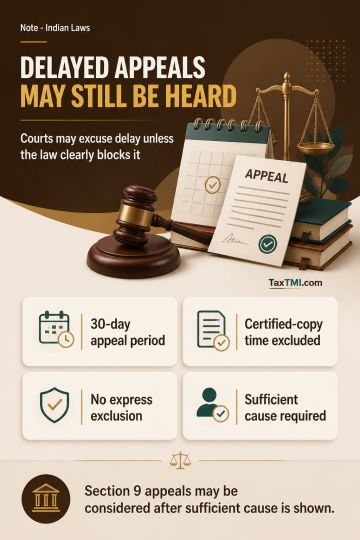
Condonation of delay under Section 5 remains available in special statutory appeals unless the governing scheme clearly excludes it.
Section 5 of the Limitation Act, 1963 applies to a special statutory appeal through Section 29(2) unless the governing enactment excludes it expressly or by necessary implication. A special limitation period alone is insufficient to exclude condonation. Restrictive language, a defined maximum condonable period, or a complete statutory limitation code may create a non-extendable outer limit. Section 9 of the Chhattisgarh Rajya Suraksha Adhiniyam contains a 30-day appeal period and excludes certified-copy time, but lacks an express bar or outer condonation ceiling; delay may therefore be considered upon proof of sufficient cause.
Case Laws Income Tax
Show AI Summary
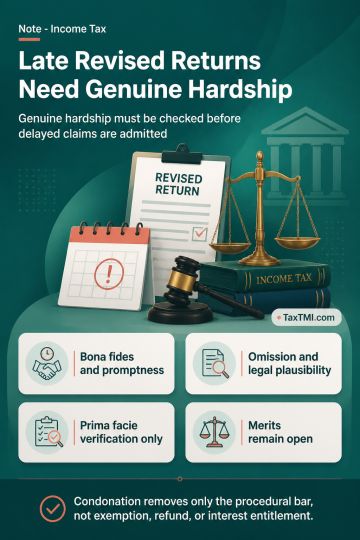
Genuine hardship in delayed revised-return claims requires prima facie verification without converting condonation into final tax adjudication.
Section 119(2)(b) may permit admission of a delayed revised-return claim where expiry of the Section 139(5) period causes genuine hardship. Condonation removes only the procedural bar and does not establish exemption, refund, or interest entitlement. Genuine hardship requires assessment of bona fides, the nature of the omission, promptness after discovery, legal plausibility, and the consequence of refusal. Circular No. 9/2015 permits prima facie verification and inquiry, but substantive taxability and refund entitlement remain for merits examination.
Case Laws Income Tax
Show AI Summary
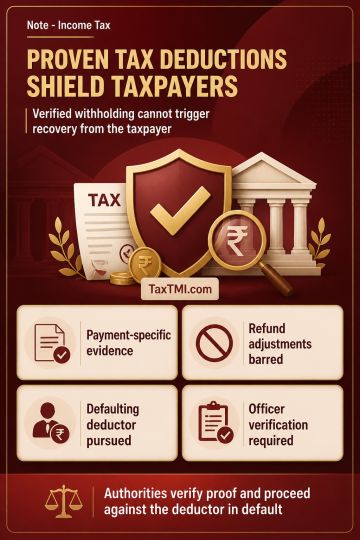
TDS credit after verified deduction protects taxpayers from demands and refund adjustments caused by deductor default.
TDS credit in domestic deductor-default cases depends on verified actual deduction from the taxpayer's income, not solely on deposit, TDS statements, Form 16 or Form 16A, or Form 26AS reflection. Section 205 bars direct or indirect recovery, including refund adjustment, to the extent tax was deducted. The taxpayer must provide reliable payment-specific evidence, and the Assessing Officer must verify the claim while the Department proceeds against the defaulting deductor.
Case Laws Indian Laws
Show AI Summary
Timely reserved judgments: a three-month framework, transparency, and staged remedies protect liberty and require reasoned decisions.
Reserved High Court judgments are subject to a three-month framework for a reasoned pronouncement, supported by monthly monitoring, status disclosures, date-recorded certified copies, and automated notice to advocates. Urgent matters may receive an operative-part pronouncement, but reasons must be uploaded within seven days or, where practical difficulties exist, within fifteen days. Parties may seek early pronouncement after the specified period and, after further delay, request withdrawal and assignment for a fresh hearing.
Case Laws SEBI
Show AI Summary
Settlement-price depression allegations require cogent proof of manipulation, not merely short exposure, closing sales, or position-limit non-disclosure.
Settlement-price depression under the PFUTP framework requires cogent proof of a manipulative act, device, scheme or artifice, not merely a substantial short derivative position, closing-window sales, or an incentive to benefit from a lower settlement price. Position concentration and position-limit non-disclosure are distinct from PFUTP fraud. Sales below the last traded price require market-wide causal analysis of other trading activity, execution mechanics, benchmark methodology, commercial rationale, and actual price impact. A genuine hedge and agency-attributed exposure do not, without further proof, establish manipulation.
Case Laws Income Tax
Show AI Summary
Foreign LTC tax exemption requires domestic travel; employers must deduct tax on known non-exempt travel reimbursements.
Foreign LTC/LFC payments for itineraries containing an overseas leg are outside the Section 10(5) exemption, which is confined to actual eligible domestic travel subject to Rule 2B shortest-route and fare conditions. Under Section 192, employers must include known non-exempt payments in estimated salary and deduct tax; they cannot disregard available claim records showing foreign or circuitous travel. A recovery restraint does not automatically suspend the deduction obligation. Section 201 recipient-compliance conditions, interest, and penalty based on reasonable cause require separate analysis.
Case Laws GST
Show AI Summary
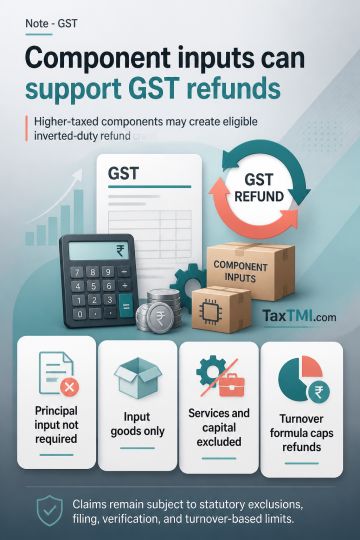
Inverted-duty GST refunds remain available where higher-taxed component inputs, rather than only principal inputs, cause accumulated eligible credit.
Refund of accumulated unutilised ITC under an inverted-duty structure depends on a causal link between higher-taxed input goods and lower-taxed output supplies. The test is not restricted to the principal raw material; higher-rated component inputs may support a claim despite parity between the principal input and output. Refund remains confined to credit on input goods, excluding input services and capital goods. Rule 89(5) separately determines the maximum refundable amount through its turnover-based formula, subject to statutory exclusions and prescribed filing and verification requirements.
Case Laws GST
Show AI Summary
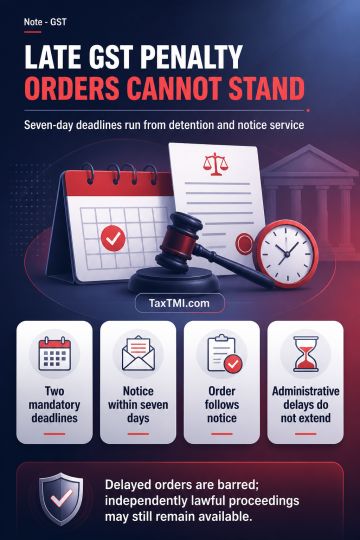
Mandatory goods-detention timelines bar delayed GST penalty orders despite administrative complications, while independently lawful proceedings may remain available.
Section 129(3) imposes two mandatory sequential deadlines: a penalty notice must be issued within seven days of detention or seizure, and the penalty order must follow within seven days of service of that notice. The service date, rather than reply, valuation or intervening events, controls the latter period. Administrative difficulty cannot extend either deadline. The framework also requires a hearing, while inspection reporting timelines and administrative forms remain distinct and cannot dilute the statutory time limits.
Case Laws GST
Show AI Summary
Input tax credit requires actual supplier tax payment, while reversal must rest on transaction-specific evidence and procedures.
Input tax credit under Section 16(2)(c) of the CGST Act is conditional upon actual payment of the tax charged on the supply to the Government. The condition is cumulative and is not replaced by the recipient's invoice, payment to the supplier, receipt of supply, return filing, or bona fides. Self-assessed credit is reversible with applicable interest where the supplier has not paid tax, but may be re-availed after subsequent supplier compliance. A bona fide-purchaser exception cannot be read into the actual-payment requirement, although any reversal or demand must rest on specific statutory facts, supporting material, and reasoned adjudication.
Case Laws GST
Show AI Summary
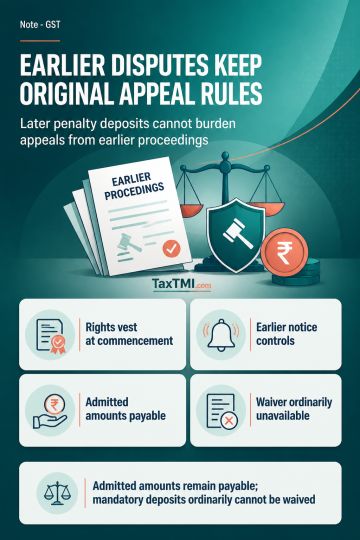
Vested appellate rights prevent later penalty-only pre-deposit conditions from burdening appeals arising from earlier commenced adjudication.
Substituted CGST pre-deposit requirement for penalty-only orders does not govern an appeal arising from a formal show-cause notice issued before 1 October 2025, absent express retrospective language or necessary implication. The right of appeal and its applicable conditions vest when the lis commences; a filing-stage deposit that bars institution is substantive, not merely procedural. Admitted amounts remain payable, while a mandatory applicable deposit cannot ordinarily be waived or reduced by the Appellate Authority.
Case Laws GST
Show AI Summary
Extended GST limitation requires show cause notices to plead fraud, wilful misstatement, or suppression through specific factual allegations.
Section 74 requires the notice itself to state the material facts supporting the precise statutory limb invoked and the causal nexus between that conduct and the alleged tax consequence. The phrase "by reason of" requires a pleaded connection; a tax discrepancy coupled with a conclusory allegation of fraud or suppression is insufficient. The notice should identify the relevant act, omission, representation, non-disclosure or device, explain why it is deliberate or wilful, and enable an effective response.
Case Laws GST
Show AI Summary
Omission of export-refund restriction requires pending integrated-tax refund claims to be assessed under surviving statutory and procedural conditions.
Omission of Rule 96(10), effective from 08 October 2024 without a saving clause, applies to integrated-tax export-refund proceedings pending on that date. Such claims are assessed without the former restriction concerning specified notification benefits because Section 6 of the General Clauses Act does not preserve an omitted subordinate rule. The omission does not remove independent requirements for zero-rated supplies, refund eligibility, export documentation, returns, limitation, verification, or the applicable Rule 96 and Rule 89 procedures.
Case Laws GST
Show AI Summary
Interim arrest protection cannot survive dismissal of anticipatory bail; GST arrest requires communicated authorisation, not merely a summons.
Interim protection from arrest is ancillary to a live anticipatory-bail proceeding and cannot subsist as a freestanding direction after an application is dismissed as not maintainable. Under the GST arrest framework, a summons does not by itself make the summoned person an accused or create a legally sustainable apprehension of arrest. Arrest depends upon the Commissioner's reasons to believe and an order authorising arrest. The Section 69 authorisation order must be communicated before arrest, enabling the affected person to pursue available remedies before personal liberty is curtailed.
Case Laws Income Tax
Show AI Summary
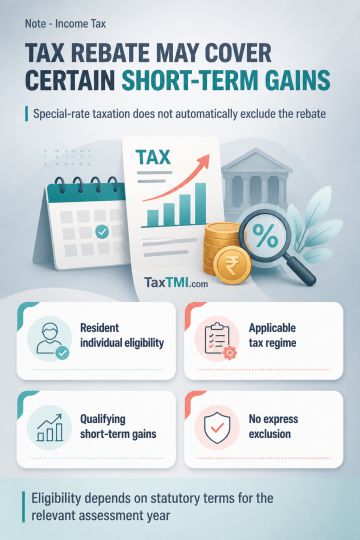
Section 87A rebate may apply after special-rate computation of qualifying short-term capital gains, absent an express statutory exclusion.
Section 111A requires qualifying short-term capital gains to be taxed at the prescribed special rate, while section 87A operates as a rebate from income-tax computed on total income for an eligible resident individual under the applicable section 115BAC(1A) regime. Special-rate taxation governs computation and does not itself imply exclusion from the rebate. Unlike section 112A(6), section 111A contains no express provision reducing the rebate base by tax on qualifying gains. Eligibility depends on the statutory terms applicable for the relevant assessment year.
Case Laws GST
Show AI Summary
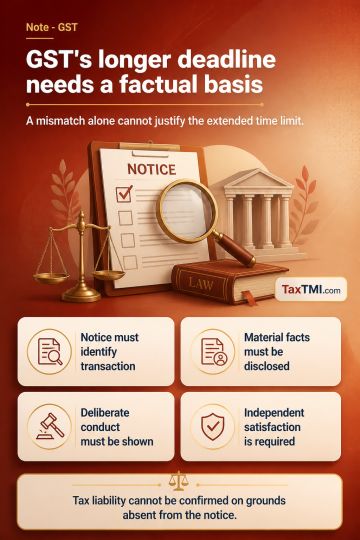
Extended GST limitation requires pleaded foundational facts linking alleged fraud, wilful misstatement, or suppression to tax evasion.
Section 74 permits extended GST limitation only where tax short payment, erroneous refund, or wrongful input tax credit arose by reason of fraud, wilful misstatement, or suppression of facts to evade tax. A mismatch or discrepancy alone is insufficient. The show cause notice must disclose foundational facts identifying the transaction, withheld or misstated material, deliberate conduct alleged, and its factual link to tax evasion. Audit objections or approaching limitation cannot replace the proper officer's independent satisfaction. Liability cannot be confirmed on grounds beyond those specified in the notice.
Case Laws Income Tax
Show AI Summary
Transfer-pricing comparability requires turnover and related-party transaction filters to reflect functional, economic, and data-based reliability rather than fixed thresholds.
Transfer-pricing comparability under the transactional net margin method requires economically reliable uncontrolled comparables selected through functional, asset, risk, contractual and market analysis. Turnover is not a universal statutory threshold, but material scale differences may justify exclusion where they affect margins through brand value, intangibles, bargaining power or economies of scale. Related-party transaction tolerance should ordinarily be the lowest practicable level; a higher threshold requires a recorded finding that sufficient lower-related-party comparables are unavailable. Any re-determination and comparable selection must comply with statutory conditions, reliable data requirements and Rule 10B.
Case Laws Income Tax
Show AI Summary
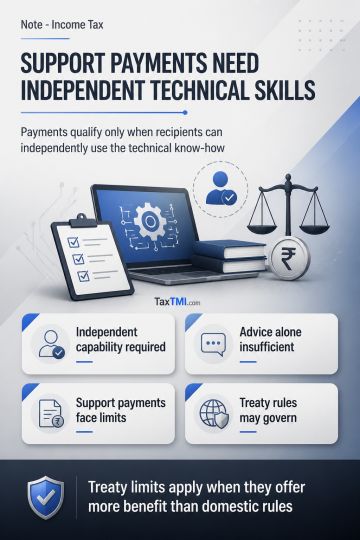
Make-available requirement limits treaty characterization of management and support payments as fees unless recipients gain independent technical capability.
Fees for technical services under Article 12(4) of the India-Singapore DTAA require more than managerial, technical or consultancy characterisation. The services must satisfy an additional treaty gateway, including making available technical knowledge, experience, skill, know-how or processes that enable the recipient to apply the technology independently. Advice, operational assistance, recurring support, training or business benefits do not alone establish transfer of technical capability. Where the DTAA is more beneficial than the broader domestic definition, the treaty limitation governs, subject to treaty-residence and documentation requirements.
Case Laws Income Tax
Show AI Summary
Income-tax rebate may extend to short-term capital gains tax when total-income conditions under the new regime are met.
Under the pre-restriction statutory formulation, a resident individual taxable under section 115BAC(1A) and within the prescribed total-income ceiling is analysed as eligible for section 87A rebate against income-tax on total income, including tax on qualifying short-term capital gains under section 111A. Section 111A fixes the special-rate computation but contains no express rebate exclusion. The explicit exclusion for specified long-term gains in section 112A(6) supports this distinction. Later limiting language in section 87A must be applied according to the statutory period concerned.
Case Laws Income Tax
Show AI Summary
Extended reassessment limitation permits reopening on qualifying book entries, independently of disputes over whether seized cash entries are assets.
Extended limitation under section 149(1)(b) may operate where books, documents or evidence reveal escaped income meeting the prescribed monetary threshold and represented as an asset, qualifying expenditure, or entries in books of account. These categories operate disjunctively; qualifying book entries may therefore provide an independent jurisdictional basis without resolving whether cash entries are assets. Handwritten and digital records may be treated as books where possession, control, corroboration, and attribution establish their nexus with the taxpayer.

TMI Notes

Back

All TMI Notes

Showing Results for :
Reset Filters
No Records Found

TMI Notes

Back

All TMI Notes

Reserved High Court Judgments: Constitutional Timelines, Accountability and Litigant Remedies

7 October, 2026

Contents
Acts
Plus +
Summary
Note

Note

-

Bookmark

(New) -

Download

Print

Print

This commentary provides doctrinal analysis and practical insights on the legal issue discussed below. The judgment is analysed in the context of its factual background, issues framed, and conclusions reached by the Court.

2026 (5) TMI 1852 - Supreme Court

Introduction

The timely pronouncement of a reserved judgment is an indispensable component of effective adjudication. A hearing does not attain legal finality merely because arguments have concluded; the litigant receives the adjudicatory outcome only when the court formally pronounces its decision. Delay at this terminal stage can keep liberty, property, livelihood, commercial rights and other legal entitlements in abeyance, notwithstanding that the judicial hearing itself is complete.

The Supreme Court, in 2026 (5) TMI 1852 - Supreme Court, has placed this concern within the guarantee of Article 21 and issued a uniform, binding framework for High Courts. The decision treats delayed pronouncement not as an internal matter of docket management alone, but as a constitutional concern affecting fair procedure, personal liberty, reasoned adjudication and institutional confidence.

The framework is particularly consequential where the litigant is in custody. A reserved criminal appeal, bail application or death reference may leave the affected person subject to continued confinement despite completion of the hearing. The constitutional injury in such circumstances is not merely delay in judicial administration; it is the possible continuation of restraint on liberty without a timely judicial resolution.

Legal & Statutory Context

Article 21 of the Constitution of India provides: "No person shall be deprived of his life or personal liberty except according to procedure established by law." The decision holds that this protection is not confined to expeditious trial. It extends to every stage of the proceeding and may be violated where a reserved judgment is left unpronounced for an undue period. Timely adjudication is therefore part of the constitutional requirement that procedure affecting life and liberty must remain fair, meaningful and effective.

The binding directions were issued under Article 142 of the Constitution of India. Article 142(1) authorises the Supreme Court to "pass such decree or make such order as is necessary for doing complete justice in any cause or matter pending before it"; a decree or order so made is enforceable throughout India. That power supplied the constitutional foundation for uniform directions applicable to all High Courts.

The decision recognises a statutory distinction between original criminal courts and High Courts. Under Section 392 of the Bharatiya Nagarik Suraksha Sanhita, 2023, every judgment in a criminal court of original jurisdiction is to be pronounced in open court "immediately after the termination of the trial or at some subsequent time not later than forty-five days." Where only the operative part is read, the whole judgment or its copy must be immediately available for parties or advocates to peruse free of cost, and the proviso requires the court, as far as practicable, to upload the judgment on its portal within seven days.

Section 392 thus supplies an express timeline for original criminal jurisdiction. The decision notes that High Courts did not face an equivalent statutory outer limit for pronouncement under the procedural regimes referred to in the judgment. It is this lacuna that made institutional directions necessary. The framework consequently does not merely reproduce the trial-court model: it creates a High Court-specific combination of timelines, internal oversight, transparency obligations and party-initiated remedies.

The constitutional position of High Courts also explains why delayed pronouncement has systemic significance. Article 226 of the Constitution of India empowers every High Court to issue directions, orders and writs for enforcement of Part III rights and "for any other purpose." Article 227 of the Constitution of India provides that every High Court has superintendence over courts and tribunals within its territorial jurisdiction. Given this role as a primary forum for constitutional and legal remedies, regularity in delivering reserved decisions is central to the High Court's institutional obligation to make rights practically enforceable.

Interpretative Issues

Speedy justice after completion of hearing

The central interpretative proposition is that speedy justice does not end when oral arguments close. The period between reservation and pronouncement is part of the adjudicatory process. A litigant whose matter is fully heard but remains undecided suffers an uncertainty that may be as acute as delay at an earlier stage. In a liberty matter, the passage of each day may have irreversible consequences.

"Endeavour" and the binding procedural architecture

The principal timeline requires a High Court to "endeavour to pronounce a reasoned judgement promptly, within a maximum period of 3 months" from reservation. The word "endeavour" preserves the deliberative character of judging and acknowledges institutional pressures. Yet the three-month formulation cannot be read in isolation as a merely aspirational target. The directions attach definite consequences to non-pronouncement: administrative placement before the Chief Justice, a two-week period for pronouncement, reassignment for rehearing, and party remedies. The framework therefore combines judicial flexibility at the initial stage with mandatory institutional responses once delay crosses stated thresholds.

Operative part and reasoned judgment

The directions distinguish between pronouncement of a complete reasoned judgment and pronouncement of an operative part because urgent relief may not await full preparation of reasons. However, the distinction is not permission for an indefinite separation between result and reasons. Where delay in a reasoned judgment would cause irreparable loss and urgent orders are necessary, the operative part may be pronounced in court; the reasoned judgment must then be uploaded within seven days, or within a maximum of fifteen days where practical difficulties arise. The decision identifies habeas corpus, acquittal of a convict in custody, demolition or eviction, and educational admissions as illustrations of urgency.

This distinction protects the efficacy of immediate relief while maintaining the discipline of reasoned decision-making. Reasons enable parties to understand the basis of the outcome, assess further remedies and ensure that the adjudicatory exercise remains transparent. The governing norm remains the pronouncement of a reasoned judgment; an operative-part order is an exceptional procedural response to urgency.

Transparency as an element of accountability

The framework treats information architecture as a substantive safeguard. The case-status record must disclose the date on which judgment was reserved. If only the operative part is delivered, that status must be reflected. Certified copies must record the dates of reservation, pronouncement and uploading. Once a reasoned judgment is uploaded, advocates representing the parties are to receive automated email or SMS intimation. These requirements make delay objectively visible and enable timely resort to the prescribed remedies.

Detailed Commentary & Analysis

The directions establish three interconnected layers: prompt adjudication, administrative accountability and party-facing remedies. First, the ordinary outer framework is three months from reservation for pronouncement of a reasoned judgment. Secondly, matters of personal liberty attract "extra promptitude." A bail order should preferably be pronounced and uploaded on the day of hearing; if reserved, it is expected to be pronounced and uploaded on the next day. An order granting regular bail, suspending sentence or acquitting a convict in custody must be communicated to jail authorities and the trial court on the date of pronouncement. The undertrial or convict must then be released on the same day or, at most, the next day, subject to custody in another case or delay in compliance with bail conditions.

The framework also regulates post-reservation engagement. In a reserved criminal appeal or death reference where the appellant is in custody, the Bench must seek any clarification from advocates within seven days of reservation. In all other matters, clarifications should be sought not later than one month from reservation. The requirement prevents an unresolved request for clarification from becoming an unrecorded source of prolonged delay.

The second layer is administrative monitoring. At the end of every month, an automated email is to be sent to the Chief Justice identifying all reserved judgments pending during that month, with a copy to the Bench concerned. The Chief Justice may confidentially circulate, in a sealed cover, information regarding cases in which judgments have remained unpronounced for two months. If a judgment is not delivered within three months, the Registrar General must place the matter before the Chief Justice, who is to bring it to the Bench's notice for pronouncement within the ensuing two weeks. If the judgment remains undelivered after that extended period, the Chief Justice should assign it to another Bench after notifying advocates and parties. The new Bench must rehear the matter and pronounce judgment promptly.

The third layer is a structured remedial route. Upon expiry of three months from reservation, a party may apply in the High Court for early judgment. The application must be listed before the concerned Bench within two days, excluding intervening holidays, and the Registry must inform the Chief Justice about such applications. If the judgment is still not pronounced within three and a half months from reservation, a party may move the Chief Justice for withdrawal and assignment to another Bench for fresh hearing.

Similar safeguards govern an operative-part pronouncement. If the reasoned judgment is not uploaded within fifteen days after pronouncement of the operative part, the Registrar General must place the matter before the Chief Justice, who is to bring it to the Bench's attention for uploading within the next three days. A party may seek early judgment after fifteen days; that application must be listed within two days, excluding holidays. If reasons remain unavailable one month after pronouncement of the operative part, the party may seek withdrawal and reallocation for fresh hearing.

The remedial scheme is procedurally important. It does not make reassignment automatic at the first instance of delay. Rather, it creates a graduated process: application for early pronouncement, administrative notice, a defined extended period, and then an application for withdrawal and fresh hearing. This sequencing respects judicial independence and the need for considered judgments, while recognising that unexplained judicial silence cannot defeat the litigant's right to an effective result.

Judicial / Administrative Perspective

2001 (8) TMI 1330 - Supreme Court supplied the earlier doctrinal foundation. It treated unreasonable and unexplained delay in pronouncing a reserved judgment as capable of impairing the right of appeal and personal liberty under Article 21. It prescribed recording of reservation and pronouncement dates, monthly monitoring, attention by the Chief Justice after two months, an application for early judgment after three months, and recourse to the Chief Justice after six months for withdrawal and reallocation. The current directions preserve that basic architecture but make it more comprehensive, particularly by addressing urgent liberty matters, uploading obligations, automated monitoring and the reduced three-and-a-half-month point for seeking withdrawal.

2003 (8) TMI 54 - HIGH COURT OF JUDICATURE AT BOMBAY demonstrates the adjudicatory prejudice that may arise from extreme delay in a tribunal's reserved decision. The tribunal's delayed order omitted material contentions and earlier orders relied upon by the party. The court set aside the challenged order and required rehearing with a reasoned decision. Its significance lies in the link between delay, loss of adjudicatory recall, non-application of mind and practical negation of appellate rights. It also extended the need for timely-pronouncement guidelines beyond courts to adjudicatory tribunals.

1953 (11) TMI 18 - Supreme Court explains why formal pronouncement is the decisive juridical act. A judgment is the court's operative declaration made by pronouncement or delivery in open court; drafts and signed opinions remain tentative until that step occurs. The decision further distinguishes curable irregularities in authentication from the absence of the core act of pronouncement. This doctrinal premise reinforces the proposition that a reserved draft, however complete, does not provide the litigant with an operative adjudication.

1987 (11) TMI 385 - Supreme Court addresses the converse situation: once judgment is formally pronounced in open court, it becomes operative. Although procedural rules may permit alteration before signature, that power is to be exercised sparingly and for adequate or exceptional reasons recorded on the file. The authority affirms that the moment of pronouncement has legal consequence; a court cannot casually withhold or undo the effect of a decision already delivered.

1995 (7) TMI 437 - Supreme Court concerns the legal continuity of a reserved civil matter after hearing concludes. It applies Order XXII Rule 6 of the Code of Civil Procedure, 1908, under which death after conclusion of hearing and before pronouncement does not cause abatement, and judgment may be pronounced with the same force and effect as if delivered before death. The authority shows that procedural law expects the adjudicatory process to culminate after hearing is complete; it does not contemplate reservation as an indefinite interruption of the court's duty to decide.

The current decision also notes a judicial approach under which an urgent outcome may be pronounced first, but reasons must quickly enter the public domain. The present binding framework gives that approach a clearer operational form: reasons should be uploaded within seven days and, where practical difficulty exists, no later than fifteen days. Thus, speed is not allowed to displace reasons, and reasons are not allowed to frustrate urgent relief.

Implications & Observations

For litigants and counsel, the first practical discipline is accurate identification of the reservation date. The framework makes that date the trigger for almost every subsequent safeguard. Counsel should also distinguish a fully reasoned judgment from an order in which only the operative result has been pronounced, because each attracts a separate remedial timeline.

In matters of custody, the operational chain is as important as pronouncement itself. The directions require immediate communication of orders granting bail, suspending sentence or acquitting a person in custody; they further require same-day or next-day release, subject to stated exceptions, and reporting of compliance by the trial court to the concerned Bench. This recognises that a favourable judicial order is ineffective if its communication and execution are delayed.

For High Court administration, the framework requires changes not only in listing practice but also in technology and record design. Automated alerts, website case-status updates, date disclosures on certified copies and automated intimation to advocates convert a previously opaque period into a trackable procedural stage. The Registrars General are directed to place the guidelines before the Chief Justices so that necessary amendments may be incorporated in High Court Rules and official websites.

The directions nevertheless acknowledge institutional reality. High Courts carry broad constitutional and statutory responsibilities, substantial caseloads and diverse urgent rosters. The framework is not framed as an adverse reflection upon any individual judge. Its purpose is structural: to assist High Courts in reconciling heavy workload with the constitutional imperative that decisions, once reserved, must not be withheld beyond a defined and reasonable period.

Concluding Remarks

The right to speedy justice under Article 21 includes the right to a timely pronouncement once the court has heard the matter. The binding framework in 2026 (5) TMI 1852 - Supreme Court translates that constitutional principle into concrete procedural safeguards: a three-month norm for reserved judgments, heightened urgency for liberty matters, tightly regulated use of operative-part orders, institutional monitoring, transparency in court records and defined applications for early pronouncement or reassignment.

The deeper constitutional insight is straightforward. Justice is not fully delivered when a matter is argued; it is delivered when the court communicates an operative and reasoned decision within a timeframe that preserves the value of the right being adjudicated. Timely pronouncement is therefore both a safeguard of individual rights and a condition for sustained public confidence in the justice-delivery system.


Full Text:

2026 (5) TMI 1852 - Supreme Court

Topics

Acts Income Tax