Loading...

⚠ ✕
❮ Top
☎ Help
☰
×

By creating an account you can:

Logo TaxTMI
Call Us / Help / Feedback✕

Contact Us At :

✉ E-mail: [email protected]

✆ To Call / Whatsapp, Check Contact Us

FAQs :

To know Frequently Asked Questions, Check FAQs

Most Asked Video Tutorials :

For more tutorials, Check Video Tutorials

Submit Feedback/Suggestion :

Email :
Please provide your email address so we can follow up on your feedback.
Category :
Description :
Min 15 characters 0/2000
Make Most of Text Search ✕
  1. Checkout this video tutorial: How to search effectively on TaxTMI.
  2. Put words in double quotes for exact word search, eg: "income tax"
  3. Avoid noise words such as : 'and, of, the, a'
  4. Sort by Relevance to get the most relevant document.
  5. Press Enter to add multiple terms/multiple phrases, and then click on Search to Search.
  6. Text Search
  7. The system will try to fetch results that contains ALL your words.
  8. Once you add keywords, you'll see a new 'Search In' filter that makes your results even more precise.
  9. Text Search
╳
Add to...
You have not created any category. Kindly create one to bookmark this item!
✕
Create New Category
Hide
Title :
Description :
❮❮ Hide
❮ Default View
Expand ❯❯
Close ✕
🔎 Filters / Advanced Search ❯
TEXT

Press 'Enter' to add multiple search terms. Rules for Better Search

Search In
Main Text + AI Text ❯
  • Main Text
  • Main Text + AI Text
  • AI Text
Law:
---- All Laws---- ❯
  • ---- All Laws----
  • Benami Property
  • Bill
  • Central Excise
  • Companies Law
  • Customs
  • DGFT
  • FEMA
  • GST
  • GST - States
  • IBC
  • Income Tax
  • Indian Laws
  • Money Laundering
  • SEBI
  • SEZ
  • Service Tax
  • VAT / Sales Tax
Types:
---- All Types ---- ❯
  • ---- All Types ----
  • Act Rules
  • Case Laws
  • Circulars
  • Manuals
  • News
  • Notifications
Sort By: ?
In Sort By 'Default', exact matches for text search are shown at the top, followed by the remaining results in their regular order.
Relevance Default Date
☰   Show Results ❯
    Case Laws Indian Laws
    Section 37 of the NDPS Act: Twin Conditions for Grant of Bail in Commercial Quantity Cases
    Case Laws Indian Laws
    Condonation of Delay in Statutory Appeals under Section 5 of the Limitation Act, 1963
    Case Laws Indian Laws
    Reserved High Court Judgments: Constitutional Timelines, Accountability and Litigant Remedies
    Case Laws Indian Laws
    Betting on Skill-Based Games: Constitutional Scope of Entry 34 and the Distinction between Skill and...
    Case Laws Indian Laws
    Admitted Cheque Signature and Presumption of Legally Enforceable Debt under Sections 118 and 139 of ...
    Case Laws Indian Laws
    Illegality of Arrest and Remand for Non-Supply of Written Grounds: The Two-Hour Pre-Remand Standard ...
    Case Laws Indian Laws
    Cheque Dishonour, Tax Compliance, and Judicial Reform: Legally Enforceable Debt and Procedural Innov...
    News Indian Laws
    Evaluating the 2025 Finance Bill: Key Changes and Their Impact
    News Indian Laws
    Supplementary FAQs for the Finance Bill, 2025: As passed by Lok Sabha
    Case Laws Indian Laws
    Dishonour of Cheques and the Burden of Proof: Rebutting the Presumption u/s 139 of the Negotiable In...
    Case Laws Indian Laws
    Upholding Arbitral Autonomy: Supreme Court Clarifies Scope of Judicial Interference u/s 11
    Case Laws Indian Laws
    Unraveling the Mineral Rights Regime: The Supreme Court's Landmark Judgment
    Case Laws Indian Laws
    Supreme Court Upholds Forfeiture of Earnest-Money Deposits under SARFAESI Rules
    Case Laws Indian Laws
    The Generality vs. Enumeration Principle: A Key to Interpreting Delegated Rule-Making Power: Validit...
    Case Laws Indian Laws
    Ensuring Fair Procedure before declaring Fraud in Bank Loan: Providing Relevant Documents and Opport...
    Case Laws Indian Laws
    Interim Orders and the Limits of Article 142: Safeguarding Natural Justice Balancing Judicial Powers...
    Case Laws Indian Laws
    Supreme Court Clarifies Vicarious Liability of Directors in Cheque Dishonour Cases
    Case Laws Indian Laws
    Interim Compensation in Cheque Dishonor Cases: Discretion and Due Process, Scope of the word "May"
    Case Laws Indian Laws
    Unraveling the Principles of Delay Condonation: A Comprehensive Analysis by the Supreme Court
    Case Laws Indian Laws
    Judicial Restraint in SARFAESI Cases: Navigating Alternative Remedies and Writ Jurisdiction
❮
❯
❯❯
Maximize Maximize Maximize
0 / 200
Expand Note
Add to Folder

No Folders have been created

+

Are you sure you want to delete "My most important" ?

NOTE:

Notes
Showing Results for :
Reset Filters
Results Found:
Show All Summaries Hide All Summaries
Case Laws Indian Laws
Show AI Summary
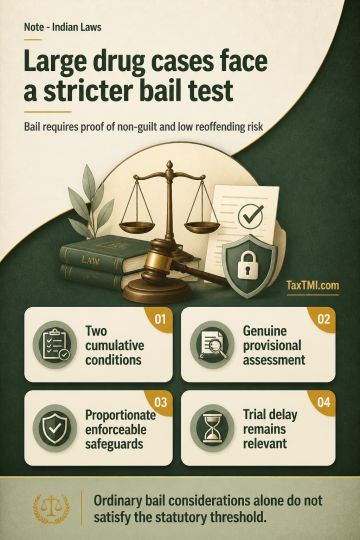
NDPS commercial-quantity bail requires independent proof of non-guilt and low reoffending risk alongside proportionate safeguards.
Section 37 of the NDPS Act imposes cumulative bail conditions in commercial-quantity cases: the court must find reasonable grounds to believe the accused is not guilty and unlikely to reoffend while on bail. These requirements supplement ordinary bail factors and demand a genuine, provisional assessment of credible material. Personal liberty and trial delay remain relevant, but must be reconciled with the statutory threshold. Bail conditions, including verification safeguards for foreign nationals, must be proportionate, genuine and capable of enforcement.
Case Laws Indian Laws
Show AI Summary
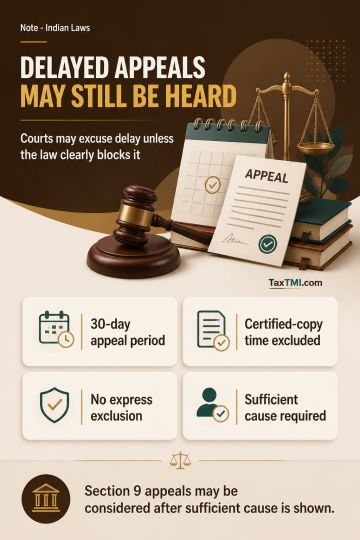
Condonation of delay under Section 5 remains available in special statutory appeals unless the governing scheme clearly excludes it.
Section 5 of the Limitation Act, 1963 applies to a special statutory appeal through Section 29(2) unless the governing enactment excludes it expressly or by necessary implication. A special limitation period alone is insufficient to exclude condonation. Restrictive language, a defined maximum condonable period, or a complete statutory limitation code may create a non-extendable outer limit. Section 9 of the Chhattisgarh Rajya Suraksha Adhiniyam contains a 30-day appeal period and excludes certified-copy time, but lacks an express bar or outer condonation ceiling; delay may therefore be considered upon proof of sufficient cause.
Case Laws Indian Laws
Show AI Summary
Timely reserved judgments: a three-month framework, transparency, and staged remedies protect liberty and require reasoned decisions.
Reserved High Court judgments are subject to a three-month framework for a reasoned pronouncement, supported by monthly monitoring, status disclosures, date-recorded certified copies, and automated notice to advocates. Urgent matters may receive an operative-part pronouncement, but reasons must be uploaded within seven days or, where practical difficulties exist, within fifteen days. Parties may seek early pronouncement after the specified period and, after further delay, request withdrawal and assignment for a fresh hearing.
Case Laws Indian Laws
Show AI Summary
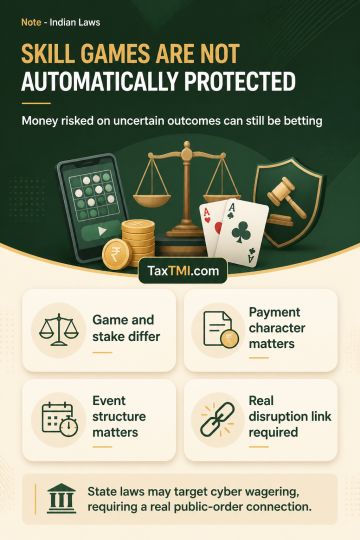
Betting on skill games remains distinct from protected skill play when money is risked on uncertain outcomes.
Entry 34 of List II is analysed as extending to betting on uncertain outcomes even when the underlying game substantially involves skill. The legal inquiry separates the game from an outcome-linked monetary stake: skill classification does not itself immunise wagering. A genuine participation fee for a skill competition may differ from betting, depending on the payment's character, the event structure and its connection to potential gain. State laws may target wagering in cyber space, while public-order competence requires a real and proximate nexus with community-wide disruption.
Case Laws Indian Laws
Show AI Summary
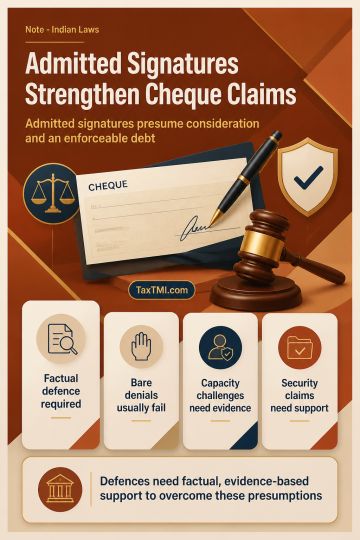
Admitted cheque signatures trigger presumptions of consideration and enforceable debt, requiring evidence-based probable defences in dishonour proceedings.
Once execution of a cheque is admitted or proved, consideration must be presumed and the holder must be presumed to have received the cheque towards discharge, wholly or partly, of a legally enforceable debt or other liability. The drawer may rebut these presumptions on a preponderance of probabilities, but the defence must have a factual foundation. Bare denials, unsupported misuse allegations, and blank-cheque or security-cheque assertions ordinarily do not displace the presumptions. Financial capacity becomes material only upon a credible, specific, and evidence-based challenge.
Case Laws Indian Laws
Show AI Summary
Arrest communication: written grounds generally required; oral only temporarily, written copy at least two hours before remand.
The obligation to communicate grounds of arrest applies across statutes and, as a rule, must be met by supplying written grounds in a language the arrestee understands. In exceptional exigencies oral communication at arrest is permissible temporarily, but a written copy must be provided within a reasonable time and no later than two hours before production for remand; remand papers must include the grounds and explain any delay. Non compliance renders the arrest and remand illegal, though authorities may seek fresh custody after supplying written grounds with reasons for earlier non supply.
Case Laws Indian Laws
Show AI Summary
Cheque dishonour cases: statutory presumptions preserved; tax breaches don't negate enforceability; procedural reforms directed.
Once a cheque's execution is admitted, statutory presumptions of consideration and of a legally enforceable debt arise and, though rebuttable, the initial burden lies on the accused; unsupported claims of payer incapacity or a 'blank cheque' are insufficient without positive evidence. Breach of tax-related cash-transaction rules attracts fiscal penalties but does not render the underlying loan unenforceable for cheque-dishonour purposes. Revisional courts may not overturn concurrent factual findings absent perversity or jurisdictional error. Procedural reforms and calibrated compounding measures are directed to expedite and streamline Section 138 proceedings.
News Indian Laws
Show AI Summary
Tax treatment for foreign securities clarified, enhancing investor certainty and tightening compliance obligations for cross border instruments.
The Finance Bill, 2025 amendments clarify tax treatment for securities held by foreign investors by defining covered instruments for FIIs and specified funds under applicable regulatory compliance, expand coverage to include over the counter derivatives while removing ambiguous intermediary language, and strengthen assessment provisions to address inconsistencies and undisclosed income; Part IV validates pension classification authority to distinguish pension entitlements by retirement date.
News Indian Laws
Show AI Summary
IFSC tax incentives expanded to ease fund relocations, clarify exemptions, and simplify non resident taxation.
Amendments relax compliance for investment funds by easing indirect participation thresholds and restoring executive modification powers; expand the relocation regime to include retail schemes and ETFs for tax neutral transfers into the IFSC; introduce a presumptive taxation scheme for non residents providing technology services for electronics manufacturing with exclusions for permanent establishment and royalty rules; correct and align IFSC insurance and specified fund exemptions with IFSCA conditions; extend derivative transaction exemptions to FPIs in the IFSC; refocus Chapter XIV B on undisclosed income and add Section 143(1) checks for return inconsistencies; and broaden the definition of capital asset to include securities held by Alternative Investment Funds under SEBI and IFSCA.
Case Laws Indian Laws
Show AI Summary
Rebuttable presumption under the Negotiable Instruments Act: burden can be discharged on preponderance of probabilities by accused.
The court holds that the statutory presumption in favour of the cheque holder is rebuttable and may be displaced by the drawer upon adducing evidence which, on the preponderance of probabilities, shows the cheque was not issued for a legally recoverable debt; inconsistencies in the holder's case, absence of supporting financial records, and unexplained issuance circumstances are salient in assessing rebuttal.
Case Laws Indian Laws
Show AI Summary
Arbitral autonomy: referral courts must limit Section 11 scrutiny to prima facie existence of arbitration agreements.
The referral court's inquiry under Section 11 is limited to the prima facie existence of an arbitration agreement; issues such as alleged accord and satisfaction and mixed questions of law and fact do not negate the arbitration clause and are within the arbitral tribunal's exclusive competence. Legislative intent behind the 2015 amendments supports minimal judicial interference at the appointment stage, and limitation under Section 11(6) should be confined to timeliness, leaving substantive limitation defenses to the tribunal.
Case Laws Indian Laws
Show AI Summary
Central legislative competence over mineral regulation affirmed; royalties characterised as compensation for resource depletion, limiting state levies.
The Court concluded that the central legislative framework occupies the field of mineral regulation and that royalties are compensation for depletion of state-owned natural resources, not conventional taxes; consequently the Centre may impose such levies while States remain constrained from imposing royalties in the nature of compensation that would encroach on the Centre's exclusive regulatory domain.
Case Laws Indian Laws
Show AI Summary
Forfeiture of earnest-money deposits under SARFAESI rules stands as a statutory consequence, limiting equitable intervention.
The analysis affirms that Rule 9(5) of the SARFAESI Rules prescribes an express statutory forfeiture of earnest-money deposits arising from auction terms, and that Sections 73 and 74 of the Indian Contract Act, 1872, addressing contractual damages, do not apply to such statutory forfeitures. Unjust enrichment and equitable considerations cannot supplant a clear statutory forfeiture, and subsequent recovery by the secured creditor does not negate the forfeiture, except in narrowly defined exceptional circumstances where equity may justify relief.
Case Laws Indian Laws
Show AI Summary
Generality vs. enumeration principle affirms broad delegated rule making power, upholding rules that further an Act's statutory purposes.
The Court held that Rule 9(3) is intra vires because the general delegated rule making power in section 29A(1) authorises rules that carry out the Act's purposes even when not covered by enumerated heads. Applying the generality vs. enumeration principle, the Court found the enumerated matters in section 29A(2) illustrative and not restrictive, and concluded Rule 9(3) furthers the misconduct chapter's object of maintaining ethical standards and preventing wrongful threshold dismissal of genuine complaints.
Case Laws Indian Laws
Show AI Summary
Right to be heard: affected parties must receive documents underlying fraud allegations and be allowed inspection and rebuttal.
Classification of a loan account as fraud invokes the Principles of Natural Justice, requiring disclosure of the documents forming the basis of a Show Cause Notice and inspection access to bank and Resolution Professional records so the affected party can identify required documents, receive copies, and submit a meaningful reply within specified timelines, with scope to request a personal hearing.
Case Laws Indian Laws
Show AI Summary
Limits on Article 142: extraordinary power cannot automatically vacate interim stays; natural justice and supervisory jurisdiction must be preserved.
Limits on the Supreme Court's extraordinary jurisdiction were defined to prevent blanket, time based vacation of interim stays; equitable power cannot deprive non parties of substantive benefits or negate the right to be heard. The Court confined vacation rules to cases where interim relief was granted without notice, instructed High Courts to grant limited ad interim relief, prioritise vacation applications, avoid routine time bound disposal directives, and recognised that past automatic vacations that led to concluded trials raise finality concerns while endorsing judicial superintendence and natural justice as constitutional constraints.
Case Laws Indian Laws
Show AI Summary
Vicarious liability of directors clarified: specific averments required to link a director to company affairs before liability attaches.
The Court held that vicarious liability of a director in cheque dishonour cases cannot be invoked by merely reproducing statutory language or alleging directorship; complaints must contain specific factual averments showing how the director was responsible for or in charge of the company's day to day affairs to link the director to issuance or dishonour of negotiable instruments.
Case Laws Indian Laws
Show AI Summary
Interim compensation discretion: courts must prima facie assess claims and defences before ordering payment under Section 143A.
The Court interpreted Section 143A(1) of the Negotiable Instruments Act as conferring a discretionary power to order interim compensation, holding that the word "may" cannot be read as mandatory. Courts must prima facie assess the complainant's case and the accused's defence; the presumption under section 139 alone does not suffice. Interim compensation may be directed only when a prima facie case is established, with the quantum determined after considering transaction nature, parties' relationship, and the accused's paying capacity, and brief reasons must be recorded.
Case Laws Indian Laws
Show AI Summary
Condonation of delay: courts require sufficient cause, balancing strict limitation rules with liberal remedial discretion.
Principles of condonation of delay require balancing the Limitation Act's public policy against stale litigation: Section 3 is to be strictly interpreted while Section 5 is to be construed liberally to allow judicial discretion where sufficient cause is shown. Discretion remains limited by considerations such as inordinate delay, negligence, and lack of due diligence, and prior decisions granting condonation do not automatically justify relief unless the factual matrices are substantially similar.
Case Laws Indian Laws
Show AI Summary
Judicial restraint in writ jurisdiction: Defer to statutory remedies under SARFAESI to preserve sale finality.
The note explains that High Courts should ordinarily refrain from exercising Article 226 writ jurisdiction where an effective statutory remedy under the SARFAESI Act exists, particularly in recovery matters; confirmed and registered auction sales attain finality and the right of redemption is extinguished, and interference is permissible only in narrow exceptions such as proven fraud, collusion, or clear statutory or procedural violations.

TMI Notes

Back

All TMI Notes

Showing Results for :
Reset Filters
No Records Found

TMI Notes

Topics

Acts Income Tax