 TaxTMI
Login

Login
Loading...
Press 'Enter' to add multiple search terms. Rules for Better Search
 of 127

Press 'Enter' after typing page number.
of 127 Press 'Enter' after typing page number.


No Folders have been created
Are you sure you want to delete "My most important" ?
NOTE:
of 127 Press 'Enter' after typing page number.




 of 127
Press 'Enter' after typing page number.

All TMI Notes
of 127 Press 'Enter' after typing page number.
of 127 Press 'Enter' after typing page number.
All TMI Notes

Note

Bookmark

Share


Download

This is a neutral professional article. The judgment is analysed in the context of its factual background, issues framed, and conclusions reached by the Court.
2026 (8) TMI 1558 - ITAT CHENNAI
The tax treatment of foreign leave travel concession or leave fare concession turns first on the limited exemption in Section 10(5) of the Income-tax Act, 1961. The provision applies to travel concession or assistance received by an individual from an employer, for the individual and family, in connection with proceeding on leave "to any place in India", subject to prescribed conditions. The exemption cannot exceed the travel expenses actually incurred.
Rule 2B operationalises that statutory limitation. It confines the eligible journey to a place in India and prescribes ceilings by reference to the shortest route. Consequently, a journey involving a foreign leg or a circuitous itinerary does not fall within the statutory exemption merely because its origin, destination, or a segment of the journey is in India.
Where an employer treats a non-exempt foreign LTC payment as exempt and does not deduct tax, the question arises under Section 192 and Section 201. The Tribunal, in 2026 (8) TMI 1558 - ITAT CHENNAI, held that the substantive issue of taxability of foreign LTC stood concluded against the employer. It dismissed the challenge to the employer's treatment as an assessee in default, while leaving a limited procedural avenue concerning interest under Section 201(1A).
The decision also addresses the separate significance of interim judicial directions that had restrained TDS on specified LTC payments. The Tribunal distinguished the obligation to deduct tax from the subsequent question of recovery from employees. It held that a suspension of recovery does not, by itself, extinguish the statutory TDS obligation once the legal character of the payment as taxable salary is established.
The controversy arose from reimbursement or payment of LTC/LFC to employees undertaking journeys containing an overseas component. The revenue authorities treated the payments as salary not exempt under Section 10(5), and consequently held the employer liable for non-deduction under Section 192, with consequential proceedings under Sections 201 and 201(1A). Certain appeals also concerned penalty under Section 271C.
The employer relied on interim directions issued in service-related litigation. Those directions had stated that LTC payments or reimbursements made pursuant to the interim arrangement would not amount to income for TDS purposes during the continuance of the interim relief, while preserving employees' liability to pay tax if the challenge ultimately failed. The employer's position was that deduction in the face of those directions would have been impermissible.
The Tribunal accepted that interim orders and the suspension of recovery had a factual and legal bearing on the period concerned. Nevertheless, it held that the statutory obligation of deduction is distinct from recovery. It noted periods during which there was no active stay and concluded that the employer had neither deducted tax on foreign LTC/LFC nor recovered the relevant amount despite the settled substantive position. The Tribunal therefore sustained the default on merits.
Section 10(5) exempts, in the case of an individual, the value of travel concession or assistance received from the employer for the individual and family in connection with proceeding on leave "to any place in India". The post-retirement limb is also confined to proceeding "to any place in India". The exemption is subject to prescribed conditions concerning the number of journeys and the permissible amount, and is capped by the amount of expenses actually incurred for the travel.
The statutory definition of "family" includes the spouse and children of the individual, and parents, brothers and sisters who are wholly or mainly dependent on the individual. That definition determines the eligible persons; it does not enlarge the territorial condition that travel must be to a place in India.
Rule 2B provides that the amount exempt is the amount actually incurred on travel to a place in India, subject to the specified fare ceilings. For air travel, the ceiling is the economy fare of the national carrier by the shortest route. Where origin and destination are connected by rail and travel is by a mode other than air, the ceiling is the air-conditioned first-class rail fare by the shortest route. In other cases, the rule applies the prescribed recognised-public-transport fare or an equivalent rail-fare measure, again by the shortest route.
Rule 2B also limits the exemption to two journeys in a block of four calendar years, subject to the specified carry-forward rule for the first calendar year of the succeeding block. Further, the exemption is generally unavailable for more than two surviving children born after the stated cut-off, subject to the stated exceptions.
Section 192(1) requires every person responsible for paying income chargeable under the head "Salaries" to deduct income-tax at the time of payment, at the average rate computed on the basis of rates in force, on the estimated salary income of the employee for the financial year. Section 192(3) permits adjustment of excess or deficiency in a previous deduction or failure to deduct during the same financial year.
The statutory task is thus an estimation exercise. It does not permit an employer to exclude a payment from estimated salary where the available particulars show that the Section 10(5) conditions are not met.
Under Section 201(1), a person required to deduct tax who "does not deduct, or does not pay, or after so deducting fails to pay" the tax is deemed to be an assessee in default. The first proviso supplies an important qualification: the deductor is not deemed in default if the payee has filed a return under Section 139, taken the sum into account in computing income, paid the tax due on the returned income, and the deductor furnishes the prescribed accountant's certificate.
Section 201(1A) imposes simple interest at one per cent for every month or part of a month from the date tax was deductible to the date of deduction, and at one and one-half per cent for every month or part of a month from deduction to payment. Where the first proviso to Section 201(1) applies, interest under clause (i) runs only up to the date on which the payee furnishes the return. The earlier administrative instruction also states that a Section 201(1) demand should not be enforced once the deductor satisfies the TDS authority that the deductee has paid the taxes: Instruction on Section 201(1).
Section 271C provides for a penalty equal to the tax that a person failed to deduct or pay, as applicable. However, Section 273B expressly covers Section 271C and provides that no penalty is imposable where the person proves that there was reasonable cause for the failure. The penalty inquiry is therefore distinct from the substantive determination of TDS default.
The governing proposition is that an LTC journey qualifying for exemption must remain within the domestic travel framework laid down by the statute and rule. In 2022 (11) TMI 426 - Supreme Court, the Court held that LTC is confined to travel from one place in India to another place in India and that the exemption must be determined by reference to the shortest domestic route. A foreign leg or circuitous route did not become exempt because the employee's origin and final destination were within India, or because reimbursement was purportedly restricted to a domestic-fare equivalent. The Court also held that the employer, having the itinerary and claim particulars at settlement, was obliged to deduct tax on the non-exempt payment.
The earlier decisions reflect the same statutory construction. In 2013 (6) TMI 519 - ITAT CHANDIGARH, the Tribunal rejected apportionment of an overseas package to isolate an Indian segment. In 2016 (3) TMI 282 - ITAT LUCKNOW, foreign-travel reimbursement was held non-exempt and a later interim direction was held incapable of retrospectively affecting earlier settlements. In 2017 (4) TMI 533 - ITAT BANGALORE, the Tribunal likewise held that foreign and circuitous journeys did not meet Section 10(5) and Rule 2B, particularly where the employer knew the relevant travel facts at final settlement.
There is an important distinction between a general duty to collect proof in every case and an employer's duty to act upon particulars actually available while estimating salary. In 2009 (1) TMI 10 - Supreme Court, the Court held that no statutory or rule-based obligation required an employer to collect and examine proof that employees actually utilised LTC or conveyance amounts. 2009 (1) TMI 11 - SC Order separately affirmed that the Section 10(5) beneficiary is the individual employee and that no CBDT circular imposed such evidence-collection duty on the employer.
Those rulings do not permit an employer to disregard known information that positively shows a foreign journey. The Supreme Court's later decision on foreign LTC treated the available itinerary and claim documents as sufficient for the employer to identify non-exempt payments. This is consistent with the salary-estimation character of Section 192.
Circular No. 8/2013 similarly states, in its discussion of LTC, that exemption is not allowable for travel abroad and that an employer claiming non-taxability must satisfy itself about Section 10(5) and preserve supporting evidence. That administrative guidance must be understood consistently with the judicial distinction: the employer is not subjected to an unlimited statutory investigation duty, but it cannot allow exemption in disregard of material available with it.
In 2015 (2) TMI 1378 - MADRAS HIGH COURT, the Court clarified, for the life of its interim arrangement, that LTC payments made pursuant to that order would not amount to income enabling TDS deduction. It simultaneously preserved employees' eventual liability to tax if the writ challenge failed. That ruling explains the source of the employer's contention that compliance with the interim direction precluded deduction.
2022 (7) TMI 291 - MADRAS HIGH COURT held that overseas LTC was an administrative concession rather than a statutory service right, and that the statutory tax exemption remained confined to domestic travel. 2023 (6) TMI 1398 - MADRAS HIGH COURT subsequently set aside the withdrawal of the overseas service concession for want of hearing and remitted that service question. Neither proposition enlarges the territorial scope of Section 10(5).
There are decisions treating a subsisting interim prohibition as a sufficient answer to Section 201 default for the particular covered period. 2025 (4) TMI 44 - ITAT AGRA, 2025 (11) TMI 1773 - KERALA HIGH COURT, and 2026 (3) TMI 1568 - ITAT AHMEDABAD each concluded that non-deduction in obedience to the interim direction did not attract Sections 201(1) and 201(1A) for the relevant period.
The Tribunal in 2026 (8) TMI 1558 - ITAT CHENNAI, however, reached the contrary result on the facts before it. It treated the duty to deduct as distinct from recovery and held that a stay or suspension of recovery did not displace the deduction obligation after taxability had been conclusively determined. It also found intervals without active stay during which no deduction or recovery occurred. On that basis, it sustained the employer's Section 201 default on the substantive issue. This conclusion governs the present analysis.
2019 (7) TMI 1562 - ITAT DELHI emphasises that relief under the first proviso to Section 201(1) requires proof that each recipient filed a return, included the amount, paid due tax, and that the prescribed accountant's certificate is furnished. It remitted the matter for verification where those statutory conditions had not been demonstrated. That approach remains relevant where an employer seeks to limit principal default or interest through recipient-level compliance.
The Tribunal in the governing decision held that interest under Section 201(1A) is mandatory and consequential, but permitted the employer to pursue a petition for periods during which recovery was stayed or where an employee had discharged the tax by self-assessment. This is not an automatic deletion of interest; it requires the relevant factual and statutory verification.
Penalty under Section 271C calls for an independent Section 273B analysis. In 2019 (1) TMI 145 - ITAT JAIPUR, a bona fide and consistently followed understanding of LFC treatment, coupled with reasonable verification and corrective conduct, was held to constitute reasonable cause. 2019 (7) TMI 1266 - ITAT BANGALORE treated the admission of substantial questions of law on the underlying LTA issue as supporting the employer's bona fides. Conversely, the governing decision does not treat a debatable issue or recovery restraint as erasing the substantive TDS obligation under Sections 192 and 201.
2007 (1) TMI 155 - PUNJAB AND HARYANA HIGH COURT turned on factual findings that the employer obtained detailed prescribed declarations, reimbursement was bona fide, and no specific false claim was identified. It illustrates that proof and bona fides are fact-sensitive. It does not dilute the rule that known foreign travel lies outside Section 10(5).
Employers should design LTC controls around the statutory test: actual travel to a place in India, actual eligible expenditure, applicable journey limits, eligible family members, and the shortest-route fare ceiling under Rule 2B.
Where claim documents disclose an overseas leg or circuitous routing, the payment should not be excluded from salary merely by limiting reimbursement to a notional domestic fare or by segregating one domestic segment of a composite itinerary.
Section 192 estimation should be based on the information available at claim settlement. The absence of a general obligation to conduct open-ended verification does not justify disregarding claim records that reveal statutory ineligibility.
Where interim judicial directions are invoked, the employer should preserve the operative order, the precise duration and scope of restraint, affected employee-wise payments, and records of any later deduction, recovery, employee return, tax payment, and accountant's certificate.
In a Section 201 proceeding, the first proviso requires recipient-specific statutory proof. A broad assertion that employees may have paid tax will not, by itself, establish the proviso's protection.
Penalty proceedings should be separately defended through evidence of reasonable cause under Section 273B; the determination of taxability or Section 201 default does not automatically decide penalty.
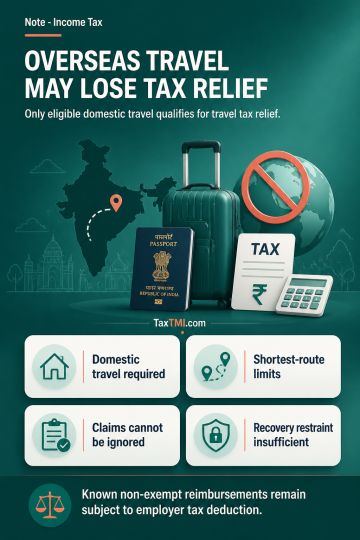
Section 10(5) and Rule 2B confine LTC exemption to domestic travel and prescribed shortest-route limits.
A foreign leg or circular route takes the claim outside the exemption; partial domestic reimbursement does not preserve the exemption.
Under Section 192, an employer must include known non-exempt LTC payments in estimated salary and deduct tax accordingly.
Under the governing Tribunal decision, recovery relief or restraint cannot automatically be equated with a suspension of the statutory obligation to deduct tax.
Section 201 recipient-compliance relief, Section 201(1A) interest, and Section 271C penalty require separate statutory and evidentiary analysis.
Full Text:
