 TaxTMI
 Login
 TaxTMI
Login
Loading...
Press 'Enter' to add multiple search terms. Rules for Better Search

Press 'Enter' after typing page number.
Press 'Enter' after typing page number.


No Folders have been created
Are you sure you want to delete "My most important" ?
NOTE:
Press 'Enter' after typing page number.
Press 'Enter' after typing page number.

All News
Press 'Enter' after typing page number.
All News

Note

Bookmark

Share


Commerce Secretary Calls for Integrated Approach to Trade and Sustainable Development
Deliberations Focus on Sustainability Measures and Domestic Carbon Framework to Support India's Trade Strategy
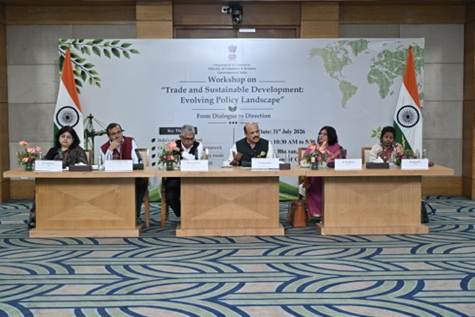
The Department of Commerce, Ministry of Commerce & Industry, organised a day-long workshop on “Trade and Sustainable Development (TSD): Evolving Policy Landscape” at Vanijya Bhawan, New Delhi, today. The workshop brought together senior government officials, trade negotiators, and representatives from industry, academia, think tanks and the legal community to deliberate on the evolving interface between international trade and sustainable development.
The workshop was the first in a proposed series of consultations aimed at strengthening India's strategic approach to Trade and Sustainable Development (TSD) in the context of evolving global trade disciplines and ongoing Free Trade Agreement (FTA) negotiations.
Addressing the gathering, Commerce Secretary Shri Rajesh Agrawal emphasised that Trade and Sustainable Development is a cross-sectoral policy issue requiring an integrated approach encompassing trade, industry, sustainability and competitiveness. Noting that sustainability regulations and unilateral environmental measures have become enduring features of the global trading system, he underlined the need to create an enabling ecosystem to support industry in adopting sustainable practices. He observed that early adaptation would strengthen India's global competitiveness and better position the country to respond to the evolving international trade landscape.
The workshop featured four thematic sessions on India's domestic carbon framework, global trends in TSD provisions in Free Trade Agreements (FTAs), the evolving global carbon regulatory framework, and strategic options for shaping India's future approach to Trade and Sustainable Development.
The discussions focused on the growing importance of sustainability-related measures, including carbon markets, carbon pricing mechanisms, carbon border adjustment measures, sustainability standards and regulatory cooperation, and their implications for India's trade and industrial competitiveness.
The workshop concluded with deliberations on India's evolving domestic sustainability architecture, including the Carbon Credit Trading Scheme (CCTS), the Indian Carbon Market, the Extended Producer Responsibility (EPR) framework, and the country's accreditation and conformity assessment ecosystem. The discussions highlighted the importance of leveraging these domestic initiatives to strengthen India's preparedness for emerging sustainability-related trade disciplines and to inform its future trade engagements.

