

Loading...

Top
Help
×

By creating an account you can:

Logo TaxTMI
Call Us / Help / Feedback

Contact Us At :

E-mail: [email protected]

Call / WhatsApp at: +91 99117 96707

For more information, Check Contact Us

FAQs :

To know Frequently Asked Questions, Check FAQs

Most Asked Video Tutorials :

For more tutorials, Check Video Tutorials

Submit Feedback/Suggestion :

Email :
Please provide your email address so we can follow up on your feedback.
Category :
Description :
Min 15 characters 0/2000
Make Most of Text Search
  1. Checkout this video tutorial: How to search effectively on TaxTMI.
  2. Put words in double quotes for exact word search, eg: "income tax"
  3. Avoid noise words such as : 'and, of, the, a'
  4. Sort by Relevance to get the most relevant document.
  5. Press Enter to add multiple terms/multiple phrases, and then click on Search to Search.
  6. Text Search
  7. The system will try to fetch results that contains ALL your words.
  8. Once you add keywords, you'll see a new 'Search In' filter that makes your results even more precise.
  9. Text Search
Add to...
You have not created any category. Kindly create one to bookmark this item!
Create New Category
Hide
Title :
Description :
❮❮ Hide
Default View
Expand ❯❯
Close ✕
🔎 News - Adv. Search
TEXT SEARCH:

Press 'Enter' to add multiple search terms. Rules for Better Search

Search In:
Main Text + AI Text
  • Main Text
  • Main Text + AI Text
  • AI Text
Category: ?
Categorized by AI
---- All Categories ----
  • ---- All Categories ----
  • Income Tax
  • GST
  • Customs, DGFT & SEZ
  • FEMA & RBI
  • Corp. Laws, SEBI & IBC
  • PMLA, Black Money & ED
  • Budget
  • News and Press Release
  • PTI News
Month:
---- All Months ----
  • ---- All Months ----
  • January
  • February
  • March
  • April
  • May
  • June
  • July
  • August
  • September
  • October
  • November
  • December
Year:
---- All Years ----
  • ---- All Years ----
  • 2026
  • 2025
  • 2024
  • 2023
  • 2022
  • 2021
  • 2020
  • 2019
  • 2018
  • 2017
  • 2016
  • 2015
  • 2014
  • 2013
  • 2012
  • 2011
Sort By: ?
In Sort By 'Default', exact matches for text search are shown at the top, followed by the remaining results in their regular order.
Relevance Default Date
    LPG subsidy: Aadhaar biometric authentication mandatory for subsidised refills from Oct 1
    RBI orders removal of Maharashtra minister Babasaheb Patil, 7 others as directors of Latur DCC Bank
    US tariffs on Indian goods: A Chronology
    Graft case: Kerl BJP chief alleges 'fixed match' between Congress, CPM
    India's FTAs opening new career opportunities for youth: PM Modi
    AutomationEdge Launched Assist-Edge at Global Fintech Fest 2026, Redefining How Enterprises Build and Scale Automation
    BC.GAME's BC Engine Rewards Surpass $8.6 Million as Ecosystem Growth Accelerates
    NLMC’s 21st Board Meeting Reviews progress of monetisation programme; stresses on Accelerated Asset Monetisation;
    IDFC FIRST Bank introduces Zero Forex Markup across all its Credit Cards, existing and new.
    India's forex reserves drop by USD 4.924 billion to USD 780.782 billion: RBI data
    Govt eases sugar stockholding limit for bulk users to 30 days ahead of festive season
    25th Meeting of SCO Ministers Responsible for Economic and Foreign Trade Activities Held in Tajikistan
    India–Nepal Inter-Governmental Sub-Committee on Trade, Transit and Cooperation to Control Unauthorised Trade Meets in New Delhi
    OnEMI Technology Solutions Limited’s Board Approves Fundraise of approximately ₹832 Crore through a Preferential Issue of Securities
    CGST Delhi South officers bust firm in fraudulent availment of ITC involving over Rs. 25.22 crore; proprietor arrested
    Net direct tax collection rises 13 pc to Rs 12.12 lakh cr till Sep 17 on higher advance tax mop-up
    Protean launches next-generation KYC Onboarding & Reporting Solution at Global Fintech Fest 2026
    Japan's central bank raises benchmark interest rate to 1.25 pc, highest in 31 years
    Net direct tax collection rises 13 pc to Rs 12.12 lakh cr till Sept 17 on higher advance tax mop-up
    SP Group backs Tata Sons listing, bolstering board's push despite Trusts' opposition
❯❯
Maximize Maximize Maximize
0 / 200
Expand Note
Add to Folder

No Folders have been created

+

Are you sure you want to delete "My most important" ?

NOTE:

News
Showing Results for :
Reset Filters
Results Found:
Show All Summaries Hide All Summaries
September 19, 2026
Show AI Summary
Biometric Aadhaar authentication becomes essential for domestic LPG consumers seeking regulated subsidised refill bookings, while market-price supply remains available.
Biometric Aadhaar authentication is required from October 1 for domestic LPG consumers to book subsidised refills at the regulated retail selling price. Authentication can be completed through delivery personnel, distributor showrooms or designated mobile applications. Consumers unwilling or unable to authenticate may obtain LPG at the applicable market price without subsidy after registering their choice through specified digital channels. The framework distinguishes subsidised LPG linked to Aadhaar-authenticated consumers from market-priced LPG and seeks targeted subsidy delivery, reduced leakage, and prevention of diversion, duplicate connections and ineligible access.
September 19, 2026
Show AI Summary
Cooperative bank director tenure limits require disqualification and removal when service exceeds the statutory maximum period.
Directors of District Central Cooperative Banks and Central Cooperative Banks are subject to a maximum 10-year tenure under the Banking Regulation Act, 1949, as amended by the Banking Laws (Amendment) Act, 2025. RBI directed removal of a director ineligible to continue under section 10A(2A)(i), read with section 56, following concerns that directors of Latur District Central Cooperative Bank had exceeded the permitted tenure.
September 19, 2026
Show AI Summary
Tariff treatment of Indian exports shifted from reciprocal duties to targeted trade measures, sectoral duties, and specified exemptions.
Upon expiry of the temporary global measure, an India-targeted 10 per cent Section 301 tariff, linked to forced-labour concerns, replaced it; the effective charge for most covered exports remained MFN duty plus 10 per cent. The current regime applies the Section 301 tariff to Indian exports except specified goods, with separate sectoral duties on steel, aluminium and auto components. Smartphones, medicines and energy products are exempt.
September 19, 2026
Show AI Summary
PMLA-based FIR request over alleged consultancy payments remains under legal examination amid criticism of non-registration.
Enforcement Directorate sought registration of an FIR concerning alleged fraudulent payments by Cochin Minerals and Rutile Ltd to Exalogic Solutions, represented as IT consultancy fees. The request relied on evidence gathered through investigation and searches under the Prevention of Money Laundering Act. Registration remained under consideration after receipt of the Advocate General's legal opinion, with the Home Department examining the matter.
September 19, 2026
Show AI Summary
Free trade agreements expand market access, entrepreneurial partnerships and youth career opportunities alongside public-sector recruitment and development participation.
Free Trade Agreements are presented as mechanisms for expanding cross-border partnerships, market access for entrepreneurs, and career opportunities for young persons. Youth employment is also linked to the expansion of the startup ecosystem beyond major cities and to public-sector recruitment through Rozgar Melas. Newly selected candidates are to join central government ministries, departments and organisations. Public service is framed around citizen-centred administration and decisions supporting a developed and self-reliant India.
September 19, 2026
Show AI Summary
AI governance for regulated financial services enables natural-language automation while preserving enterprise security, auditability, control, and scalable deployment.
Assist-Edge enables teams to describe intended processes in natural language and use AI to create, modify, and enhance executable workflows. Working with reusable AI agents and workflows, it supports discovery, customisation, deployment, and scaling of enterprise automation. For banking, financial services, and insurance operations, its use is positioned alongside security, governance, auditability, and control, supporting governed adoption of scalable AI capabilities and movement from isolated experimentation to enterprise-wide intelligent automation.
September 19, 2026
Show AI Summary
Recurring token reward distributions connect eligible holdings, platform activity, and partner participation through hourly settlement cycles.
BC Engine permits eligible $BC holdings to participate in hourly settlement rounds distributing BCD rewards. Participants can monitor active balances, cumulative rewards, unclaimed BCD, and settlement history through the Engine interface. Settlement amounts vary with ecosystem activity, while the mechanism links platform activity, token utility, user participation, and commercial partners through repeated value distribution rather than one-time promotional incentives.
September 19, 2026
Show AI Summary
Asset monetisation of surplus public land and buildings is accelerated through transparent, value-oriented processes and stakeholder coordination.
NLMC's Board recommended monetisation proposals involving surplus land and building assets valued at over Rs. 5,000 crore. Monetisation is facilitated through asset identification, due diligence, valuation and appropriate process structuring, with emphasis on transparency, efficiency and value realisation. Sustained coordination with asset-owning entities is intended to expedite implementation and support timely, commercially appropriate monetisation of underutilised public assets.
September 19, 2026
Show AI Summary
Zero forex markup on credit cards applies automatically to international transactions without conditions while preserving applicable rewards.
Zero Forex Markup applies automatically to international transactions made through all existing and new credit cards, without a new-card application, upgrade, spending threshold or other stated condition. International card spends do not attract forex markup charges. Reward Points or Cashback, where applicable to the relevant card, continue on international transactions. Existing credit cards may be used for overseas and cross-border payments without requiring a separate forex card solely to avoid such charges.
September 18, 2026
Show AI Summary
Foreign exchange reserve valuation reflects currency movements as foreign currency assets and gold holdings decline.
India's foreign exchange reserves declined to USD 780.782 billion for the week ended September 11, driven by reductions in foreign currency assets and gold holdings. Foreign currency assets fell to USD 645.796 billion, with their dollar value reflecting movements in reserve currencies against the US dollar. Gold reserves also declined, while Special Drawing Rights increased to USD 18.845 billion. The reserve position with the IMF stood at USD 4.916 billion.
September 18, 2026
Show AI Summary
Bulk sugar stockholding limits now allow expanded inventories only where additional supplies derive from designated import channels.
Bulk sugar consumers using more than 10 tonnes monthly as a raw material may hold up to 30 days' requirement instead of 15 days. Holdings above 15 days must consist exclusively of sugar imported under the Tariff Rate Quota or Advance Authorisation Scheme; sugar obtained from the open market remains restricted to 15 days' consumption. Bulk consumers must declare and disclose their sugar inventories every Friday through the food ministry's online portal.
September 18, 2026
Show AI Summary
Trade facilitation and digitalisation support regional economic cooperation through simpler customs procedures, paperless exchange, resilient supply chains, and MSME access.
Priority measures included expanded intra-SCO trade, lower trade costs, resilient and diversified supply chains, trusted multimodal connectivity, greater market access, simplified customs processes, paperless trade and electronic document exchange. Digital and cross-border payments and accessible trade finance were identified to enable MSMEs and start-ups to participate in trade and value chains. Ministers agreed an Action Plan for 2026-2030 for further approval and approved regulations for a special working group on creative-economy development.
September 18, 2026
Show AI Summary
Customs cooperation and trade facilitation advance electronic origin verification, pre-arrival information exchange, and safeguards against preferential trade misuse.
Customs cooperation and trade facilitation measures included pre-arrival information exchange, electronic verification of Certificates of Origin, and Customs automation and digitalisation. These measures are directed at facilitating legitimate trade while ensuring compliance with applicable rules and preventing misuse of preferential trade arrangements. Rail and road connectivity, freight movement, Integrated Check Posts and land-port infrastructure were reviewed to improve infrastructure utilisation and address operational bottlenecks affecting bilateral and transit trade.
September 18, 2026
Show AI Summary
Preferential equity issuance approved to strengthen capital, support digital lending expansion, and fund subsidiary operations subject to required approvals.
OnEMI Technology Solutions Limited has approved a preferential issue of equity shares to identified investors, subject to shareholder and requisite regulatory and statutory approvals. The issuance is proposed under the Companies Act, 2013, the SEBI capital-issue and disclosure framework, other applicable SEBI regulations, and applicable law. Seventy-five per cent of the additional capital raised is proposed for infusion into its wholly owned subsidiary to support lending, technology, digital capabilities and product expansion, while the remaining twenty-five per cent is proposed for general corporate purposes.
September 18, 2026
Show AI Summary
Fraudulent input tax credit claims through bogus invoices prompted arrest over alleged invoicing without actual supply of goods.
Alleged fraudulent availment, utilisation and passing on of inadmissible input tax credit involved invoices from purported suppliers found to be non-existent, non-functional, suspended or cancelled. Input tax credit was allegedly claimed without actual receipt of goods and passed on through invoices unsupported by corresponding supplies. Following investigation and recorded statements, the proprietor of an iron and steel trading firm was arrested under statutory arrest powers, while further investigation remains in progress.
September 18, 2026
Show AI Summary
Direct tax collections: stronger advance tax payments support growth in corporate, non-corporate, and securities transaction tax receipts.
Direct tax collections grew through September 17, supported principally by increased advance tax payments from corporate and non-corporate taxpayers. Gross collections exceeded Rs 14.32 lakh crore, while net collections, after refunds, exceeded Rs 12.12 lakh crore. Corporate tax collections grew more strongly than non-corporate tax collections, and Securities Transactions Tax receipts recorded significant growth. The trend indicated broad-based tax buoyancy, supported by underlying economic activity, taxpayer confidence and business performance.
September 18, 2026
Show AI Summary
Reusable consent-based KYC enables integrated onboarding, reporting, record updates and periodic re-verification for regulated financial institutions.
Central KYC-based onboarding enables regulated financial institutions to reuse a customer's existing verified identity record through the Central KYC Registry with customer consent. The integrated solution supports onboarding, KYC reporting, unsolicited notifications and re-KYC. It retrieves consented KYC records through CKYC APIs, uses facial matching or video-based customer identification for authentication, and applies AI-based duplicate detection. Reporting automates validation, image correction and real-time registry submission, while record updates and simplified periodic re-verification support the currency of institutional KYC information.
September 18, 2026
Show AI Summary
Benchmark interest rate normalisation raises borrowing costs while monetary policy monitors inflation, wage growth, currency risks, and economic recovery.
The Bank of Japan increased the uncollateralised overnight call rate from 1.0 per cent to 1.25 per cent, advancing monetary-policy normalisation after a prolonged period of near-zero or negative rates. The increase was assessed against gradual economic recovery, inflation near its target, wage growth, currency fluctuations, elevated crude oil prices, and external risks. Further tightening remains contingent on stable price increases, wage developments, and monitoring of other risks.
September 18, 2026
Show AI Summary
Direct tax collections reflect stronger advance tax payments, alongside increased corporate tax, securities transaction tax, and refund issuance.
Net direct-tax collections exceeded Rs 12.12 lakh crore through 17 September, reflecting 13 per cent growth following increased advance-tax receipts. Gross direct-tax collections exceeded Rs 14.32 lakh crore, while refunds exceeded Rs 2.20 lakh crore. Corporate-tax and non-corporate tax collections increased, as did Securities Transaction Tax collections. Advance-tax receipts exceeded Rs 5.22 lakh crore, comprising increased corporate advance tax and non-corporate advance tax payments.
September 18, 2026
Show AI Summary
Upper-layer NBFC listing compliance sharpens corporate governance conflict over public accountability, shareholder liquidity, and preservation of private ownership.
Tata Sons' status as an upper-layer non-banking financial company has brought its proposed public listing into focus after the Reserve Bank of India rejected its application to voluntarily surrender core investment company registration. Tata Sons is required to take steps to comply with the enhanced regulatory framework applicable to upper-layer NBFCs, which includes stock-market listing. Classified in 2022, Tata Sons did not meet the original listing deadline and had pursued deregistration after repaying debt.

News

Back

All News

Showing Results for :
Reset Filters
No Records Found

News

Back

All News

Showing Results for : Reset Filters
Corp. Laws, SEBI & IBC

Union Minister of State for Corporate Affairs Shri Harsh Malhotra and Justice (Retd.) Shri Dipak Misra, Former Chief Justice of India, inaugurate National Conference on Responsible Business Conduct in New Delhi

September 5, 2024

Contents
Summary
Note

Note

-

Bookmark

Print

Print

Indian businesses to lead by example in adopting ethical and sustainable practices, positioning India as a global leader in responsible governance: MoS Shri Harsh Malhotra

Sound ESG policies will act as fulcrum in ensuring that businesses operate within bounds of justice and fairness: Justice (Retd.) Dipak Misra

Union Minister of State for Corporate Affairs and Road Transport and Highways, Shri Harsh Malhotra and Justice (Retd.) Shri Dipak Misra, 45th Chief Justice of India, inaugurated the flagship ‘National Conference on Responsible Business Conduct 2024- Escalating Environmental, Social, and Governance (ESG) for Viksit Bharat’ in New Delhi. The conference was organised by the School of Business Environment, Indian Institute of Corporate Affairs (IICA).

In his keynote address, Shri Malhotra emphasised on the government's unwavering commitment to fostering responsible business practices that are crucial for sustainable development and highlighted the essential role of ESG, particularly inclusiveness in achieving Viksit Bharat and urged Indian businesses to lead by example in adopting ethical and sustainable practices, thereby positioning India as a global leader in responsible governance.
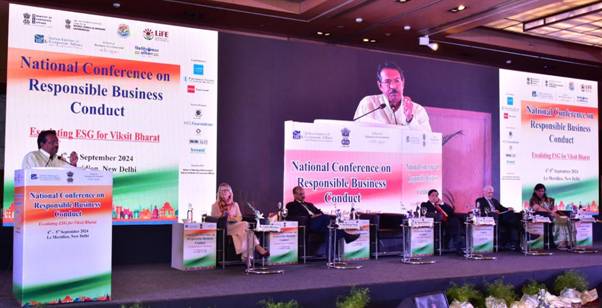
Justice (Retd.) Dipak Misra, Former Chief Justice of India, delivered a profound special address, focusing on the ethical imperatives of corporate governance. He underscored the crucial role of crafting ESG policies that will act as the fulcrum in ensuring that businesses operate within the bounds of justice and fairness, aligning their practices with the broader goals of social and environmental responsibility.

He further elaborated that ESG is a philosophical thought that must be imbibed and should not be treated as a mere legal compliance task.  Justice Misra reminded the august gathering that the Supreme Court of India in National Textile Workers’ Union v. P R Ramkrishnan recognised the new concept of a corporation adopting the socialistic pattern of society as the goal of the country’s economic and social policies.  He mentioned that the maintenance of Environmental Ethicality is a categorical imperative as value addition of any business entity depends upon its ‘Green Behaviour’ and to that extent ESG has now become a competitive barometer for reputation.  He suggested that it is the time for the nations to take a pledge to make an endeavour to change the philosophy of the commercial concerns at the highest level and to make every corporate and individual aware of new lexicon that the thinkers of the world are developing and expecting every entity to remain ‘Argus-eyed’ to be progressively complaint and not to take shelter under any adroit intent to bring in expeditious institutional solutions.

In his welcome address, Dr. Ajay Bhushan Prasad Pandey, Director General & CEO, IICA, extended a warm welcome to the distinguished speakers and participants, stressing the importance of responsible business conduct in driving India's sustainable development agenda. He highlighted that the IICA through its School of Business Environment has been promoting the responsible business conduct through policy advocacy, research, and capacity building programmes for public and private sector on aspects of ESG, Sustainability, CSR, Business & Human Rights, Business & Biodiversity Conservation, Sustainable Finance etc. The annual national conference on responsible business conduct is a testament of the IICA’s commitment to the Viksit and Sustainable Bharat.     

The inaugural session by Professor Garima Dadhich, Head, School of Business Environment, IICA, set the context for the conference.

Mr. Shombi Sharp, United Nations Resident Coordinator to India, in his special address highlighted the importance of responsible business conduct in achieving the vision of a Viksit Bharat (Developed India) and emphasised the need for collaborative efforts between the government, private sector, and civil society.

The inaugural session featured special addresses highlighting pressing issues related to responsible business conduct. Ms. Cynthia McCaffery, UNICEF Country Representative India shared insights on the global relevance of ESG principles in fostering inclusive growth and incorporating meaningful sustained livelihood integrated goal in achieving developed India; and Ms. Helen Brand OBE, Chief Executive, ACCA focused on the evolving role of governance in promoting responsible business practices and highlighted the significant role that India plays on the global stage in advancing ESG-driven development. The inaugural session brought together eminent leaders, policymakers, corporate executives, and international experts to deliberate on the critical role of businesses in driving responsible and sustainable development.

On the occasion, the book ‘Embracing ESG in India’ by Dr. Garima Dadhich & Dr. Ravi Raj Atrey was also released during the inaugural session. The book offers a comprehensive guide on ESG practices in the Indian context, it is a compilation of case studies of the torch-bearers, promoters and initiators of change. Additionally, the online Data Portal on Business Responsibility and Sustainability Reporting (BRSR) was launched, providing an essential tool for businesses and stakeholders to access critical data and insights for responsible business conduct.

The first insightful high-level panel discussion on ‘Responsible Governance: The Leadership Dialogue’ brought together some of India’s most distinguished leaders from the government and private sectors to discuss the critical role of responsible governance in driving sustainable and equitable growth. The Distinguished speakers include; Dr. V. Anantha Nageswaran, Chief Economic Adviser, Government of India; Mr. Inder Deep Singh Dhariwal, Joint Secretary, Ministry of Corporate Affairs; Mr. Praveen Kumar, Former Secretary, Ministry of Skill Development and Entrepreneurship, Government of India;  Mr. Arun Maira, Former Member, Planning Commission of India and Former Chairman, Boston Consulting Group, India; Mr. Bharat Wakhlu, Former Resident Director, TATA Sons; Ms. Megha Garg, Director, Happy Forgings Limited. The Panel was moderated by Professor Garima Dadhich. The panel delved into the challenges and opportunities associated with embedding responsible governance within the corporate framework, especially in the context of India’s ambitious goal of becoming a developed nation — Viksit Bharat.

The panel concluded with a consensus on the need for a multi-stakeholder approach to governance that includes collaboration between the government, private sector, and civil society. The insights and recommendations from this discussion are expected to shape the subsequent sessions of the conference, driving forward the agenda of responsible business conduct in India.

The Second High Level panel discussion centred on the theme ‘Nature Restoration: Role of Business’. The panel featured key industry leaders: Mr. Vishal Dev, Director of Sustainable Business at WWF India, Mr. Bose Varghese, Senior Director of ESG at Cyril Amarchand Mangaldas, and Mr. Siddharth Edake, Senior Programme Manager for Food, Land, and Water at WRI India, moderated by Mr. Suneel Padele, Senior Technical Advisor at the United Nations Global Compact Network India.

The momentum continued with an insightful third high-level panel focused on ‘Sectoral Adaptation of the National Guidelines on Responsible Business Conduct in the Ready-Made Garment Sector.’

The session began with Mr. Alay Barah, Director of Innovative Change Collaborative Services Pvt. Ltd. (ICCSPL), setting the context by outlining the importance of adapting national guidelines to the specific needs and challenges of the ready-made garment sector. The panel featured prominent voices from both industry and policy-making circles. Dr. Naresh Tyagi, Chief Sustainability Officer at Aditya Birla Fashion & Retail Limited, Mr. Abhishek Bansal, Vice President of Sustainability at Arvind Ltd., Mr. Shikhar Jain, Executive Director of CII - CESD, Mr Pradeep Narayanan, Director Partners in Change and Mr. Naveen Sainani, Joint Honorary General Secretary of the Clothing Manufacturers Association of India Ltd. The discussion was expertly moderated by Mr. Shankar Venkateswaran, Adjunct Faculty at the Indian Institute of Corporate Affairs, who facilitated a dynamic exchange of ideas and best practices among the panelists.

The fourth session delved on ‘Just Transition: Balancing Growth, Equity & Sustainability.’ This session addressed the complex challenge of achieving sustainable development while ensuring that economic growth is inclusive and equitable. Moderated by Dr. Bhaskar Chatterjee, Senior Adviser on CSR & ESG at Dua Consulting and Deloitte India, the panel brought together a diverse group of experts who provided in-depth insights into the multidimensional aspects of a just transition.  The high-level panel comprised of Ms. Bharti Birla, Enterprise Development Specialist at the International Labour Organization (ILO), Ms. Geetanjali Master, Head of Public & Private Partnership at UNICEF India, and Mr. Viraf Mehta, Adjunct Faculty at the IICA.

Topics

Acts Income Tax