Loading...

Top
Help
×

By creating an account you can:

Logo TaxTMI
Call Us / Help / Feedback

Contact Us At :

E-mail: [email protected]

Call / WhatsApp at: +91 99117 96707

For more information, Check Contact Us

FAQs :

To know Frequently Asked Questions, Check FAQs

Most Asked Video Tutorials :

For more tutorials, Check Video Tutorials

Submit Feedback/Suggestion :

Email :
Please provide your email address so we can follow up on your feedback.
Category :
Description :
Min 15 characters 0/2000
Make Most of Text Search
  1. Checkout this video tutorial: How to search effectively on TaxTMI.
  2. Put words in double quotes for exact word search, eg: "income tax"
  3. Avoid noise words such as : 'and, of, the, a'
  4. Sort by Relevance to get the most relevant document.
  5. Press Enter to add multiple terms/multiple phrases, and then click on Search to Search.
  6. Text Search
  7. The system will try to fetch results that contains ALL your words.
  8. Once you add keywords, you'll see a new 'Search In' filter that makes your results even more precise.
  9. Text Search
Add to...
You have not created any category. Kindly create one to bookmark this item!
Create New Category
Hide
Title :
Description :
❮❮ Hide
Default View
Expand ❯❯
Close ✕
🔎 News - Adv. Search
TEXT SEARCH:

Press 'Enter' to add multiple search terms. Rules for Better Search

Search In:
Main Text + AI Text
  • Main Text
  • Main Text + AI Text
  • AI Text
Category: ?
Categorized by AI
---- All Categories ----
  • ---- All Categories ----
  • Income Tax
  • GST
  • Customs, DGFT & SEZ
  • FEMA & RBI
  • Corp. Laws, SEBI & IBC
  • PMLA, Black Money & ED
  • Budget
  • News and Press Release
  • PTI News
Month:
---- All Months ----
  • ---- All Months ----
  • January
  • February
  • March
  • April
  • May
  • June
  • July
  • August
  • September
  • October
  • November
  • December
Year:
---- All Years ----
  • ---- All Years ----
  • 2026
  • 2025
  • 2024
  • 2023
  • 2022
  • 2021
  • 2020
  • 2019
  • 2018
  • 2017
  • 2016
  • 2015
  • 2014
  • 2013
  • 2012
  • 2011
Sort By: ?
In Sort By 'Default', exact matches for text search are shown at the top, followed by the remaining results in their regular order.
Relevance Default Date
    Trump used to slam China. Here's why he's now rolling out the red carpet for Xi
    RBI orders removal of Maharashtra minister Babasaheb Patil, 7 others as directors of Latur DCC Bank
    LPG subsidy: Aadhaar biometric authentication mandatory for subsidised refills from Oct 1
    RBI orders removal of Maharashtra minister Babasaheb Patil, 7 others as directors of Latur DCC Bank
    US tariffs on Indian goods: A Chronology
    Graft case: Kerl BJP chief alleges 'fixed match' between Congress, CPM
    India's FTAs opening new career opportunities for youth: PM Modi
    AutomationEdge Launched Assist-Edge at Global Fintech Fest 2026, Redefining How Enterprises Build and Scale Automation
    BC.GAME's BC Engine Rewards Surpass $8.6 Million as Ecosystem Growth Accelerates
    NLMC’s 21st Board Meeting Reviews progress of monetisation programme; stresses on Accelerated Asset Monetisation;
    IDFC FIRST Bank introduces Zero Forex Markup across all its Credit Cards, existing and new.
    India's forex reserves drop by USD 4.924 billion to USD 780.782 billion: RBI data
    Govt eases sugar stockholding limit for bulk users to 30 days ahead of festive season
    25th Meeting of SCO Ministers Responsible for Economic and Foreign Trade Activities Held in Tajikistan
    India–Nepal Inter-Governmental Sub-Committee on Trade, Transit and Cooperation to Control Unauthorised Trade Meets in New Delhi
    OnEMI Technology Solutions Limited’s Board Approves Fundraise of approximately ₹832 Crore through a Preferential Issue of Securities
    CGST Delhi South officers bust firm in fraudulent availment of ITC involving over Rs. 25.22 crore; proprietor arrested
    Net direct tax collection rises 13 pc to Rs 12.12 lakh cr till Sep 17 on higher advance tax mop-up
    Protean launches next-generation KYC Onboarding & Reporting Solution at Global Fintech Fest 2026
    Japan's central bank raises benchmark interest rate to 1.25 pc, highest in 31 years
❯❯
Maximize Maximize Maximize
0 / 200
Expand Note
Add to Folder

No Folders have been created

+

Are you sure you want to delete "My most important" ?

NOTE:

News
Showing Results for :
Reset Filters
Results Found:
Show All Summaries Hide All Summaries
September 20, 2026
Show AI Summary
Tariff policy and trade truce reshape bilateral engagement as rare-earth leverage limits coercive economic measures.
United States-China trade relations are being conducted through continued tariff policy, prior export restrictions, and a trade truce after escalating tariffs did not achieve their intended effect of changing Chinese economic conduct. China's concentrated supply of rare-earth inputs used in electronics provided negotiating leverage and contributed to the trade armistice. Indications that Chinese goods are routed through third countries to lessen tariff exposure qualify the decline in the bilateral goods imbalance. Continued tariffs have not constrained China's manufacturing expansion or its access to export markets.
September 20, 2026
Show AI Summary
Ten-year director tenure cap governs removal of ineligible cooperative bank board members after regulatory review.
RBI required Latur District Central Cooperative Bank to remove directors considered ineligible for exceeding the ten-year maximum tenure applicable to district central cooperative bank directors. The action invoked director ineligibility under the Banking Regulation Act. Following a complaint and a court-directed timeline for regulatory action, RBI sought responses from the concerned directors, seven of whom resigned. An issue was raised over whether the tenure cap could apply retrospectively to appointments made before its stated commencement and whether it was being applied uniformly.
September 19, 2026
Show AI Summary
Biometric Aadhaar authentication becomes essential for domestic LPG consumers seeking regulated subsidised refill bookings, while market-price supply remains available.
Biometric Aadhaar authentication is required from October 1 for domestic LPG consumers to book subsidised refills at the regulated retail selling price. Authentication can be completed through delivery personnel, distributor showrooms or designated mobile applications. Consumers unwilling or unable to authenticate may obtain LPG at the applicable market price without subsidy after registering their choice through specified digital channels. The framework distinguishes subsidised LPG linked to Aadhaar-authenticated consumers from market-priced LPG and seeks targeted subsidy delivery, reduced leakage, and prevention of diversion, duplicate connections and ineligible access.
September 19, 2026
Show AI Summary
Cooperative bank director tenure limits require disqualification and removal when service exceeds the statutory maximum period.
Directors of District Central Cooperative Banks and Central Cooperative Banks are subject to a maximum 10-year tenure under the Banking Regulation Act, 1949, as amended by the Banking Laws (Amendment) Act, 2025. RBI directed removal of a director ineligible to continue under section 10A(2A)(i), read with section 56, following concerns that directors of Latur District Central Cooperative Bank had exceeded the permitted tenure.
September 19, 2026
Show AI Summary
Tariff treatment of Indian exports shifted from reciprocal duties to targeted trade measures, sectoral duties, and specified exemptions.
Upon expiry of the temporary global measure, an India-targeted 10 per cent Section 301 tariff, linked to forced-labour concerns, replaced it; the effective charge for most covered exports remained MFN duty plus 10 per cent. The current regime applies the Section 301 tariff to Indian exports except specified goods, with separate sectoral duties on steel, aluminium and auto components. Smartphones, medicines and energy products are exempt.
September 19, 2026
Show AI Summary
PMLA-based FIR request over alleged consultancy payments remains under legal examination amid criticism of non-registration.
Enforcement Directorate sought registration of an FIR concerning alleged fraudulent payments by Cochin Minerals and Rutile Ltd to Exalogic Solutions, represented as IT consultancy fees. The request relied on evidence gathered through investigation and searches under the Prevention of Money Laundering Act. Registration remained under consideration after receipt of the Advocate General's legal opinion, with the Home Department examining the matter.
September 19, 2026
Show AI Summary
Free trade agreements expand market access, entrepreneurial partnerships and youth career opportunities alongside public-sector recruitment and development participation.
Free Trade Agreements are presented as mechanisms for expanding cross-border partnerships, market access for entrepreneurs, and career opportunities for young persons. Youth employment is also linked to the expansion of the startup ecosystem beyond major cities and to public-sector recruitment through Rozgar Melas. Newly selected candidates are to join central government ministries, departments and organisations. Public service is framed around citizen-centred administration and decisions supporting a developed and self-reliant India.
September 19, 2026
Show AI Summary
AI governance for regulated financial services enables natural-language automation while preserving enterprise security, auditability, control, and scalable deployment.
Assist-Edge enables teams to describe intended processes in natural language and use AI to create, modify, and enhance executable workflows. Working with reusable AI agents and workflows, it supports discovery, customisation, deployment, and scaling of enterprise automation. For banking, financial services, and insurance operations, its use is positioned alongside security, governance, auditability, and control, supporting governed adoption of scalable AI capabilities and movement from isolated experimentation to enterprise-wide intelligent automation.
September 19, 2026
Show AI Summary
Recurring token reward distributions connect eligible holdings, platform activity, and partner participation through hourly settlement cycles.
BC Engine permits eligible $BC holdings to participate in hourly settlement rounds distributing BCD rewards. Participants can monitor active balances, cumulative rewards, unclaimed BCD, and settlement history through the Engine interface. Settlement amounts vary with ecosystem activity, while the mechanism links platform activity, token utility, user participation, and commercial partners through repeated value distribution rather than one-time promotional incentives.
September 19, 2026
Show AI Summary
Asset monetisation of surplus public land and buildings is accelerated through transparent, value-oriented processes and stakeholder coordination.
NLMC's Board recommended monetisation proposals involving surplus land and building assets valued at over Rs. 5,000 crore. Monetisation is facilitated through asset identification, due diligence, valuation and appropriate process structuring, with emphasis on transparency, efficiency and value realisation. Sustained coordination with asset-owning entities is intended to expedite implementation and support timely, commercially appropriate monetisation of underutilised public assets.
September 19, 2026
Show AI Summary
Zero forex markup on credit cards applies automatically to international transactions without conditions while preserving applicable rewards.
Zero Forex Markup applies automatically to international transactions made through all existing and new credit cards, without a new-card application, upgrade, spending threshold or other stated condition. International card spends do not attract forex markup charges. Reward Points or Cashback, where applicable to the relevant card, continue on international transactions. Existing credit cards may be used for overseas and cross-border payments without requiring a separate forex card solely to avoid such charges.
September 18, 2026
Show AI Summary
Foreign exchange reserve valuation reflects currency movements as foreign currency assets and gold holdings decline.
India's foreign exchange reserves declined to USD 780.782 billion for the week ended September 11, driven by reductions in foreign currency assets and gold holdings. Foreign currency assets fell to USD 645.796 billion, with their dollar value reflecting movements in reserve currencies against the US dollar. Gold reserves also declined, while Special Drawing Rights increased to USD 18.845 billion. The reserve position with the IMF stood at USD 4.916 billion.
September 18, 2026
Show AI Summary
Bulk sugar stockholding limits now allow expanded inventories only where additional supplies derive from designated import channels.
Bulk sugar consumers using more than 10 tonnes monthly as a raw material may hold up to 30 days' requirement instead of 15 days. Holdings above 15 days must consist exclusively of sugar imported under the Tariff Rate Quota or Advance Authorisation Scheme; sugar obtained from the open market remains restricted to 15 days' consumption. Bulk consumers must declare and disclose their sugar inventories every Friday through the food ministry's online portal.
September 18, 2026
Show AI Summary
Trade facilitation and digitalisation support regional economic cooperation through simpler customs procedures, paperless exchange, resilient supply chains, and MSME access.
Priority measures included expanded intra-SCO trade, lower trade costs, resilient and diversified supply chains, trusted multimodal connectivity, greater market access, simplified customs processes, paperless trade and electronic document exchange. Digital and cross-border payments and accessible trade finance were identified to enable MSMEs and start-ups to participate in trade and value chains. Ministers agreed an Action Plan for 2026-2030 for further approval and approved regulations for a special working group on creative-economy development.
September 18, 2026
Show AI Summary
Customs cooperation and trade facilitation advance electronic origin verification, pre-arrival information exchange, and safeguards against preferential trade misuse.
Customs cooperation and trade facilitation measures included pre-arrival information exchange, electronic verification of Certificates of Origin, and Customs automation and digitalisation. These measures are directed at facilitating legitimate trade while ensuring compliance with applicable rules and preventing misuse of preferential trade arrangements. Rail and road connectivity, freight movement, Integrated Check Posts and land-port infrastructure were reviewed to improve infrastructure utilisation and address operational bottlenecks affecting bilateral and transit trade.
September 18, 2026
Show AI Summary
Preferential equity issuance approved to strengthen capital, support digital lending expansion, and fund subsidiary operations subject to required approvals.
OnEMI Technology Solutions Limited has approved a preferential issue of equity shares to identified investors, subject to shareholder and requisite regulatory and statutory approvals. The issuance is proposed under the Companies Act, 2013, the SEBI capital-issue and disclosure framework, other applicable SEBI regulations, and applicable law. Seventy-five per cent of the additional capital raised is proposed for infusion into its wholly owned subsidiary to support lending, technology, digital capabilities and product expansion, while the remaining twenty-five per cent is proposed for general corporate purposes.
September 18, 2026
Show AI Summary
Fraudulent input tax credit claims through bogus invoices prompted arrest over alleged invoicing without actual supply of goods.
Alleged fraudulent availment, utilisation and passing on of inadmissible input tax credit involved invoices from purported suppliers found to be non-existent, non-functional, suspended or cancelled. Input tax credit was allegedly claimed without actual receipt of goods and passed on through invoices unsupported by corresponding supplies. Following investigation and recorded statements, the proprietor of an iron and steel trading firm was arrested under statutory arrest powers, while further investigation remains in progress.
September 18, 2026
Show AI Summary
Direct tax collections: stronger advance tax payments support growth in corporate, non-corporate, and securities transaction tax receipts.
Direct tax collections grew through September 17, supported principally by increased advance tax payments from corporate and non-corporate taxpayers. Gross collections exceeded Rs 14.32 lakh crore, while net collections, after refunds, exceeded Rs 12.12 lakh crore. Corporate tax collections grew more strongly than non-corporate tax collections, and Securities Transactions Tax receipts recorded significant growth. The trend indicated broad-based tax buoyancy, supported by underlying economic activity, taxpayer confidence and business performance.
September 18, 2026
Show AI Summary
Reusable consent-based KYC enables integrated onboarding, reporting, record updates and periodic re-verification for regulated financial institutions.
Central KYC-based onboarding enables regulated financial institutions to reuse a customer's existing verified identity record through the Central KYC Registry with customer consent. The integrated solution supports onboarding, KYC reporting, unsolicited notifications and re-KYC. It retrieves consented KYC records through CKYC APIs, uses facial matching or video-based customer identification for authentication, and applies AI-based duplicate detection. Reporting automates validation, image correction and real-time registry submission, while record updates and simplified periodic re-verification support the currency of institutional KYC information.
September 18, 2026
Show AI Summary
Benchmark interest rate normalisation raises borrowing costs while monetary policy monitors inflation, wage growth, currency risks, and economic recovery.
The Bank of Japan increased the uncollateralised overnight call rate from 1.0 per cent to 1.25 per cent, advancing monetary-policy normalisation after a prolonged period of near-zero or negative rates. The increase was assessed against gradual economic recovery, inflation near its target, wage growth, currency fluctuations, elevated crude oil prices, and external risks. Further tightening remains contingent on stable price increases, wage developments, and monitoring of other risks.

News

Back

All News

Showing Results for :
Reset Filters
No Records Found

News

Back

All News

Showing Results for : Reset Filters
News and Press Release

Annual Survey of Unincorporated Sector Enterprises (ASUSE) Results for 2021-22 and 2022-23

July 6, 2024

Contents
Summary
Note

Note

-

Bookmark

Print

Print

(Reference & Survey period: April, 2021 to March, 2022 for ASUSE 2021-22; October 2022 to September 2023 for ASUSE 2022-23)

Unincorporated Sector has witnessed growth in estimated number of establishments (by 5.88%), estimated number of workers (by 7.84%) and in GVA (by 9.83%; in current price) during October, 2022 - September, 2023 as compared to April, 2021 - March, 2022.

Over the two survey periods, the sector has demonstrated enhanced capital investment, greater accessibility to loans, and increased utilization of information technology.

Fixed assets owned by an unincorporated non-agricultural establishment, on average, has risen from Rs. 2,81,013 in ASUSE 2021-22 to Rs. 3,18,144 in ASUSE 2022-23.

The use of internet for entrepreneurial purpose has increased by 7.2% indicating a rapid rate of digitization taking place in the sector.

About 54% of the proprietary establishments in the manufacturing sector were run by women entrepreneur.

The key results of the Annual Survey of Unincorporated Sector Enterprises (ASUSE) for the reference periods of April 2021 to March 2022 (ASUSE 2021-22) and October 2022 to September 2023 (ASUSE 2022-23) in the form of a factsheet were released by the Ministry of Statistics and Programme Implementation (MoSPI), on 14th June 2024 through a press note. The detailed reports and unit level data of these two surveys are now being released through this press note. These are now available in the website of the Ministry (https://www.mospi.gov.in).A brief overview of the survey in terms of coverage, sampling strategy, data collection mechanism, etc., is provided in the Endnote.

The unincorporated non-agricultural sector holds significant importance in the Indian economy, primarily due to its ability to absorb a significant portion of the country’s workforce, its inclusivity in providing employment opportunities to a diverse range of people, including those from rural areas, and those with limited formal education and also its contribution to country’s Gross Domestic Product (GDP).

The survey period of ASUSE 2021-22, particularly the period April – June, 2021, was severely impacted by the second wave of the pandemic and, in turn, the survey got hampered to a great extent. As a result, the overall annual aggregate estimates of ASUSE 2021-22 were affected. For this reason, the estimates of ASUSE 2021-22 have been presented annually (April, 2021 – March, 2022), andalso for the 3-month (April, 2021 – June, 2021) and 9-month period (July, 2021 – March, 2022) separately along-with the annual estimates of ASUSE 2022-23 (October, 2022 – September, 2023) in the factsheet which was published on 14th June 2024 and is available in the website of the Ministry.

Key highlights from ASUSE 2021-22 and ASUSE 2022-23 results

The total number of establishments in the sector increased from 5.97 crore in 2021-22 to 6.50 crore in 2022-23, representing a 5.88% annual growth[1]. Among the broad sectors under coverage, the number of establishments in the other services sectorhas been the most in ASUSE 2022-23 (37.88%) followed by Trade (34.71%) and Manufacturing (27.41%). More than 40% of the establishments in this sector are engaged in either retail trade (around 30%) or manufacturing of wearing apparel (around 11%) as per ASUSE 2022-23. Among the major states, highest number of establishments (rural and urban combined) has been reported in Uttar Pradesh, followed by West Bengal and Maharashtra in ASUSE 2021-22 as well as in ASUSE 2022-23.

During the same period, the Gross Value Added (GVA) which is a key indicator of economic performance of the sector witnessed an annual growth of 9.83%. The top three states in terms of GVA were Maharashtra, Uttar Pradesh and Gujarat in 2021-22 and Maharashtra, Uttar Pradesh and Tamil Nadu in 2022-23.

The unincorporated non-agricultural sector employed about11 crore workers from October 2022 to September 2023, up from 9.8 crore in ASUSE 2021-22. More than one-third of this labour force was engaged in the states of Uttar Pradesh, Maharashtra and West Bengal. Proportion of female workers to total workers has marginally increased from 25.52% in ASUSE 2021-22 to 25.63% in ASUSE 2022-23. About 54% of the proprietary establishments were observed to be headed by female proprietors in the Manufacturing sector both in ASUSE 2021-22 and ASUSE 2022-23.

Among the activity categories, it is observed thatother retail trade, followed by manufacturing of wearing apparel and other community, social and personal services have reported most number of establishments and engaged maximum number of workers at all-India level in both ASUSE 2021-22 and ASUSE 2022-23. The percentage share of these three activity categories in estimated number of total establishments and total workers are given in Table 1.

Table1: Percentage share of establishments and workers in respect of  top 3 activity categories

Activity Category

Number of Establishments

Number of Workers

ASUSE 21-22

ASUSE 22-23

ASUSE 21-22

ASUSE 22-23

Other Retail Trade

33.40

30.38

31.54

29.80

Manufacture of Wearing Apparel

10.74

11.27

8.26

8.39

Other Community, Social and Personal Service Activities

8.48

9.47

7.26

8.19

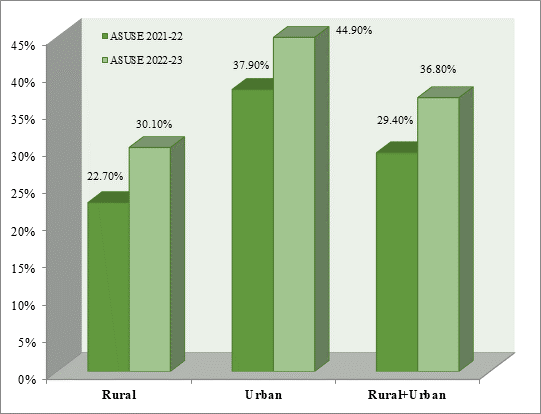
Percentage ofregistered establishments has increased from 29.40% in ASUSE 2021-22 to 36.80% in ASUSE 2022-23 thus showing an increasing trend of registration in the sector. Figure 1 illustrates the change in percentages of establishments registered under any acts/authorities, disaggregated by sector, over the two survey periods.

Figure 1: Percentage of establishments registered under acts/authorities

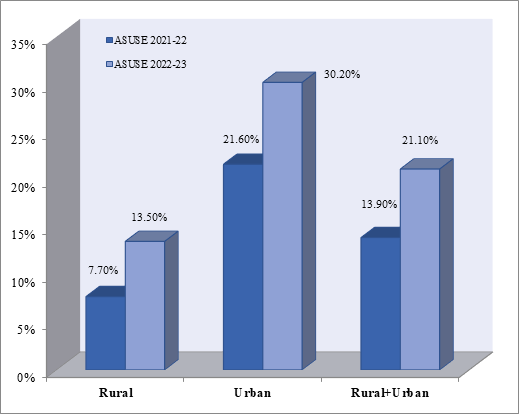
The use of internet for entrepreneurial purpose such as, taking orders online, carrying out transactions online or using UPIs, placing orders online, etc. has increased to 13.5%  from 7.7% in rural and to 30.2% from 21.6% in urban sector during ASUSE 2022-23 with an overall increase of 7.2%. This shows an improved use of IT and digital platforms and also indicates a fast rate of digitization taking place in the sector. Figure 2, given below shows the change in usage of internet in ASUSE 2022-23 as compared to ASUSE 2021-22.

Figure 2: Percentage of establishments using internet for entrepreneurial purpose

Fixed assets owned by an unincorporated non-agricultural establishment, on average, has risen from Rs. 2,81,013 in ASUSE 2021-22 to Rs. 3,18,144 in ASUSE 2022-23 showing an improved capital investment in the sector. At the same time, Outstanding Loan per establishment has increased from Rs. 37,408 in ASUSE 2021-22 to Rs. 50,138 in ASUSE 2022-23, indicating an improvement in availability of loan in this sector.

Endnote: A brief about the coverage, sampling scheme, sample size and data collection mechanism in the Annual Survey of Unincorporated Sector Enterprises (ASUSE):

A. Coverage of ASUSE:

A.1. Geographically, ASUSE covers the rural and urban areas of whole of India (except the villages in Andaman and Nicobar Islands, which are difficult to access).

A.2. Sector-wise, this survey captures unincorporated non-agricultural establishments belonging to three sectors viz., Manufacturing, Trade and Other Services.

A.3. Ownership-wise, unincorporated non-agricultural establishments pertaining to proprietorship, partnership (excluding Limited Liability Partnerships), Self-Help Groups (SHG), co-operatives, societies/trusts etc. have been covered in ASUSE.

B. Sampling Scheme:

The survey has been conducted following a multi-stage stratified sampling scheme, where first stage units (FSUs) are census villages in rural (except for rural Kerala, where Panchayat wards have been taken as FSUs) and UFS (Urban Frame Survey) blocks in urban areas.  The ultimate stage units (USUs) are establishments for both sectors. In the case of large FSUs, one intermediate stage of sampling has been done in the form of hamlet groups in rural and sub-blocks in urban. 

C. Sample Size:

In ASUSE 2021-22, data were collected from a total of 4,16,269 establishments (2,39,981 in rural and 1,76,288 in urban) from 16,199 surveyed FSUs (8,425 in rural and 7,774 in urban) whereas in ASUSE 2022-23, 4,58,938 establishments (2,58,296 in rural and 2,00,642 in urban) were surveyed from 16,382 FSUs (8,495 in rural and 7,887 in urban).

DData Collection Mechanism:

Both ASUSE 2021-22 and ASUSE 2022-23 have been conducted based on area frame and establishments have been listed in the selected FSUs of both rural and urban sector. Mostly, data were collected from the selected establishments through oral enquiry pertaining to the ‘monthly’ reference period barring a few big establishments, which had provided annual data from their audited Books of Accounts. ASUSE 2021-22, the first full-fledged survey on ASUSE, has been conducted in Pen-and-Paper Personal Interview (PAPI) mode; whereas ASUSE 2022-23 has been conducted in Computer Assisted Personal Interview (CAPI) mode.

Topics

Acts Income Tax