

Just a moment...

Top
Help
AI Drafter

Generate professional replies to Show Cause Notices, assessment orders, audit objections, and other legal communications using TaxTMI's AI Drafter.

Step 1 – Issue Identification & Review

The AI analyses your query, notice, order, or uploaded documents and identifies the key issues involved.

• Review the issues identified by the AI
• Add, edit, remove, or refine issues as required


Step 2 – Draft Generation

Once you approve the issues, the AI performs issue-wise legal research and prepares a structured draft response.

• Relevant statutory provisions
• Judicial precedents and Supreme Court, High Court and other citations
• Issue-wise legal analysis
• Practical arguments and supporting content
• Professionally structured draft ready for further review.

Try Now
×

By creating an account you can:

Logo TaxTMI
>
Call Us / Help / Feedback

Contact Us At :

E-mail: [email protected]

Call / WhatsApp at: +91 99117 96707

For more information, Check Contact Us

FAQs :

To know Frequently Asked Questions, Check FAQs

Most Asked Video Tutorials :

For more tutorials, Check Video Tutorials

Submit Feedback/Suggestion :

Email :
Please provide your email address so we can follow up on your feedback.
Category :
Description :
Min 15 characters0/2000
Make Most of Text Search
  1. Checkout this video tutorial: How to search effectively on TaxTMI.
  2. Put words in double quotes for exact word search, eg: "income tax"
  3. Avoid noise words such as : 'and, of, the, a'
  4. Sort by Relevance to get the most relevant document.
  5. Press Enter to add multiple terms/multiple phrases, and then click on Search to Search.
  6. Text Search
  7. The system will try to fetch results that contains ALL your words.
  8. Once you add keywords, you'll see a new 'Search In' filter that makes your results even more precise.
  9. Text Search
Add to...
You have not created any category. Kindly create one to bookmark this item!
Create New Category
Hide
Title :
Description :
❮❮ Hide
Default View
Expand ❯❯
Close ✕
🔎 News - Adv. Search
TEXT SEARCH:

Press 'Enter' to add multiple search terms. Rules for Better Search

Search In:
Main Text + AI Text
  • Main Text
  • Main Text + AI Text
  • AI Text
Category: ?
Categorized by AI
---- All Categories ----
  • ---- All Categories ----
  • Income Tax
  • GST
  • Customs, DGFT & SEZ
  • FEMA & RBI
  • Corp. Laws, SEBI & IBC
  • PMLA, Black Money & ED
  • Budget
  • News and Press Release
  • PTI News
Month:
---- All Months ----
  • ---- All Months ----
  • January
  • February
  • March
  • April
  • May
  • June
  • July
  • August
  • September
  • October
  • November
  • December
Year:
---- All Years ----
  • ---- All Years ----
  • 2026
  • 2025
  • 2024
  • 2023
  • 2022
  • 2021
  • 2020
  • 2019
  • 2018
  • 2017
  • 2016
  • 2015
  • 2014
  • 2013
  • 2012
  • 2011
Sort By: ?
In Sort By 'Default', exact matches for text search are shown at the top, followed by the remaining results in their regular order.
RelevanceDefaultDate
    No Records Found
    ❯❯
    MaximizeMaximizeMaximize
    0 / 200
    Expand Note
    Add to Folder

    No Folders have been created

      +

      Are you sure you want to delete "My most important" ?

      NOTE:

      News
      Showing Results for :
      Reset Filters
      Results Found:
      AI TextQuick Glance by AIHeadnote
      Show All SummariesHide All Summaries
      No Records Found

      News

      Back

      All News

      Showing Results for :
      Reset Filters
      Showing
      Records
      ExpandCollapse
        No Records Found

        News

        Back

        All News

        Showing Results for : Reset Filters
        Case ID :
        News and Press Release

        NITI Aayog Releases Handbook to Guide EV Charging Infrastructure in India

        August 12, 2021

        📋
        Contents
        Note

        Note

        -

        Bookmark

        print

        Print

        Login to TaxTMI
        Verification Pending

        The Email Id has not been verified. Click on the link we have sent on

        Didn't receive the mail? Resend Mail

        Don't have an account? Register Here

        NITI Aayog Releases Handbook to Guide EV Charging Infrastructure in India

        The handbook will enable states and local bodies to establish public charging networks efficiently

        NITI Aayog today released a handbook to guide state governments and local bodies to frame policies and norms towards setting up charging networks for electric vehicles (EV). The objective is to enhance charging infrastructure and facilitate a rapid transition to electric mobility in the country.

        The Handbook for Electric Vehicle Charging Infrastructure Implementation has been jointly developed by NITI Aayog, Ministry of Power (MoP), Department of Science and Technology (DST), Bureau of Energy Efficiency (BEE), and World Resources Institute (WRI) India.
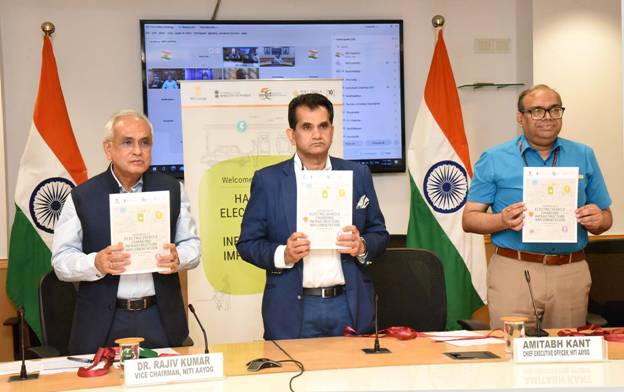
        The Handbook provides a systematic and a holistic approach for adoptions by implementing authorities and other stakeholders involved in planning, authorisation and execution of EV charging infrastructure. It presents an overview of the technological and regulatory frameworks and governance structures needed to facilitate EV charging. It focuses on the present needs of charging infrastructure development while considering the evolving nature of the sector.

        The transition to electric mobility is a global strategy in the fight against climate change, on which India has expressed ambitious aspirations. “The handbook addresses the common challenges being faced by different local authorities in implementing EV charging networks. It serves as a starting point for the peer-to-peer exchange of best practices between states and local bodies,” said Dr Rajiv Kumar, Vice Chairman, NITI Aayog.

        “The EV ecosystem in India is evolving rapidly and there are several players entering the charging infrastructure market. This handbook provides holistic governance for public and private stakeholders to work together in establishing robust and accessible EV charging networks,” said, Mr Amitabh Kant, CEO, NITI Aayog.

        EV charging is a new type of power demand for discoms, which play a pivotal role in providing seamless power supply connections for charging facilities and ensuring that the electrical distribution network has the requisite capacity to serve this demand. “The Ministry of Power and it's Central Nodal Agency for the establishment of Charging Infrastructure for EVs in India i.e. the Bureau of Energy Efficiency (BEE), are working closely with DISCOMs and State agencies in overcoming barriers to charging infrastructure implementation, for which this handbook will be greatly helpful. With the rapidly growing share of renewables in the energy mix in the country, the benefits from transition towards e-mobility are only expected to become more significant in the coming years,” said Mr Alok Kumar, Secretary, Ministry of Power.

        Unlike fossil fuel-powered vehicles, electric vehicles can be charged at any location, provided charging points are available. This requires a distinct approach to planning EV charging networks-one that allows them to charge whenever they are parked, either at night or during the day. Local authorities need to set targets for the required scale of public charging infrastructure and ensure that it is covered in planning processes. “The handbook highlights the critical role of planning authorities in integrating EV charging infrastructure into their transport and urban planning frameworks. It’s a timely resource to support local planning for charging networks, as more states and cities begin to consider the requirements for charging infrastructure implementation,” said Dr OP Agarwal, CEO, WRI India.

        Creating a robust, widespread network of charging points either public or private-is crucial to support this transition. “The DST is spearheading the development of Indian standards and prototypes for EV charging, to support cost-effective charging networks that are tailored for the requirements of the EV ecosystem in India. The distributed planning approach for low-cost EV charge points defined in this handbook is well-aligned with the upcoming standards, and can support the rapid scaling of charging infrastructure,” said Dr Ashutosh Sharma, Secretary, DST.

        While the MoP has set a national target of having at least one charging station for every 3*3 grid, or at every 25km on a highway, setting granular targets and plans are up to urban local bodies or state nodal agencies. The handbook is primarily meant for implementing authorities like municipal corporations and discoms but also highlights regulatory measures that can further ease the process of installing charging infrastructure.

        The handbook has received the support from the Ministry of Housing and Urban Affairs, Ministry of Environment, Forest and Climate Change, and Department of Heavy Industry.

        The report can be accessed here.

        EV charging infrastructure planning to guide local authorities and utilities in deploying accessible public charging networks. The handbook provides a systematic approach for implementing authorities-municipal corporations, state nodal agencies and distribution companies-to plan, authorise and execute public charging infrastructure, integrating technological, governance and regulatory measures, promoting distributed low-cost charge-point planning, grid coordination for new power demand from EVs, and local targets embedded in transport and urban planning.
                          Cases where this provision is explicitly mentioned in the judgment/order text; may not be exhaustive. To view the complete list of cases mentioning this section, Click here.
                            Provisions expressly mentioned in the judgment/order text.

                                EV charging infrastructure planning to guide local authorities and utilities in deploying accessible public charging networks.

                                The handbook provides a systematic approach for implementing authorities-municipal corporations, state nodal agencies and distribution companies-to plan, authorise and execute public charging infrastructure, integrating technological, governance and regulatory measures, promoting distributed low-cost charge-point planning, grid coordination for new power demand from EVs, and local targets embedded in transport and urban planning.


                                Note: It is a system-generated summary and is for quick reference only.

                                Topics

                                ActsIncome Tax
                                No Records Found