 TaxTMI
Login
 TaxTMI

Login
Loading...
Press 'Enter' to add multiple search terms. Rules for Better Search
 of 127

Press 'Enter' after typing page number.
of 127 Press 'Enter' after typing page number.


No Folders have been created
Are you sure you want to delete "My most important" ?
NOTE:
of 127 Press 'Enter' after typing page number.








 of 127
Press 'Enter' after typing page number.

All TMI Notes
of 127 Press 'Enter' after typing page number.
of 127 Press 'Enter' after typing page number.
All TMI Notes
 Get Daily Updates

Note

Bookmark

Share


This is a neutral professional article. The judgment is analysed in the context of its factual background, issues framed, and conclusions reached by the Court.
2026 (10) TMI 604 - ITAT MUMBAI
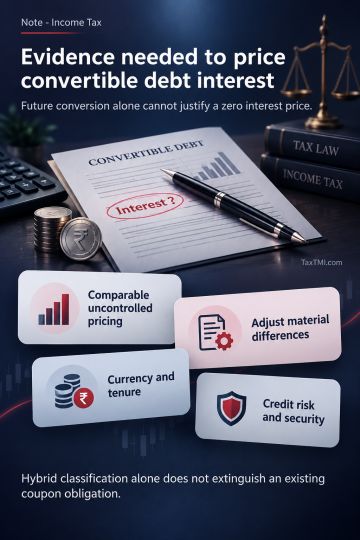
Compulsory conversion of a debenture into equity does not, by itself, establish that contractual interest payable before conversion has a nil arm's length price. In 2026 (10) TMI 604 - ITAT MUMBAI, the tribunal deleted a transfer pricing adjustment because the authorities had displaced the existing interest obligation through an unsupported equity characterisation, misstated material contractual terms and failed to establish a nil price through the asserted method.
The assessee issued compulsorily convertible debentures (CCDs) to its non-resident associated enterprise. The instruments carried a stated annual coupon of 14%, subject to an initial moratorium, and compulsory conversion after twenty years, with provision for earlier conversion. The conversion price depended on fair market value at conversion, subject to a contractual floor.
The assessee claimed that the moratorium reduced the effective interest rate over the instrument's life to 10.50%, which it benchmarked under the Other Method against an SBI prime lending rate of 12.23%. The Transfer Pricing Officer (TPO) treated the CCDs as equity-like funding and determined the interest's arm's length price at nil. The Dispute Resolution Panel (DRP) sustained the adjustment and directed an alternative disallowance under the ordinary deduction provisions.
The tribunal deleted the transfer pricing adjustment and set aside the alternative disallowance as reasoned. It nevertheless preserved the distinct inquiries concerning capitalisation and the statutory limitation on interest deduction. It did not independently approve either the stated coupon or the asserted effective rate.
The Explanation to Section 92 of the Income-tax Act, 1961, corresponding to Section 161 of the Income-tax Act, 2025, expressly requires that "the allowance for any expense or interest arising from an international transaction" be determined having regard to the arm's length price. Section 161(2) states that requirement separately for international and specified domestic transactions.
Section 92B of the Income-tax Act, 1961, corresponding to Section 163 of the Income-tax Act, 2025, includes transactions between associated enterprises involving a non-resident and "lending or borrowing money". Explanation (i)(c) also includes "capital financing", encompassing long-term or short-term borrowing and other specified financing arrangements. Section 163(1)(c) similarly covers capital financing, lending and borrowing. Describing a CCD as hybrid or quasi-equity therefore does not remove its interest transaction from scrutiny.
Section 92C of the Income-tax Act, 1961, corresponding to Section 165 of the Income-tax Act, 2025, requires application of the "most appropriate method", selected with reference to the transaction, associated enterprises, functions and relevant prescribed factors. Section 92C(1)(f) permits another method prescribed by the Board.
Section 92C(3) permits redetermination on material showing that the prescribed methodology was not followed, required documentation was not maintained, the information or data was unreliable or incorrect, or required information was not furnished within the specified time. Its proviso requires a show-cause opportunity. Section 165(4)-(5) separately states the corresponding grounds and notice requirement.
Section 92CA of the Income-tax Act, 1961, corresponding to Section 166 of the Income-tax Act, 2025, connects the reference procedure with that substantive inquiry. Section 92CA(3) requires a written determination after hearing the assessee's evidence and considering all relevant material, in accordance with Section 92C(3). Section 166(6) correspondingly refers to Section 165(4).
Circular No. 12/2001 reinforces that recourse to Section 92C(3) requires the enumerated circumstances and material supporting the opinion. The relevant principle is reasoned rejection of the taxpayer's analysis, not automatic acceptance of every financing benchmark.
Rule 10AB of the Income-tax Rules, 1962 requires consideration of the price "charged or paid, or would have been charged or paid" for the same or similar uncontrolled transaction between non-associated enterprises, "under similar circumstances, considering all the relevant facts". Notification No. 18/2012 inserted this method and the corresponding reference in Rule 10B(1)(f).
Rule 10B of the Income-tax Rules, 1962 makes contractual terms, functions, assets, risks and market conditions relevant to comparability. Under Rule 10B(3), material differences must either be absent or capable of elimination through "reasonably accurate adjustments". These requirements are central when comparing a long-tenor convertible instrument with conventional lending.
The tribunal examined the rights created by the agreement rather than deciding the dispute solely from the word "debenture". The holder could not demand ordinary cash repayment of principal at maturity. However, the revenue authority had not shown that shares had already been allotted, that shareholder voting or dividend rights existed during the relevant period, or that the contractual interest obligation had ceased.
The conversion clause required conversion at "a fair market value determined as on the Conversion Date" using an internationally accepted arm's length pricing methodology, while providing that the conversion price would not be below the fair value on the offer date. This contradicted the DRP's assumption that the number of shares had been fixed at inception. The TPO had also proceeded on a fifteen-year term, whereas the agreement prescribed twenty years.
These inaccuracies affected identification of the actual bargain. Nevertheless, the tribunal did not hold that future conversion rights were irrelevant. The conversion mechanism and its floor could influence the investor's eventual return and required coupon. A twenty-year instrument without cash redemption could not automatically be equated with an ordinary short-term bank loan. Those characteristics called for pricing analysis; they did not establish a price of zero.
The distinction also governed the assessee's evidence. Its claimed effective rate required support for the moratorium calculation, benchmark date and adjustments for tenure, risk, non-redemption and conversion rights. The tribunal deleted the defective adjustment without treating those matters as independently proved.
The High Court authority examined in paragraphs 50-51 of the decision recognises that the transaction actually undertaken ordinarily governs the analysis. Exceptional departure may arise where economic substance differs from legal form, or where the arrangement, viewed as a whole, is commercially irrational and practically impedes determination of an appropriate transfer price.
Neither an absolute prohibition on recharacterisation nor an unrestricted power to substitute equity states the complete principle. Here, the TPO did not establish the exceptional basis. The order did not explain why the instrument's features made appropriate pricing impracticable, reconcile the contractual errors, or identify evidence that the coupon obligation was a sham or did not bind the issuer.
Calling the exercise the Other Method did not cure that deficiency. No sufficiently analysed uncontrolled transaction supported a nil pre-conversion return. Long tenure, weak creditworthiness and absence of principal redemption may affect price, but they do not logically establish an exact zero without evidence and reasoning.
The capital-issue authority examined in paragraphs 35-36 observed that a CCD "does not postulate any repayment of the principal". Its concern was the application of debenture-holder protection guidelines. That reasoning prevents an assumption of ordinary cash-repayable debt, but does not determine the arm's length value of a separate pre-conversion coupon.
The insolvency authority examined in paragraphs 37-38 turned on the financing documents and the identity of the obligor. The relevant coupon and buyback obligations rested on a sponsor, and the court declined to create a debt against another company. Its relevance lies in reading the complete agreement and identifying who owes the payment, not in automatically assigning nil value to interest expressly owed by the issuer.
The securities-law authority discussed in paragraph 39 concerned optionally fully convertible instruments and regulatory jurisdiction. Its treatment of hybrid features did not supply an uncontrolled price for the interest in issue.
The electricity-security-deposit authority discussed in paragraph 40 recognised that not every deposit must bear interest. That conclusion depended on the statutory supply arrangements and an express non-interest condition. It did not provide a comparable for a CCD subscription carrying an agreed coupon.
The Special Bench issue-expenditure authority discussed in paragraph 41 concerned the cost of issuing convertible instruments, including immediate conversion features. It did not decide the pricing of a recurring payment before conversion. Separately, the share-capital expenditure authority considered there addressed expenditure incurred to raise equity; that question likewise did not determine the coupon's arm's length price.
The convertible-debenture issue-cost authority examined in paragraph 42 rejected the proposition that prospective conversion necessarily made the expenditure a share-capital raising cost. The separate hotel-business issue-cost authority considered in that paragraph addressed the same category of expenditure. Each assists in distinguishing future conversion from present legal consequences, but neither fixes a recurring interest rate.
The High Court rights-issue expenditure authority examined in paragraph 43 allowed costs connected with fully convertible debentures notwithstanding prospective conversion. Its holding remained one about issue expenses. It did not establish full deductibility or arm's length status of the coupon under examination.
In 2026 (6) TMI 366 - ITAT MUMBAI, the tribunal deleted a nil-interest adjustment founded on treating CCDs as equity-like instruments after disregarding the assessee's benchmarking. The decision supports examination of subsisting holder rights rather than denial of interest merely because conversion is compulsory. It does not replace the need to benchmark materially different coupon and conversion terms.
In 2020 (12) TMI 779 - ITAT PUNE, recharacterisation of optionally and compulsorily convertible debentures rested on thin-capitalisation, shareholder-activity and anti-avoidance concepts unavailable for the relevant period. The tribunal rejected that approach but remitted interest pricing for fresh determination. Its significance is the separation between rejecting an equity substitution and establishing the correct price.
In 2020 (12) TMI 110 - ITAT BANGALORE, the tribunal held that foreign-investment classification did not determine tax treatment of pre-conversion interest. Absence of shareholder voting and dividend rights was relevant to the subsisting relationship. The arm's length rate was separately remitted, demonstrating that favourable characterisation does not settle quantum.
In 2019 (8) TMI 554 - ITAT BANGALORE, the tribunal rejected mechanical reliance on regulatory equity classification and foreign thin-capitalisation concepts. It treated pre-conversion interest as interest on debt, but remitted pricing because the authorities had not conclusively addressed the benchmark, timing and adjustments. The decision preserves scrutiny under a prescribed method even after the characterisation objection fails.
In 2020 (6) TMI 505 - ITAT BANGALORE, the issue was ordinary deduction of pre-conversion interest. The tribunal distinguished expenditure on issuing convertible instruments from interest accruing while they remained unconverted, and allowed the latter under the borrowing-interest provision. Its relevance concerns the nature of expenditure, not independent proof of an arm's length coupon.
In 2022 (9) TMI 1413 - ITAT BANGALORE, the tribunal rejected denial of interest based on regulatory characterisation and accounting entries. Actual incurrence of interest and the continuing debt relationship before conversion were material. The decision supports treating accounting presentation as evidence rather than a conclusive answer to tax liability.
In 2026 (9) TMI 577 - ITAT CHENNAI, the tribunal considered an actual Ind AS reclassification of part of a compound instrument into equity. It allowed interest in principle, subject to verification that no actual conversion or redemption into equity had occurred. This differs from the governing appeal, where the DRP had not identified the alleged equity entry, but reinforces the limited effect of presentation alone.
In 2021 (6) TMI 1120 - ITAT BANGALORE, inconsistent treatment across assessment years-debt with reduced interest, equity with nil interest, and subsequent acceptance of contractual interest-led to remand. The tribunal required fresh examination rather than fixing the rate. The decision demonstrates the evidentiary relevance of other years without making earlier acceptance conclusive.
In 2019 (9) TMI 920 - BOMBAY HIGH COURT, the court sustained acceptance of interest on INR-denominated CCDs by reference to Indian market conditions and relevant comparable coupon evidence. Blanket reliance on USD corporate-bond rates or LIBOR was inappropriate. The result supported currency-aligned benchmarking and fact-sensitive adjustments, not a universal rate for all rupee CCDs.
In 2018 (1) TMI 1604 - ITAT HYDERABAD, the tribunal rejected treating rupee-denominated hybrid instruments as foreign-currency borrowings for LIBOR-based pricing. SBI PLR and public coupon data supported deletion on the facts. The decision addresses the correct benchmark market; its quasi-equity terminology does not establish that contractual interest must be nil.
In 2022 (8) TMI 1272 - ITAT BANGALORE, the tribunal rejected recharacterisation of INR CCDs as external commercial borrowings and accepted rupee-based benchmarking consistently with earlier decisions concerning the assessee. Its significance lies in the instrument's currency and supported comparison, rather than automatic acceptance of any domestic lending rate.
In 2023 (3) TMI 1296 - ITAT BANGALORE, the tribunal separately accepted the assessee's study and rejected the nil-price adjustment based on external-commercial-borrowing treatment. The CCDs were denominated, serviced and repaid in rupees. Acceptance of the study was a merits outcome on that record, unlike deletion without independent rate approval in the governing appeal.
In 2023 (6) TMI 1385 - ITAT BANGALORE, the tribunal restored the CCD-interest dispute for fresh consideration consistently with directions in earlier years. It did not finally determine the rate for the year before it. The decision shows why an earlier favourable currency principle must not be confused with final acceptance of every subsequent computation.
In 2023 (6) TMI 24 - ITAT BANGALORE, the tribunal rejected equity-based denial of pre-conversion interest but directed the TPO to determine the arm's length rate using an appropriate SBI PLR after hearing the assessee. It supplied a benchmark direction, not a finally quantified price. The distinction matters when describing the scope of appellate relief.
In 2016 (9) TMI 106 - ITAT DELHI, relevant public-market comparability and bank-lending data were admitted as additional evidence because reasonable cause explained their earlier non-production. The tribunal remitted the dispute for consideration of that evidence and a hearing. The case illustrates that procedural relief and fresh inquiry do not themselves establish the ultimate coupon.
The uncontrolled-issuance authority discussed in paragraph 46 of the governing decision provides a complementary evidentiary lesson: the tribunal rejected a nil adjustment where actual comparable CCD issuances supported the coupon and the TPO had discarded that analysis without cogent reasons or a regulatory search. Its importance is the comparable evidence, not merely the debt label.
The embedded-option authority discussed in paragraph 47 concerned an alleged option-premium transaction. It required identification and support of the transaction sought to be priced. That principle is relevant to accurate transaction identification, but supplies no independent benchmark for the present coupon.
Section 94B of the Income-tax Act, 1961, corresponding to Section 177 of the Income-tax Act, 2025, restricts otherwise deductible interest in specified non-resident associated-enterprise debt arrangements where the relevant expenditure exceeds one crore rupees, subject to statutory exclusions. "Debt" includes a "financial instrument" or arrangement giving rise to deductible interest, discounts or other finance charges.
Under Section 94B(2), excess interest is the lower of total interest paid or payable exceeding 30% of EBITDA and interest paid or payable to associated enterprises. Section 94B(4) permits carry-forward subject to the prescribed annual limitation, for no more than eight immediately succeeding assessment years. Section 177(4)-(6) retains the corresponding computation and eight-tax-year limit. The financing concerns described in Circular No. 2/2018 explain the interest-limitation framework; they do not substitute for transfer pricing analysis.
In 2022 (11) TMI 1323 - ITAT BANGALORE, the tribunal deleted the equity-based transfer pricing adjustment but required application of the statutory interest limitation, which the assessee had not applied. The result demonstrates that success against recharacterisation need not produce unrestricted current deduction.
In 2023 (3) TMI 399 - ITAT BANGALORE, the assessee had already made the statutory interest-limitation disallowance. The tribunal rejected use of transfer pricing to achieve a thin-capitalisation result through equity recharacterisation, while recognising that excessive pricing could separately be tested by benchmarking. The governing decision preserves that distinction without treating statutory disallowance as proof of an arm's length rate.
Section 36(1)(iii) of the Income-tax Act, 1961 addresses "interest paid in respect of capital borrowed for the purposes of the business or profession". Its proviso denies current deduction for the specified asset-acquisition period from borrowing until the asset is first put to use, whether capitalised in the books or not. Section 37(1) of the Income-tax Act, 1961 is residual: it excludes expenditure described in Sections 30-36 and capital or personal expenditure, while requiring expenditure wholly and exclusively for business or profession.
The DRP's alternative denial rested substantially on the same assumption of presently issued equity. No separate supported finding on utilisation or business purpose sustained denial of the whole amount. Setting aside that reasoning did not dispense with the applicable deduction and capitalisation requirements.
The assessee's assertion concerning an 11.25% safe-harbour limit was not accepted as an independent basis of relief. Rule 10TD of the Income-tax Rules, 1962 requires an eligible assessee, an eligible international transaction and an option not held invalid under Rule 10TE. Its intra-group loan entries concern advancing loans and prescribe minimum returns; they do not establish a general maximum coupon for an issuer's CCD borrowing.
Finally, withholding tax and taxation of the recipient's interest did not independently establish arm's length pricing or deductibility. The payer and recipient remain subject to their respective provisions. Section 92C(4)'s second proviso also provides that the recipient associated enterprise's income is not recomputed merely because of the payer-side determination where tax was deducted or deductible.
The decision calls for a transaction-specific record rather than reliance on a categorical debt or equity label. The following matters materially affect analysis and the scope of relief:
In the governing appeal, the capital-base reduction founded solely on nil pricing fell with the adjustment. Verification of actual capitalisation and consequential statutory interest-limitation treatment nevertheless remained necessary. The correspondence with the 2025 Act identifies related statutory provisions; it does not alter the basis on which the dispute under the 1961 Act was adjudicated.
Full Text:
