Cost-to-cost reimbursement of seconded employees is not service consideration; transfer-pricing markup was deleted and amalgamation amortisation allow...
Crystallisation of liability supports prior-period expense deduction, while functionally distinct divisions require separate transfer-pricing benchmar...
Functional comparability under TNMM requires transaction-specific FAR analysis before benchmarking business-support services provided to associated en...
Advance pricing agreement methodology can guide benchmarking for non-covered years when functions, assets, risks and activities remain materially unch...
Tax-audit exemption for substantially State-funded educational universities prevents audit-failure penalties where income qualifies for statutory exem...
Functional, asset and risk analysis excludes diversified technology companies from captive software development comparables under cost-plus arrangemen...
Anti-profiteering liability following a GST rate reduction may...
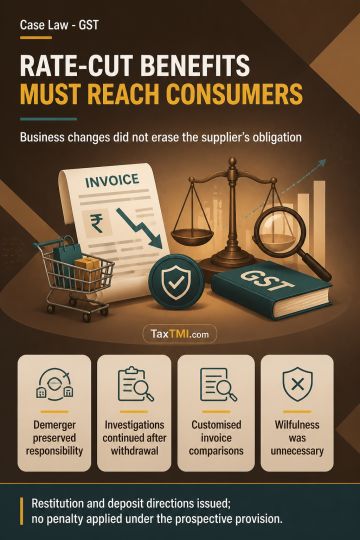
Anti-profiteering obligations survive business demerger, complaint withdrawal, and customized supply arrangements where rate-reduction benefits are not passed on.
Contents
Summary
Note
Bookmark
Share
✓ Copied successfully !
Print
Print Options
For full text, please login
Login to TaxTMI
Verification Pending
The Email Id has not been verified. Click on the link we have sent on
Anti-profiteering liability following a GST rate reduction may apply despite a business demerger and a post-reduction registration where transactional evidence establishes the supplier's nexus to affected supplies. Investigation may extend beyond the original complaint and continue after its withdrawal because the regime serves consumer welfare. For customised lump-sum supplies, invoice-wise base-price comparison is permissible if rational, evidence-based and reconciled; the computation was accepted. Wilful retention need not be proved, although non-passing of the benefit must be established. The supplier was found to have breached the pass-through obligation and was subject to restitution and deposit directions; no penalty applied because the penal provision operated only prospectively.
Anti-profiteering liability following a GST rate reduction may apply despite a business demerger and a post-reduction registration where transactional evidence establishes the supplier's nexus to affected supplies. Investigation may extend beyond the original complaint and continue after its withdrawal because the regime serves consumer welfare. For customised lump-sum supplies, invoice-wise base-price comparison is permissible if rational, evidence-based and reconciled; the computation was accepted. Wilful retention need not be proved, although non-passing of the benefit must be established. The supplier was found to have breached the pass-through obligation and was subject to restitution and deposit directions; no penalty applied because the penal provision operated only prospectively.
Note: It is a system-generated summary and is for quick reference only.
 TaxTMI
  TaxTMI
 of 4913