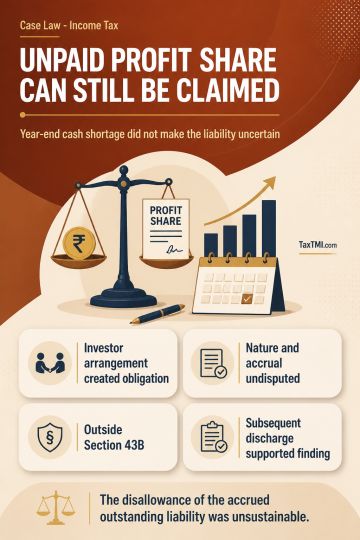
Under the mercantile system, an accrued but unpaid obligation to share overflow profit with investors remains deductible where its nature and accrual are undisputed. Lack of funds at the close of the previous year does not by itself make the liability contingent. The obligation arose under the investor arrangement, had neither ceased nor failed to accrue, and was outside payment-based liabilities governed by section 43B. Its subsequent discharge further supported the conclusion that it was not contingent. Accordingly, disallowance of the accrued outstanding liability was unsustainable.
Under the mercantile system, an accrued but unpaid obligation to share overflow profit with investors remains deductible where its nature and accrual are undisputed. Lack of funds at the close of the previous year does not by itself make the liability contingent. The obligation arose under the investor arrangement, had neither ceased nor failed to accrue, and was outside payment-based liabilities governed by section 43B. Its subsequent discharge further supported the conclusion that it was not contingent. Accordingly, disallowance of the accrued outstanding liability was unsustainable.
Note: It is a system-generated summary and is for quick reference only.
 TaxTMI
  TaxTMI
 of 4907