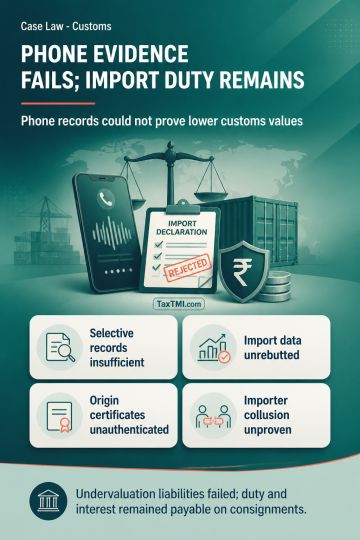
Mobile-phone electronic evidence failed to establish customs undervaluation, while duty survived on non-authentic origin certificates without importer...
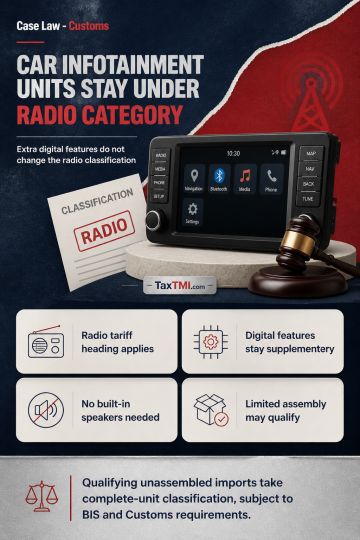
Automotive radio classification treats integrated infotainment features as supplementary, placing complete and qualifying unassembled units under the ...
Separate corporate personality prevents directors from being personally liable for company deposits without a guarantee or independent legal undertaki...
Cross-segment derivatives manipulation: integrated order patterns can support interim restraints, while director liability requires responsibility, co...
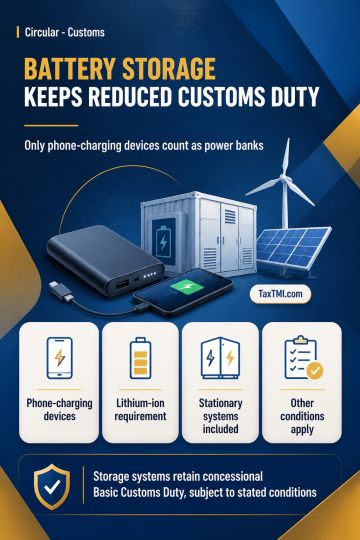
Power bank definition limits the customs-duty exclusion, preserving concessional treatment for stationary, grid-scale and industrial battery storage s...
Page of 4918
Press 'Enter' after typing page number.
361 to 380 of 98352 Results
❮
❯
❯❯
0 / 200
Expand Note
Add to Folder
No Folders have been created
+
Are you sure you want to delete "My most important" ?
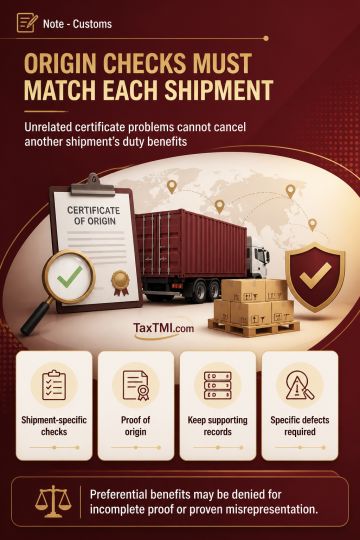
Preferential customs duty under the ASEAN-India arrangement requires proof that goods satisfy the applicable origin rules; a country-of-origin certificate does not remove the importer's duty of reasonable care. Origin verification must be certificate- and consignment-specific: an adverse foreign communication concerning identified unauthentic certificates cannot, without evidence linking other certificates to the defect or showing their cancellation or revocation, justify denial of benefits for those certificates. Importers must retain origin-related information and supporting records, while customs must undertake focused verification and identify the precise alleged defect. Preferential treatment may be denied for incomplete or non-conforming proof, or where origin requirements or misrepresentation are independently established.
Preferential customs duty under the ASEAN-India arrangement requires proof that goods satisfy the applicable origin rules; a country-of-origin certificate does not remove the importer's duty of reasonable care. Origin verification must be certificate- and consignment-specific: an adverse foreign communication concerning identified unauthentic certificates cannot, without evidence linking other certificates to the defect or showing their cancellation or revocation, justify denial of benefits for those certificates. Importers must retain origin-related information and supporting records, while customs must undertake focused verification and identify the precise alleged defect. Preferential treatment may be denied for incomplete or non-conforming proof, or where origin requirements or misrepresentation are independently established.
Note: It is a system-generated summary and is for quick reference only.
 TaxTMI
 TaxTMI

 of 4918