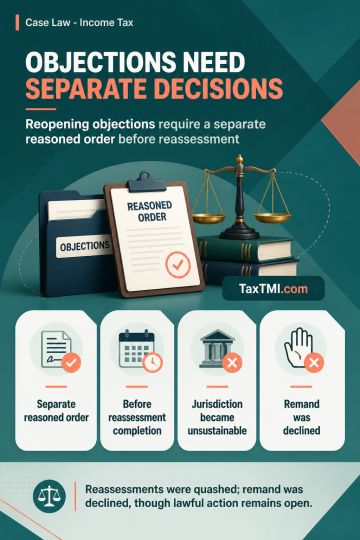
Separate speaking orders on reopening objections are mandatory; deciding them within reassessment invalidates jurisdiction and precludes revival of st...
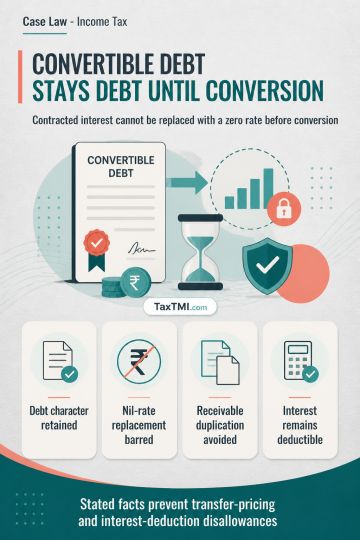
Compulsorily convertible debentures remain debt before conversion, preventing transfer-pricing and interest-deduction disallowances on the stated fact...
Stock-in-trade transfer taxability follows possession and consideration, not later conveyance registration, limiting deemed-value provisions to the ac...
Page of 4915
Press 'Enter' after typing page number.
581 to 600 of 98288 Results
❮
❯
❯❯
0 / 200
Expand Note
Add to Folder
No Folders have been created
+
Are you sure you want to delete "My most important" ?
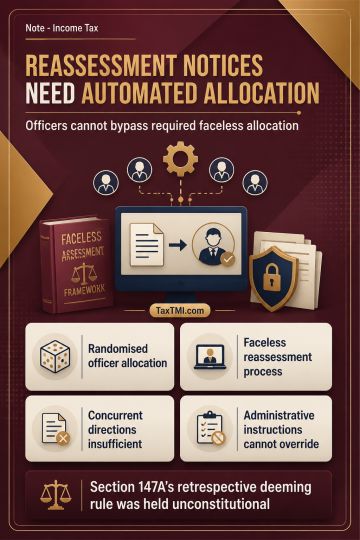
Section 151A and the e-Assessment of Income Escaping Assessment Scheme, 2022 require randomised automated allocation for reassessment functions, including the section 148A process and issuance of section 148 notices. General concurrent-jurisdiction directions cannot permit a jurisdictional Assessing Officer to bypass the prescribed faceless allocation, because allocation determines the officer's statutory competence. Risk-based selection of a matter is distinct from algorithmic allocation of the officer. Section 147A's retrospective deeming rule was held unconstitutional because it did not amend the continuing statutory and scheme-based requirements for automated allocation, and therefore did not remove the legal foundation of prior jurisdictional rulings. Administrative instructions cannot override the Act or a valid notified scheme.
Section 151A and the e-Assessment of Income Escaping Assessment Scheme, 2022 require randomised automated allocation for reassessment functions, including the section 148A process and issuance of section 148 notices. General concurrent-jurisdiction directions cannot permit a jurisdictional Assessing Officer to bypass the prescribed faceless allocation, because allocation determines the officer's statutory competence. Risk-based selection of a matter is distinct from algorithmic allocation of the officer. Section 147A's retrospective deeming rule was held unconstitutional because it did not amend the continuing statutory and scheme-based requirements for automated allocation, and therefore did not remove the legal foundation of prior jurisdictional rulings. Administrative instructions cannot override the Act or a valid notified scheme.
Note: It is a system-generated summary and is for quick reference only.
 TaxTMI
 TaxTMI

 of 4915