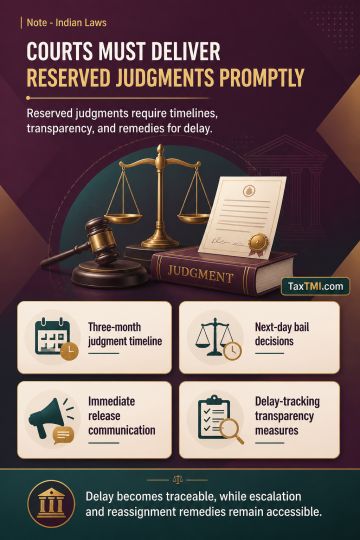
Timely pronouncement of reserved judgments requires defined timelines, transparency measures, and remedial pathways to protect liberty and effective j...
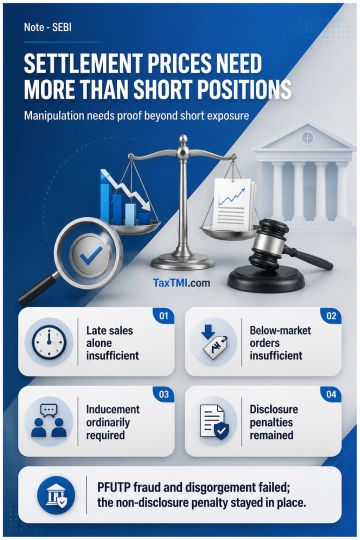
Settlement-price depression requires proof of manipulation, not merely short exposure, late selling, or below-market orders, preserving disclosure pen...
Income Declaration Scheme declarations can evidence share-capital sources, while round-tripped funds and cash-linked credits require further verificat...
Permanent establishment tests: independent subsidiary premises and principal-to-principal dealings did not create Indian taxability for offshore suppl...
Page of 4899
Press 'Enter' after typing page number.
161 to 180 of 97978 Results
❮
❯
❯❯
0 / 200
Expand Note
Add to Folder
No Folders have been created
+
Are you sure you want to delete "My most important" ?
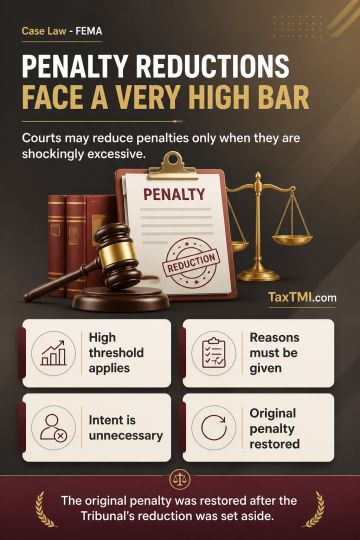
Judicial review of the quantum of a FERA penalty permits interference on proportionality grounds only where the sanction is grossly excessive, unduly harsh, or so disproportionate that it shocks the court's conscience. A Tribunal cannot reduce a penalty without demonstrating and giving reasons that this high threshold is met; its reduction was therefore unsustainable. FERA penalty adjudication follows proof of breach of a statutory civil obligation, without requiring mens rea. Absence of criminal intent or monetary gain does not legally justify a reduced penalty. The appellate outcome restored the penalty imposed by the Adjudicating Authority after setting aside the Tribunal's reduction.
Judicial review of the quantum of a FERA penalty permits interference on proportionality grounds only where the sanction is grossly excessive, unduly harsh, or so disproportionate that it shocks the court's conscience. A Tribunal cannot reduce a penalty without demonstrating and giving reasons that this high threshold is met; its reduction was therefore unsustainable. FERA penalty adjudication follows proof of breach of a statutory civil obligation, without requiring mens rea. Absence of criminal intent or monetary gain does not legally justify a reduced penalty. The appellate outcome restored the penalty imposed by the Adjudicating Authority after setting aside the Tribunal's reduction.
Note: It is a system-generated summary and is for quick reference only.
 TaxTMI
  TaxTMI
 of 4899