Functional comparability under TNMM requires transaction-specific FAR analysis before benchmarking business-support services provided to associated en...
Advance pricing agreement methodology can guide benchmarking for non-covered years when functions, assets, risks and activities remain materially unch...
Tax-audit exemption for substantially State-funded educational universities prevents audit-failure penalties where income qualifies for statutory exem...
Functional, asset and risk analysis excludes diversified technology companies from captive software development comparables under cost-plus arrangemen...
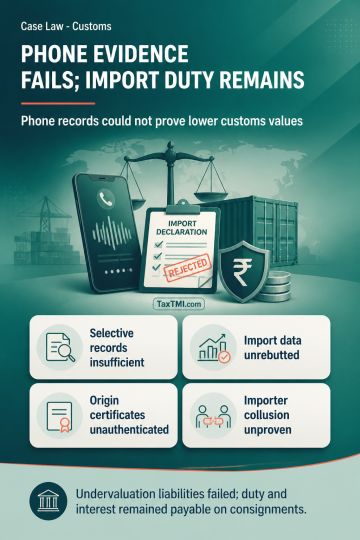
Mobile-phone electronic evidence failed to establish customs undervaluation, while duty survived on non-authentic origin certificates without importer...
Automotive radio classification treats integrated infotainment features as supplementary, placing complete and qualifying unassembled units under the ...
Separate corporate personality prevents directors from being personally liable for company deposits without a guarantee or independent legal undertaki...
Page of 4905
Press 'Enter' after typing page number.
81 to 100 of 98083 Results
❮
❯
❯❯
0 / 200
Expand Note
Add to Folder
No Folders have been created
+
Are you sure you want to delete "My most important" ?
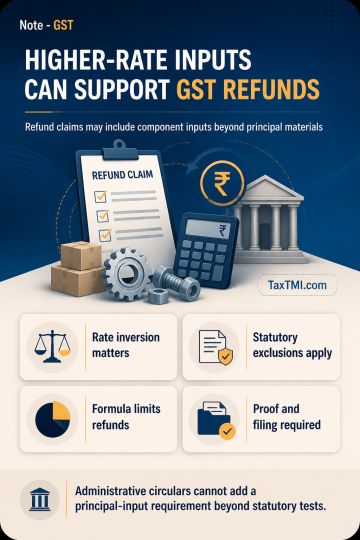
Refund of accumulated ITC under an inverted duty structure depends on whether higher-rated input goods cause credit accumulation relative to output supplies, not solely on whether the principal raw material and output carry the same rate. Section 54(3)(ii) permits the claim subject to notified exclusions, credit eligibility, and proof of a causal nexus between qualifying inputs and accumulation. Input services and capital goods are excluded from Net ITC for the Rule 89(5) calculation. Rule 89(5) limits refundable quantum, while the prescribed process requires electronic filing, invoice details, ledger debit and verification. Administrative circulars cannot add a principal-input condition beyond the statutory test; claimants must substantiate rate inversion, manufacturing nexus, computation and procedural compliance.
Refund of accumulated ITC under an inverted duty structure depends on whether higher-rated input goods cause credit accumulation relative to output supplies, not solely on whether the principal raw material and output carry the same rate. Section 54(3)(ii) permits the claim subject to notified exclusions, credit eligibility, and proof of a causal nexus between qualifying inputs and accumulation. Input services and capital goods are excluded from Net ITC for the Rule 89(5) calculation. Rule 89(5) limits refundable quantum, while the prescribed process requires electronic filing, invoice details, ledger debit and verification. Administrative circulars cannot add a principal-input condition beyond the statutory test; claimants must substantiate rate inversion, manufacturing nexus, computation and procedural compliance.
Note: It is a system-generated summary and is for quick reference only.
 TaxTMI
  TaxTMI
 of 4905