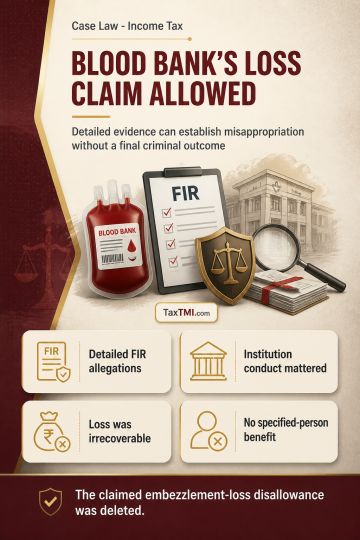
Embezzlement losses in charitable institutions remain allowable when misappropriation is established, irrecoverable, and not a specified-person benefi...
National long-distance undertaking status supports deduction where separately licensed infrastructure, resources, revenue, and expenditure establish c...
Agency reimbursement income follows contractual deposit-liability computation, while pending deposit collections do not constitute deemed-dividend loa...
Membership-consent thresholds for oppression petitions are satisfied by unchallenged voter-list consents, while unsupported forgery claims require pro...
Page of 4918
Press 'Enter' after typing page number.
761 to 780 of 98359 Results
❮
❯
❯❯
0 / 200
Expand Note
Add to Folder
No Folders have been created
+
Are you sure you want to delete "My most important" ?
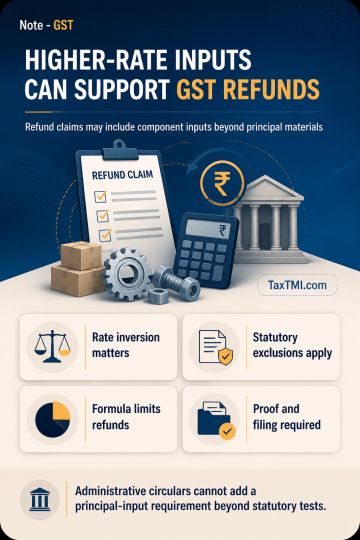
Refund of accumulated ITC under an inverted duty structure depends on whether higher-rated input goods cause credit accumulation relative to output supplies, not solely on whether the principal raw material and output carry the same rate. Section 54(3)(ii) permits the claim subject to notified exclusions, credit eligibility, and proof of a causal nexus between qualifying inputs and accumulation. Input services and capital goods are excluded from Net ITC for the Rule 89(5) calculation. Rule 89(5) limits refundable quantum, while the prescribed process requires electronic filing, invoice details, ledger debit and verification. Administrative circulars cannot add a principal-input condition beyond the statutory test; claimants must substantiate rate inversion, manufacturing nexus, computation and procedural compliance.
Refund of accumulated ITC under an inverted duty structure depends on whether higher-rated input goods cause credit accumulation relative to output supplies, not solely on whether the principal raw material and output carry the same rate. Section 54(3)(ii) permits the claim subject to notified exclusions, credit eligibility, and proof of a causal nexus between qualifying inputs and accumulation. Input services and capital goods are excluded from Net ITC for the Rule 89(5) calculation. Rule 89(5) limits refundable quantum, while the prescribed process requires electronic filing, invoice details, ledger debit and verification. Administrative circulars cannot add a principal-input condition beyond the statutory test; claimants must substantiate rate inversion, manufacturing nexus, computation and procedural compliance.
Note: It is a system-generated summary and is for quick reference only.
 TaxTMI
 TaxTMI

 of 4918