Membership-consent thresholds for oppression petitions are satisfied by unchallenged voter-list consents, while unsupported forgery claims require pro...
Juridical seat versus arbitral venue determines supervisory court jurisdiction, while timely award challenges remain within the prescribed limitation ...
Page of 4913
Press 'Enter' after typing page number.
701 to 720 of 98250 Results
❮
❯
❯❯
0 / 200
Expand Note
Add to Folder
No Folders have been created
+
Are you sure you want to delete "My most important" ?
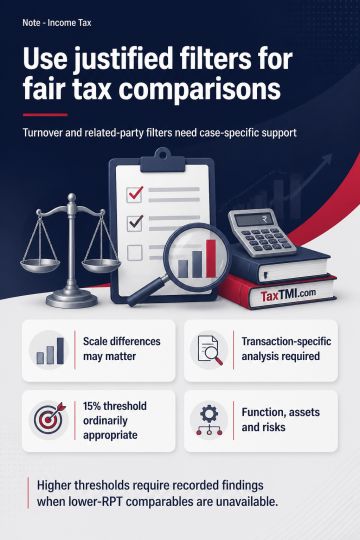
Transfer-pricing comparability under the transactional net margin method requires economically reliable uncontrolled benchmarks under Section 92C and Rule 10B. Turnover is not a standalone statutory bar, but material scale differences may justify excluding enterprises where brand value, intangibles, bargaining power, assets, risks or market conditions could affect margins. A turnover threshold must therefore be supported by transaction-specific comparability analysis rather than applied as a universal rule. Related-party transaction filters seek to reduce the influence of controlled dealings on comparable profitability. A 15% threshold is ordinarily appropriate where sufficient reliable comparables exist; a higher threshold requires a recorded finding that lower-RPT comparables are unavailable. Functional, asset and risk analysis remains essential, and appellate review may address disregard of statutory criteria or perverse findings.
Transfer-pricing comparability under the transactional net margin method requires economically reliable uncontrolled benchmarks under Section 92C and Rule 10B. Turnover is not a standalone statutory bar, but material scale differences may justify excluding enterprises where brand value, intangibles, bargaining power, assets, risks or market conditions could affect margins. A turnover threshold must therefore be supported by transaction-specific comparability analysis rather than applied as a universal rule. Related-party transaction filters seek to reduce the influence of controlled dealings on comparable profitability. A 15% threshold is ordinarily appropriate where sufficient reliable comparables exist; a higher threshold requires a recorded finding that lower-RPT comparables are unavailable. Functional, asset and risk analysis remains essential, and appellate review may address disregard of statutory criteria or perverse findings.
Note: It is a system-generated summary and is for quick reference only.
 TaxTMI
 TaxTMI

 of 4913