Cost-to-cost reimbursement of seconded employees is not service consideration; transfer-pricing markup was deleted and amalgamation amortisation allow...
Crystallisation of liability supports prior-period expense deduction, while functionally distinct divisions require separate transfer-pricing benchmar...
Functional comparability under TNMM requires transaction-specific FAR analysis before benchmarking business-support services provided to associated en...
Advance pricing agreement methodology can guide benchmarking for non-covered years when functions, assets, risks and activities remain materially unch...
Tax-audit exemption for substantially State-funded educational universities prevents audit-failure penalties where income qualifies for statutory exem...
Functional, asset and risk analysis excludes diversified technology companies from captive software development comparables under cost-plus arrangemen...
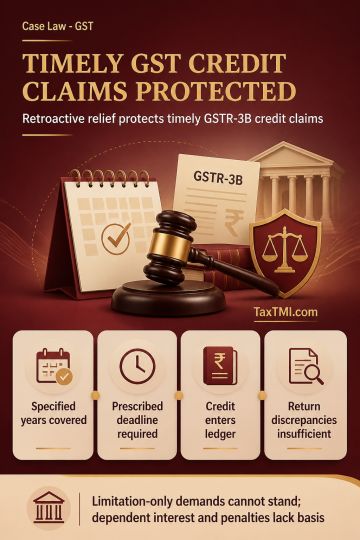
Retrospective section 16(5) permits input tax credit for specified financial years where claimed through GSTR-3B filed by the prescribed deadline, overriding the earlier limitation in section 16(4). GSTR-3B functions as the section 39 return for this purpose. Credit is availed when claimed and credited to the Electronic Credit Ledger; later utilisation does not constitute delayed availment. Discrepancies in GSTR-9 or GSTR-9C cannot by themselves extinguish credit already claimed through GSTR-3B. A demand founded solely on limitation cannot be sustained on new substantive grounds absent from the show-cause notice and original adjudication. Interest and penalty dependent exclusively on an invalid credit denial lack an independent basis.
Retrospective section 16(5) permits input tax credit for specified financial years where claimed through GSTR-3B filed by the prescribed deadline, overriding the earlier limitation in section 16(4). GSTR-3B functions as the section 39 return for this purpose. Credit is availed when claimed and credited to the Electronic Credit Ledger; later utilisation does not constitute delayed availment. Discrepancies in GSTR-9 or GSTR-9C cannot by themselves extinguish credit already claimed through GSTR-3B. A demand founded solely on limitation cannot be sustained on new substantive grounds absent from the show-cause notice and original adjudication. Interest and penalty dependent exclusively on an invalid credit denial lack an independent basis.
Note: It is a system-generated summary and is for quick reference only.
 TaxTMI
  TaxTMI
 of 4913