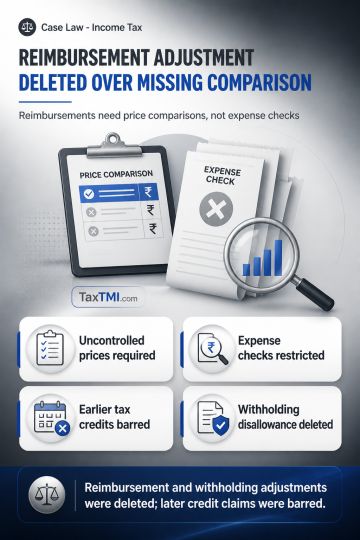
Transfer-pricing reimbursement adjustments require uncontrolled comparables and cannot become expense-genuineness reviews, resulting in deletion of th...
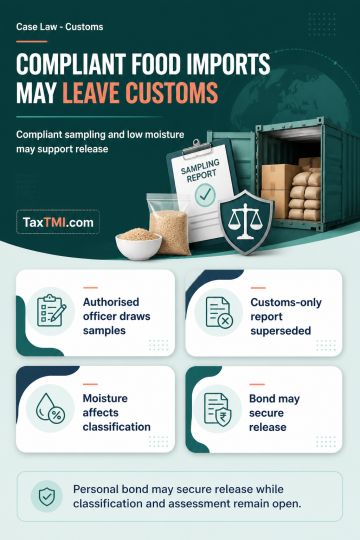
Food import sampling requirements support provisional release where unseized consignments conform to standards and raw areca classification is unestab...
Diagnostic microcuvette classification follows sole-use analytical function, placing specialised disposable cuvettes with their analyser rather than g...
Customs Broker licensing proceedings fail when their offence-report foundation collapses and authorisation, advisory, and KYC duties remain unbreached...
Page of 4915
Press 'Enter' after typing page number.
981 to 1000 of 98300 Results
❮
❯
❯❯
0 / 200
Expand Note
Add to Folder
No Folders have been created
+
Are you sure you want to delete "My most important" ?
Dependent-agent permanent establishment under Article 5(5)(i) of the India-Switzerland DTAA requires evidence that the Indian associated enterprise had, and habitually exercised, authority to negotiate or conclude contracts on behalf of the foreign enterprise. Group affiliation, dependency and arm's-length remuneration do not independently establish that status. Contemporaneous emails, approval matrices and supplier contracts indicated that Indian personnel communicated pre-approved terms, performed liaison, account-management and administrative functions, and escalated non-approved proposals overseas. Essential commercial approvals remained outside India. The Indian enterprise therefore did not constitute a dependent agent permanent establishment, making proposed profit attribution academic; the appeal was partly allowed.
Dependent-agent permanent establishment under Article 5(5)(i) of the India-Switzerland DTAA requires evidence that the Indian associated enterprise had, and habitually exercised, authority to negotiate or conclude contracts on behalf of the foreign enterprise. Group affiliation, dependency and arm's-length remuneration do not independently establish that status. Contemporaneous emails, approval matrices and supplier contracts indicated that Indian personnel communicated pre-approved terms, performed liaison, account-management and administrative functions, and escalated non-approved proposals overseas. Essential commercial approvals remained outside India. The Indian enterprise therefore did not constitute a dependent agent permanent establishment, making proposed profit attribution academic; the appeal was partly allowed.
Note: It is a system-generated summary and is for quick reference only.
 TaxTMI
 TaxTMI

 of 4915