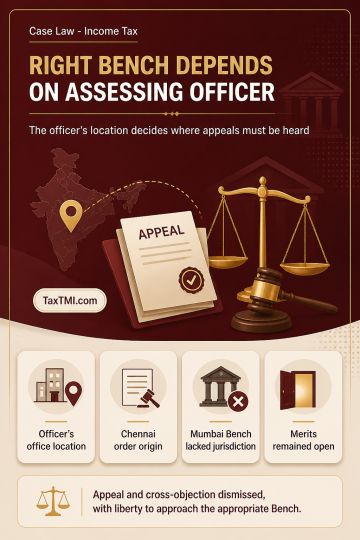
Assessing Officer jurisdiction after statutory transfer invalidates reassessment notices issued by transferor officers and nullifies resulting proceed...
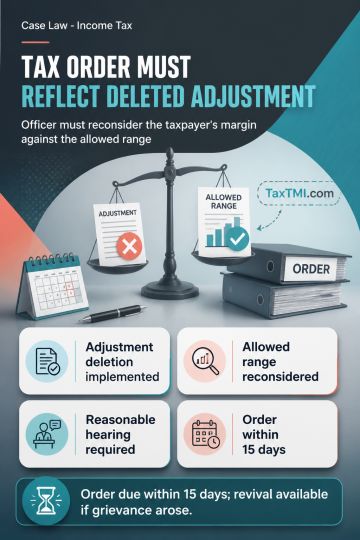
Consequential appeal-effect orders must implement rectification deleting working-capital adjustments and reconsider the resulting arm's-length range c...
Discounted cash flow valuation protects share premium where projections are reasonable, while audited book expenses defeat unexplained-expenditure add...
Section 54 construction relief survives pre-transfer commencement when completion occurs within the statutory period, excluding ineligible spouse-owne...
Fraud classification show-cause notices founded on inconclusive forensic audit material cannot sustain action, permitting fresh proceedings on conclus...
Page of 4913
Press 'Enter' after typing page number.
881 to 900 of 98250 Results
❮
❯
❯❯
0 / 200
Expand Note
Add to Folder
No Folders have been created
+
Are you sure you want to delete "My most important" ?
Dependent-agent permanent establishment under Article 5(5)(i) of the India-Switzerland DTAA requires evidence that the Indian associated enterprise had, and habitually exercised, authority to negotiate or conclude contracts on behalf of the foreign enterprise. Group affiliation, dependency and arm's-length remuneration do not independently establish that status. Contemporaneous emails, approval matrices and supplier contracts indicated that Indian personnel communicated pre-approved terms, performed liaison, account-management and administrative functions, and escalated non-approved proposals overseas. Essential commercial approvals remained outside India. The Indian enterprise therefore did not constitute a dependent agent permanent establishment, making proposed profit attribution academic; the appeal was partly allowed.
Dependent-agent permanent establishment under Article 5(5)(i) of the India-Switzerland DTAA requires evidence that the Indian associated enterprise had, and habitually exercised, authority to negotiate or conclude contracts on behalf of the foreign enterprise. Group affiliation, dependency and arm's-length remuneration do not independently establish that status. Contemporaneous emails, approval matrices and supplier contracts indicated that Indian personnel communicated pre-approved terms, performed liaison, account-management and administrative functions, and escalated non-approved proposals overseas. Essential commercial approvals remained outside India. The Indian enterprise therefore did not constitute a dependent agent permanent establishment, making proposed profit attribution academic; the appeal was partly allowed.
Note: It is a system-generated summary and is for quick reference only.
 TaxTMI
  TaxTMI
 of 4913