Mandatory textile export qualifiers distinguish flame-retardant fabrics from other listed fabrics for automated identification under the textiles ince...
Personal liberty safeguards restrict arrest after court-directed GST appearance, requiring interim release where authorities overreach pending proceed...
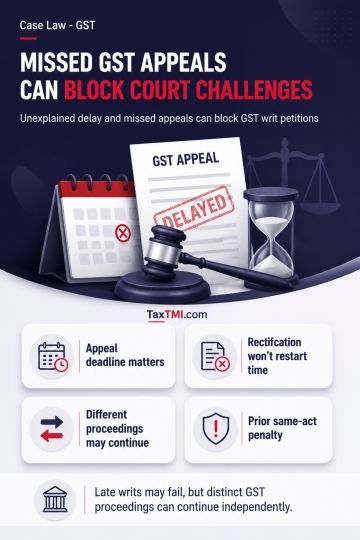
Alternative statutory remedy and delay bar GST writ challenges despite pending rectification, while distinct subject matter permits parallel proceedin...
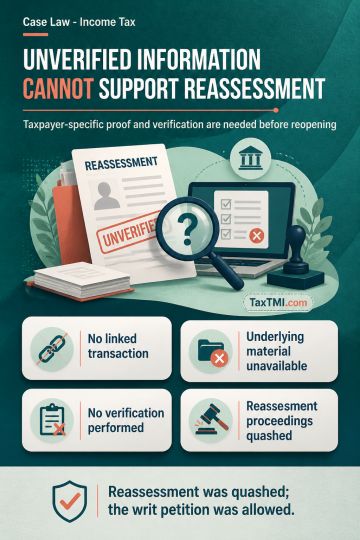
Unverified Insight Portal Information Cannot Justify Reassessment Without a Verified Taxpayer-Specific Income-Escape Nexus or Demonstrated Application...
Page of 4913
Press 'Enter' after typing page number.
861 to 880 of 98250 Results
❮
❯
❯❯
0 / 200
Expand Note
Add to Folder
No Folders have been created
+
Are you sure you want to delete "My most important" ?
Dependent-agent permanent establishment under Article 5(5)(i) of the India-Switzerland DTAA requires evidence that the Indian associated enterprise had, and habitually exercised, authority to negotiate or conclude contracts on behalf of the foreign enterprise. Group affiliation, dependency and arm's-length remuneration do not independently establish that status. Contemporaneous emails, approval matrices and supplier contracts indicated that Indian personnel communicated pre-approved terms, performed liaison, account-management and administrative functions, and escalated non-approved proposals overseas. Essential commercial approvals remained outside India. The Indian enterprise therefore did not constitute a dependent agent permanent establishment, making proposed profit attribution academic; the appeal was partly allowed.
Dependent-agent permanent establishment under Article 5(5)(i) of the India-Switzerland DTAA requires evidence that the Indian associated enterprise had, and habitually exercised, authority to negotiate or conclude contracts on behalf of the foreign enterprise. Group affiliation, dependency and arm's-length remuneration do not independently establish that status. Contemporaneous emails, approval matrices and supplier contracts indicated that Indian personnel communicated pre-approved terms, performed liaison, account-management and administrative functions, and escalated non-approved proposals overseas. Essential commercial approvals remained outside India. The Indian enterprise therefore did not constitute a dependent agent permanent establishment, making proposed profit attribution academic; the appeal was partly allowed.
Note: It is a system-generated summary and is for quick reference only.
 TaxTMI
  TaxTMI
 of 4913