 TaxTMI
 TaxTMI


 31 Oct 2026

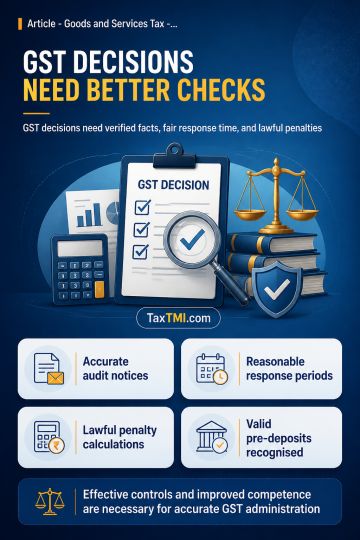
The GST law in India entered the tenth year on 01/07/2026 itself. During these last nine years, so much developments have taken place. Lot of positive developments have taken place in GST since September 2025 and now we are seeing the positive ray of hope on GST administration. While the GSTAT, CBIC as well as the GST Council are all collectively working for steady growth in improvements, the field formation appears to live still in the year 2017 only. In railways, there were no vande Bharath Trains as on 01/07/2017 whereas as on date it is 164. Growth of artificial intelligence during last 9 years in India. Over the last 9 years (2017-2026) India has evolved from a nascent experimental market into a global powerhouse in Artificial Intelligence, driven by massive digital public infrastructure, explosion in tech talent, and strategic sovereign policies. Today, India sits behind only the US and China in global AI competitiveness metrics. (Source Press Information Bureau, 25/10/2025). Our country economic growth, GST collections are improving but the mindset of GST officials seems to be stagnant.
Let me narrate my recent experience during last four days. A friend of mine called me on a clarification pertaining to section 65 of the CGST Act. I asked him to share whatever papers he was having which was the root cause for this question. On examination, it is ascertained that his company was subjected to audit during September 2025 covering tax periods 2018-19, 2019-20, 2020-21, 2021-22, 2022-23 as well as 2023-24. How they have concluded that there would be scope for section 74 even before audit ?. Now the second notice is dated 21/10/2026 by the same audit team on the same company covering 2020-21 till 2024-25. I met the concerned officer and questioned whether they are planning to do audit for the second time the same years or they openly admit that they were not able to conclude the audit in one go?. They informed that it was only an inadvertent error and they have no intention to audit except 2024-25. When I was anxious to know why it was not checked, they quoted it to be a portal issue and the notice was generated by system. If that is so, why there are no checks and balances to give a proper notice?. They had given exactly 15 days time to respond and when I quoted that it was 15 working days and not 15 days, they agreed to give me three week time to respond.
In the second case, penalty was levied @ 10% on taxes that were paid even before issuance of show cause notice. This is how routinely as well as mechanically demands are being raised and a taxpayer who is not so well versed with the extant provisions, end up paying illegal penalty to the Government. To explain further, there was non-payment to the tune of 50 lakhs and 40 lakhs was paid one year prior to date of audit. In SCN, it was proposed as to why 50 lakhs should not be confirmed and why 40 lakhs should not be appropriated against the proposed demand. In OIO, net demand was 10 lakhs but penalty was 10% on 50 lakhs.
In yet another case, the OIA was dated 24/04/2025. In order to ensure that no recovery action is taken, a second pre-deposit of 10% was made on 23/07/2025 through DRC 03 and it was categorically mentioned in DRC 03 that the reason for the deposit is pre deposit for Tribunal appeal against the order dated 24/04/2025. However, as the taxpayer failed to make payment in DRC 03A, the department is taking a stand that we have to make yet another 10% as pre-deposit and the issue is live before GSTAT.
Despite the hard fact that as on 29/10/2026, there are 97,273 e filed appeals before GSTAT, 10,375 admitted cases and 572 final orders by GSTAT benches, the field formation still continue to issue show cause notices demanding reversal of ITC under section 17(5) on steel and cement used in repair jobs which were written off as expenditure in the same year. One of my client is in the business of manufacture of valves and they use a variant of petroleum product to keep the steel free from rust. It was presumed to be petrol even without verification and demand stands confirmed. It is not my case that all officers behave like above, but at least 25 % of the GST officials have the opinion that the businessmen are running the business only to make profit by not paying the genuine GST and involve in bill trading. The e -invoicing is now mandatory for even an annual turnover of Five Crores and e way bill is mandatory in most of the cases. Section 16 as well as 17 of the CGST Act has necessary safeguard measures to ensure availing only the genuine ITC by the taxpayer. Lots of checks and balances are available for GST officials, well within the framework. Despite all these, I got a audit observation dated 21/10/2026, wherein it is proposed to levy 18% GST on closing trade payables as on 31/03/2024.
Conclusion: A rough estimate on decisions of GSTAT during last 9 months reveal that a taxpayer has a success rate of a minimum 80% wherever the appellant is the taxpayer whereas the success rate of Revenue, where they are the appellant is hardly around 10% as of now. Despite the monetary limit of 20 lakhs for departmental appeals, cases are filed for disputed amount of even 3 lakhs and the appeal gets dismissed. There are 1000s of cases where the jurisdictional high court have even quashed the OIO as well as OIA, which would only mean that the official who has passed such orders needs training on handling GST adjudication.
Before parting: The tax officials may update themselves constantly on all the developments taking place through CBIC Circulars and notifications as well as final orders of GSTAT. A success rate of 80% by the taxpayer at GSTAT proves that the adjudication is not up to desired level. Why should not the relief which is possible at second appeal is not happening in first appeal?. The improvement required is very huge at both adjudication as well as first appeal level. Hope, the officials take this write up in the right perspective.