 TaxTMI
 TaxTMI


 31 Oct 2026

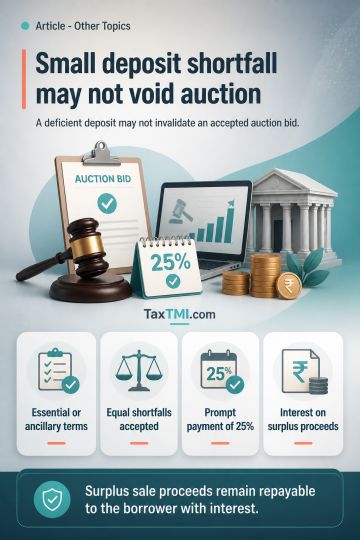
In Lakshmi Mohan (Dead) Through LRs. & Anr. Versus M/s. Airtech Projects Engineers Pvt. Ltd. & Anr. (Vice-Versa) and The Chief Manager and Authorized Officer Versus M/s Airtech Projects Engineers Pvt. Ltd. & Ors. - 2026 (10) TMI 1855 - Supreme Court, Airtech Projects Engineers Private Limited (‘Borrower’ for reference) borrowed a cash credit facility from the bank. The borrower was sanctioned a loan of Rs.85 lakhs. The borrower did not repay the loan amount. The said loan was declared by the bank as a non performing asset (‘NPA’ for short) on 01.08.2008. The Borrower was to pay a sum of Rs. 88,52,741/-. On 01.08.2008 the bank issued a notice to the borrower under Section 13(2) of the Securitisation and Reconstruction of Financial Assets and Enforcement of Security Interest Act, 2002 (‘SARFAESI’ for short) calling upon the borrower to pay Rs.88,52,741/-
On 12.11.2008, the Bank issued a possession-cum-sale notice, fixing 04.01.2009, a Sunday, as the date of sale, which was revised to 05.01.2009. The borrower challenged the said notice before Debts Recovery Tribunal (‘DRT’ for short). The DRT allowed the said application on 29.12.2008 and quashed the notice on the ground that the sale was fixed on a Sunday, while granting the Bank liberty to issue a fresh notice.
Being aggrieved by the said order, the Bank filed a Civil Revision Petition before High Court contending that the order was passed without notice to the bank. The High Court set aside the impugned order and remitted the matter back to the DRT.
The Bank, on 18.03.2009 issued a fresh notice fixing 24.04.2009 as the date of auction. The last date for submission of the bid was 23.04.2009. The bidder, along with the bid, pay Rs.21.5 lakhs as Earnest Money Deposit (‘EMD’ for short) by means of demand draft. The bid without EMD shall be rejected. The Borrower challenged this before DRT. The DRT granted a conditional stay on 21.04.2009. However, the DRT permitted the bank to proceed with the auction and not to finalise the same till 21.05.2009. The auction purchaser submitted its bid along with EMD of Rs.21,15,000/-, a short fall of Rs.35000/- on 23.04.2009. The Auction purchaser offered Rs.2,17,40,000/- in the auction held on 24.04.2009. Two bids were received. The Auction Purchaser was selected being the highest one and successful bidder in the said auction. On the same day, the Auction Purchaser deposited Rs.33,20,000/-. The total amount deposited by the Auction Purchase is Rs.54,35,000/-that amounts to 25% of the bid amount. The DRT dismissed the application of the borrower.
The Auction Purchases deposited the balance amount as required. A sale certificate was issued in their favour and the same was registered. The borrower filed an appeal before the DRT against the dismissal order. The DRT held that the auction had not been conducted in compliance with Rule 8 (5) of the Security Interest (Enforcement) Rules, 2002 and was vitiated by non-compliance with the express terms of the auction notice. The appeal was accordingly allowed, and the Bank was directed to restore the possession of secured asset to the borrower.
Against the said order Both the auction-purchasers and the Bank assailed this order before the High Court in separate writ petitions. By order dated 16.08.2011, the High Court, set aside the order of the DRAT and remitted the matter, on the ground that the memorandum of appeal before the DRAT had not raised any ground touching noncompliance with Rule 8(5) of the Rules or breach of the terms of the auction notice, thereby depriving the auction-purchasers of an opportunity to meet the case on which the DRAT’s order rested. On remand, the DRAT, by order dated 31.08.2012, reaffirmed the findings recorded in its earlier order dated 20.06.2011. Both the purchaser and the bank filed writ petitions against the order of the DRT which was also dismissed by the High Court. Against the order of the High Court, the present appeal was filed by the affected parties before the Supreme Court.
The Auction Purchase submitted the following before the Supreme Court-
- The deposit of earnest money along with the bid is neither a statutorily prescribed condition nor a mandatory one.
- The auction-purchasers had, in compliance with Rule 9(3) of the Rules, deposited 25% of the amount of sale price.
- the shortfall in the EMD had not even been urged by the borrower before the DRT, that there were only two bidders in the fray, and that the other bidder also had committed an identical shortfall of Rs. 35,000/-.
- the irregularity was a minor technical one incapable of vitiating the auction.
The Bank submitted the following before the Supreme Court-
- The acceptance of a non-compliant bid could, at the highest, be questioned by a rival bidder, and since the only other bidder was similarly placed, no such challenge could arise.
- The excess sale proceeds, though inadvertently retained in a non-interest-bearing account, were liable to be refunded, and the Bank remained ready and willing to do so.
The Borrower submitted the following before the Supreme Court-
- In the absence of the requisite EMD, no valid bid could be said to exist at all, the deposit being a mandatory and essential condition of eligibility from which the Bank was not competent to deviate.
- The balance sale consideration, required to be paid within 15 days of the sale, had in fact been paid after a delay of nearly five months.
The Supreme Court considered the submissions of the parties to the present appeal. The Supreme Court analysed Clause 7 of the possession-cum-sale notice dated 18.03.2009 and Rule 8 and 9. The Supreme Court observed that there are two categories of tender as detailed below-
- those which lay down the essential condition of eligibility; and
- the others which are merely ancillary or subsidiary with the main object to be achieved by the condition.
In the first case, the authorities issuing the tender may be required to enforce the condition rigidly whereas in other cases, it may be open to the authority to deviate from it and not to insist upon strict literal compliance of the condition. It is equally well-settled in law that where upon due consideration of the tender documents submitted by all the tenderers on their own merits, if it is ultimately found that successful bidders had in fact substantially complied with the purport and object for which the essential conditions were laid down, the same may not ordinarily be interfered with, the Supreme Court observed.
The Supreme Court observed that in the present case, in response to the notice of the banker two bidders had submitted their bids and both of them had deposited a sum of Rs.21,15,000/- each instead of Rs.2.5 lakhs. The Bank entertained and considered both the bids. Since the Auction Purchaser is the highest bid and a successful tenderer, paid 25% of the bid amount inclusive of EMD on the next day. The short payment of EMD has not resulted in any prejudice or injustice to the other bidder much less to the borrower. Therefore, the shortfall in deposit of EMD as required by Clause 7 of possession-cum-sale notice dated 18.03.2009 does not affect the validity of the bid of the auction purchasers in any manner.
The Supreme Court further observed that the plea of the borrower that the balance sale consideration was paid after a period of 15 days, is concerned, suffice it to say that the aforesaid plea was neither taken before the DRT nor before the DRAT. The appeal of the borrower was dismissed. Immediately thereafter the auction-purchasers paid the balance amount on 05.10.2009 itself. Therefore, the Supreme Court held that the aforesaid contention, does not deserve acceptance.
After appropriation of sale proceeds, the Bank was left with an excess amount of Rs.1,33,94,054/-. The Bank had offered the aforesaid amount to the borrower by way of a demand draft, which was not accepted presumably on account of pending litigation. The Bank ought to have kept the aforesaid balance amount in an interest-bearing account. However, the Bank has failed to do so. For this omission on the part of the Bank, the borrower cannot be penalized. The borrower is entitled to refund of the balance sale consideration along with interest.
In view of the above the Supreme Court quashed the impugned orders and directed the bank to refund the amount of Rs.1.34 crores along with interest @ 7% per annum from 23.03.2010 i.e. the date when the surplus amount was kept in a non-interest-bearing account till the payment is made to the borrower.