 TaxTMI
 TaxTMI


 31 Oct 2026

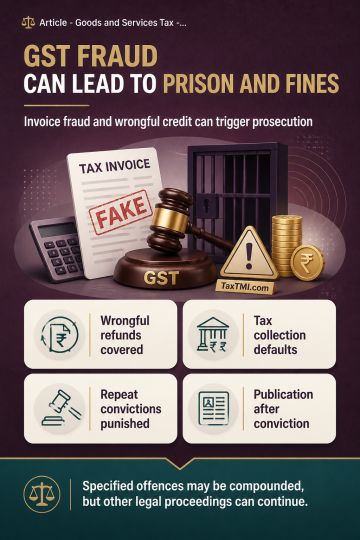
Punishment for certain offences (Section 132)
For the purposes of arrest under section 69 of the CGST Act, 2017, the person shall be punishable with arrest in respect of following offences:
Whoever commits or causes to commit and retain the benefits arising out of following offences:
- supplies any goods or services or both without issue of any invoice, in violation of the provisions of this Act or the rules made thereunder, with the intention to evade tax;
- issues any invoice or bill without supply of goods or services or both in violation of the provisions of this Act, or the rules made thereunder leading to wrongful availment or utilisation of input tax credit or refund of tax;
- avails input tax credit using the invoice or bill referred to in clause (b) or fraudulently avails input tax credit without any invoice or bill;
- collects any amount as tax but fails to pay the same to the Government beyond a period of three months from the date on which such payment becomes due;
punishable with:
(i) in cases where the amount of tax evaded or the amount of input tax credit wrongly availed or utilised or the amount of refund wrongly taken exceeds five hundred lakh rupees, with imprisonment for a term which may extend to five years and with fine;
(ii) in cases where the amount of tax evaded or the amount of input tax credit wrongly availed or utilised or the amount of refund wrongly taken exceeds two hundred lakh rupees but does not exceed five hundred lakh rupees, with imprisonment for a term which may extend to three years and with fine.
Where any person convicted of an offence under this section is again convicted of an offence under this section, then, he shall be punishable for the second and for every subsequent offence with imprisonment for a term which may extend to five years and with fine.
According to amended section 132(1) of the CGST Act, 2017, the punishment includes both, imprisonment as well as fine and such person shall be punishable with the following types of punishments:
| Offence involving | Punishment (Imprisonment extending to) |
| Tax evaded exceeding INR 5 crore or repeat offender INR 250 lakh |
5 years and fine |
| Tax evaded between INR 2 crore and INR 5 crore | 3 years and fine |
| Tax evaded between INR 1 crore and INR 2 crore | 1 years and fine |
| False records Obstructing officer (upto 30.09.2023) Tamper records (upto 30.09.2023) | 6 months or fine or both |
Repeated offences (Sub-section 2)
In terms of section 132(2) of the CGST Act, 2017, if any person is convicted of an offence under this section again, then, he shall be punishable for the second and for every subsequent offence with imprisonment for a term which may extend to five years and with fine. However, in the absence of special and adequate reasons to the contrary to be recorded in the judgment of the court, the imprisonment shall not be for a term of less than six months.
Scope of tax for calculating limit
As per explanation to section 132, the term 'tax' shall include the amount of tax evaded or the amount of input tax credit wrongly availed or utilised or refund wrongly taken under the provisions of this Act, the State Goods and Services Tax Act, the Integrated Goods and Services Tax Act or the Union Territory Goods and Services Tax Act and cess levied under the Goods and Services Tax (Compensation to States) Act.
Minimum punishment
In terms of sub-section (1) and (2) of section 132 of the GST law, the imprisonment shall not be for a term which is less than six months.
Finance Act, 2023 has decriminalised certain offences which have been brought into force w.e.f. 01.10.2023, these offences are as follows:
- Obstruction or preventing any officer from discharging his duties [Clause g of Section 132(1)]
- Tampering with or destruction of material evidence or documents [Clause j of Section 132(1)]
- Failure to supply information required under law or supplying false information [Clause k of Section 132(1)]
Compounding of Offences (Section 138)
Section 138 of the CGST Act, 2017 provides for compounding of offences specified in sub-section (1) of Section 132.Such compounding has to be done by designated officers in this regard and even after the compounding has been done, prosecution and other proceedings under any other law shall continue. It may be noted that section 138 of the CGST Act, 2017 provides for compounding of offences by the Pr. Commissioner/Commissioner on payment of compounding amount. The provisions regarding compounding of offence should be brought to the notice of person being prosecuted and such person be given an offer of compounding. Where a case is considered suitable for launching prosecution and where adequate evidence is forthcoming, securing conviction largely depends on the quality of investigation.
Publication of information in certain cases (Section 159)
Section 159 of the CGST Act, 2017 grants power to the Principal Commissioner/ Commissioner or any other officer authorised by him on his behalf to publish name and other particulars of the person convicted under the Act. In deserving cases, the department should invoke this section in respect of all persons who are convicted under the CGST Act, 2017.