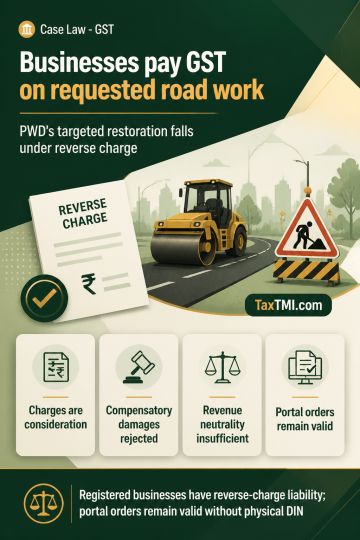
Request-driven road restoration attracts reverse-charge GST, not governmental-function treatment or compensatory-damages status for business recipient...
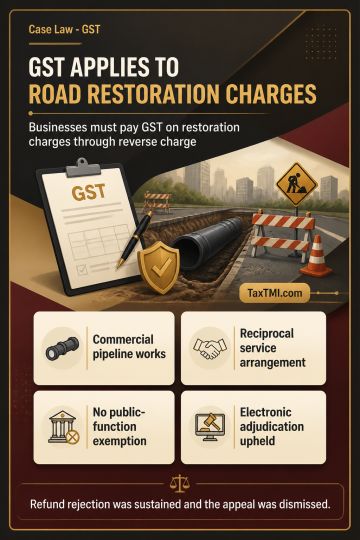
Road restoration charges for commercial pipeline works are taxable Government services, with reverse charge liability and no public-function exemption...
Model-wise import cap monitoring cannot justify withholding used multifunction machines where all-India tracking is absent and full security is furnis...
GST offences involving liability below the statutory threshold are treated as non-cognizable and bailable under Section 132 of the CGST/CGGST Act, 2017. The High Court noted that the proceedings against the applicant related to a GST liability of less than Rs. 5 crore and held that, on that basis, the alleged offence did not justify an apprehension of arrest. The plea for anticipatory bail under Section 482 BNSS was therefore found to be without merit and was rejected.
GST offences involving liability below the statutory threshold are treated as non-cognizable and bailable under Section 132 of the CGST/CGGST Act, 2017. The High Court noted that the proceedings against the applicant related to a GST liability of less than Rs. 5 crore and held that, on that basis, the alleged offence did not justify an apprehension of arrest. The plea for anticipatory bail under Section 482 BNSS was therefore found to be without merit and was rejected.
Note: It is a system-generated summary and is for quick reference only.
 TaxTMI
  TaxTMI
 of 4912